If you live in Oxford or have been reading our blog for a while you may remember a project we created called Goes to Town: twelve specimens escaped from the Museum, set themselves up in locations around Oxford city and provided a treasure-hunt style trail around town. They then returned in time for our reopening party in 2014.
It was a fun project with many elements so we are very pleased indeed to say that it picked up the winning trophy in last night’s Museum + Heritage Awards show, in the marketing campaign category. Here’s the first video we made to promote Goes to Town:
In just under a month we’ll be opening a brand new exhibition called ‘Sensing Evolution’. It will be a dramatic overhaul of our touchable displays, with many new touchable specimens for you to explore. Touchable taxidermy is always one of the most popular features in the Museum, but it’s been a real challenge sourcing some larger pieces for this new display.
Bethany Palumbo, our Conservator of Life Collections, has been busy researching far and wide to find the ideal specimens.
**
As well as the touchable tables that will form the major part of Sensing Evolution, we wanted an animal which would make a big impression when you arrive in the Museum. This specimen must also be obtained from an ethical source.
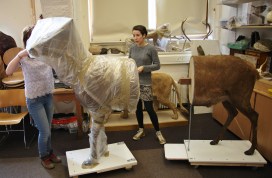
Mieke arrives at the Museum with the deer
Based on its availability and abundance, we decided to go for a farmed Red Deer, (Cervus elaphus) which is one of the largest deer species. The specimen, a male, was collected and prepared by taxidermist Mieke De Leeuw, from Taxidermieke in Belgium.
Work began with tanning the skin and preparing the armature. We had a few special requests. The first was that the specimen would able to fit into our walk-in freezer, should it require freezer treatment to eradicate insect pests, such as webbing clothes moth. Another request was that the specimen be reinforced as much as possible – strong enough to withstand potentially decades of affection and curiosity from museum visitors. Mieke was enthusiastic about the mount and the unusual challenges it presented.
Packing up ready for freezing. All new arrivals are frozen to ensure pests aren’t brought into the Museum.
In order for it to fit into our freezer, it was necessary for the specimen to come apart into three pieces. For this Mieke devised a locking pin system, which would be completely invisible on the finished specimen. The beautiful antlers are also removable using a similar system.
Vulnerable areas of the deer were reinforced to withstand years of attention
She reinforced the specimen in weaker areas, such as the ears and the tendons of the legs, which were strengthened using metal rod. Once all the skin was glued into place, it was pinned down to keep it stable while it dried.
The deer is unpacked at the MuseumWalter puts finishing touches to the deer
Last week Mieke and her family drove from Peer, in Belgium, to deliver the specimen to us. They showed us how to assemble the beautiful specimen, before we took him all apart again for freezing.
We thank the deer’s creators, Mieke and her husband Walter, for their hard work and skill in producing such a wonderful feature for the ‘Sensing Evolution’ display.
A museum can be a busy, daunting and overwhelming place, particularly if you find unknown surroundings challenging. Today is World Autism Awareness Day – an ideal opportunity to highlight a set of resources recently launched at the Museum, which help to make the environment more accessible to all. The resources are aimed at families with children on the autistic spectrum and provide a visual and descriptive introduction to the Museum, including pictures of everything from cockroaches to carpets and the café!
An example of the clear images which help prepare for a museum visit
The idea for the resources came from a member of the public who in Summer 2012 asked: did we have a guide she could use to help prepare her son, who is on the spectrum, to visit the Museum? The answer at that point was ‘No’, but it got us thinking…
So while this Museum was under wraps for a year having its roof restored, we scoured the websites of museums on both sides of the Atlantic trying to find out what other places were up to. Although, in one way, we were reassured to discover we weren’t alone in our lack of resources, we were still surprised by how few places did provide anything.
Though we eventually modelled our resources on those of the Metropolitan Museum of Art, our budget sadly couldn’t stretch to a trip to New York. We found inspiration and support a lot closer to home, fortunately, and we spent a day with staff at the Science Museum in London. Their Early Birds programme has proven a great success, giving families exclusive access to the museum before other visitors are let in. We hope to pilot a similar event later this year.
The front page of the new resources
And so began the creative process – or rather not-so-creative process. For me, the biggest challenge was altering my writing style. I have to admit that this blog post is not particularly autism-friendly, with its idioms and (attempts at) humour. Sentences like ‘Walk when you are inside the museum. Do not run.’ are more typical of the resources – direct and to the point – no chattiness, no alliteration.
Pages introducing the Museum’s feely boxes and DNA model
Anyway, fast-forward several more months, and we’ve now had the resources up on the Museum website for a few weeks. They’re still very much a work in progress, but they’re a really positive start.
As for the mum who initially emailed us… we’ve kept in touch, and in her last email she said, ‘I remember contacting you one summer wishing that there was something I could just download and print off that would allow me to do that all important pre-work … I think it looks fabulous and I will be trying it out during the holidays coming up.’
I’ve been to see the dinosaurs at the Pitt Rivers Museum!
It’s a common exclamation, but alas, there are no dinos in the Pitt Rivers, nor totem poles in the Museum of Natural History. Rather, there are two museums with a shared front door, and a fair amount of confusion.
To address this perpetual museum muddle we present a short play, Welcome to My Museum, where the Victorian founders of each institution come to life to discuss ‘two marvellous museums under one roof’.
A small grant from the Oxford University Museums Partnership allowed a collaboration between us, the Pitt Rivers Museum, Pegasus Theatre, and Film Oxford to produce two versions of the play – one for public performance and another for a film adaptation, which is the one you can watch below.
Ciaran Murtagh (left) as General Augustus Henry Lane-Fox Pitt Rivers and Andrew Jones as Henry Acland
Working with Pegasus Theatre, Rachel Barnett scripted an imagined conversation between the founders of the two museums, Henry Acland and General Augustus Henry Lane-Fox Pitt Rivers. Pegasus helped to source actors and costumes and even a prop-maker for Pitt Rivers’s fine pufferfish helmet.
Film Oxford spent several late nights with a very patient rent-a-crowd, immortalising their adaptation of the play on film. The public performance was well attended, with over 250 visitors dropping in to watch General Pitt Rivers rudely interrupt Henry Acland’s speech welcoming visitors to his museum. Pitt Rivers rightly points out that there must be two museums as the building has two gift shops and even two differently-branded pencil sharpeners for sale in them – ‘scientifically incontrovertible’ proof!
So if you think that you have ever been to the Pitt Rivers Museum to see the dinosaurs, or the Museum of Natural History to look at the totem-pole, watch the film below and you will discover that our building is actually ‘two sublime museums under one roof’.
Ever wondered what we get up to all day? This video offers a nice flavour. Thanks to Tom Wilkinson and Tom Fuller in the University of Oxford Public Affairs Directorate for putting this together.
Beautiful gemstones are always popular with the public when they’re brought out for Spotlight Specimens. Monica Price talks about some she’s been showing off recently at our daily drop-in sessions.
**
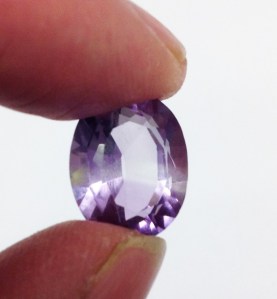
Now here’s a mineral that most people recognise straight away when I bring it out for Spotlight specimens. It is amethyst, and it is the most popular of all purple gem minerals. By a happy coincidence it is very common too, so jewellery made with amethyst need not be very expensive.
But that wasn’t always the case. In the past, fine, large, transparent crystals of amethyst could only be found in Germany, Russia and a few other places in the world. In Europe, the colour purple is traditionally associated with royalty and wealth, and so rare amethyst gems would feature in crowns and jewellery worn by heads of state and religious leaders.
Amethyst is actually a variety of one of the Earth’s most common minerals, quartz. Quartz is composed of silicon dioxide and helps form many different kinds of rock…. it even makes up most beach sands! Amethyst is the kind of quartz that contains a little bit of iron to turn it purple.
So how did amethyst suddenly become so common? During the 18th century, huge flows of volcanic lava were found by explorers in Brazil and Uruguay. Some had air bubbles which were lined with superb purple crystals of amethyst. Soon, these crystal-filled cavities were being sent to Europe, and today, they are sold all over the world. The biggest bubbles were a metre or more in size – huge! Nowadays, nearly all the amethyst you see for sale comes from those 135 million year-old South American lava flows.
My spotlight specimens include an amethyst gemstone and some lovely examples of those gas bubble cavities lined with crystals. One rather curious thing is that the crystals are rarely purple all the way through. The colour typically concentrates towards the tips of the six-sided crystals. If you come when I next show my ‘gas bubble gems’, you will see exactly what I mean!








 Beautiful gemstones are always popular with the public when they’re brought out for Spotlight Specimens. Monica Price talks about some she’s been showing off recently at our daily drop-in sessions.
 Now here’s a mineral that most people recognise straight away when I bring it out for Spotlight specimens. It is amethyst, and it is the most popular of all purple gem minerals. By a happy coincidence it is very common too, so jewellery made with amethyst need not be very expensive.
 So how did amethyst suddenly become so common? During the 18th century, huge flows of volcanic lava were found by explorers in Brazil and Uruguay. Some had air bubbles which were lined with superb purple crystals of amethyst. Soon, these crystal-filled cavities were being sent to Europe, and today, they are sold all over the world. The biggest bubbles were a metre or more in size – huge! Nowadays, nearly all the amethyst you see for sale comes from those 135 million year-old South American lava flows.
 More Than A Dodo