

Special deer-livery

In just under a month we’ll be opening a brand new exhibition called ‘Sensing Evolution’. It will be a dramatic overhaul of our touchable displays, with many new touchable specimens for you to explore. Touchable taxidermy is always one of the most popular features in the Museum, but it’s been a real challenge sourcing some larger pieces for this new display.
Bethany Palumbo, our Conservator of Life Collections, has been busy researching far and wide to find the ideal specimens.
**
As well as the touchable tables that will form the major part of Sensing Evolution, we wanted an animal which would make a big impression when you arrive in the Museum. This specimen must also be obtained from an ethical source.

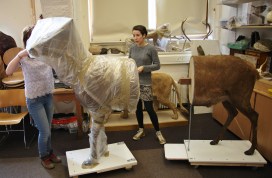
Based on its availability and abundance, we decided to go for a farmed Red Deer, (Cervus elaphus) which is one of the largest deer species. The specimen, a male, was collected and prepared by taxidermist Mieke De Leeuw, from Taxidermieke in Belgium.
Work began with tanning the skin and preparing the armature. We had a few special requests. The first was that the specimen would able to fit into our walk-in freezer, should it require freezer treatment to eradicate insect pests, such as webbing clothes moth. Another request was that the specimen be reinforced as much as possible – strong enough to withstand potentially decades of affection and curiosity from museum visitors. Mieke was enthusiastic about the mount and the unusual challenges it presented.

In order for it to fit into our freezer, it was necessary for the specimen to come apart into three pieces. For this Mieke devised a locking pin system, which would be completely invisible on the finished specimen. The beautiful antlers are also removable using a similar system.

She reinforced the specimen in weaker areas, such as the ears and the tendons of the legs, which were strengthened using metal rod. Once all the skin was glued into place, it was pinned down to keep it stable while it dried.


Last week Mieke and her family drove from Peer, in Belgium, to deliver the specimen to us. They showed us how to assemble the beautiful specimen, before we took him all apart again for freezing.

We thank the deer’s creators, Mieke and her husband Walter, for their hard work and skill in producing such a wonderful feature for the ‘Sensing Evolution’ display.
Bethany Palumbo, Conservator, Life Collections




 Beautiful gemstones are always popular with the public when they’re brought out for Spotlight Specimens. Monica Price talks about some she’s been showing off recently at our daily drop-in sessions.
 Now here’s a mineral that most people recognise straight away when I bring it out for Spotlight specimens. It is amethyst, and it is the most popular of all purple gem minerals. By a happy coincidence it is very common too, so jewellery made with amethyst need not be very expensive.
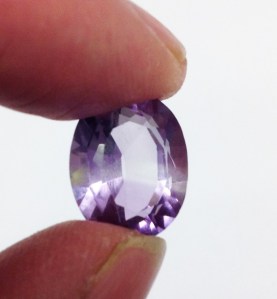 So how did amethyst suddenly become so common? During the 18th century, huge flows of volcanic lava were found by explorers in Brazil and Uruguay. Some had air bubbles which were lined with superb purple crystals of amethyst. Soon, these crystal-filled cavities were being sent to Europe, and today, they are sold all over the world. The biggest bubbles were a metre or more in size – huge! Nowadays, nearly all the amethyst you see for sale comes from those 135 million year-old South American lava flows.
