A moving story

img_0737

For the past nine months there has been a lot of moving going on around here. Imagine moving house endlessly for weeks on end, but where your house is full of bones, insects, fossils, rocks, and weird and wonderful taxidermy. And the location of everything has to be precisely recorded. The museum move project was a bit like that.

Project assistant Hannah Allum explains…

The museums are migrating, we declared in May 2016. And so they have. The first major stage of the stores project has been completed. After we had created inventories for the largely unknown collections held in two offsite stores, the next stage was to pack them safely and transport them to a new home nearer the museum, a job which demanded almost 70 individual van trips! We now have over 15,000 specimens sitting in vastly improved storage conditions in a new facility.
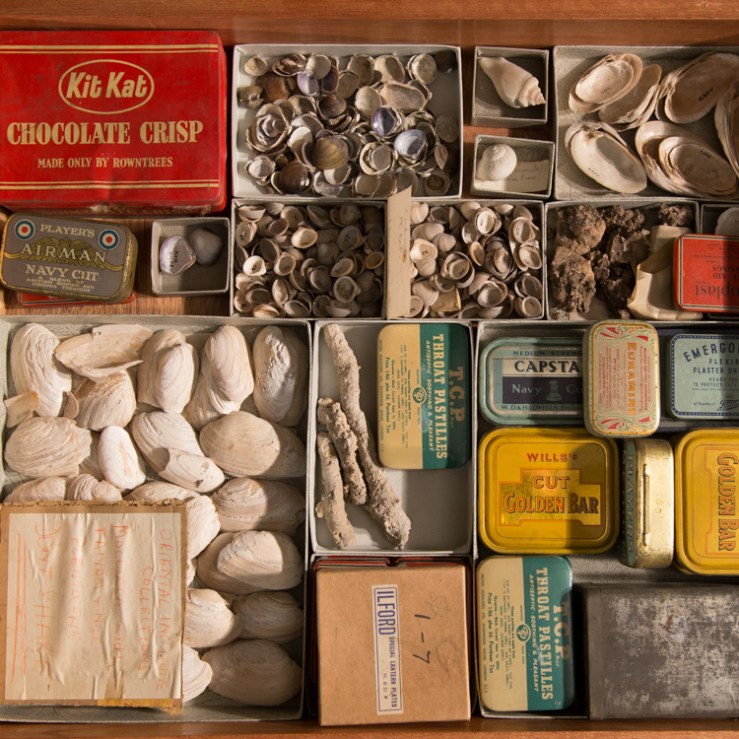
A miscellany of boxes for a collection of shells

Let’s revel in some numbers. All in all there were over 1,000 boxes of archive material, mostly reprints of earth sciences and entomological research papers; over 1,300 specimens of mammal osteology (bones); and more than 1,000 boxes and 650 drawers of petrological and palaeontological material (rocks and fossils).

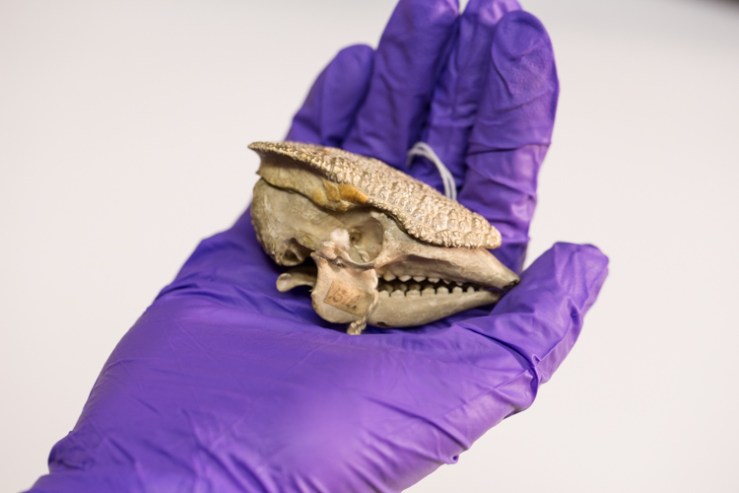
Some of the more memorable specimens include old tobacco tins and chocolate boxes filled with fossils and shells; a beautifully illustrated copy of the ‘Report on the Deep-Sea Keratosa’ from the HMS Challenger by German naturalist Ernst Haeckel; and the skull of a Brazilian Three-banded Armadillo (Tolypeutes tricinctus), complete with armour-plated scute carapace.
img_0756
The skull and carapace of a Brazilian Three-banded Armadillo (Tolypeutes tricinctus)

There were also a few objects that have moved on to more unusual homes. A 4.5 m long cast of Attenborosaurus conybeari (yep, named after Sir David) was too large to fit in our new store and so made its way to another facility along with a cornucopia of old museum furniture. A set of dinosaur footprint casts, identical to those on the Museum’s lawn, have been gifted to the Botanical Gardens for use at the Harcourt Arboretum in Oxford.

And last but not least, a model of a Utahraptor received a whopping 200 applications from prospective owners in our bid to find it a suitable home. After a difficult shortlisting process it was offered to the John Radcliffe Children’s Hospital and following a quarantine period should soon be on display in their West Wing.

Footprint casts, attributed to Megalosaurus, queuing for a lift to Harcourt Arboretum. Credit: Hannah Allum
Casts of footprints by made Megalosaurus, queuing for a lift to Harcourt Arboretum. Image: Hannah Allum

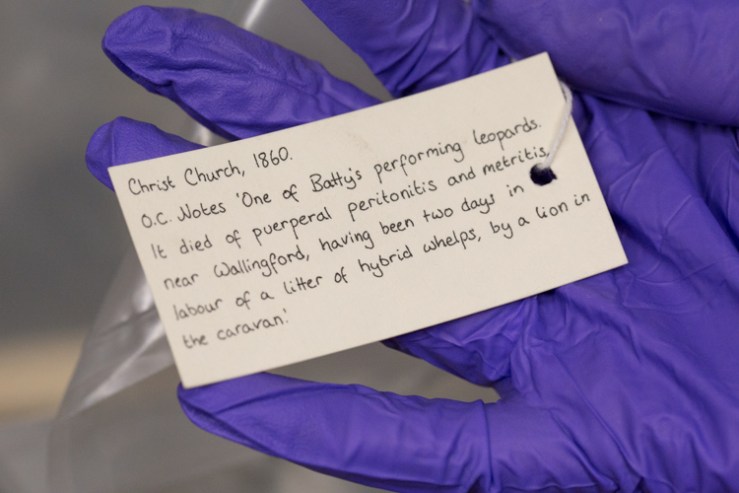
Fittingly, the final specimen I placed on the shelf in the new store was the very same one that had been part of my interview for this job: The skeleton of a female leopard with a sad story. It apparently belonged to William Batty’s circus and died of birthing complications whilst in labour to a litter of lion-leopard hybrids before ending up in the Museum’s collections in 1860.
img_0760
The sad story of a performing leopard

Though the moving part of this project is now complete there is still plenty of work to do. We are now updating and improving a lot of the documentation held in our databases, and conservation work is ongoing. The new store will also become a shared space – the first joint collections store for the University Museums, complete by April 2018.

To see more, follow the hashtag #storiesfromthestores on Twitter @morethanadodo and see what the team at Pitt Rivers Museum are up to by following @Pitt_Stores.

A poetic ending

steven-matthews

Steven Matthews, one of our three Poets in Residence, reflects on his residency at the Museum during our Visions of Nature year.

It is sad that our poetry residency is at an end; I shall miss the frequent escapes for the hustle of the everyday Oxford streets into the light and space of the Museum.

As a resident in Oxford for over twenty years, I had gradually accumulated a bit of knowledge about the building. I had, like so many local parents, hugely enjoyed taking our two sons there when they were young, and loved to see their delight at the displays. Seeing the fossil, mineral, and animal world, as it were, through their eyes, really re-engaged me with its wonders.

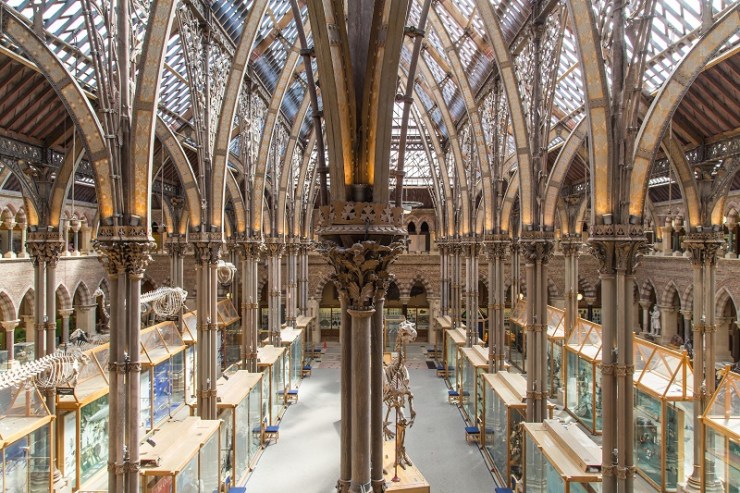
The Museum's centre court
The Museum’s centre court

I have been very privileged, then, to go ‘behind the scenes’ at the Museum, and to speak to the scientists engaged in research into its collections and history. They are bringing new knowledge and understanding to bear at a moment when, let’s face it, humankind has inflicted catastrophe upon the natural world, and so upon itself.

The Victorian spirit and vision which instigated the building of the Museum, a spirit revelling in creation and in exorbitant creativity, seems very remote. This is tragically borne home when looking at the cabinets of butterflies and moths, the Lepidoptera, where the majority of the specimens are of species that no longer exist.

xcgfdfdg
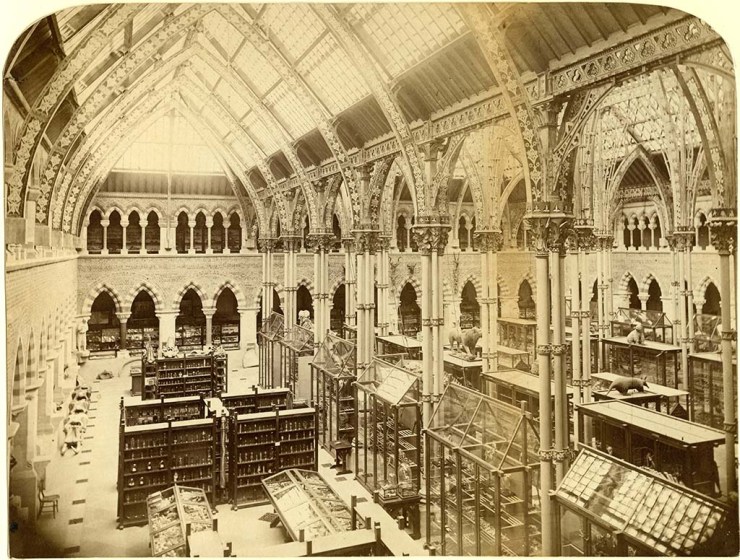
A photograph from the Museum Archive showing the construction and layout of the building in the mid-19th century

The prime mover behind the Museum, the Victorian Henry Acland, said in an early promotional lecture that the ambition behind it was to show that all branches of science needed to work together to produce a greater understanding of the world. The zoologist could not understand the physiological structure of animals without deploying information and knowledge held in common with the geologist and the anatomist.

The Museum should be a place where that type inspiring dialogue could occur daily. It feels as though we are in a moment now where that collaboration, and collective and imaginative ingenuity, is hard-pushed to find solutions to the divided interests and dire afflictions of the world.

The Visions of Nature year at the Museum, which brought artists and us poets together with the scientists, has been one way in which all of these things have been, for me excitingly, furthered. It has been a challenge and a thrill to imagine and write – ‘in their own voices’ –  lives for some of the Museum’s specimens which have particularly fascinated or moved me. But also a great delight, for which I’ll always be grateful.

Pioneers of photography

The Anatomy Lesson with Dr George Rolleston by Charles Lutwidge Dodgson
Image: Victoria and Albert Museum, London

The latest display in our changing Presenting… case showcases some pioneers of photography and features a recently-discovered original print of Charles Darwin by Julia Margaret Cameron…

In the early days of photography, in the mid-19th century, a number of photographic innovators had close links to the Museum and its collections. Perhaps the most famous of these is Charles Lutwidge Dodgson (1832-1898), better known as Lewis Carroll. Dodgson was an author and mathematician at Christ Church College in Oxford, and also an accomplished early photographer.

Dodgson’s friends were often the subjects of his photos. A well-known example is Alice Liddell who, as well as sitting for portraiture, provided inspiration for Dodgson’s book Alice’s Adventures in Wonderland, as did the Dodo in the Museum’s collections.

The image at the top of the article is titled The Anatomy Lesson with Dr George Rolleston and was taken by Dodgson around 1857. It shows Dr Rolleston, Professor of Medicine at the University of Oxford at the time, pictured with a selection of specimens from the Museum’s collections.

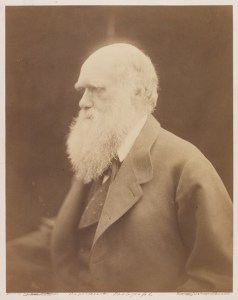
‘Charles Darwin, Naturalist’, 1868, Julia Margaret Cameron, The Royal Photographic Society Collection © National Media Museum, Bradford / SSPL. Creative Commons BY-NC-SA

Two of Dodgson’s subjects were accomplished photographers in their own right, and perhaps the most famous female photographers of their time: Julia Margaret Cameron (1815-1879) and Sarah Angelina Acland (1849-1930).

Cameron’s innovative and distinctive style of portraiture raised photography to a true art form. Her intentional use of shifted focus and experiments with process and finish gave an ethereal look to her works resembling the artistic style of the contemporary Pre-Raphaelites.

Many prominent scientists sat for Cameron, including naturalist Charles Darwin. She took the portrait above in 1868 at her home on the Isle of Wight. An original print of this photograph, made by Cameron, was recently discovered in the Museum Archive, uncatalogued. It features her signature on the back and the blind stamp from her printseller in London on the front.

'Mr Ruskin & his old friend at Brantwood' by Sarah Angelina Acland, 1893
‘Mr Ruskin & his old friend at Brantwood’ by Sarah Angelina Acland, 1893

Sarah Angelina Acland, inspired and taught by Cameron, is best known for her innovations in colour photography, but she also took many black and white photographs while learning the art form. The portrait above features her father Sir Henry Wentworth Acland and the artist John Ruskin at his home. Both Ruskin and Acland were instrumental in the founding of this Museum, and Sarah even helped to lay the founding stone in 1855.

In a 1904 Royal Photographic Society exhibition Acland was the first to exhibit work combining images taken with red, green and blue filters, three years before the launch of the colour photography process invented by the Lumière brothers.

These images, including the original print of Charles Darwin by Julia Margaret Cameron, are on display in our Presenting… case until 24 January.

The stars our destination?

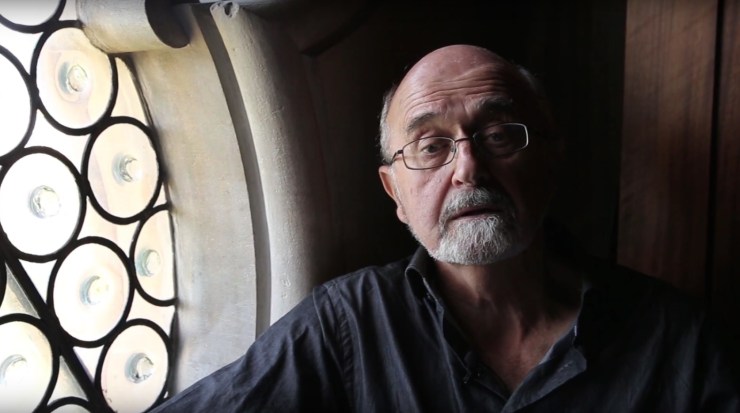
john-barnie

John Barnie, one of our three Poets in Residence, reflects on claims that the future of life from Earth lies deep in the Solar System…

In a recent article in The New York Review of Books, physicist Freeman Dyson speculates that in three or four hundred years it may be possible to seed promising planets and moons in the solar system with organisms genetically engineered to withstand their harsh conditions, eventually transforming them into environments which could support humans – fleeing, perhaps, from an irreparably damaged Earth.

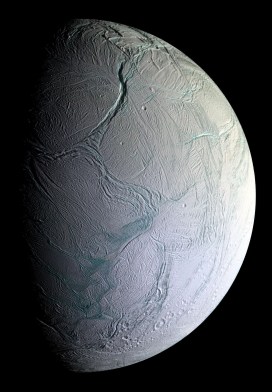
297191main_enceladus_full
Does Saturn’s moon, Enceladus, offer a viable site for the seeding of life? Image: NASA/JPL/Space Science Institute

Saturn’s moon Enceladus is one example he gives; geysers pierce its hostile icy surface, and Dyson hypothesises a warm sea hidden below. The process would be achieved by landing ‘pods’ of self-sustaining life forms – ‘Noah’s Arks’ he calls them. The rocket technology is well on its way, he argues, and will be perfected by small cost-effective space companies rather than lumbering giants like NASA. Biotechnology, too, will develop by leaps and bounds to produce, for example, ‘warm-blooded plants’ that would absorb energy – on Saturn’s moon Enceladus, say – concentrated from starlight and the distant rays of the Sun.

In the increasingly stressed and chaotic twenty-first century, it is impossible to predict what will happen in two or three years, let alone two or three hundred. In the meantime, while Professor Dyson elaborates his techno-fantasies, we are here, on the only Ark we have, and the only one, I’d say, we are ever likely to have.

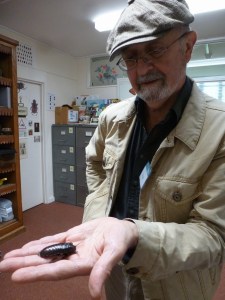
asfas
John Barnie meets some of our live residents, the Madagascar Hissing Cockroaches, during his residency at the Museum

My year at the Museum has been a fascinating and unforgettable reminder of this, the Museum itself forming an ark within an ark, celebrating the extraordinary diversity of multicellular life as it evolved over 650 million years. Many of its specimens, of course, represent extinct species, and they, too, are a reminder – of how life on Earth is fragile but also robust, endlessly reacting and adapting to changing circumstances. Life has survived at least five mass extinctions in the geological record, and will survive the largely human-induced one many biologists and naturalists, from Niles Eldredge to David Attenborough, think we are entering now – though our species may not be around to see what gets through the inevitable extinction bottleneck.

For techno-utopians like Freeman Dyson, the future is out there in space, not here where we evolved, where we have the grounding of our being. The new biotechnology, he argues, will have to be perfected on Earth first, filling ‘empty ecological niches’. They may, he suggests, ‘make Antarctica green before they take root on Mars’. There are so many things wrong with this it is difficult to know where to start. Luckily for us, the Museum of Natural History represents a very different vision of the Earth, its creatures, and our place among them.

Nature’s medals

By Sarah Joomun, Documentation officer

In the 1820s a young geologist named Charles Lyell travelled around France studying the landscape and rock formations to try and work out the processes that created them.

In between these field-trips, he met the people who had been studying the geology of France and from these discussions and his observations he created The Principles of Geology, one of the first significant popular science books on the subject and a foundation for the methods of modern geology.

pal_cl01718_01

Lyell collected many samples from the rocks he studied, amassing thousands of fossils during his lifetime. The Museum has a collection of some 16,000 of them, around 90 per cent of which are shells, mostly gastropods (snails) and bivalves (clams), many collected during his travels in France.

The reason for this prodigious collection of fossil shells, or testacea as they were then known, was that Lyell believed them to be the most useful clue to understanding the Earth’s history.

The testacea are by far the most important of all classes of organic beings which have left their spoils in the subaqueous deposits : they are the medals which nature has chiefly selected to record the history of the former changes of the globe.

– Lyell’s Principles of Geology, Vol III, 1833.

Fossil shells can show how the animal that lived inside the shell behaved, and whether it lived on the land, in freshwater or in the sea. Species of shelled animals have a wide geographical range and individual species survive for a long time, so they can be compared across time and space.

pal_cl01742_02

This allowed Lyell and his colleagues to determine the relative ages of the rock layers that the fossil shells came from. He looked at the proportion of shells that belonged to living species and determined that the rock layers with the lowest proportion of living species were likely to be older than rocks with higher proportions of living species.

And so three main groups of rock layers were found: the Eocene, containing fewer than 4% living species; the Miocene, with fewer than 18% living species; and the Pliocene, with more than a third of living species.

Although what is now known as the Eocene (from 56 to 34 million years ago), Miocene (23 to 5.3 million years ago) and the Pliocene (from 5.3 to 2.6 million years ago) don’t denote exactly the same periods as Lyell described, we still use these terms for some of the youngest geological epochs today.

Darwin, dolphins and a ‘Monkeyana’

macmanimalkingdompl60-crop-750

The Museum is home to a vast collection of natural history specimens but is perhaps less well-known for its substantial art and object collection. This material became the focus of Charlie Baker and Imogen Stead, two of our summer interns, as they spent six weeks researching, organising and curating it for the Museum.

The range and amount of material was formidable: numerous prints, non-scientific objects, paintings, photographs and sculptures from across the Museum, all coming together into a single organised collection for the first time. Here, Charlie and Imo unearth just a small sample of some of the items they catalogued during their time at the Museum:

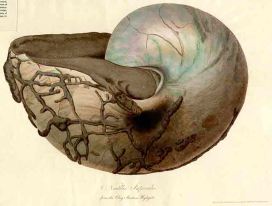
Nautilus Imperialis
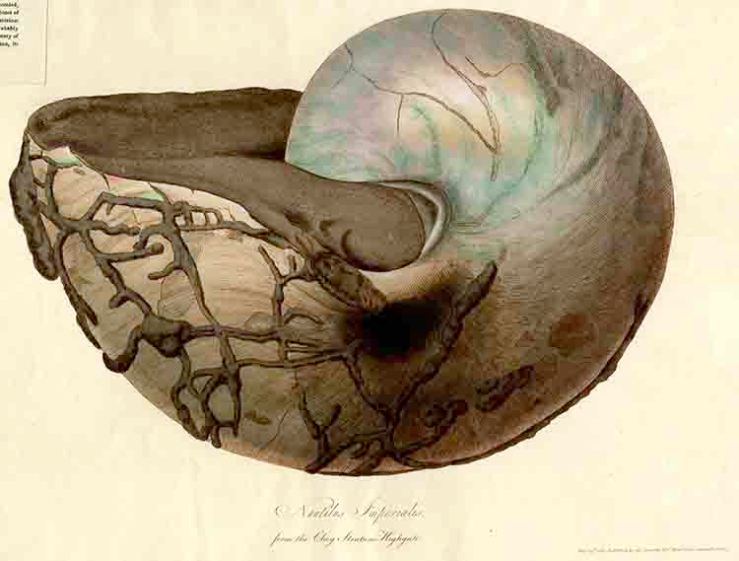
This beautiful print shows a fossil of the Nautilus Imperialis. It is one of the largest prints the Museum holds: measuring 48cm x 43 cm, it’s too large for the scanner! It has a small pamphlet of text stuck to it, just visible in the picture, and we speculate that this may have been promotional material for James Sowerby’s Mineral Conchology of Great Britain, the first volume of which was published in 1812, the same year as this print.

nautilusimperialis-for-web
Nautilus Imperialis print

Plate 60 from The Animal Kingdom
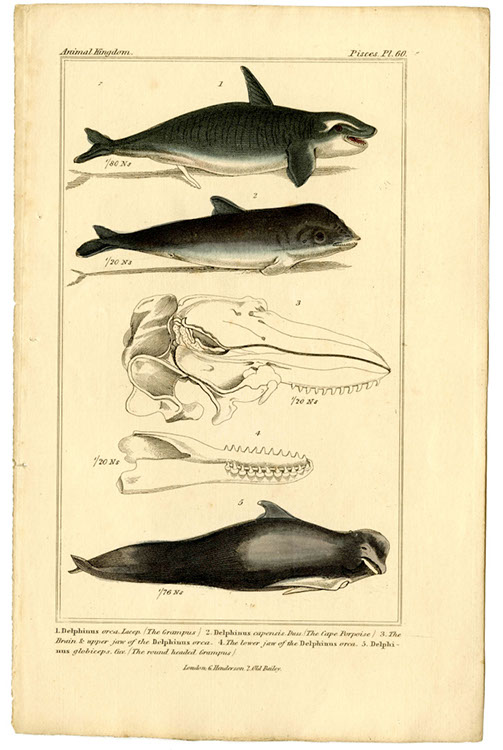
This is a plate from Henry MacMurtrie’s translation of Georges Cuvier’s Le Règne Animal, showing a few species of the genus Delphinus, or Common Dolphins. The Museums has 32 plates from this book in the collection. The publication demonstrates the intellectual collaboration between countries and the international appeal of Cuvier’s famous work. In fact, the collections holds plates from the original French and two different English translations.

macmanimalkingdompl60
Plate 60 from ‘Animal Kingdom‘ (Le Régne Animal) by Georges Cuvier, 1829

Slide cutter
This tool was found in a chest of drawers in the Hope Library at the Museum. It initially baffled us, but staff identified it as a slide cutting tool. The circular blade scores the glass, and the notches are used to carefully break off the piece of glass. When cataloguing and storing it, we discovered the blade is still sharp enough to cut through a sheet of paper!

slidecuttercloseup
Slide cutter tool

Photo of Charles Darwin
This framed photo of the great Victorian scientist is one of 22 pieces of art hanging in the Museum’s Hope Library. What makes this copy of the photo special, however, is the caption beneath it: “I like this photograph very much better than any other which has been taken of me.”

darwin
Photograph of Charles Darwin with his annotations

Monkeyana Cartoon
One of the most bizarre items we came across was this 1828 satirical cartoon about lawyers. The collection has eight ‘Monkeyana’ cartoons, all by Thomas Landseer.

monkeyana
Monkeyana Cartoon by Thomas Landseer, 1828