Art of glass

Spotlight Specimens by Mark Carnall

From the comfort of our own homes, or even on a mobile device, we are accustomed to watching video footage from the most remote environments on Earth, and beyond. It is easy to take for granted this kind of visual access but we don’t have to go too far back in time to reach a point when the uninhabitable parts of the world remained much more mysterious. Then, the only windows into the nature of exotic locations were through drawings, paintings or collected specimens.

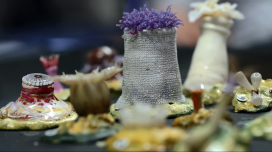
In museums, illustrations of nature were – and are – used in teaching to show what certain animals or environments look like. Along with our biological specimens, the Museum’s collections contain representations of animals whose natural appearance is not preserved after death, including a set of beautiful glassworks of British sea anemones.

These delicate models were created by the Blaschkas, a family which specialised in glasswork and ran a business spanning 300 years and nine generations. But it was only from the late 19th century that Leopold Blaschka, later to be joined by his son Rudolf Blaschka, turned his skills to making models of microscopic organisms and soft-bodied invertebrates for museums and universities.

Blaschka anemones still
The only Blaschka models at the Museum today form a series of British anemones, many of which are recognisable as the species and even individual animals illustrated in British Sea-Anemones and Corals published in 1860 by Philip Henry Gosse

Inspired by zoological specimens, scientific papers, and observation of living animals, as well as artworks showing colours and structures that were difficult to preserve or too small to show, the Blaschkas created thousands of glass models before they accepted a contract in 1886 to work exclusively at Harvard University on the Ware Collection of plant models.

historyofbritish00goss_0299
Plate from Philip Henry Gosse, 1860. British Sea-Anemones showing many of the species in the Oxford University Museum of Natural History series. Public domain image from the Biodiversity Heritage Library. http://www.biodiversitylibrary.org

It is somewhat surprising that these incredibly fragile specimens made their way to museums and universities across the globe back in the 19th century and even more surprising that any have survived 150 years later.

Anemones tend to lose their shape and colour when preserved in fluid

Earlier this year the Corning Museum of Glass published an interactive map of marine invertebrate models showing the known locations of collections, or records of collections, of Blaschka glass models.

The models at the Museum, acquired in 1867, are thought to be some of the oldest surviving Blaschka glass models. Even though they are over 150 years old, and in some cases slightly inaccurate representations of species, they still show the vibrant colours and alien shapes of British anemones in a way that can’t be seen outside their living environments.

Gemstones, fairy boats and the Orchid Mantis

This year the Museum is playing host to three poets in residence as part of our Visions of Nature year. The poets, John Barnie, Steven Matthews, and Kelley Swain, have been working alongside staff in our collections and out in the Museum itself to gain inspiration for their writing over the past six months. In the autumn, they will take part in a number of events and activities to present their work, and will be publishing a small anthology at the end of the year.

Here Kelley Swain reveals what has inspired her poems during one of her recent visits to the Museum.

IMG_9441
In May, I had the opportunity to meet with several curators who had previously introduced me to their collections. This time, with the orientation they’d provided, I had more specific questions:

Kelley2For Monica in Minerology, I wanted to know more about what people historically considered ‘sympathies’ of gemstones. She directed me to Nichols’ Faithfull Lapidary of 1652, the oldest book in English about the properties of gemstones. The Museum has a copy of the book on loan to the Bodleian, so I’m heading in the direction of that most famous library to get to see the book, perhaps on my next visit.
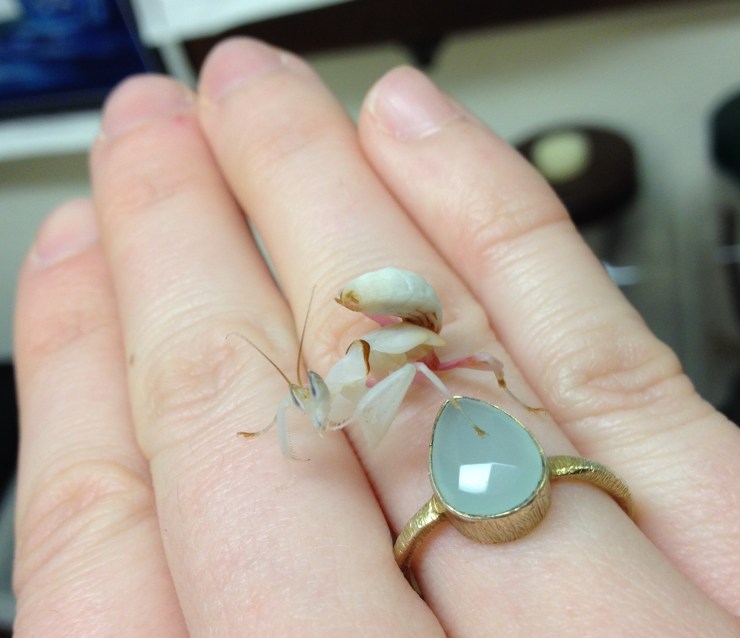
With Amo in Entomology, I was eager to pay another visit to the Orchid Mantis whom I’d named ‘Daphne’ on my last visit. In the interim, the Mantis had moulted to her final life stage – she has wings and is now fully adult, but we don’t know how long she’ll live. She might not be there when I next visit. (Amo said this is the reason she stopped naming the insects – she became too attached.)

IMG_8844
Daphne the Orchid Mantis in March 2016

It was especially wondrous to see that Daphne’s colouring had changed from that of a bright pink-and-white orchid blossom to something darker, that looks just like a dying orchid blossom – and she seemed much less alert than before – almost sleepy. I know a bit about cryptography and camouflage, but that the lifespan of the Orchid Mantis directly correlates with the lifespan of the orchid blossoms on which it hunts is more than I might have imagined. I’ve been working on a poem about Daphne, which, by the time of our poetry-residency anthology is published, is likely to be ‘in memoriam’.

IMG_9120Daphne2
Daphne the Orchid Mantis in May after moulting

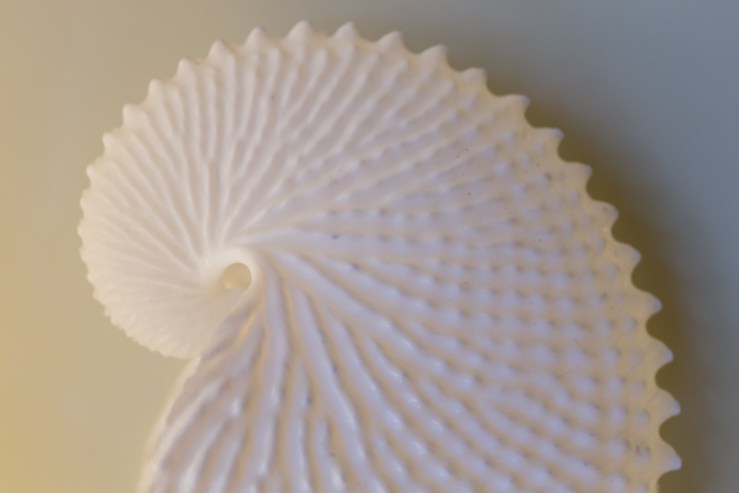
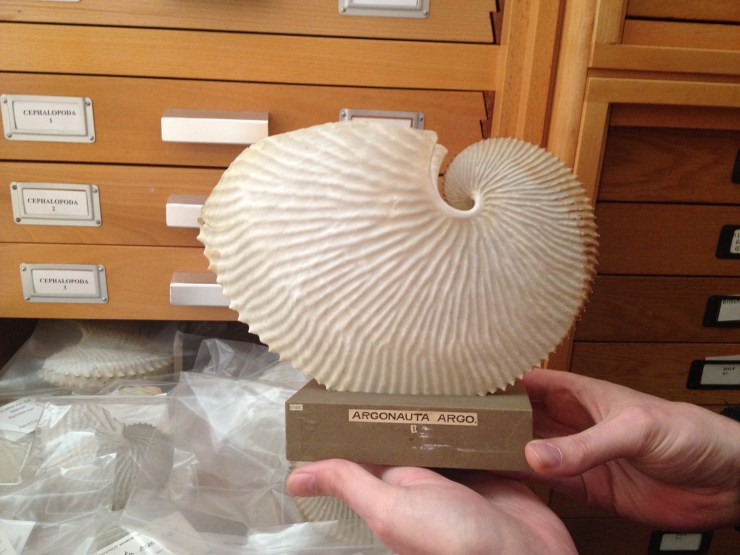
And thanks to Mark, Curator of Life Collections, I was able to finally see something that I’ve wanted to see for a very long time: not only one, but a large collection of fragile, mysterious Argonauta brood chambers. Cepalopods are a particular interest of mine, and while many people have collected marvellous ammonite fossils in Lyme Regis or admired the highly-polished specimen of a nautilus shell, Argonauta brood chambers are often mistaken for similar shells, when they are something rather different.

They are secreted by the female of the species (which is a type of octopus). Though this case is not attached to her body, she lives in it with her tentacles dangling out – she can spin it and turn it, but will never completely let go of it. This is the egg sac or brood chamber for her young: she lays her eggs in it, and when they hatch, they are in a safe, contained chamber in the sea. It’s likely that, as with many cephalopods, senescence sets in around the time the young are about to hatch – that is, the adults deteriorate and seem to have a kind of dementia, until they die and their bodies fall apart, just as the young hatch and need food.

IMG_9126
An Argonauta argo specimen from the Museum’s collections

The thing about the Argonauta that most intrigues me is that, though this papery shell is not attached to the female, she will die without it. Studies have revealed that other species of octopus, placed in cages, would squeeze out of the bars of the cage to reach food; the Argonaut, on the other hand, would not let go of its shell, remained in the cage, and died.

Argonauts can direct their buoyancy and swimming, but seem to drift with tides, and there are a few videos online of scuba divers happening upon them: they seem quite directionless and cumbersome. Despite this, to me they are, without doubt, one of the most beautiful, mysterious, and poignant creatures in the ocean, and it was a great gift to be able to see so many Argonauta cases in the Museum stores.

The Argonaut is often called the ‘paper nautilus,’ though their beautiful remnants were also called ‘fairy boats’. The best chapter I’ve read so far on these creatures is ‘Flight of the Argonauts’ by Helen Scales in her book Spirals in Time. I’m working on a poem about these marvellous creatures for the Museum residency.

Looking up

Blue sky

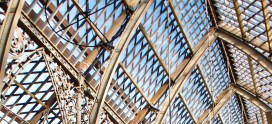
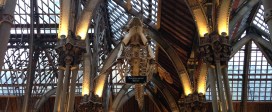
There can be many reasons for a museum’s decision to install a temporary exhibition, but the most powerful is that its visitors have asked for it. While working in the Museum’s shop, Magdalena Molina is often quizzed about the building’s iconic roof, which can be admired as they browse. “What’s it made from? Who designed it? How does it get cleaned?” The most popular question of all is, “Where can I find out more?”.

A detail from the roof's rafters
A detail from the roof’s rafters. Credit: Mike Peckett.

Magdalena is an experienced designer, who has worked on various exhibitions, so she approached the Museum with her ideas for a creative, artistic display all about the roof. An exhibition to satisfy the interests of curious visitors.

As a designer I feel inspired by the exquisite design and architecture of the roof of the Museum. Assisting in the shop, I have received a lot of comments from visitors who are fascinated by the building.

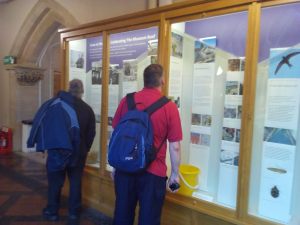
Visitor exploring the exhibition

The exhibition, Lives at the Top: celebrating the museum roof, has just opened. It allows visitors to discover the people behind its creation, secrets of its beautiful design and find out how it has been maintained for generations to come.

It begins with the origins of the Museum building, with an architectural competition won by Woodward and Deane, soon followed by the architect’s tragic early death.

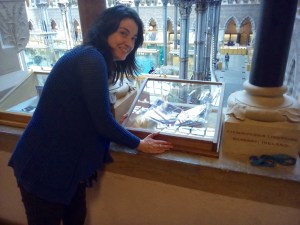
Magdalena with one of the Curiosity Boxes

The story continues with the 2013 roof renovation project and moves on to current museum concerns such as pests living up in the rafters. There are also 6 ‘Curiosity Boxes’ to explore, which use mirrors and magnifiers to look at the roof in a new, imaginative way.

Magdalena hopes that visitors will:

Follow the story which celebrates the people involved in the life of this astonishing roof,  and playfully engage with the interactive designed boxes to help them explore different perspectives of the roof.

Magdalena is encouraging visitors to join the celebration of beautiful roofs, ceilings and architectural details, by sharing their photos with us… and the world! Inspired by the Lives at the Top exhibition, we’ve put together a special board on the Museum’s Pinterest account. If you would like to appear on the board, simply share your photo on Twitter or Instagram and tag with #lookingupMNH.

Lives at the Top is open until 13th November 2016.

A scene from the 2013 renovation. Credit: Mike Peckett

The museums are migrating!

Night falls in the Museum

by Hannah Allum, Project Assistant

The film ‘Night at the Museum‘ is not as far from the truth as you might think. Museum specimens may not come back to life at night, but they are moving all the time. Whether we’re putting on a new display, loaning a specimen to another museum or using them for teaching sessions, our collections are very active, despite being long dead.

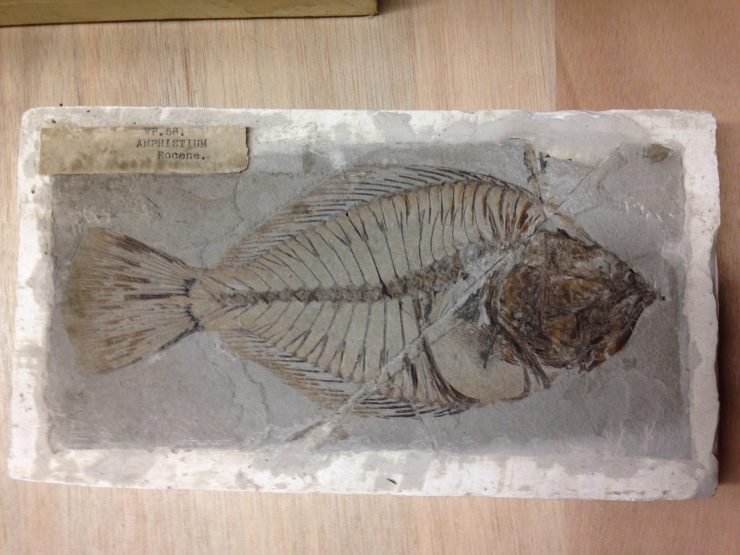
Amphistium fossil fish; an early relative of the flatfish and part of the Earth collection

The Oxford University museum collections are about to begin a huge migration as they move from various off-site stores to a new facility. Generally, museum stores are not open to the public and often house important reference and research specimens, which make up a huge proportion of natural history collections. These valuable stored collections require specific environmental conditions to make sure that they last for generations to come. Taxidermy and articulated skeletons make for eye-catching displays, but tend to be a relatively small part of the collection. In fact, having just 1% of your natural history specimens on public display is the norm.

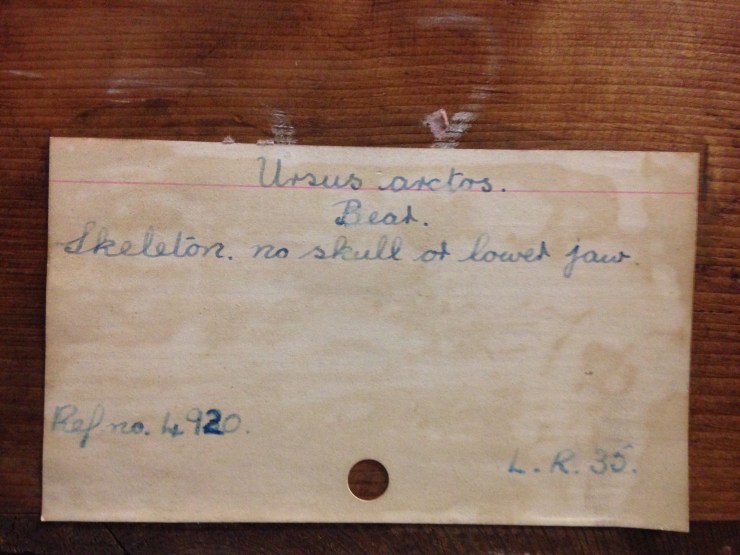
Lured in by Life Collection labels; this headless brown bear will soon have a new home.

As well as improving the storage conditions and ease of access for staff and researchers, this will also be the first time that the Oxford University museums have shared a storage space. It will be a challenging but rewarding project to re-home such a huge variety of artefacts and specimens that have come from all over the world; each with their own unique story.

Hannah profileAs the new Project Assistant working for the Museum of Natural History, I am the lucky person who gets to discover some of these stories. I will be working with specimens from both Earth and Life collections, as well as some material from the Library and Archives. The first stage will be making a detailed list of everything that needs to be moved, then I can go on to prepare the new store and get the supplies I’ll need to document, pack and transport everything safely.

Some enticing titles from the Library

As you can see, I have already come across some fascinating specimens and look forward to getting stuck in to this project.

There will be blog posts throughout the year to update you on our progress and to reveal some exciting stories from the stores.

You can also follow the hashtag #storiesfromthestores on the Museum’s Twitter feed: @morethanadodo

‘Father of English geology’

William_Smith

by Kate Diston, Head of Archives and Library

Today marks the 247th birthday of William Smith. “Who’s he?”, you may well ask. William Smith is perhaps one of the least well-known, yet very significant, figures in the history of the science. Among other things, he created the very first geological map of England and Wales, 200 years ago.

Smith’s work as a land surveyor and mining engineer in the early days of the Industrial Revolution allowed him to understand first-hand how the layers, or strata, of rock beneath the earth are related to those above and below them. From this, he realised you could predict those three-dimensional layers in other locations and also represent the whole thing on a two-dimensional map.

Smith_1815Map
A section of the famous 1815 geological map of England and Wales
IMG_4696
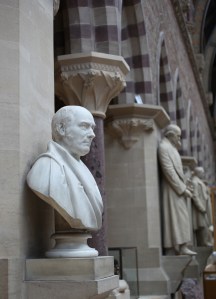
William Smith’s bust in the Museum court

If you visited us in the past few months you may have seen lots of Smith’s maps and other material in Handwritten in Stone, our special exhibition which celebrated his life and work. Now, a new exhibition featuring copies of items from our collections is opening in Smith’s birthplace of Churchill, Oxfordshire.

The displays at the Heritage Centre in Churchill take a very different look at the ‘father of English geology’, offering a rare glimpse of Smith’s personal correspondence with his family.

In honour of Smith’s birthday, we showed off his most famous work, the beautifully coloured 1815 map, in front of his bust in the Museum court today. As one of the Museum’s treasures not normally on display, it is a real treat to see it being admired by visitors.

20160323_151319
Visitors get a close look at the original 1815 map with Chris Jarvis

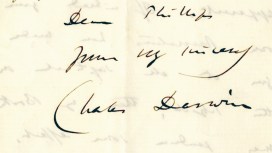
“My dear Phillips…”

Phillips_Darwin9001_signature

Today, across the world, a birthday is celebrated. It’s that of Charles Darwin, perhaps the best-known naturalist to have ever lived, and he would have been 207 years old this year. This Darwin Day, Kate Diston, Head of Archives and Library shares a very special letter from the man himself.

**

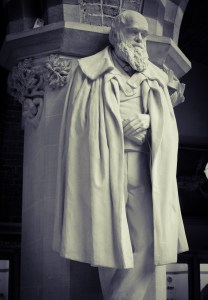
The Museum's statue of Darwin
The Museum’s statue of Darwin

In 1859 Darwin published his best-known book, On the Origin of Species, which presented his theory of evolution for the first time. While his book caused quite a stir, Darwin’s conclusions were the result of years of travel, observation and communication with other scientists in various fields.

One of those scientists was Oxford Professor of Geology, John Phillips. In 1859, Phillips was overseeing the final stages of the construction of this Museum, before taking up the position as its first Keeper.

A record of correspondence between Darwin and Phillips was recently rediscovered in the archive and highlights an interesting relationship between the two iconic men of science. Strikingly, the letter was sent less than two weeks before ‘On the Origin of Species’ was to be released.

I fear that you will be inclined to fulminate awful anathemas against it.

John Phillips
John Phillips, a few years after the book’s publication

Darwin knew that Phillips was not going to like his book. He had corresponded with him over many years about geology, recognizing that Phillips was one of the leading minds on the geological timescale. Phillps’ work had provided him with an understanding of the potential age of the Earth, and the implications this may have had on his theories. Phillips, however, would remain a man of faith.

Yours very sincerely

While Darwin knew that Phillips was not necessarily going to take his work at face value, it is clear from the letter that Darwin respected him immensely. This letter is almost a perfect snapshot of what was happening in science at that precise moment in history. Darwin’s book was about to call into question not just what was commonly understood about the natural world at the time, but also the very core of beliefs for most of society.

It is also a letter that reminds me how remarkable the collection I have the privilege to care for really is.

Kate Diston, Head of Archives and Library