And the winner is…

IMG_3525
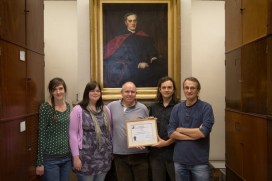
Katherine Child, Kate Santry, Peter Eeles, James Hogan and Darren Mann (l-r)

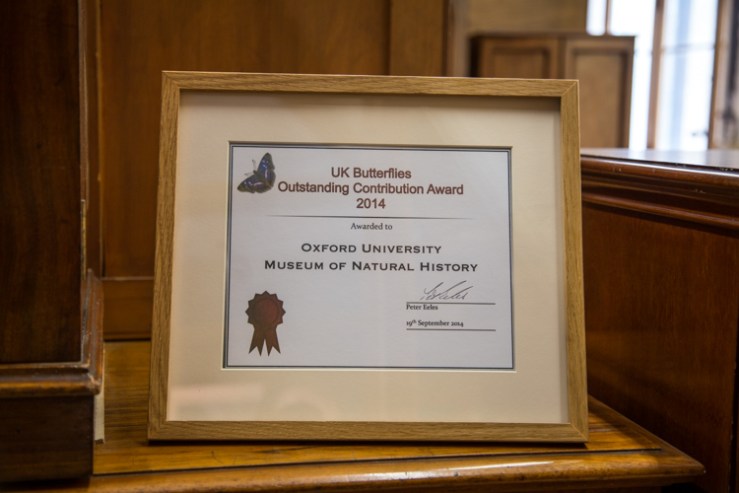
Congratulations to our fabulous Life and Archival Collections teams! They’re a pretty friendly bunch, always keen to help researchers and enthusiasts, giving unrivalled access to their knowledge and their collections. This welcoming attitude has now been recognised by the organisation UK Butterflies, who have awarded them with an Outstanding Contribution Award.

Peter Eeles (l) presents the award to James Hogan

This is the first time that the award has been given to an organisation, rather than an individual, which was apparently “in special recognition of the role that this team of committed individuals has played in helping bring the UK Butterflies website to a whole new level.”
IMG_3532

Peter Eeles, who developed and runs the UK Butterflies website, has been visiting the Hope Entomological Collections (part of our Life Collections) for many years. He says that the staff have always been “encouraging, knowledgeable and welcoming” and have truly helped advance the mission statement of the organisation; Building a community of responsible butterfly enthusiasts.

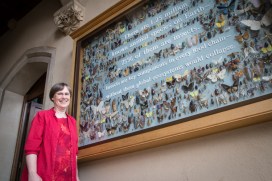
Peter Eeles admires some Camberwell Beauty butterflies.
Peter admires some Camberwell Beauty butterflies.

James Hogan, from the Hope Collection, has worked closely with Peter and his colleagues and says;
“It’s a great honour to be recognised and it’s always a pleasure to welcome the UK Butterflies members.

“They’re always enthusiastic about what they do and I learn a huge amount about our collections, too. There’s no point having collections if no-one uses them!”

The Library and Archives, run by Kate Santry, has been vital in research into the history of entomology. Last year, Mark Colvin, a contributor to the website, used the collections to study the life and works of James Charles Dale. By combining diaries and photos from the Archives and specimens from the Life Collections, he built up a thorough report on the entomologists’ work. Peter interviewed Kate about her work back in December last year and put the interview onto the website.

Mark and Peter talked about the impressive ‘open door’ policy that the staff have, and this doesn’t just extend to entomologists. Kate is always very keen to point out that the Library is open to anyone who would like to visit. Just drop her an email on libary@oum.ox.ac.uk to arrange a good time to call in.

Thanks to Peter, Mark and all at UK Butterflies, for this exciting award – now to find the perfect spot to show it off!

Rachel Parle, Interpretation and Education Officer
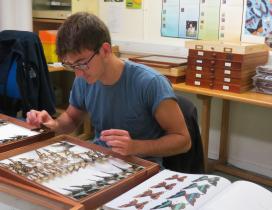
It must be autumn – the interns have flown

James organising the South Sudanese butterflies
James Evry organising the South Sudanese butterflies

It seems very quiet this week, now the last of our undergraduate interns has left us. A week ago, third year Earth sciences student Keyron Hickman-Lewis identified and numbered his last tray of specimens from the 19th century Parker collection, photographed some of the finest Jurassic fish jaws, sharks’ teeth, and other beautifully preserved fossils, before heading home to enjoy a well-earned break.

We’ve been running paid undergraduate internships for several years now, supported by grants from the University’s E.P.A. Cephalosporin Fund. The students tackle curatorial projects – sorting, identifying, numbering and cataloguing specimens, or helping to organise and list archives. This enables us to get a lot of curatorial work done, and it gives the interns a chance to handle and learn about a wider range of specimens and materials than they would ever see on their degree courses, while learning new skills which will be useful in their future careers. This year we also had interns funded through Oxford University’s own internship scheme, all tackling projects with more of a research focus.

Naomi (l) and Branwen (r) numbering Freeman collection minerals

Second year biologist, Ellen Foley-Williams worked on the Long-horn Beetle collection, but she’s really interested in science communication, so we set her an extra challenge of running a blog where all the interns could share their experiences; have a look at More Than an Intern to discover more.

Naomi (r) showing off some Cumbrian iron ore from her home county, and a an iron meteorite from space in ‘Spotlight specimens’

Some of the interns rose to the challenge of joining our ‘Spotlight Specimens’ rota. Every weekday afternoon at 2.30, a member of staff takes some favourite specimens from behind-the-scenes, and talks about them to museum visitors. It may be a bit scary first time, but every one of the interns said it was really fun to do – if sometimes a little challenging with such a varied audience.

In total, we had eleven interns, each spending six weeks working on a specific project. So Branwen, Cecilia, Ellen, Emily G., Emily T., Grace, James, Keyron, Max, Naomi, and Steph, we’d like to thank you all for being hard-working and lots of fun to have around. We hope we’ll see lots more of you all in coming years.

Monica Price, Head of Earth Collections

Treasure hunters

dsc_64661

The many nooks, crannies, corridors and cupboards of the Museum are often home to fascinating historical material, long-since filed away for safe keeping and sometimes half-forgotten. Rummaging around in towers and basements is therefore quite an exciting prospect.

Cecilia Karlsson, one of the twelve interns who joined us recently, had the enviable task of doing just this kind of rummaging, high up on one of the top levels of the building. Here Cecilia tells us a bit more about what she was doing and what she found.

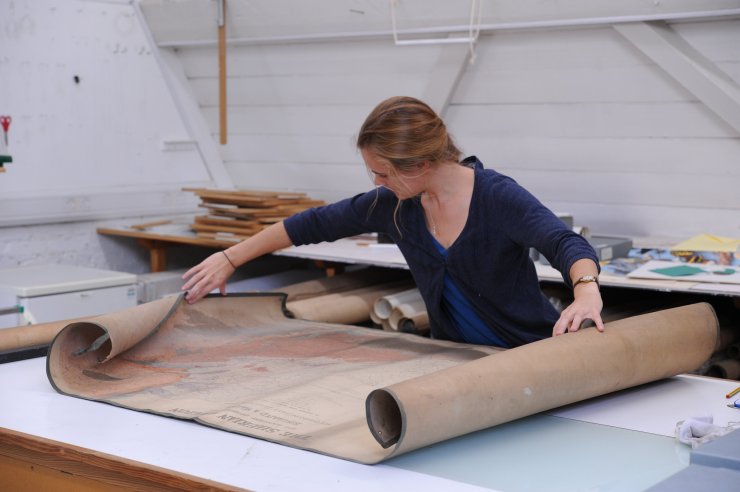
“At the start of my internship I worked in the Library archive with the more well-used material that is already collated and stored by author. But later I got the chance to sort through the archive of maps and charts that is hidden away in the old paper conservation studio.

Excitingly, the first thing we pulled out was a signed map by Roderick Impey Murchison, produced between 1831 and 1838, depicting the Silurian region and adjacent counties of England and Wales – the first geological map produced of that region!

Murchison was a Scottish geologist who in 1831 started studying the greywacke rocks underlying the Old Red Sandstone at the border of England and Wales. He subsequently grouped them into a new order of succession, which he called the Silurian System, a period lying between the older Ordovician and younger Devonian periods, and with its own distinct organic remains and unique rock formations.

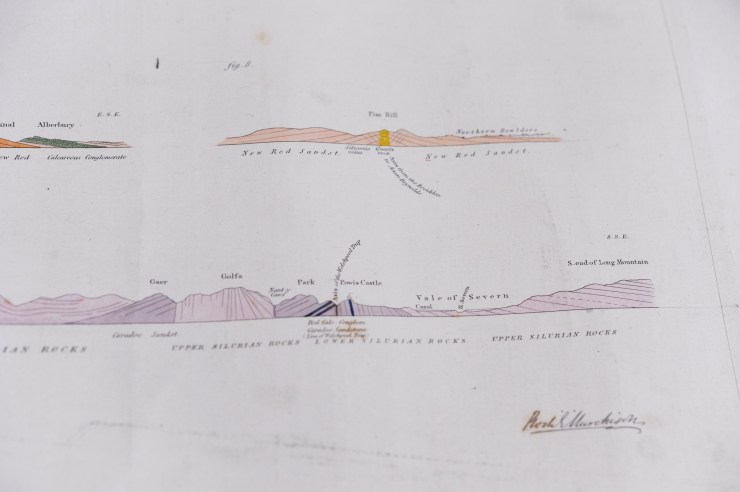
I later found three watercolours of numerous geological sections from the Lower and Upper Silurian, signed by Murchison but owned by William Buckland, Oxford’s first Reader in Geology.

dsc_64631
A watercolour signed by Murchison.

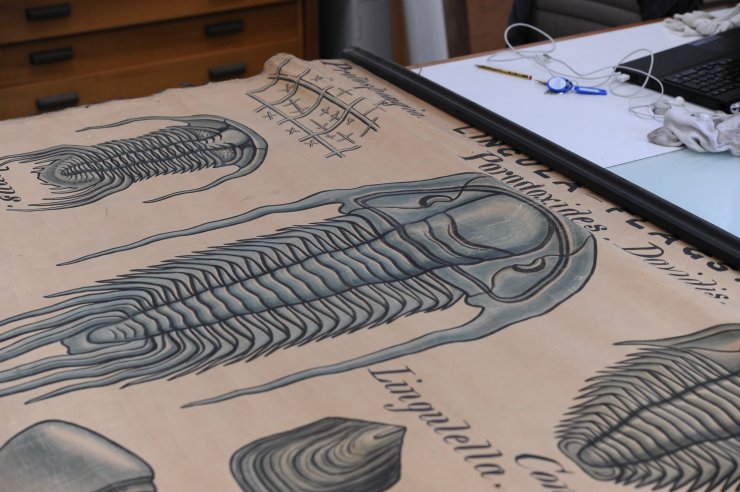
I’ve since encountered a whole array of maps of various parts of the world, from regional maps of the Nile basin in Egypt, to small parishes in the UK, through to maps of continents and the world, all dating between 1836 and 1924. Other finds in the archive have included numerous lecture diagrams depicting mainly fossil shells and trilobites from Silurian and Devonian rock deposits. These are in the style of English geologist John Phillips, who was William Buckland’s successor as Reader of Geology. Phillips may have used the displays as lecture aids during his time at the University, from 1853 to his death in 1874.

dsc_6473
A lecture poster depicting trilobites, in the style of, and possibly used by John Phillips, Reader in Geology at the University of Oxford, 1853-1874.

Most of the maps and charts are in need of some conservation care, including cleaning and storage in conservation-grade boxes. I have also been cataloguing them with descriptions so that they can be uploaded to the new content management system for later searching online. These descriptions include information on the author, date, and dimensions of an item, as well as an outline of its key features, language, location and condition.

However, the majority of the material has no associated authors or dates, so the next stage would be to trace their origins so that this information can be added.”

A job for another treasure hunter perhaps?

Cecilia Karlsson – EPA Cephalosporin Fund intern, 2014
Scott Billings – Public engagement officer

All change

IMG_2233

This week marks a landmark in the history of the Museum. Kristin Andrews-Speed will retire after 23 years of loyal work.

Over the years, Kristin has arranged corporate events and venue hire, been an essential part of hiring new staff, and managed all sorts of complicated logistics. She’s a dab hand at coaxing the photocopier back to life, too!

When a landmark is reached, it’s a chance to look back. In Kristin’s 23 years, she has seen enormous changes in the Museum, so I caught up with her to share some memories and reflections.

IMG_2245On 22nd July 1991, Kristin walked through the doors of the Museum and into her new job as assistant to the administrator.
With a zoologist father and a previous job at the Scott Polar Research Institute in Cambridge, Kristin always had a love of natural history. She soon fell in love with the beautiful building and its fascinating collections.

In 1991, just 83,000 people visited the museum, – the fact that it was open only Monday to Saturday from 12-4.30pm probably didn’t help. But with extended hours and Sunday opening introduced in January 1999, visitor numbers soared, reaching 575,000 in 2012.

“It’s wonderful to see how many more people are now enjoying the museum and still gasping as they walk through the main door.”

The museum’s first director, Keith Thomson, arrived in 1998 and Kristin’s job changed to include Director’s Assistant duties. They shared a love of ornithology and Kristin remembers when they watched a Black redstart clinging to the museum building. The Director brought many changes, like a full refurbishment of the main museum displays, which Jim Kennedy later continued.

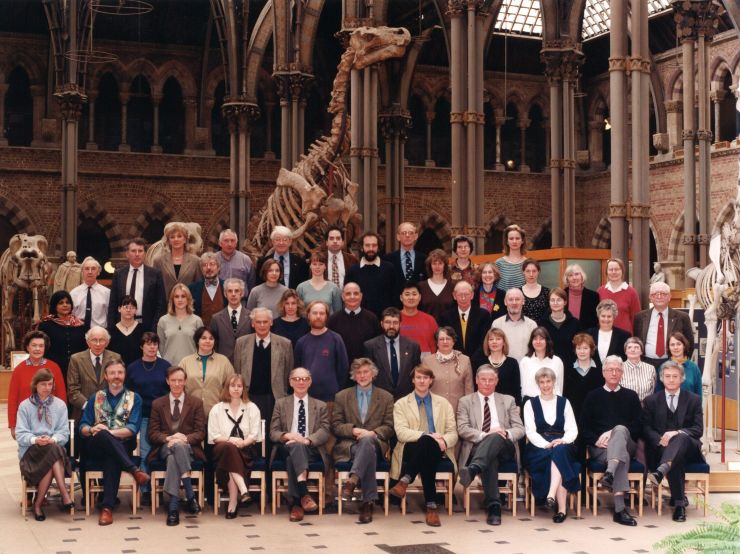
Museum staff in summer 1998. Kristin stands on the far right, second row from the front. Delphrene is on her left.

Kristin described a major change in how the Museum runs reception events. She talked affectionately about a hot evening in August 1991 where she served drinks to guests on the gallery, with help from the museum’s cleaners, Delphrene and Sue, and quickly learnt how to open a bottle of wine. All a long way from the professionally catered events of today.

Kristin’s meticulously maintained diaries have become such a valuable piece of the museum’s history that they will be added to our Archival Collections, for future fact-finding missions.

Kristin has enjoyed meeting all kind of people, from new young scientists to older staff and visitors with their stories about the Museum over the years.

Great events for her have been the Wildlife Photographer of the Year exhibitions, which returned this year, Slade Lectures, Mark Wallinger’s tardis, Angela Palmer’s Ghost Forest and Derek Siveter’s amazing Chinese fossils from Chengjiang.

IMG_2173One way that Kristin will remain connected with the Museum is by watching out for our summer visitors; not the tourists, but the swifts!

I’ve always kept my office window open in late April to listen for the first screech of the birds round the tower, and will continue to listen out for them around Oxford.


Rachel Parle, Education and Interpretation Officer

Experience gained

IMG_2199

Over the past few days the ranks of the Museum have been swelled by the arrival of a host of summer interns from the University of Oxford Internship Programme and the EPA Cephalosporin Fund scheme. Overall, twelve internships are being run at the Museum, and the new faces have been squirreled away into the various departments and collections throughout the building.

We’ve got people working on a wide variety of activities, from audience research for Oxford ASPIRE, to the curation of longhorn beetles (Cerambycidae) in the Life Collections, to work on the archive of 19th-century entomologist James Charles Dale.

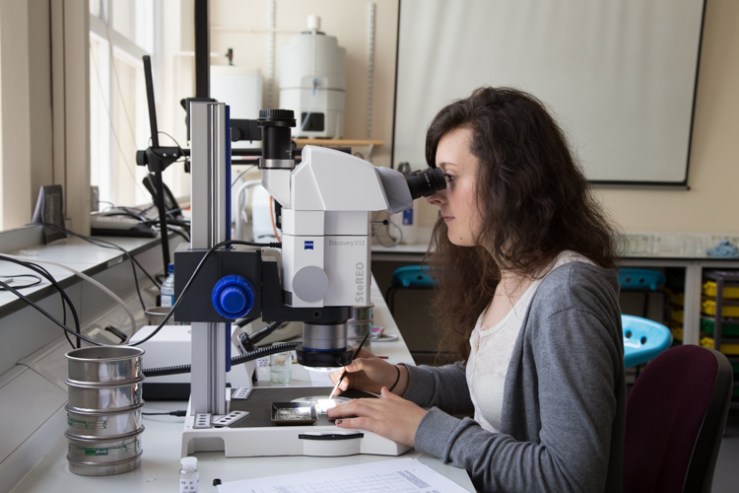
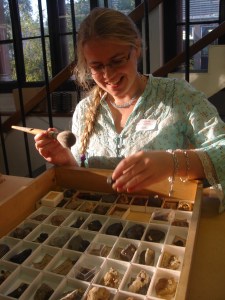
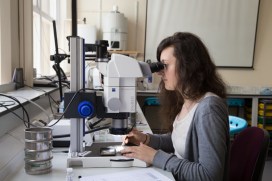
One of the interns, Grace Manley, is pictured above peering into a microscope. Grace is working with Dr Tracy Aze, a research fellow at the Museum who is studying planktonic foraminifera – fossils of single-celled organisms found in deep-sea sediments – to investigate marine extinctions. Tracy explains how Grace is contributing to the work during her internship:

Grace is helping me to test some methodological practices that will feed into how I conduct my future research. She has been involved in all the stages of micropalaeontological processing, from washing down core sediments and microfossil identification, through to imaging specimens on the scanning electron microscope.

The project gives her the opportunity to learn many of the common practices that micropalaeontologists use in a lab today and is excellent experience should she decide to continue to work in this field, or other areas of palaeontology.

Caption
Grace Manley working on the planktonic foraminifera as part of her internship with Research Fellow Dr Tracy Aze

For Grace, the internship provides ‘a practical experience of scientific research in the field of environmental change and extinction’. At the same time, she is enjoying ‘the chance to learn about the hugely diverse range of collections in the Museum and how they are actively used for scientific research today.’

We hope that all the interns across the Museum are finding a similarly rich and rewarding experience and we’ll feature some of the highlights of their work on this blog over the coming weeks.

In the meantime, a big welcome to Naomi Saunders, Stephanie Faulkner, Grace Manley, Emily Giles, and Samuel Peacock on the University of Oxford programme; and to Branwen Snelling, Keyron Hickman-Lewis, Ellen Foley-Williams, Max Brown, James Evry, Cecilia Karlsson, and Emily Tibly on the EPA Cephalosporin Fund scheme.

Scott Billings – Public engagement officer


Viva Volunteers!

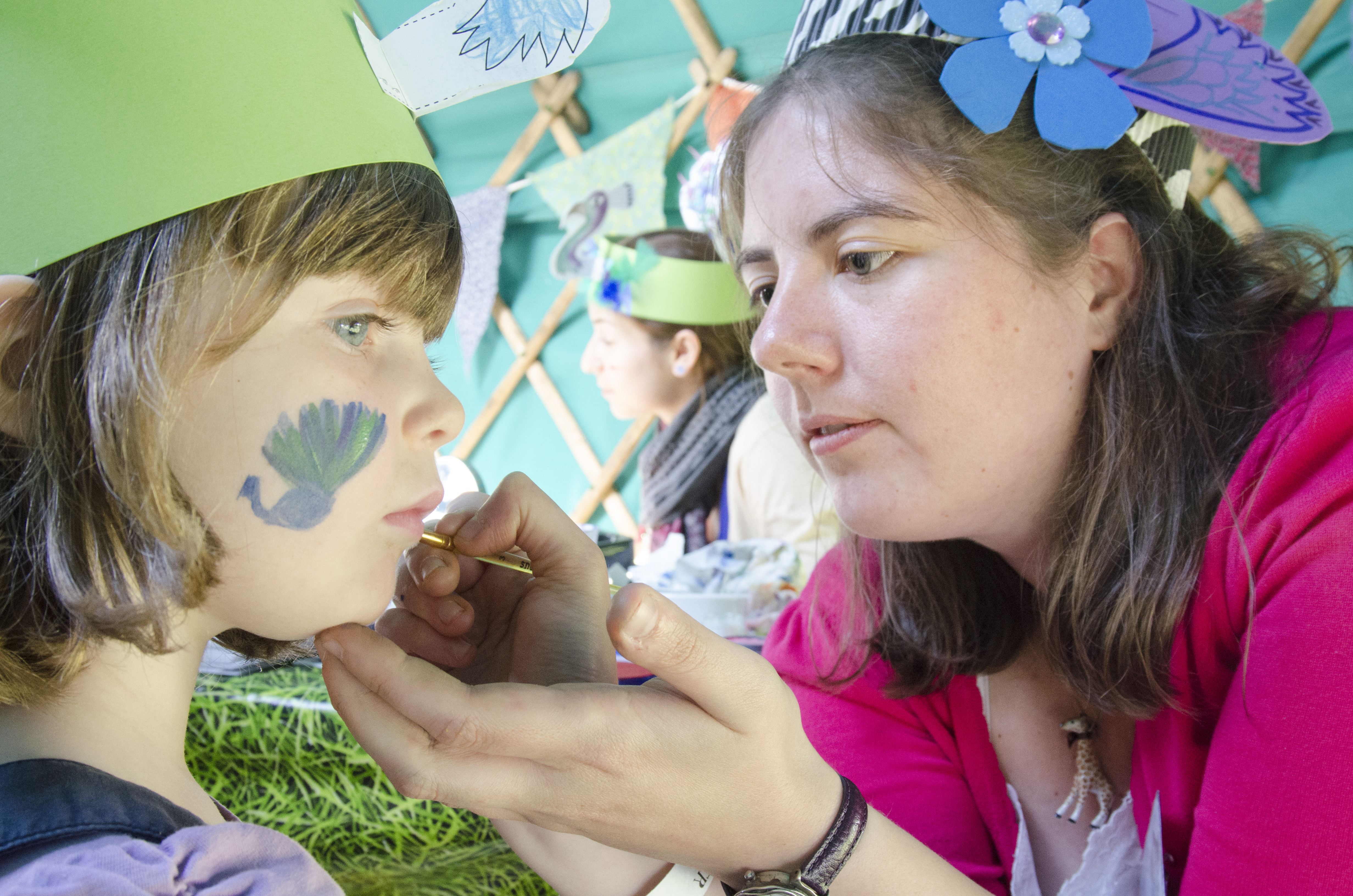
Alice facepaintingThey sort, they scan, they stick, they smile: who are they? Our team of brilliant Collections and Public Engagement Volunteers of course! This week has been the 30th anniversary of Volunteers’ Week, so we wanted to put the spotlight on them…

The majority of our volunteers help with public events, particularly those for our family audience. In 2014 alone, our awesome team of volunteers have given the Museum over 1500 hours of their time to help with public engagement events. This includes painting children’s faces, like the wonderful Alice Wilby (above), leading tours of the Museum’s architecture and running a pub quiz at one of our late night events. IMG_1322

On top of that, we have a team working away behind the scenes supporting our collections staff. Here’s just a sample of the projects they’ve been working on this week…

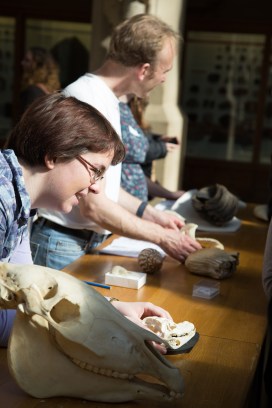
Laura Cotton in the Earth Collections.

– 5 volunteers identifying butterflies from painted images in our Archival Collections.
– 1 volunteer working in the Life Collections sorting and cataloguing bones.
– 4 volunteers tucked away in the Earth Collections cleaning ancient horse fossils or sorting Jurassic fish teeth.

Simone Dogherty is the Museum’s Education Assistant and co-ordinator of Science Saturdays – a weekly family event aimed at older children and led entirely by volunteer scientists. So why does she think volunteers are so valuable?

We’re very lucky here to have such a large quantity and high quality of volunteers. They help us with a huge range of activities and with the increase in visitor numbers that the Museum has been experiencing since re-opening in February, I just don’t know how we’d cope without them.
For Science Saturdays we use volunteers with a specific expertise. This gives children access to enthusiastic and inspiring individuals that they can look up to. And, in return, the volunteers gain valuable science communication skills.

Fancy joining our merry band of volunteers? Whether you’re into making masks or dusting off molluscs, we need you! You can simply sign up to help out on our Volunteers website.

But what’s in it for you? Aside from the glow of knowing you’ve simply helped us do more, you can develop your confidence when working with the public, learn a new skill or get up close with the treasures stashed away behind the scenes. But that’s forgetting the most important part – you’d be joining a fantastic team of people who, like you, think this museum is a pretty exciting place to be!

Rachel Parle, Interpretation and Education Officer