Mysteries of the deep

by Sammy De Grave, Head of Research

It is often said that the final frontier of our exploration of the Earth lies deep in the oceans. Covering 70 per cent of the planet’s surface, the oceans nevertheless remain 95 per cent unexplored, according to the National Oceanic and Atmospheric Administration in the United States. And they know, for they are doing the exploring…

Since 2008, the Okeanos Explorer at the NOAA has been investigating deep water ecosystems and has live-streamed many of its remotely operated vehicle (ROV) dives for scientists and the public to observe. Last year, Okeanos was engaged in an exploration of the Mariana Trench Marine National Monument in the Pacific Ocean. During a single dive at an impressive 4,826 metres, on a muddy bottom at a site nicknamed Twin Peaks, a large shrimp was observed, which the participating scientists did not recognise.

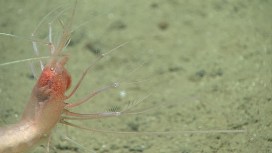
Spotted 4,826m below sea level, in the Mariana Trench Marine National Monument: the shrimp Bathystylodactylus
Spotted 4,826m below sea level, in the Mariana Trench Marine National Monument: the shrimp Bathystylodactylus cf. bathyalis

This was an unexpected find. Although there are about 4,000 species of caridean shrimps in the world’s oceans, very few live below 1,000 metres, and fewer than 20 species are known from depths lower than 3,000 metres. Those that do are usually only found as broken specimens, creatures damaged by the trawls which also bring them to the surface.

Photos of the deep-dwelling shrimp were duly sent to two experts: Dr Mary Wicksten at Texas A&M University and Dr Sammy De Grave, head of research here at Oxford University Museum of Natural History. Both immediately recognised the specimen as belonging to the rare genus Bathystylodactylus, which comprises of only three scientifically-described species, which in turn are only known from six specimens, all damaged.

The bristly legs, called setose legs, are used in passive filter feeding
The bristly legs are used in passive filter feeding

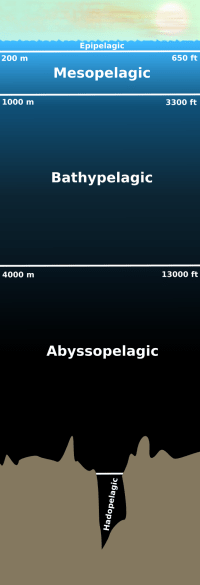
wfm_pelagicThe Okeanos team had made something of a discovery, one which was published in the open access journal Zookeys. The posture of the shrimp clearly show it to be a filter-feeding species, with its long, bristly legs facing into the current. This type of feeding behaviour has not been seen in caridean shrimps before.

Surprisingly, although the shrimp was observed at almost 5,000 metres below the surface, it is not the deepest recorded shrimp. That honour goes to a different species, Glyphocrangon atlantica, living in the western Atlantic, which has been trawled from as deep as 6,373 metres. Blurry photographs from 6,890 metres in the Kermadec Trench might indicate that carideans live even deeper still, maybe even as far down as a related group of shrimps called dendrobranchiates, which are known from depths down to 7,703 metres.

These findings show that life of many kinds continues to be discovered in regions of the planet once thought to be completely inhospitable.
A poetic ending

steven-matthews

Steven Matthews, one of our three Poets in Residence, reflects on his residency at the Museum during our Visions of Nature year.

It is sad that our poetry residency is at an end; I shall miss the frequent escapes for the hustle of the everyday Oxford streets into the light and space of the Museum.

As a resident in Oxford for over twenty years, I had gradually accumulated a bit of knowledge about the building. I had, like so many local parents, hugely enjoyed taking our two sons there when they were young, and loved to see their delight at the displays. Seeing the fossil, mineral, and animal world, as it were, through their eyes, really re-engaged me with its wonders.

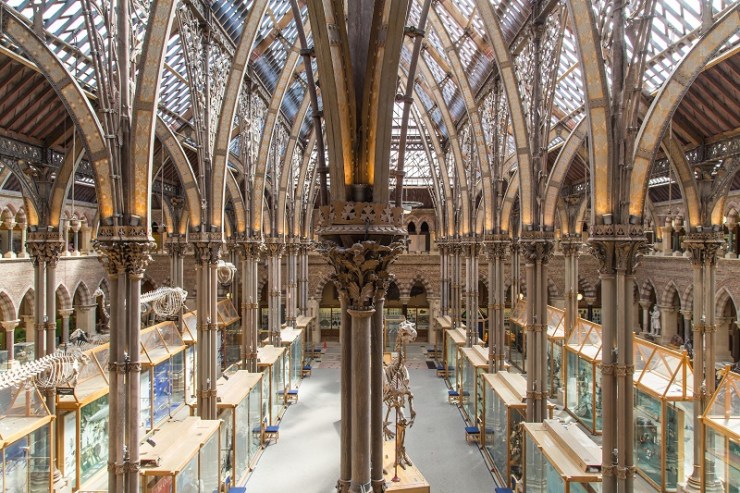
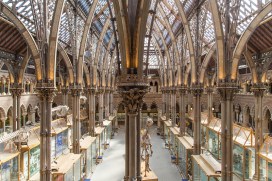
The Museum's centre court
The Museum’s centre court

I have been very privileged, then, to go ‘behind the scenes’ at the Museum, and to speak to the scientists engaged in research into its collections and history. They are bringing new knowledge and understanding to bear at a moment when, let’s face it, humankind has inflicted catastrophe upon the natural world, and so upon itself.

The Victorian spirit and vision which instigated the building of the Museum, a spirit revelling in creation and in exorbitant creativity, seems very remote. This is tragically borne home when looking at the cabinets of butterflies and moths, the Lepidoptera, where the majority of the specimens are of species that no longer exist.

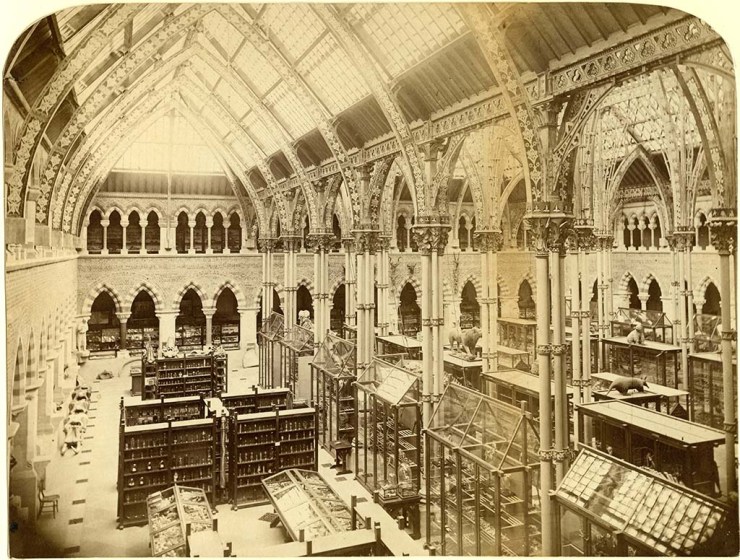
xcgfdfdg
A photograph from the Museum Archive showing the construction and layout of the building in the mid-19th century

The prime mover behind the Museum, the Victorian Henry Acland, said in an early promotional lecture that the ambition behind it was to show that all branches of science needed to work together to produce a greater understanding of the world. The zoologist could not understand the physiological structure of animals without deploying information and knowledge held in common with the geologist and the anatomist.

The Museum should be a place where that type inspiring dialogue could occur daily. It feels as though we are in a moment now where that collaboration, and collective and imaginative ingenuity, is hard-pushed to find solutions to the divided interests and dire afflictions of the world.

The Visions of Nature year at the Museum, which brought artists and us poets together with the scientists, has been one way in which all of these things have been, for me excitingly, furthered. It has been a challenge and a thrill to imagine and write – ‘in their own voices’ –  lives for some of the Museum’s specimens which have particularly fascinated or moved me. But also a great delight, for which I’ll always be grateful.

The power of real

mnh-badger

Of all the questions that curious children ask about specimens in the Museum, the most frequent by far is ‘Is it real?’. It’s a surprisingly complex question, mixing ideas of authenticity with more basic confusion over whether something is, was, or wasn’t ever alive.

So what do children make of all the weird and wonderful things on display in museums and how does it affect their experiences? Research by psychologist Dr Louise Bunce aims to find out, as she explains here…

If you want to know when dinosaurs roamed the Earth, or how bees extract nectar from a flower, or what meteorites are made of, what would you do to find out? Search the web perhaps? The answers to all these questions, and many more besides, can be found on the internet, so why visit a museum instead to learn about the natural world?

Example animal used in the research - Oryctolagus cuniculus and the toy rabbit
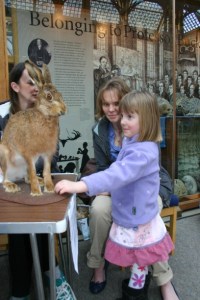
A taxidermy rabbit (Oryctolagus cuniculus), used in the research in the Museum…

Despite the wealth of information available online, the objects in museums continue to captivate visitors and offer something that the internet can’t. There’s something about ‘the real’ that has a certain power. Standing close to, and sometimes even touching, the genuine article – whether that be the head of a Dodo, or a painting by a Dutch Master, or a fossilised dinosaur skeleton – can induce goose bumps in museum visitors. But where does this potent effect come from?

... and a soft toy rabbit. Even younger children know the toy rabbit is not 'real'.
… and a soft toy rabbit. Even younger children know the toy rabbit is not ‘real’.

To begin to look at this question I have studied the importance and understanding of the ‘real’ in children visiting museums. When do children develop an understanding that they are looking at the real thing as opposed to a copy or model?

I conducted research with children visiting the Oxford University Museum of Natural History to see whether they understood that displays are of genuinely real animals, not manufactured models or replicas. And if they think they are models, how does that affect their experience?

The results were quite striking. Most 4- to 5-year-olds believed that the animals on display were not real because they were not moving, or because they were not alive. Consequently their reaction was somewhat dismissive.

A child participating in the research at the Museum

In contrast, most older children, those from the age of around 8 years, said that the animals were real because, for example, they had the real animal’s fur, or other authentic features. These children were also more curious about the animals because they were more likely to ask a question about the displays than children who perceived the specimens as not real.

So if younger children were missing out on the power of the real, I wondered whether there was something we could do to help them. I repeated the experiment but this time introduced children to toy animals and asked them to compare them to the museum animals. Now the majority of 4- to 5-year-olds seemed to gain a sense of awe because they perceived the museum animals as genuinely real in comparison to the toys, which they knew were not real.

These experiments seem to indicate that children do not necessarily perceive museum objects in the same ways as adults, but that we can help to give them meaningful encounters with museum specimens to create an inspiring museum visit. So don’t just Google it – grab the kids, a cuddly toy prop, and get down to the museum – or indeed out into nature – to be inspired by the real.

Steven’s Christmas spiders

by Steven Williams, Oxford Brookes University research student

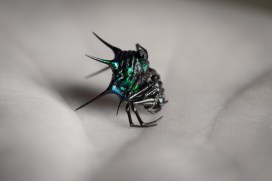
Described by A.G. Butler in 1873 as ‘the most gorgeously coloured spider in this genus’, Gasteracantha scintillans, with its metallic green iridescent abdomen, is the first of my Christmas Spiders.

img_0532
Spiky and sparkly: Gasteracantha scintillans

The beautiful colour of the abdomen certainly has a very festive feel and it would not be out of place next to a bauble on a Christmas tree; at least not in my house. This species and the other closely-related metallic Thorn Spiders are currently only found on the Solomon Islands.

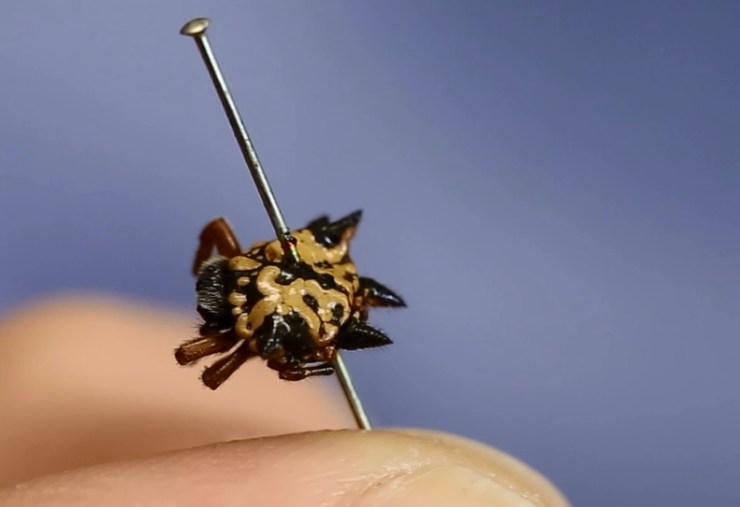
Christmas Island, in the Indian Ocean, is one of the locations where my second Christmas spider, Austracantha minax, can be found. Although not as striking as the metallic green of Gasteracantha scintillans, the layout of the abdominal spines on this spider almost give it the appearance of a star – perfect for the top of a Christmas tree, no?

Austracantha minax: starry, and found, amongst other places, on Christmas Island

The common name of ‘Christmas Spider’ is attributed to this species because in areas of Western Australia it is associated with the arrival of Christmas as the males reach maturity in mid-December and females in January.

Did you know that there is also an Eastern European folk tale of how tinsel came to be included in Christmas tree decorations? The legend tells of how spiders spun cobwebs on a poor family’s undecorated Christmas tree overnight. In the morning the webs turned to gold and silver and the family never lived in poverty again. So when you put the tinsel on the tree this year you could imagine you are a spider spinning a web!

With that spidery festive thought, have a very Merry Christmas from everyone at the Museum!

AAA (Adam Apprentice Award)

Edmontosaurus re-instate 011

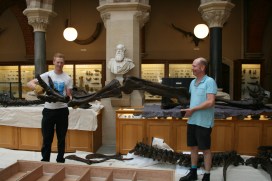
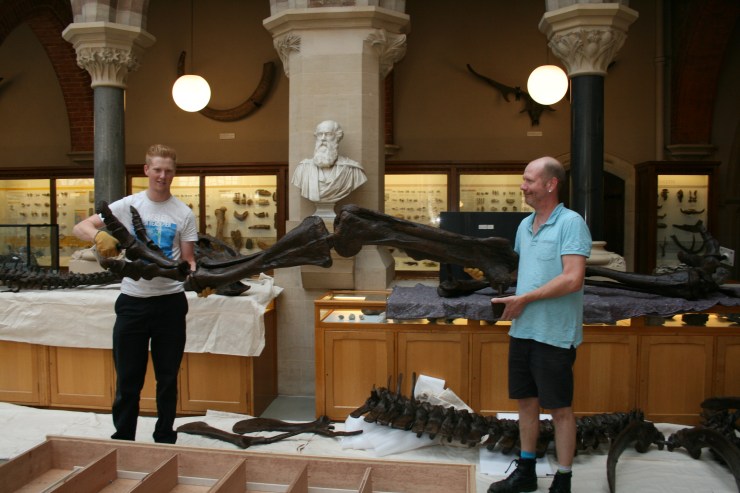
Last year we introduced you to Adam Fisk, our (then) new apprentice. He’s the slightly younger-looking one in the photo above; on the right is Pete Johnson, the Museum’s technician and Adam’s mentor and supervisor. Together, the two are a vital component that keeps the Museum machinery a-turning.

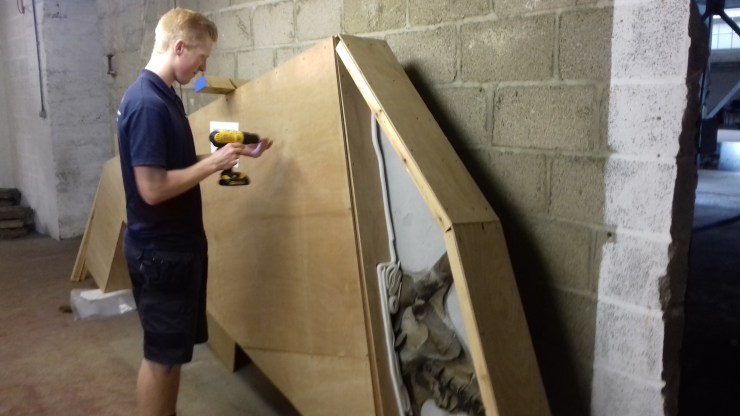
Over the past twelve months or so Adam has busied himself with many vital tasks: installing and de-installing our exhibitions, including Kurt Jackson’s Bees (and the odd wasp) in my Bonnet and Microsculpture; reconstructing an Edmontosaurus; and, more recently, sporting an excellent Star Wars Christmas jumper.

Packing an Attenborosaurus ready for transit

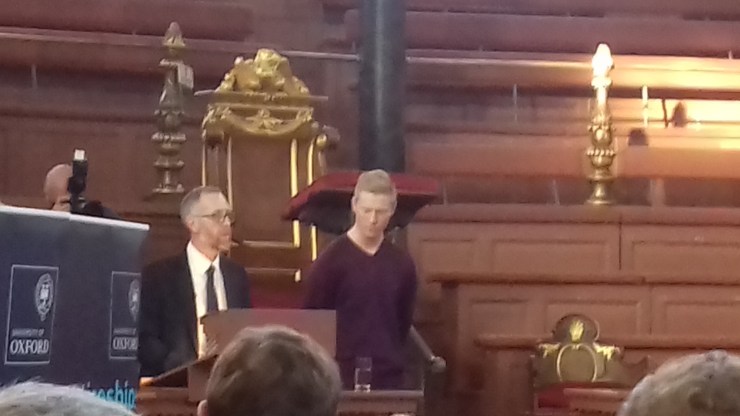
We’re therefore exceptionally pleased to announce that Adam has just been selected as a winner in the Annual University of Oxford Apprenticeships Awards. This calls for a small whoop, and a large ‘Well done Adam!’.

The awards, which celebrate the achievements of the University’s apprentices, supervisors and departments, were given out at a ceremony at the rather grand Sheldonian Theatre this afternoon.

Adam collecting his award at the Sheldonian Theatre in Oxford

When Adam joined the Museum last summer for his three-year apprenticeship he had just finished his GCSEs. Now he’s walking the stage at the Sheldonian… As Pete says:

Adam’s contribution to all aspects of work from maintenance and workshop demands to exhibition installation and Collections assistance has been outstanding. We have all benefitted greatly from his input, and he has helped us to achieve a high standard of public service.

Thanks for all the hard work Adam and we look forward to the next 18 months with you on the team.

Solving a prickly mystery…

oumnh-zc-17347_echinorhinus_brucus_mark_carnall_01-800px

by Mark Carnall, Life Collections manager

Visitors to the Museum often comment on just how many things there are to see here, but in fact only a small percentage of the collection is on public display – less than 0.1%. The remaining 99.9% is held in storage for use in research, teaching and to loan to other museums and universities.

I receive hundreds of enquiries from researchers all over the world who are interested in many aspects of animal biology. In exchange for our information about the skeletons, skins, specimens preserved in fluid, nests, shells and taxidermy here, the Museum gets knowledge from world experts who are publishing new science.

Bramble Shark (Echinorhinus brucus)
Bramble Shark (Echinorhinus brucus). Image: Illustrations of South Africa / Wikimedia

One such recent enquiry, from researchers Dr Samuel Iglésias and Frederik Mollen, concerned the Bramble or Spinous Shark (Echinorhinus brucus). You may not have heard of the Bramble Shark – it’s an enigmatic bottom-of-the-sea dwelling species – but this is one of the reasons why the researchers are trying to track down all known specimens held in European institutions.

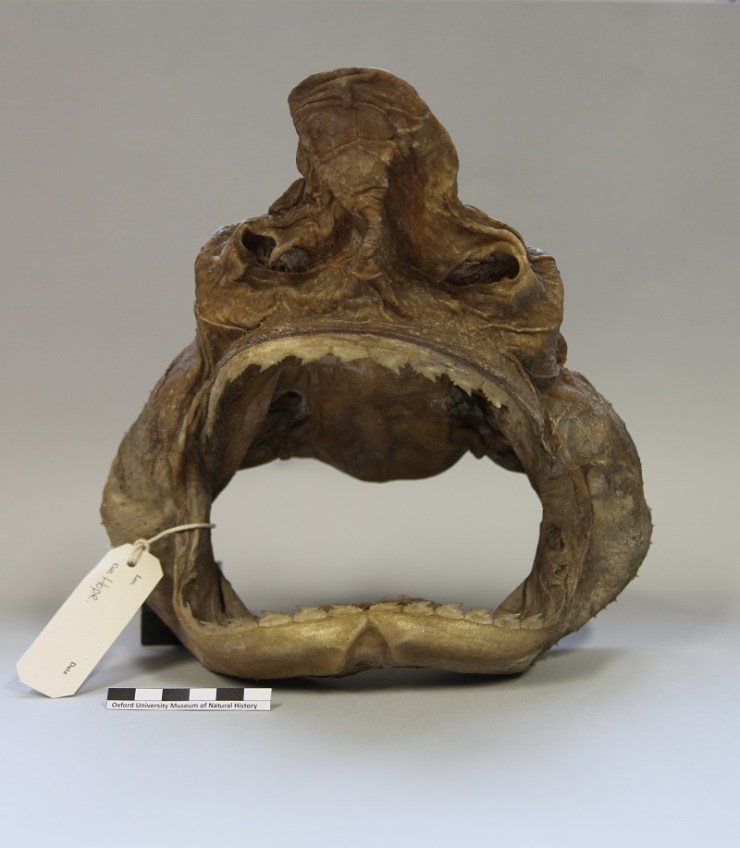
The characteristic brambles of the Spinous Shark, Echinorhinus brucus

Bramble Sharks are so called because of the large thorn-like structures, called dermal denticles, that cover the skin. These sharks are thought to be once common in European waters but are now virtually extinct.

I checked the Museum databases and stores and found 14 Bramble Shark specimens in the collections: one taxidermy specimen; one set of jaws with skin; a section of skin; and 11 fluid-preserved dissections. Unfortunately, as is often the case in older natural history collections, the fluid specimens did not have data associated with them – information such as age, locality, who collected them, what the dissections were or who dissected them.

After passing images and this list of specimens to the researchers they sent through an 1875 paper titled The Brain and Cranial Nerves of Echinorhinosus spinosus with notes on the other viscera by Bruce Clarke and the excellently named Hatchett Jackson. This paper describes the dissection of two specimens at the University of Oxford, one of which was a female collected from Penzance on 15 February 1875.

Armed with this new information I was able to cross-reference this dissection with some of our archives to confirm that most of the dissected specimens actually came from this single female shark collected in 1875, which was dissected and the parts used in illustrations in a technical publication.

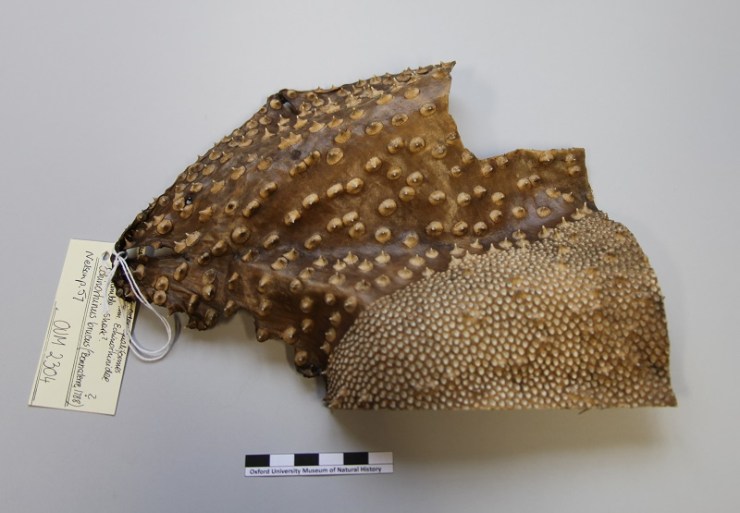
Section of skin previously identified as Bramble Shark but now re-identified as from a Porcupine Ray (Urogymnus asperrimus)

Another discovery came while photographing the skin specimen, and comparing it to the other dry specimens. It became clear that the thorns of the skin were very different to the typical Bramble Shark arrangement and it turned out that the skin was in fact from a Porcupine Ray (Urogymnus asperrimus).

The happy ending here is that the researchers now have better information for their publication and these specimens will be put ‘on the map’ in the technical literature for other researchers to access.

Although the Museum collections are effectively one Bramble Shark down (but up one Porcupine Ray skin), we do now have better information about the age, locality, relationship, identification, citation in the literature, and history of some these specimens. This makes them even more useful for research in the future.

Not all enquiries end with such a deeply satisfying result, but it is certainly nice when they do.