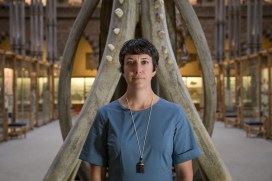
As part of the Museum’s Visions of Nature year in 2016, we have had the pleasure of hosting three poets in residence: John Barnie, Steven Matthews, and Kelley Swain. During the year the poets worked alongside staff in the collections and out in the Museum itself to gain inspiration for their writing. A small anthology of the resulting poetry is published at the end of 2016.
In this video Kelley Swain reads two of her poems To The Palaeontologists and Rorqual. Kelley is a poet, writer and editor.
You can meet Kelley at the Museum for National Poetry Day on Thursday 6 October 2016.
This is the second in a short series of articles to accompany the Stone Age Primates temporary display at the Museum, created with the Primate Archaeology group at Oxford University. Here, Dr Tomos Proffitt, Postdoctoral Research Assistant in Primate Archaeology, shows how the use of stone tools by modern primates might connect with our earliest human ancestors.
Over the past five years I have been fortunate enough to work with and study some of the earliest known stone tools, uncovered from archaeological sites at Olduvai Gorge, one of the most famous Palaeolithic archaeological sites on our planet. Olduvai Gorge seemingly appears out of nowhere as you drive down the dirt tracks of the north western slope of the Ngorogoro caldera and national park in Northern Tanzania.
The view from the top of Naibor Soit overlooking Olduvai Gorge. Photo Credit: Tomos Proffitt
It is here that the famous Louis and Mary Leakey uncovered evidence which proved that our evolutionary origins extended not thousands, but millions of years into the past, and over the years the site has provided a wealth of animal and early human, or hominin, fossils as well as tens of thousands of examples of the stone tools they made.
Two million years ago if you were sitting where I was in Olduvai, the most noticeable feature would have been a great lake surrounded by vast floodplains, occupied by a range of herbivorous and carnivorous animals taking advantage of the abundant grass, shrubs and fresh water constantly feeding the lake. It is in this setting that you would have found small groups of our hominin ancestors (Homo habilis) standing upright and walking across the floodplains in search of food.
Lake Ndutu located at the south western end of Olduvai Gorge. Early hominins would have occupied a similar lake environment. Photo Credit: Tomos Proffitt.
As a large part of my research involved closely studying and analysing the stone tools used by the hominins who once lived in this landscape my thoughts turned to how these individuals would have used tools for the different tasks they faced.
Once this hominin group had found a partially eaten carcass, possibly that of a Deinotherium (an extinct ancestor of the modern day elephant), they would have set about trying to make the most of this valuable resource.
By using quartz flakes with extremely sharp cutting edges, made by striking a quartz block with a round hammerstone cobble, they would have been able to cut the small scraps of meat that were still attached to areas of the carcass untouched by other predators, such as lions, hyenas, wild dogs and vultures. The hominins, would, however, also have been very interested in the leg bones because they contained an incredibly nutritious food source than not many other animals could easily get to – the bone marrow.
Examples of quartz anvils used by early hominins at Olduvai Gorge. Photo Credited to Mora and de la Torre, 2005.
After butchering the animal they would have carried the meat and bones back to another group, some of whom had been collecting various nuts and roots and were now busy preparing them to be eaten. They would be cracking open the nuts and pulverising the roots on a large flat quartzite anvil using rounded hammerstones. The group that had just arrived would have used the same tools to carefully open the elephant leg bones to access the marrow inside. A whole range of dynamic food gathering, eating, sharing, learning, teaching, tool making, communicating behaviour was taking place at this location.
Fast forward 2 million years: since that original meal, the site has been repeatedly buried in sand and sediment and eroded by flowing water and the only thing that remains from this location of vibrant activity and of the lives of these hominins are a few fossilised bones and a small collection of fragmented and broken stones. This is the type of material we were excavating in 2015.
Archaeologists use a range of methods to try and understand how stone tools were used and some of the most powerful insights can be gained through observing how stone tools are used today.
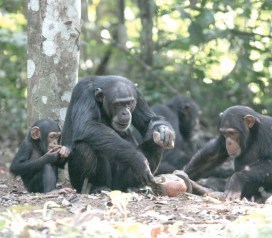
Chimpanzees using both a hammerstone and anvil to crack open nuts. Photo Credit: Haslam et al, 2009.
Transport yourself now to a small forest clearing in western Africa, where a group of our closest living relatives, chimpanzees, are quietly sitting underneath a number of nut- and fruit-bearing trees. This group is taking advantage of these important food sources, and is doing so by using stone anvils and stone hammers not too dissimilar from the group of hominins at Olduvai Gorge, two million years earlier.
A hammerstone used by a capuchin, on display in the Museum
But it is possible to directly observe the chimpanzee behaviour, recording how the tools are being made and used, what waste is being produced, the learning processes going on between infant and adult, and the range of social interactions that are happening. This modern primate behaviour represents a valuable window into the types of activities that some of our earliest hominin ancestors may have also undertaken.
The Stone Age Primates exhibit at the Museum showcases these types of stone tools and how they are used by modern primates. By closely studying how our closest living primate ancestors, including chimpanzees, capuchins and macaques, make, use and discard stone tools it is becoming increasingly possible to better understand the dynamic range of early human behaviours behind similar types of hammers and anvils found at Olduvai Gorge and other East African archaeological sites.
Thanks to the work of our Head of Life Collections Darren Mann, and the Dung Beetle UK Mapping Project team, the conservation status of the UK’s dung beetles, chafers, and stag beetles (Scarabaeoidea) is currently undergoing a comprehensive review.
Contributing to this effort, Jack Davies, one of our summer interns, has been on the trail of a species that has proven to be particularly rare in the UK…
Aphodius lividus
I am on the hunt for Aphodius lividus, a dung beetle with a truly cosmopolitan distribution, being found across most of the globe, but which is rather rare in Britain. Since 1990 it has been recorded at only six sites, though historical accounts suggest it was more common in the past.
Most of these historic records are from the south east of England, particularly Kent and the London area, but there are several geographically isolated records from across England and Wales too. So might A. lividus, whilst being extremely local, actually be widespread across the UK?
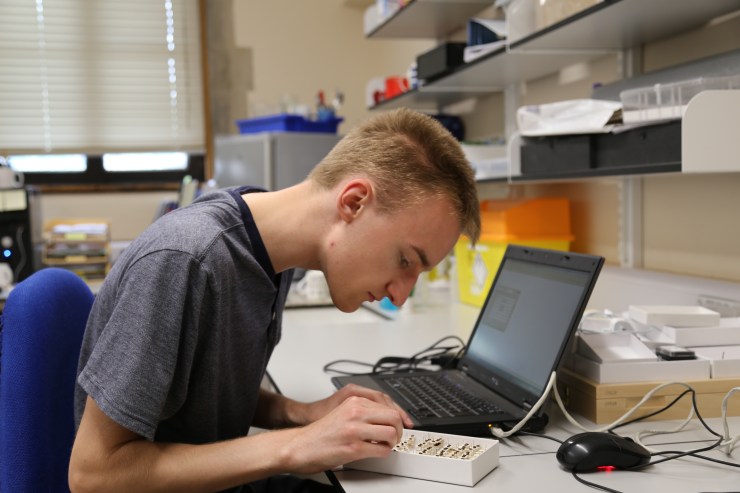
During my time at the Museum I have been contributing to a comprehensive review of this species’ distribution by helping to verify these records. This has involved a thorough search of collections, journals and the Museum archives, a process which revealed that many of the recordings of A. lividus were almost certainly erroneous.
We were able to discount the only two Welsh records, as well as single records from Cheshire, Leicestershire and Lincolnshire. Our reasons for doing so included a lack of supporting evidence, the unreliability of certain collectors, and the confirmed misidentifications of some specimens.
Jack Davies working on a collection of Aphodius lividus
The number of known localities for A. lividus decreased further when we realised that three of the reported sites in Kent most probably all refer to the same location. This is a common problem in this type of research, due to the very broad locality names found on Victorian specimen labels.
So it has become clear that this incredibly scarce beetle is even rarer than we first thought. But it’s not all bad news for A. lividus; our research has uncovered reports from localities in Devon and Northumberland in the old literature, which we found to be trustworthy records.
Map showing the distribution of the dung beetle Aphodius lividus in the UK
All the verified data from the project has been collated to produce this map of the distribution of A. lividus in the UK. Its very local distribution, and the very low number of recent records, confirm that this species should be classified as Vulnerable to Extinction in the UK.
Although it would be a shame to lose this species in Britain, we don’t believe it should be a priority for conservation efforts. Since Aphodius lividus has a strong preference for high temperatures, it’s likely that the UK is simply at the very edge of its range. It is also a very abundant species in many areas around the world, and it contributes little in terms of ecosystem services in Britain compared to many of our other dung beetles.
So conservation should instead aim to preserve the dung beetle ecosystem as whole, which supports a huge number of species and also brings many benefits to agriculture.
Young volunteers Genevieve Kiero Watson and Poppy Stanton tell the tale of the Museum’s resident Wool Carder Bee and their investigative bee work in our Life Collections…
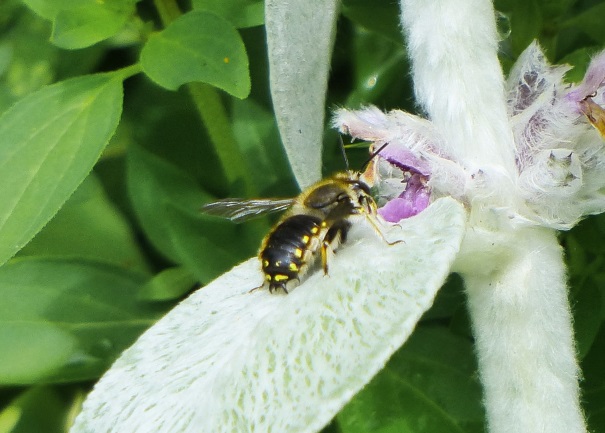
A small guardian patrols its territory among the luscious bed of Lamb’s-ears that grow at the front of the Museum. This feisty critter, the Wool Carder Bee (Anthidium manicatum), is just one of the roughly 270 bee species that buzz around Britain. Having spotted this unusual hovering bee we seized the opportunity to identify, photograph and explore the species a little further.
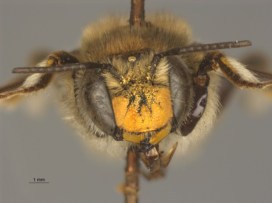
The male of this solitary bee species is fiercely territorial, fighting off other males as well as any other insects it considers to be intruders. Techniques used in combat vary from skilful aerial hovering to ferocious wrestling. But perhaps its greatest weapon is a series of stout spines found at the tip of the abdomen. These are used to bully an intruder into submission, or even to kill it. In so doing, the male protects the precious supply of pollen for the smaller females which in turn collect it on stiff bristles on the undersides of their abdomens.
Females, being slightly less aggressive, are in charge of constructing the nests, which are built in existing cavities such as beetle holes. Hairs shaved off plants, such as the favoured Lamb’s-ear, are used to create the brood cells for the next generation.
Male Wool Carder Bee on Lamb’s ear in the Museum’s front garden
The Museum houses many specimens of the Wool Carder Bee and our job was to pull out the data from each one to help with an ongoing online survey about this species. Although making friends with hundred-year-old bees was enjoyable, trying to comprehend the miniscule handwritten labels accompanying them was altogether more trying.
Every label explains where and when the bee was captured, who collected and identified it, and gives the reference for its current collection. All this on a slip of paper no bigger than half a stamp.
One of the Museum’s Wool Carder Bee specimens, circled, featured in a display of all 270 species of British bee in the Bees (and the odd wasp) in my Bonnet exhibition by artist Kurt Jackson
After recording data from 120 labels we began to find the grid reference of the location each was originally collected. This too was challenging as many place names have changed in the last hundred years. Ultimately, the information will be used by the Bees, Wasps & Ants Recording Society (BWARS) to improve the distribution map for the Wool Carder Bee.
Why not see if you can spot the Wool Carder Bee in your garden? Characteristics to look out for include small spines on the tip of the abdomen and lateral lines of yellow spots on either side of the abdomen. The bees themselves are about 11-13mm long for females, and 14-17mm for males. Good luck!
From the comfort of our own homes, or even on a mobile device, we are accustomed to watching video footage from the most remote environments on Earth, and beyond. It is easy to take for granted this kind of visual access but we don’t have to go too far back in time to reach a point when the uninhabitable parts of the world remained much more mysterious. Then, the only windows into the nature of exotic locations were through drawings, paintings or collected specimens.
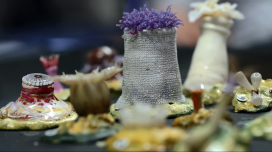
In museums, illustrations of nature were – and are – used in teaching to show what certain animals or environments look like. Along with our biological specimens, the Museum’s collections contain representations of animals whose natural appearance is not preserved after death, including a set of beautiful glassworks of British sea anemones.
These delicate models were created by the Blaschkas, a family which specialised in glasswork and ran a business spanning 300 years and nine generations. But it was only from the late 19th century that Leopold Blaschka, later to be joined by his son Rudolf Blaschka, turned his skills to making models of microscopic organisms and soft-bodied invertebrates for museums and universities.
The only Blaschka models at the Museum today form a series of British anemones, many of which are recognisable as the species and even individual animals illustrated in British Sea-Anemones and Corals published in 1860 by Philip Henry Gosse
Inspired by zoological specimens, scientific papers, and observation of living animals, as well as artworks showing colours and structures that were difficult to preserve or too small to show, the Blaschkas created thousands of glass models before they accepted a contract in 1886 to work exclusively at Harvard University on the Ware Collection of plant models.
Plate from Philip Henry Gosse, 1860. British Sea-Anemones showing many of the species in the Oxford University Museum of Natural History series. Public domain image from the Biodiversity Heritage Library. http://www.biodiversitylibrary.org
It is somewhat surprising that these incredibly fragile specimens made their way to museums and universities across the globe back in the 19th century and even more surprising that any have survived 150 years later.
Anemones tend to lose their shape and colour when preserved in fluid
Earlier this year the Corning Museum of Glass published an interactive map of marine invertebrate models showing the known locations of collections, or records of collections, of Blaschka glass models.
The models at the Museum, acquired in 1867, are thought to be some of the oldest surviving Blaschka glass models. Even though they are over 150 years old, and in some cases slightly inaccurate representations of species, they still show the vibrant colours and alien shapes of British anemones in a way that can’t be seen outside their living environments.
This year the Museum is playing host to three poets in residence as part of ourVisions of Natureyear. The poets,John Barnie,Steven Matthews, and Kelley Swain,have been working alongside staff in our collections and out in the Museum itself to gain inspiration for their writing over the past six months. In the autumn, they will take part in a number of events and activities to present their work, and will be publishing a small anthology at the end of the year.
Here Steven Matthews reveals what has inspired his poems during one of his recent visits to the Museum.
Fossil in the Charles Lyell collection
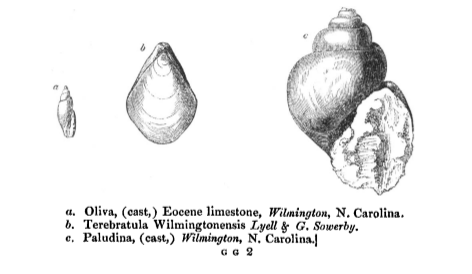
I was struck strongly, during our early visits as poets-in-residence behind the scenes at the Museum, by one particular aspect of the research being undertaken. The history of the Museum collections, their vast reach, is being traced in several instances by the identification of the particular individual specimen which was drawn and lithographed as part of a key scientific paper, in the nineteenth- or twentieth-centuries. Out of the many thousands of specimens held at the Museum, for example, we were shown the exact fossil in the Charles Lyell Collection which had helped, when reproduced in a paper, confirm the geological record of part of the United States.
‘Observations on the White Limestone and other Eocene or Older Tertiary Formations of Virginia, South Carolina and Georgia’ by Charles Lyell, 1845
The history of the Collections, in other words, is the history not just of their remarkable beauty or strangeness, but of their usefulness in advancing scientific thought; just as it is the history of the individual people who have recognised something new to say from the specimens they were studying. There is a firm analogy between this activity and what the making of poems involves. Concise comparison is, after all, what poetry also seeks to attain, bringing the multifariously divergent elements of the world into intense and new combinations with each other.
In preparing to write poems in response to the Museum building and Collections, I have kept that history in mind, researched it. I have read pamphlets by Henry Acland and John Ruskin, Victorians key to the impulse behind the creation of a Museum here to Science, and to defining what the nature of a building on these principles should look like. I have re-read much Victorian and Pre-Raphaelite poetry in order to steep myself in the kinds of language being used to describe Nature by poets at the time the Museum was becoming active. I have read in the work of scientists working at, or associated with, the Museum in its early days and subsequently.
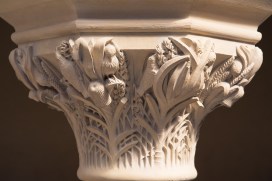
One of the capitals that adorn the Museum court carved by the O’Shea brothers
Out of this reading, but also out of the looking, the many hours spent with the Collections on public display or behind the scenes, have come what is a surprising variety of poems which reflects the wonderful and overwhelming reach of the items at the Museum. I have written about the O’Shea brothers who did much of the amazing carving of column-tops on the Ground Floor; there is a poem on the crystallographer Dorothy Hodgkin, whose lab I was privileged to spend some time alone in.
Nonsense verses have arisen from contemplating the presence of Lewis Carroll here; the astounding collection of multi-coloured marble blocks, the Corsi Collection, has impelled me to create blocks of prose-poetry in their shape. There is a poem ‘voiced’ by an ammonite. The sadness of some specimens, posed in isolation (or in glass jars) far from their original contexts, has moved me; as has the shocked intensified awareness that the history of the Collections is a history of accelerating losses, as more and more of the species gathered in the Museum are extinguished from the world each day.