On the trail of the evolution of mammals
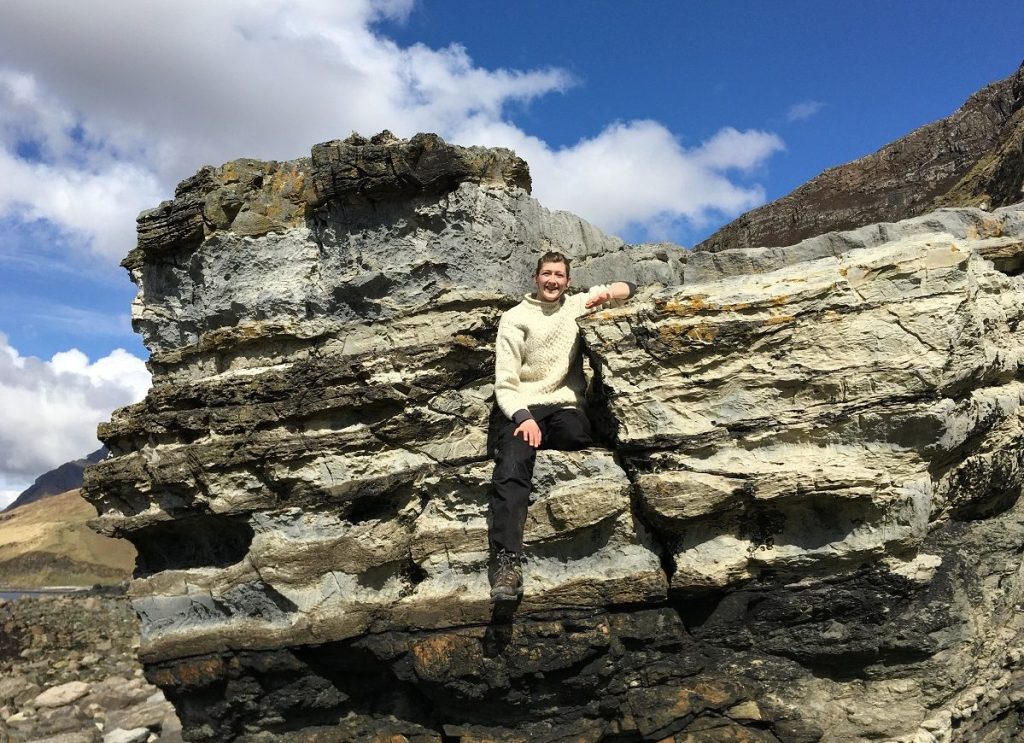
Woman sitting on top of a large, layered rock formation

Elsa Panciroli recently joined the Museum research team as an Early Career Leverhulme Research Fellow. Elsa is a Scottish palaeontologist, whose studies focus on the early evolutionary origins of mammals, working extensively on fossils from the Isle of Skye. Here she tells us how her work will combine studies of mammal evolution with stunning new fossil finds from Scotland.

We are mammals. This means we share a common ancestor with creatures as different as hippos, opossums and platypuses. All of us are united in one taxonomic group by a suite of characteristics in our bodies, but principally, that we feed our young on milk. Every mammal from a baboon to a blue whale produces milk for their offspring, and this makes us unique among animals alive on Earth today.
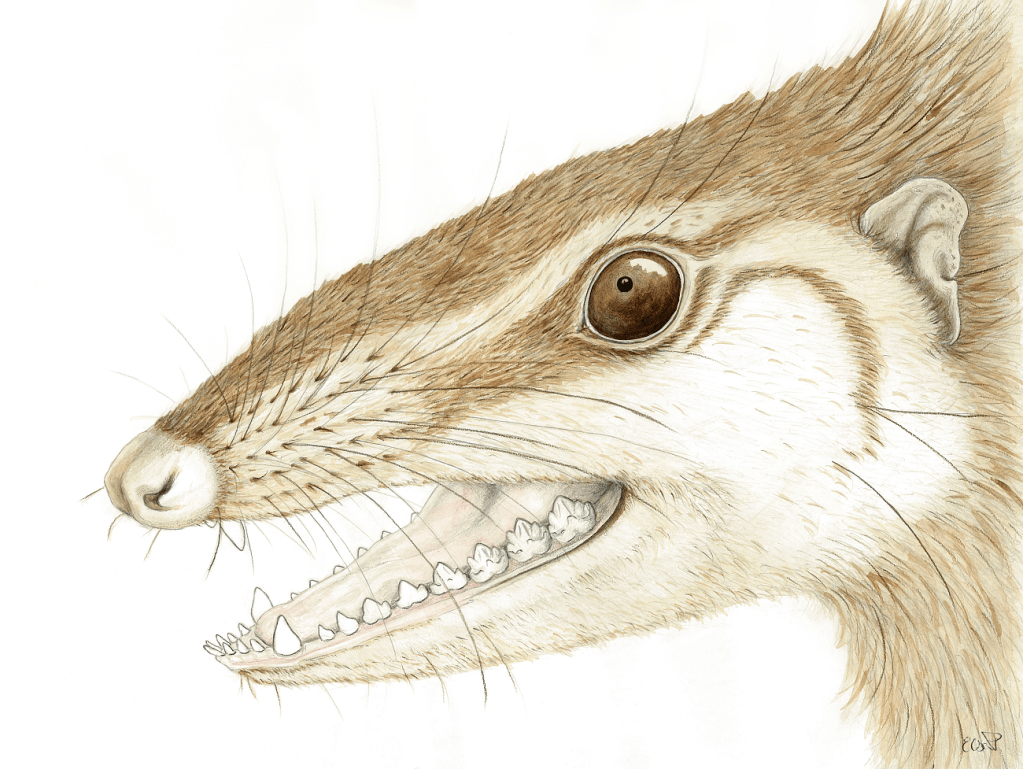
Wareolestes rex is a Middle Jurassic mammal, illustrated here by Elsa Panciroli

But not all mammals bring their young up in the same way; raising a kitten is nothing like raising a kangaroo or a platypus. Kittens are born stumbling around with their eyes closed, while platypus babies are laid in eggs – yes eggs – and when they hatch they look like little scampi. Both are underdeveloped at birth or hatching, but that’s nothing compared to kangaroos. They leave the womb only millimetres in length, and wriggle their way like living jellybeans toward a teat in the marsupial pouch, where they latch on. Only after two months of milk-drinking are they able to hop for themselves and leave the pouch.

The different ways that mammals are born and grow is a huge area of scientific research. But there are still some major questions to answer about the evolution of these growth patterns. When did the ancestors of mammals stop laying eggs? Were they born defenceless, or able to fend for themselves? How quickly did they grow up and how long did they live?
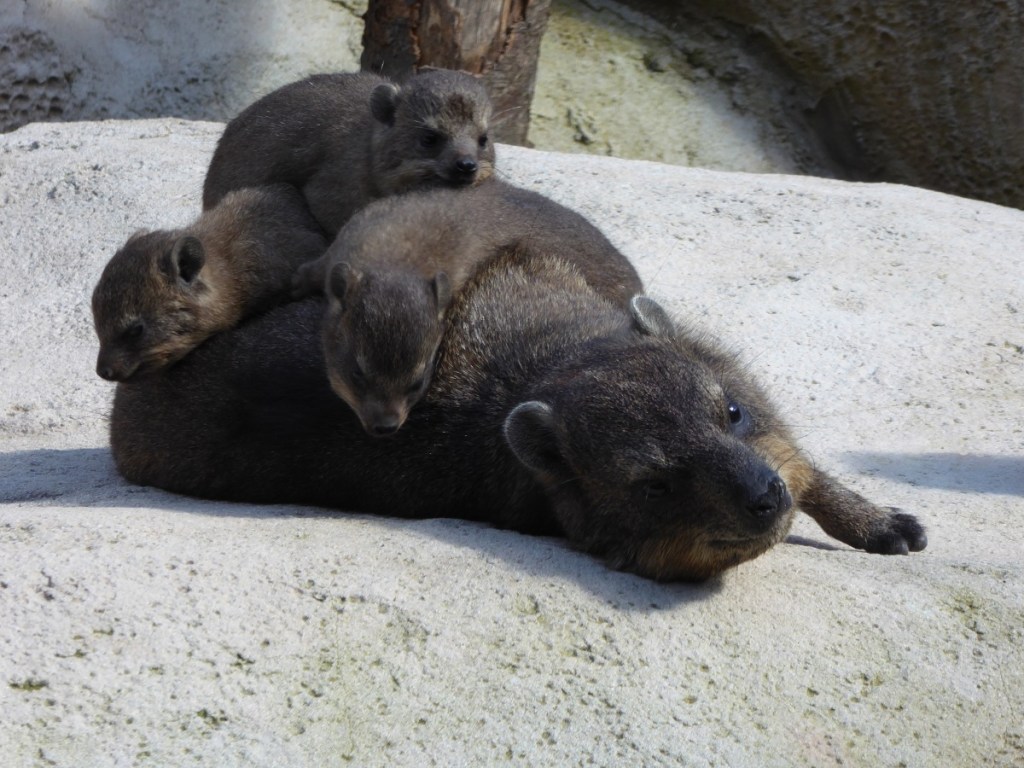
The Rock Hyrax (Procavia capensis) is a terrestrial mammal native to Africa and the Middle East

Over the next three years at the Museum, I’ll be looking for evidence in the fossil record to help us try and answer some of these questions. I’ll study living mammals to understand how they are born and grow, combining this information with data from some of the amazing fossils being found on the Isle of Skye. With collaborators in South Africa I’ll try and work out how the ancestors of mammals developed, and what this means for the bigger picture of the origin of mammals as a group.

Alongside my main research I hope to share lots of stories about our fossil past through the museum’s fantastic public engagement programme. I’m also very active on social media, and I write about science for online and in print publications. So if you see me on your next visit to the building, or find me online, feel free to ask about my research! I look forward to seeing you, and sharing more about the elusive and exciting origins of mammals – and ourselves.

Follow Elsa on Twitter at twitter.com/gssciencelady.

High-tech insect origami

By Dr Ricardo Pérez-de la Fuente, Research Fellow

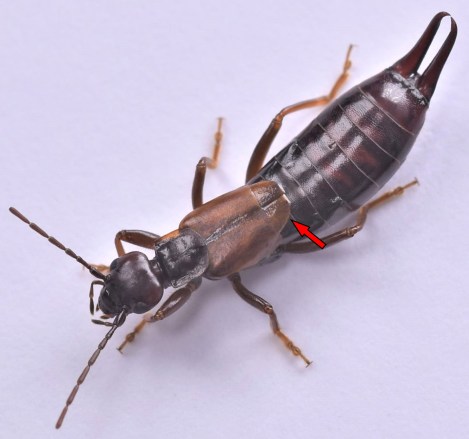
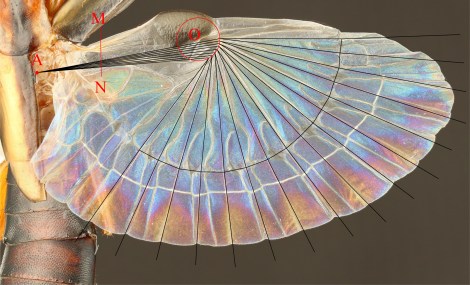
Earwigs are fascinating creatures. Belonging to the order Dermaptera, these insects can be easily recognised by their rear pincers, which are used for hunting, defence, or mating. But perhaps the most striking feature of earwigs is usually hidden – most can fly with wings that are folded to become 15 times smaller than their original surface area, and tucked away under small leathery forewings.

With protected wings and fully mobile abdomens, these insects can wriggle into the soil and other narrow spaces while maintaining the ability to fly. This is a combination very few insects achieve.

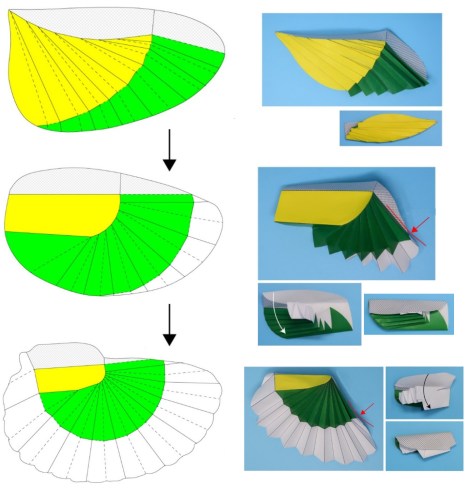
I have been working on research led by Dr Kazuya Saito from Kyushu University in Japan, which presents a geometrical method to design earwig wing-inspired fans. These fans could be used in many practical applications, from daily use articles such as fans or umbrellas, to mechanical engineering or aerospace structures such as drone wings, antennae reflectors or energy-absorbing panels!

Dr Saito came to Oxford last year for a six-month research stay at Prof Zhong You’s lab, in the Department of Engineering Science at the University of Oxford. He introduced me to biomimetics, an ever-growing field aiming to replicate nature for a wide range of applications.

Biological structures have been optimised by the pressures of natural selection over tens of millions of years, so there is much to learn from them. Dr Saito had previously worked on the wing folding of beetles, but now he wanted to tackle the insect group that folds its wings most compactly – the earwigs.

He was developing a design method and an associated software to re-create and customise the wing folding of the earwig hind wing, in order to use it in highly compact structures which can be efficiently transported and deployed. Earwigs were required!

Here at the Museum we provided access to our insect collections, including earwig specimens from different species having their hind wings pinned unfolded. These were useful to inform the geometrical method that Saito had been devising.

Dr Saito was also interested in learning about the evolution of earwigs and finding out when in deep time their characteristic crease pattern established. Some fossils of Jurassic earwigs show hints of possessing the same wing structure and folding pattern of their relatives today.

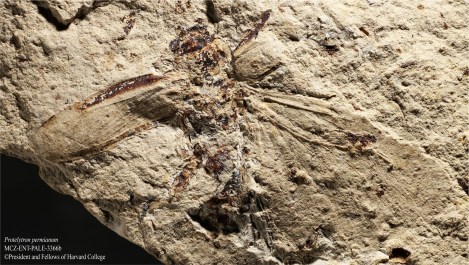
However, distant earwig relatives that lived about 280 million years ago during the Permian, the protelytropterans, possessed a different – yet related – wing shape and folding pattern. That provided the chance to test the potential and reliability of Saito’s geometrical method, as all earwigs have very similar wings due to their specialised function.

The geometrical method turned out to be successful at reconstructing the wing folding pattern of protelytropterans as well, revealing that both this extinct group and today’s earwigs have been constrained during evolution by the same geometrical rules that underpin the new geometrical design method devised by Dr Saito. In other words, the fossils were able to inform state-of-the-art applications: palaeontology is not only the science of the past, but can also be a science of the future!

We were also able to hypothesise intermediate extinct forms – somewhere between protelytropterans and living earwigs – assuming that earwigs evolved from a form closely resembling the protelytropterans.

As a collaboration between engineers and palaeobiologists, this research is a great example of the benefits of a multidisciplinary approach in science and technology. It also demonstrates how even a minute portion of the wealth of data held in natural history collections can be used for cutting-edge research, and why it is so important to keep preserving it for future generations.

Soon these earwig-inspired deployable structures might be inside your backpacks or used in satellites orbiting around the Earth. Nature continues to be our greatest source of inspiration.

Original paper:  Saito et al. (2020). Earwig fan designing: biomimetic and evolutionary biology applications. Proceedings of the National Academy of Sciences of the United States of America.

Stop, look, listen

By Sarah Lloyd, Head of Education, and William Sharpley, Youth Forum member

Connecting with the natural world around us is important for many reasons. It’s proven to help our mental health, it’s enjoyable and fascinating, and it gives us an insight into the rhythms and changes of the life that surrounds us. And during the pandemic lockdown this has taken on more significance than ever.

Over the past few months we have been keeping in touch with the Museum’s youth groups as part of our HOPE for the Future project, which is supported by the National Lottery Heritage Fund. The project is themed around the Museum’s British insect collection and our discussions with the youth groups have triggered a particular interest in the diversity of insects in our outdoor spaces.

Common Cardinal Beetle (Pyrochroa serraticornis). These beetles are often found basking in the sun on leaves and flowers in woodland margins. Image: William Sharpley.

A great way to become more observant about the world around you is through photography. During a recent lockdown walk, Youth Forum member William Sharpley took out his camera and captured the beautiful images of insects you can see in this post. Looking at insects more closely made William curious about what he could find in his garden, where he noticed a colony of bees active around a compost bin.

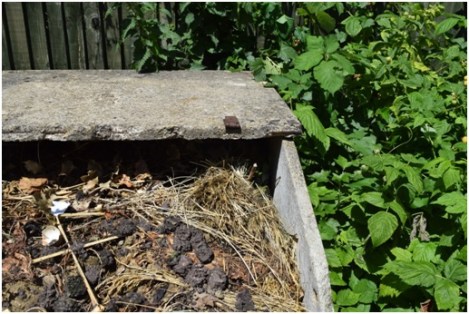
The compost bin is in an old coal bunker. It gets very hot in the sunny weather. I have watched the bees going in and going out of here.

The compost bin in an old coal bunker provides a good habitat for a colony of Tree Bumblebees (Bombus hypnorum). Image: William Sharpley.

Noticing what animals are present, and learning to identify them, helps to build a picture of how the natural world may be changing.

Bees are a good case study. The image below is of a Tree Bumblebee (Bombus hypnorum). Tree Bumblebees were first recorded in the UK in 2001, and since 2007 they have thrived in our increasing urban environments, with numbers and range rising dramatically. They are now a common sight in gardens, establishing colonies in enclosed spaces above ground. William’s old coal bunker compost heap is the perfect spot.

Tree Bumblebees (Bombus hypnorum) like this one have increase in numbers and range dramatically in the UK over the past couple of decades. Image: William Sharpley.

By noticing new species around us we are reminded that populations of living things change over time. Some species, like the Tree Bumblebee, have become more common, while others, such as the Great Yellow Bumblebee (Bombus distinguendus), are now much rarer than they once were.

Great yellow bumble bee (Bombus distinguendus). Image by Nick Owens.

Once we know what is around us we can turn our attention to patterns of behaviour. William went on to use his science skills to plan an investigation.

I will be trying to find out if bees are more active during the morning or in the afternoon. I will count the bees going in and out of the nest at different times during the day.

The Youth Forum conducted a similar study earlier in the spring, observing when female Hairy-footed Flower Bees and Honeybees were active and feeding on garden plants. They found that the Hairy-footed Flower Bees foraged mostly in the morning, and the Honeybees in the afternoon.

Feeding behaviour in bees is an interesting thing to study because it may be affected by some pesticides called neonicotinoids. Honeybees exposed to low levels of these pesticides spend less time feeding, and over a long period their reduced food intake causes a hive of bees to decline and become more susceptible to other pressures, such as disease, habitat destruction, or extreme weather.

Rather than relying on a handful of chemicals like neonicotinoids, farmers are now encouraged to use a range of methods to control pests. These include using natural predators – known as biological control – and organic methods.

From these relatively simple observations of the natural world we can gain important information about changing environments. And by sharing what we notice, and encouraging others to do the same, we are better able to understand environmental changes and we’ll feel more connected to nature as a bonus. So head out and start looking!

The Museum’s Youth Forum was established to connect with and learn from local young people. The group meet every month to take part in a programme of activities designed for and by the group.

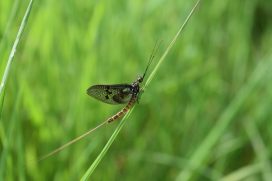
Top image: Common mayfly (Ephemera Danica) by William Sharpley.

Eggs in the tower

By Chris Jarvis, Education Officer

We have our first eggs! After an earlier than usual return from the warmth of Africa, followed by a cold snap of north easterly winds, our swifts have begun to lay their first clutches of eggs in the tower.

Ten eggs were counted on 14 May, some in pairs and some lying singly on nests. Birds in other nests appear to be incubating as well, sitting in pairs and screaming out at any newcomers investigating possible nesting sites.

More swifts are arriving daily and screaming parties are urgently exploring for potential nesting locations. They buzz the tower’s nesting holes at speed and bang on the entrances with their wings like naughty teenagers playing a vociferous game of ‘knock and run’!

Typically, no bird has yet elected to nest in either of the boxes fitted with webcams. But as the weather warms and more swifts take up residence every day, we’re sure you’ll be able to follow all the drama of the Swifts in the tower very soon.

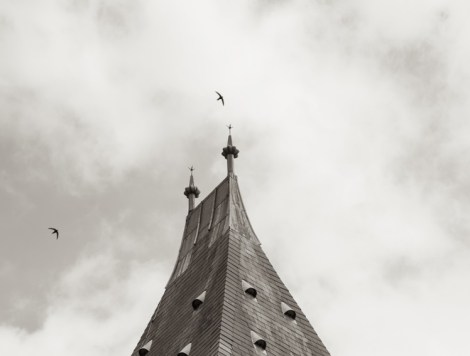
The swifts circle the Museum tower looking for suitable nesting sites

The delicate art of laying
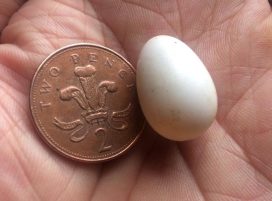
Swifts tend to lay their eggs in the mornings, usually between 8am and 11am. The small, fragile eggs are white to reflect light, an adaptation shared by most cavity-nesting birds that makes the eggs more visible to adults in the dark of the nest.

The first eggs this year appear to be quite early in the season compared with the observations by David Lack in the 1940s and 50s. At that time, when the study of the Museum’s colony began, the first eggs were recorded on average between 17 and 22 May, but sometimes none was laid until the first week of June.

Egg production and laying in swifts are very closely tied to the weather, and production seems to be triggered by the availability of food. Swifts feed exclusively on small airborne insects, which are more abundant in the warm thermals and light winds we experience on good summer days.

It takes a swift five days to produce and then lay an egg. Five days before our first eggs were laid it was sunny and warm, just before the strong, cold north easterly winds swept down over the weekend and lowered the temperature. The warmer early start to the summer seems to have triggered this early laying; whether this is a trend that is increasing as the climate changes is something we should able to answer with long-term datasets provided by studies like this.

Dealing with the weather
Whatever climate change has in store for us it is becoming clear that we won’t experience repeated hot summers. The unpredictability of the British summer reigns supreme.

Swifts have evolved several wonderful adaptations to deal with the vagaries of our weather. Their eggs can be left without an adult to keep them warm for several days. There are records of eggs being left unattended for almost a week and still developing normally. Although adults usually take it in turns to feed and brood the eggs, sometimes during the day the eggs are left unattended by both birds which are then able to forage far afield for food.

Unlike many songbirds which produce one egg a day until their clutch is completed, swifts are able to space out their laying. In a clutch of two or three eggs, the second or third may be laid two or three days after the first, depending on weather conditions. The birds will also limit the size of clutches, with clutches of three eggs the average in warm weather and two eggs the average in cold weather. This helps the adults to supply all of their young with enough food.

Finally, swifts may also eject eggs and lay a second clutch. Some studies have linked this behaviour to cold weather but this has not always been the case at the Museum colony and is a further line of investigation in the ongoing studies of these most secretive of birds.

From laying to hatching usually takes about 19 days, depending on the weather. So we should be seeing our first chicks at the very beginning of June, hopefully streaming live on the Swiftcam…

*

Screaming parties prospecting for nest sites are a good way for you to see if you have nesting swifts nearby. Any records really help with our understanding of the current population in the UK. You can help conservation and recording for the Oxford Swift City project, or use the RSPB’s Swift Mapper for the rest of the UK.

Through the looking glass

With our Life, As We Know It redisplay project now underway, our Senior Archives and Library Assistant Danielle Czerkaszyn takes a behind-the-scenes look at how we captured the contents of the current displays for the Museum’s archive.

The archive here holds a unique collection of natural history books, journals and documents covering a wide range of subjects related to the Museum’s collections and research. It also contains papers and objects on the history of the building, providing an institutional memory of Oxford’s ‘University Museum’ since its foundation in 1860.

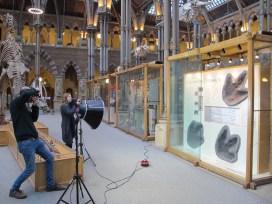
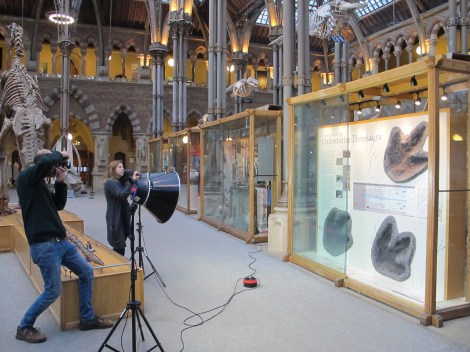
From an archive perspective it was really important to document the current layout of the cases, their specimens and text before they were removed from the court to make way for the new showcases in the first phase of our redisplay work.

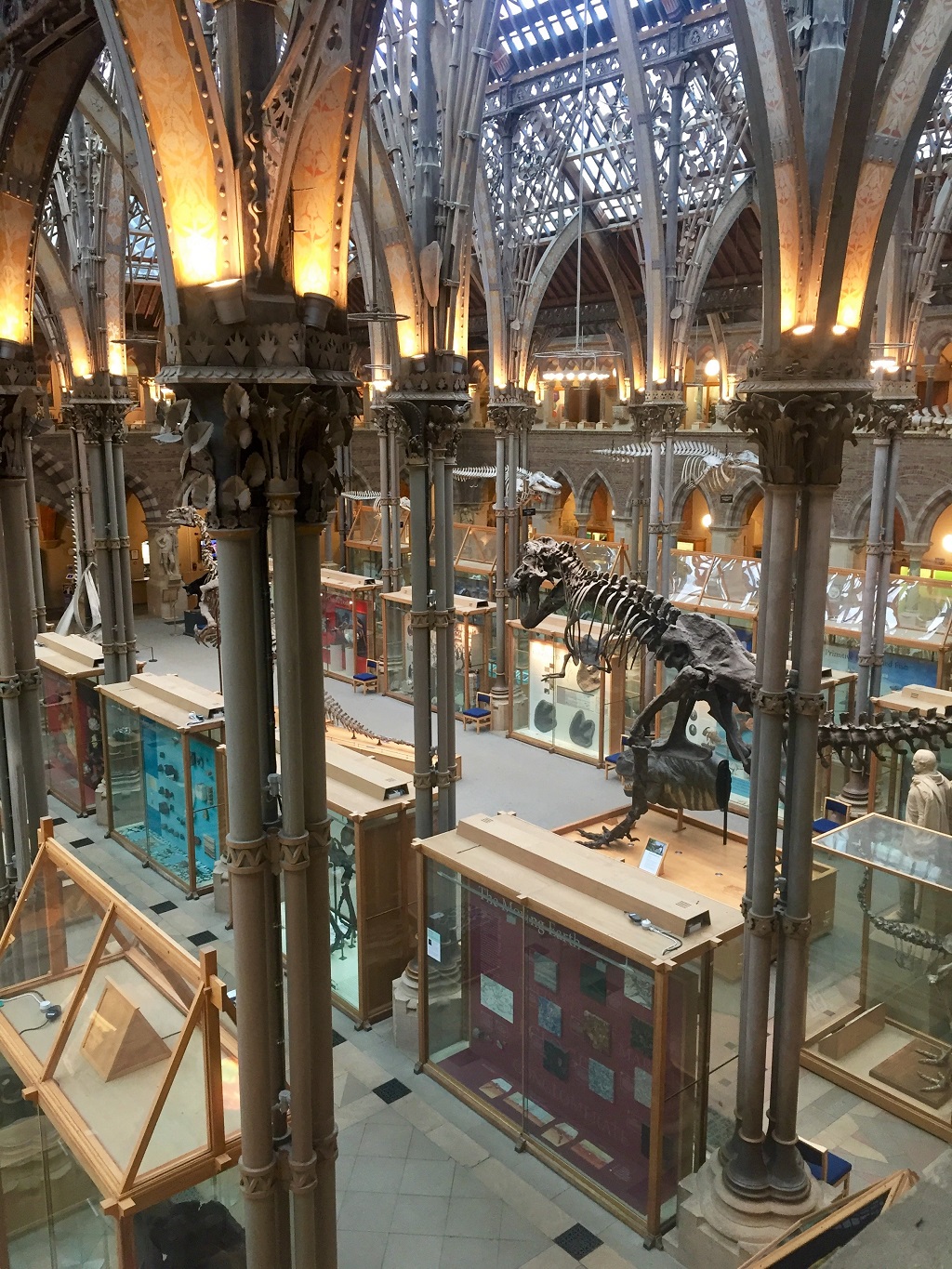
The museum in late 2019

The displays as we know them – with exhibitions on the Oxfordshire dinosaurs, Alice in Wonderland, the Oxford Dodo, and more – were last changed in 2000. For the last 20 years visitors to the Museum would remember their first time being wowed by the Megalosaurus jaw – the world’s first scientifically-described dinosaur – or charmed by the Dodo made famous in Lewis Carroll’s Alice Adventures in Wonderland.

Although after 20 years it is time for a change, the stories and information in the displays are too good to be forgotten. So before anything was removed we began to build the archive for the future.

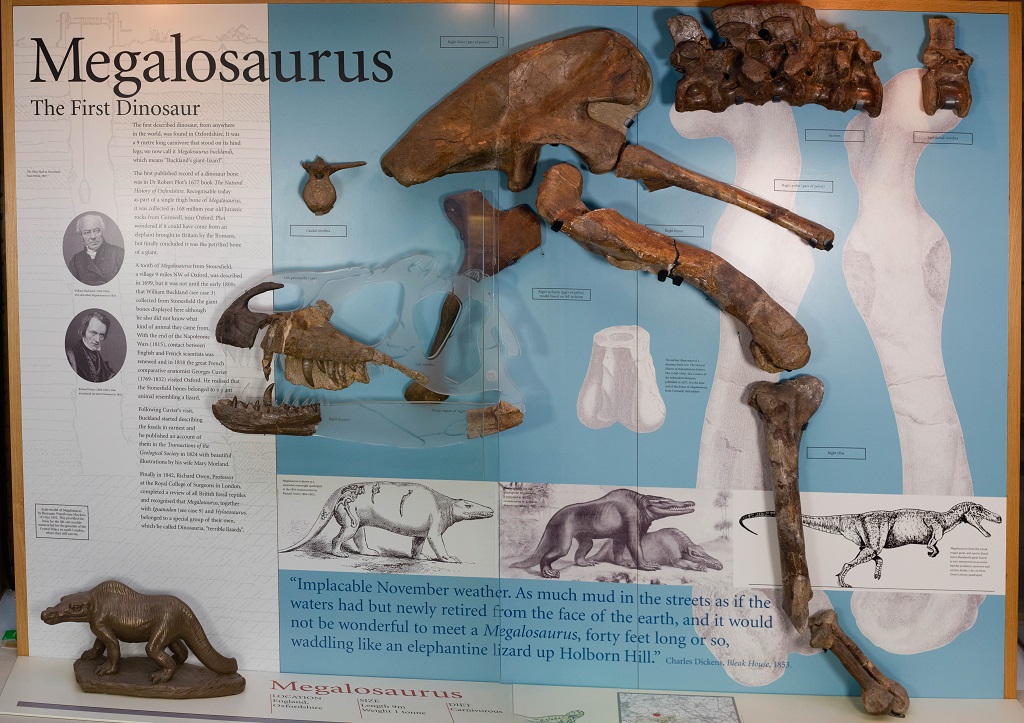
A display of the fossilised remains of Megalosaurus
The previous display on Megalosaurus: The First Dinosaur

The best way to capture all the information of the displays was through high resolution photography, but this was not as straightforward as we hoped.

The first two obstacles to good photographs are pretty obvious to anyone looking at the cases: glass causes huge amounts of glare; and each case has a big dividing line down the centre where the two sliding glass doors meet, cutting what should be a lovely seamless image into two halves.

To avoid glare and the solve the problem of the dividing line, our photographer Scott opened each individual side of the case, photographed two or three images of the display, and then stitched the separate photos together using Photoshop.

Each case was photographed in two or three segments

The segments were then stitched back together and adjusted for exposure and colour balance to create the final image

Another obstacle to taking good photographs of the displays came from the Museum itself. Some of our larger display furniture, such as the glass case for the Atlantic Bluefin Tuna or the huge T. rex plinth – got in the way of a nice straight shot. Because these items are so large and heavy they were impossible to move, so we had to improvise and do our best.

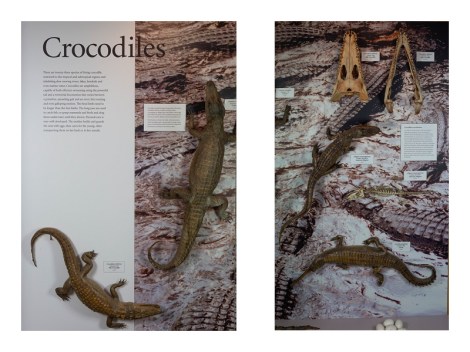
Capturing the displays before the current cases were removed allowed us to keep an archival record of their contents

Thankfully, we managed to get shots of all 24 displays before they were removed and so a record of each case now rests with the Museum’s archive. If anyone wants to know what the display cases in the court looked like from 2000 to 2020, they will now be able to look back at the images in the archive and recall the magic of the Oxford Dodo exhibit that perhaps first made them fall in love with the Museum.

Our new displays are now in development, and will include some beautiful presentations of the diversity of life, looking at the importance and fragility of biodiversity and human impact on the environment. These new exhibits will show how the biological processes of evolution combine with the geological processes of our dynamic Earth to give rise to the immense, interconnected variety of the natural world.

We look forward to telling you more about that here as the project progresses.

The Life, As We Know It redisplay project is supported by a generous grant from FCC Communities Foundation.

That’s Amore

By Laura Ashby and Megan MacLean, events managers

From cockroaches hissing alluringly to their mate, to smooth newts wafting intoxicating pheromones, and butterflies with eyes in their genitalia, the amorous pursuits of the natural world are enough to make St Valentine blush.

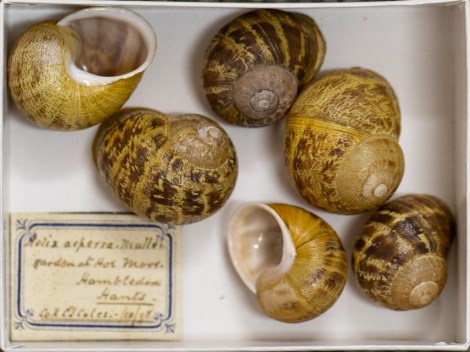
Valentine’s Day may conjure images of Cupid and his arrows, and indeed the romantic cherub of mythology has a brutal counterpart in nature. When the hermaphrodite Garden Snail (Helix aspersa) snuggles up to mate, both partners try to stab each other with love-darts in a mating duel. These darts are coated in chemicals that increase the chances of the dart-receiver’s eggs being fertilised. Love is a dangerous game: sometimes a dart misfires and hits a vital organ – a dart to the heart.

The hermaphrodite Garden Snail (Helix aspersa) fires love-darts as part of its mating ritual

Traditionally given as wedding presents in Japan, the lacy white deep-ocean glass sponge Euplectella, known as Venus’ flower basket, offers an interesting take on “…’til death do us part”. When a young shrimp pair enters the sponge to mate, they become trapped inside as they grow too large to escape. The couple then spend the rest of their lives together, caged in the sponge, whilst their offspring are small enough to leave through the small gaps and seek sponge-mates of their own.

The glass sponge Euplectella spp., also known as Venus’ flower basket

And if you forgot all about Valentine’s Day you will no doubt be panic-buying a bunch of overpriced roses on the way home, but be heartened that humans are not the only creatures that try to attract mates by presenting each other with gifts. The male Bowerbird builds a bower to attract females, decorating it with brightly coloured embellishments including flowers, leaves, stones, and even bits of plastic.

Objects from a Spotter Bowerbird bower, showing an interesting preference for white and green material

Meanwhile, male Empids (dance flies) offer a high-protein ‘nuptial gift’ – a gloopy sac called a spermatophore – for the female to eat during copulation. One theory is that females use the size of the gift as a way of choosing their mates…

Moving on from the natural world to natural historians, in 1835, Frederick William Hope married the wealthy heiress Ellen Meredith. He donated one of the founding collections to the Museum that they subsequently worked on together, the inspiration behind our current HOPE for the Future project. Meredith had recently rejected a marriage proposal from the future Prime Minister Benjamin Disraeli, stating that:

a life as the wife of a politician would have been a very dull one indeed

We at the Museum completely understand that weekends rootling around in dung for beetles with her entomologist husband seemed more appealing than stiff diplomatic receptions at Number 10.

Ellen Meredith and Frederick William Hope married in 1835

Fast forward to the modern day, and romance is in the air at the Museum, as many couples celebrate their marriages here each year. Every wedding has a different flavour, depending on the interests of the bride and groom, but natural history puns are guaranteed during the speeches, and dancing amongst the dinosaurs is a must!

A wedding in the Museum is surely the best start to a marriage

It may seem like a strange idea to tie the knot in a Museum, but perhaps 60-odd years of marriage seems comfortingly short in the context of 4.5 billion years of geological time?

If you are interested in talking with our events team about celebrating your wedding at the Museum of Natural History, contact Laura and Megan at venue@oum.ox.ac.uk / 01865 282780.

HOPE for the Future is supported by the National Lottery Heritage Fund. Find out more and get involved: https://www.oumnh.ox.ac.uk/hope-future

Top image: Gold-fronted Bowerbird, once thought to be extinct, but rediscovered in the Foja Mountains of Indonesia, painted by activist artist Jane Mutiny for the Conservation Optimism film festival at the Museum in 2019.