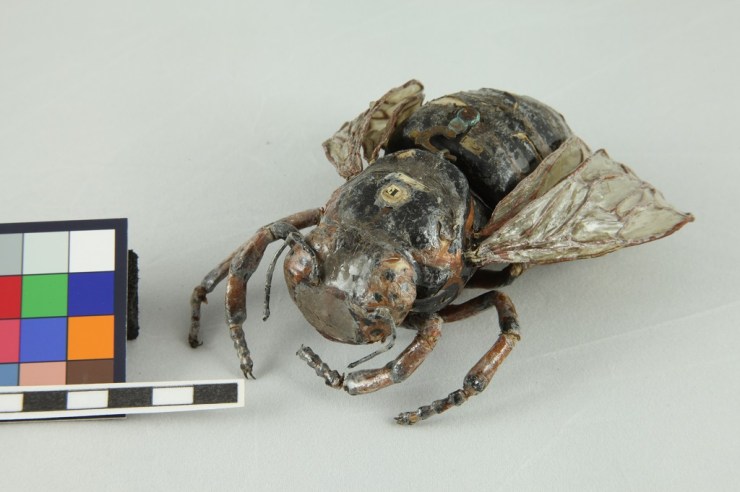
Bee beautiful

Our conservator Bethany Palumbo tells us how she restored a beautiful 19th-century papier-mâché model of a honeybee hive, created by master model-maker and anatomist Louis Thomas Jérôme Auzoux

Louis Thomas Jérôme Auzoux

Although the Museum’s collections are mostly of organic specimens, we also hold a fascinating collection of scientific models made to represent the natural world, made from all types of materials, from wax and cardboard to plaster and paint.

We are lucky enough to own a model made by esteemed French anatomist Louis Auzoux (1797-1880), who in the late 19th century developed a method of building strong yet light papier-mâché models that could be taken apart and rebuilt, allowing internal elements such as tissues and organs to be studied in detail.

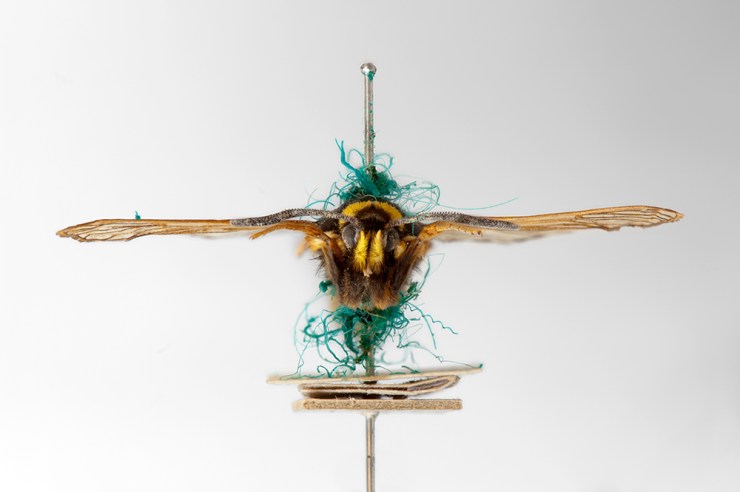
Model of a honeybee hive in box with six bees, by Louis Auzoux

While Auzoux made many models demonstrating human anatomy, he later expanded his business to include magnified models of plants and insects. The model we have is of a honeybee hive, containing six beautiful bees.

The hive, painted with a protein-based paint and varnished with gelatine, is large enough to allow the viewer to see the fine details of the hive, including individual chambers containing tiny larvae.

As you can see in the image at the top of the article, the bees themselves are also intricately painted, with rabbit hair used to simulate their natural fuzz, and delicate wings constructed from metal wire.

While there was much to admire about this model, it was in received in poor condition. Previous restoration attempts had introduced many materials that were now failing. There were fills, constructed of paper, applied to areas in an attempt to hide cracks in the original model. These were covered in oil paint, which was dripping over the original paintwork and had become brittle and discoloured.

Oil paint layers were peeling from the model

The whole hive was coated in a layer of cellulose nitrate film, a popular coating in the mid-20th century which was used as protection and to create a gloss finish. This coating doesn’t age well, resulting in peeling. It had also been applied to the bees themselves, clumping together the bee ‘fuzz’ and disguising the paintwork underneath.

The priority for treatment was to return the model to its original form while stabilising it for the future.

I undertook treatment in several stages over the course of six months. First, the cellulose nitrate film was removed from all areas using acetone, which could be applied with a cotton bud and fortunately didn’t affect the paint layer beneath.
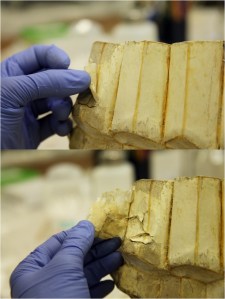
Fill material used to cover previous damage had become discoloured

The next stage was to remove the discoloured oil paint from the hive. This was done manually using metal and wooden tools lubricated with white spirit, which were used to gently scrape the surface under magnification. This revealed old fills on the hive, made from a combination of plastic tape, paper and old adhesives which also needed to be removed. They were easily softened with water and gently peeled away.

Once all unstable introduced materials were removed, work began to stabilise the original model. The bees were suffering from paint cracking and peeling, as seen in the magnified photograph below.

Peeling paint at 6x magnification

We decided to consolidate this using gelatine as it would be in keeping with the original construction and could easily be reversed if necessary. Gelatine was mixed in water and warmed to make it a thin consistency, and then applied with a paintbrush. Once the paint flakes had softened they could be gently pressed down. Gelatine was also used with acid-free tissue to stabilise the cracks and areas of surface loss on the hive.

With the hive and bees now clean and stable, the quality of this piece and its incredible paintwork can really be admired. We hope to put it on display soon for all our visitors to enjoy!

Crafty camouflage

Last week we brought you snails that attach all manner of pebbles, fossils, corals and shark teeth to their shells. Today we give you a newly-discovered fossil green lacewing larva that attached pieces of soil to its body as an act of camouflage. Our research fellow Ricardo Pérez-de la Fuente, lead author of the new paper, explains…

Visual camouflage is one of the most successful survival strategies in nature. Camouflaging is usually defensive, allowing animals to be left unnoticed by their predators, but it can also be used aggressively by predators themselves to approach their prey undetected.

Some camouflaging animals can actively change their colouring to match that of the background ‒ a technique called crypsis. Others can make their bodies resemble elements of the environment, such as leaves or twigs, which is called mimicry.

Italochrysa italica, an extant green lacewing larva carrying a dense debris packet made of soil fragments. Taken from the open access publication Tauber & Winterton, 2014.

Yet another approach to camouflage involves collecting diverse materials from the environment and incorporating them on the animals’ bodies in order to better blend with the surroundings. This is known as debris-carrying, trash-carrying, or decoration, and it can be found across a wide variety of animals including sea urchins, gastropods, and arthropods, such as decorating crabs, or sand- and mud-covering spiders.

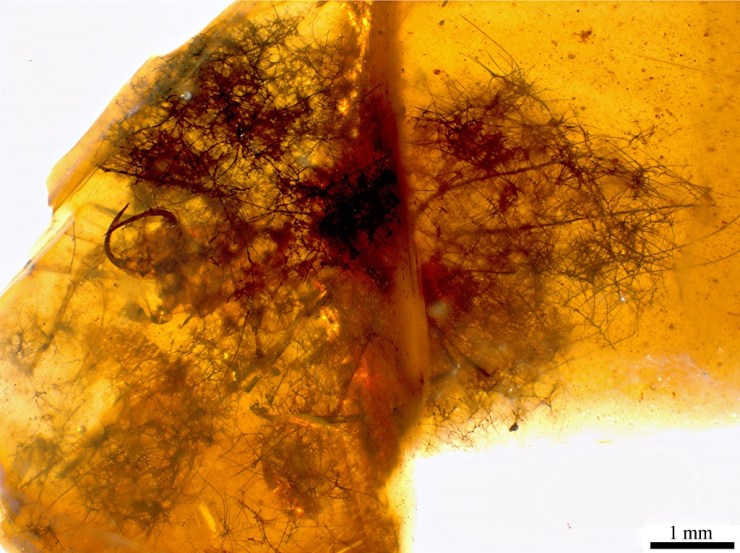
My colleagues and I have just published the discovery of a fossil green lacewing larva, pictured at the top of the article, that has been preserved carrying bits of soil that it used for camouflage and physical protection. It’s a new larval species just 1.5 mm in length, and is preserved in Early Cretaceous Lebanese amber. We have named it Tyruschrysa melqart after the Phoenician city of Tyre and its tutelary god Milk-Qart (if you want to learn the reasons behind this name check out our open access paper!).

Interpretative drawing of Tyruschrysa melqart: body in grey, ‘tubes’ with setae coloured according to which body part they are attached to, and soil debris in brown.

Green lacewing larvae are active predators that eat other insects such as aphids, using sickle-shaped ‘jaws’ to pierce their prey, suck out their fluids and liquefy their tissues; eating is easier when there is no need to chew! Some green lacewing larvae are debris carriers, entangling all kinds of debris among their velcro-like ‘hairs’ called setae, which extend from relatively short ‘bumps’ on their backs. This debris is carefully selected and gathered with meticulous head and body movements to form a so-called debris packet on the back of the insect.

‘Tubes’ bearing setae of Tyruschrysa melqart, with detail of their mushroom-shaped endings (bottom), used for anchoring bits of soil.

The new fossil and similar ones described from younger Cretaceous ambers differ from modern relatives because instead of short ‘bumps’ with setae on their backs they have relatively long ‘tubes’, giving them a bizarre appearance.

These tubes have setae with mushroom-shaped endings of a kind never seen before in extinct or living green lacewing larva species. The mushroom-shaped ending is a special adaptation to anchor debris, which in the case of Tyruschrysa melqart are fragments of soil.

Hallucinochrysa diogenesi, another Cretaceous green lacewing larva bearing long ‘tubes’ with setae on its back, but carrying a debris packet made of plant hairs (trichomes). Preserved in Spanish amber (105 million years old).

It was already known that Cretaceous green lacewing larvae like Tyruschrysa had long tubes on their backs and that they collected plant hairs and other plant material to construct their packet of debris. But thanks to the new discovery we now know that these immature insects also used bits of soil, and that in the deep past debris packets were probably as diverse as those we see today.

Green lacewing larvae have been gathering debris to camouflage and protect themselves for about 130 million years, giving rise to the different body adaptations we see amongst these fascinating tiny collectors.

‘A soil-carrying lacewing larva in Early Cretaceous Lebanese amber’ Ricardo Pérez-de la Fuente, Enrique Peñalver, Dany Azar and Michael S. Engel is published as open access in Scientific Reports this month.

Nature’s collectors

by Mark Carnall, Collections Manager in the Life Collections

When giving tours of the invertebrate collections at the Museum, I don’t have much time to cover the considerable diversity of invertebrate animals. When it comes to molluscs (the group including snails, bivalves, squid, octopuses, chitons etc.), which perhaps most people aren’t too excited about, I try to inspire, enthuse and engage with this diverse group by pulling out some of the more weird and wonderful species from the group.

Xenophorids, or Carrier Shells, are up there on the list of weird and wonderful molluscs. Xenophoridae is a small family of around 30 species of marine snails that live on sandy and muddy sea floors in subtropical and tropical seas. So far so snail.

What makes them interesting is that these animals attach objects they encounter to the outside of their shells. The scientific and common name of the group is derived from this behaviour xenos and phoros from Greek translates to “foreign carriers” or “carrier shells”.

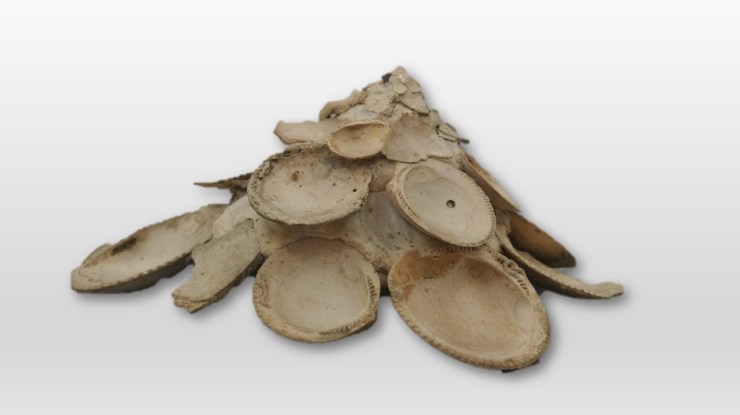
This Xenophora pallidula shows a preference for bivalve shells which extend significantly beyond the edges of its shell.
OUMNH.ZC.M3593
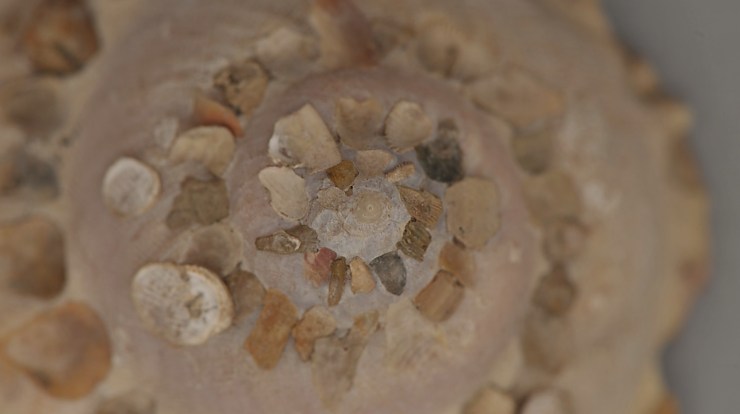
Xenophora mekranensis konoi. Top down view of shell, showing bivalve shells and coral fragments attached.
OUMNH.ZC.M3617

Carriers have been found with shells, shell fragments, pebbles, fossils, corals and even shark teeth attached. Predictably human detritus such as coins, bottlecaps and glass and metal fragments have also been found. In this way, they are one of nature’s collectors. Shells preserved in museum collections give us some direct evidence of habitats, environments and preferences of different individuals and species, from the objects affixed to them.

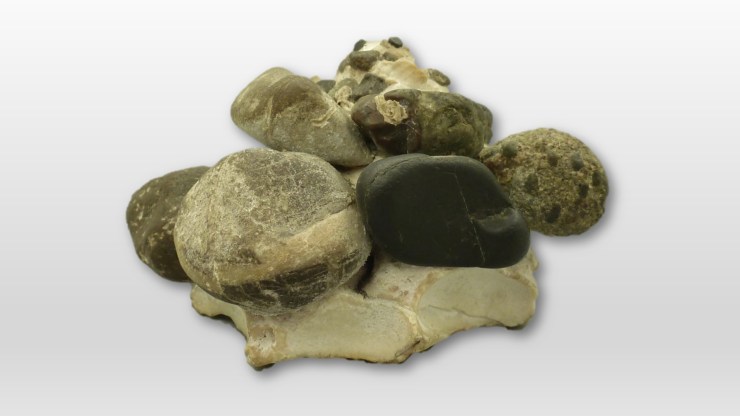
Xenophora cerea going for the rock golem look. The thick cement and attachment site for pebbles which have come off this specimen can be seen at the bottom.
OUMNH.ZC.M3614

The mechanisms and evolution of this behaviour are still not well understood and few of the described species have been studied in depth. In species where the process of attachment has been observed, objects are painstakingly manoeuvred to an attachment site by the tentacles, proboscis and foot, the shell surface is then cleaned and the object cemented in place. Generally, objects are deliberately cemented to follow the lines of the shell maintaining an overall cone-shaped shell.

Xenophora neozealanica This individual has gone for a more modest suite of attached objects from sand grains to the discarded spire of another gastropod.
OUMNH.ZC.M3615

There are a number of competing or complementary explanations for why carrier shells attach objects to themselves. This behaviour in molluscs is not unique to Xenophorids, a number of fossils species are known, and some living species in other groups attach things to their shells, but not to the same extent as found in this group.

Perhaps most obviously, this behaviour has been suggested as a form of camouflaging, breaking up the outline of the shell against a sandy sea floor. In some species, long objects attached to the outer whorl of the shell raise it up like stilts, and it’s been suggested that this help to break up a continuous scent trail.

Other suggestions to explain this behaviour include; added armour; predator deterrent; prevention of shells being flipped over and damage to core tissues from shell-borers. It may even increase the surface area in contact with substrate, preventing it from sinking into soft sands or muds.

A trio of Xenophora from the Caribbean, showing the variation in attachment patterns, materials and sizes.
OUMNH.ZC.M3613

Xenophorids aren’t the only animals to ‘collect’ objects from their surroundings. Some of the better known examples are; Bower Birds, which discriminatively collect coloured objects to decorate their bowers; a number of insect larvae and marine worms, which incorporate objects into cases, shells and tubes, and Hermit Crabs, famed for collecting shells in which to live.

Marvellous Mantodea

In the latest display in our Presenting… series, collections manager Amoret Spooner takes a look at the wonderful and sometimes strange world of the praying mantis.

Praying mantis is the common name given to an order of insects called Mantodea, a word which derives from mantis meaning prophet, and eidos meaning form or type. The more familiar ‘praying mantis’ refers to the striking way that they hold their large forelimbs, in a ‘praying’ posture.

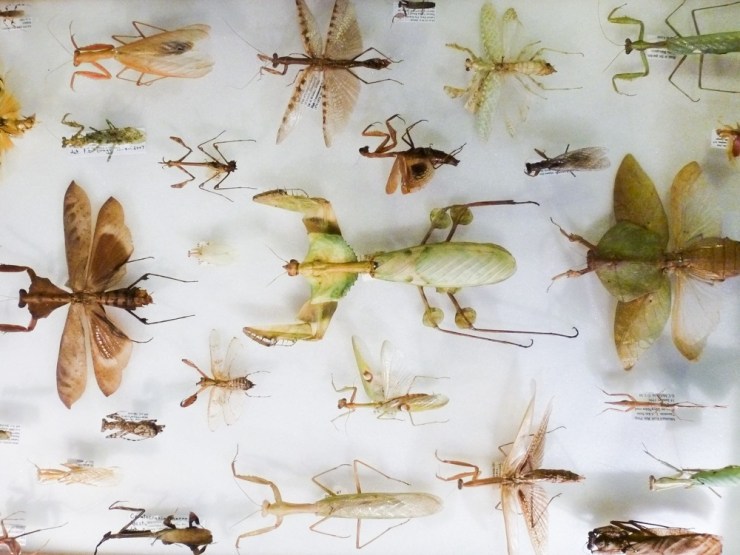
Display of different mantis species

There are over 2,400 species of mantis worldwide, split into 21 different families. The image above shows their incredible diversity of colour, shape and size. But while they may differ in appearance, their biology and many behavioural traits are the same.

Mantis are predators of insects, including other mantis, but larger species will eat small lizards and birds. But they are perhaps best known for being cannibalistic. This behaviour is most commonly seen in nymphs straight out of the egg case, or ootheca, but it can also occur when the female eats the male after mating. However, cannibalism is not required to mate, so when it happens it’s usually because the female is hungry!

The egg case, or ootheca, of mantis vary greatly depending on the size and behaviour of the species.
Revisio Insectorum Familiae Mantidarum was one of John Obadiah Westwood’s greatest works. Thankfully he kept all of his drawings, annotated pages and notes for the publication, allowing us an insight into the years of work he put into its production.

Praying mantis are ambush hunters, either camouflaging themselves while waiting for their prey to approach, or actively stalking prey. Their compound eyes are specialised in perceiving motion, and are widely spaced giving them a wide field of vision. Along with powerful front legs and an ability to move the head up to 180°, this makes them successful predators.

The Museum’s archive contains original drawings and annotations by John Obadiah Westwood (1805–1893), the first Hope Professor of Zoology. As a renowned scientist Westwood described many new mantis species, and he was also a talented artist.

The Presenting… Marvellous Mantodea case is on display at the Museum until 1 November 2018.

From pin to paper

Katherine Child, image technician in the Museum’s Life collections, doesn’t just use photography to capture the beauty of specimens. She is also an artist and has been trying out innovative techniques for her paintings. You may remember her amazing moth illustrations created with deposits of verdigris on pinned insects and she’s now using that technique to explore Museum staff’s favourite insect specimens.

Verdigris is a green corrosion often found on old pins within entomology collections (as well as elsewhere, on things like statues and copper pipes). Last year, after learning that the substance was once used as a pigment, I decided to try and make my own paint.

A clearwing moth before conservation, showing verdigris spreading where metal reacts with insect fats, or lipids.

Verdigris forms when copper or a copper alloy reacts with water, oxygen, carbon dioxide or sulphur. While a beautiful shade of green, the substance is damaging in natural history collections, where it can actually develop inside specimens and if left, split them irreversibly. So as part of the conservation of the Hope Entomological Collections, verdigris is removed.

I started to collect up the substance as it was cleaned from specimens and after about three years (you only get a little bit per pin) I was ready to make my paint! After my first moth project, the only question was, what to paint next…?

Attelabid_small
Byctiscus populi or ‘The Attelabid that changed my life’, chosen by Zoë (collections manager) who said ‘I saw a pink version of this species in the Natural History Museum in London and that’s when I decided I wanted to study entomology’.

With an estimated 6 million insects and arachnids in the entomology collections, it’s very easy to feel overwhelmed. You can pull open any one of thousands of draws and find astonishing specimens. While I have favourites, my first inclinations as to what to paint still felt a little arbitrary. After mulling over various possibilities, I decided to get help!

Chosen by DPhil student Leonidas, Agalmatium bilobum is a little bug which lays its eggs on tree bark, then covers them with mud to protect them.

I asked my co-workers what their favourite insects were, then opened the question out to regular volunteers and visitors of the Life collections. I loved finding out why people chose the things they did. Answers varied from ‘It was the first spider I ever looked at under a microscope aged 12’ to ‘Because they’re cool’ to ‘Because they have an ingenious way of manipulating spiders!’

Nuctenea_small
One of arachnologist Russell’s favourite spiders: Nuctenea umbratica. Though common in the UK, umbratica is Latin for “living in the shadows”, and it often hides away during the day. The slight transparency of the paint lends itself to a spider’s glittering eyes.


Painting this live African Mantis Sphodromantis lineola (chosen by conservator Jackie) was made slightly more challenging by the fact that the subject thought Katherine’s pencil might be tasty.

Most of the subjects I painted were based on specimens from the Museum’s collections or specimens individuals had brought in from their own collections, but one favourite was a live African Mantis, housed in the department to help with education and outreach. When I began to draw her she was intrigued by the movement of my pencil and came to the front of the tank, to follow every mark I made with her intimidating gaze.

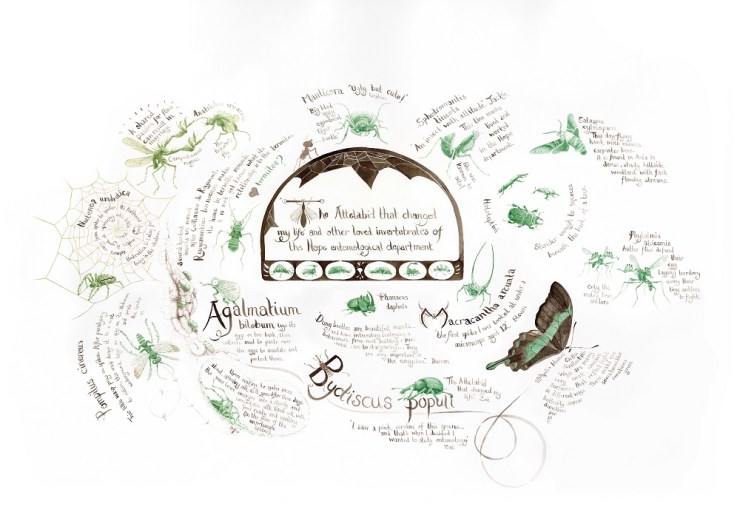
A detail from the final painting
Attelabid that...
Katherine’s fabulous finished painting, which will be framed and displayed in the Life collections department.

Though time consuming, the painting was loads of fun to research and do. It’s fantastic to be surrounded not only by extremely knowledgeable people, but also by people with a genuine passion for what they do and a love for the insects (and spiders) they study.

Why do we need pinned insect specimens?

Since we posted about ten-year-old Sarah’s amazing beetle discovery, we’ve had lots of queries as to why the insect needed to be caught and pinned. It’s a question we’re often asked, so here’s Darren Mann, Head of Life Collections at the Museum, to explain the value of ‘voucher specimens’.

The Museum’s collection houses over five million insect specimens, amassed over the past 300 years. This collection is, in effect, a biodiversity database, but unlike virtual databases, each data point has an associated ‘voucher specimen’ that was caught, pinned and labelled.

Although technical advances in digital macro-photography do reduce the need for some collecting, it is impossible to dissect an image to confirm an identification. So for many groups, even the best photograph in the world is inadequate for identification purposes.

Shingle CrawlerD18 (Psammoporus insularis Pittino, 2006) one of our few endemic insects.

Unlike plants and birds, many insects can only be identified with the aid of a microscope, to study tiny features that distinguish closely-related species. Some groups even require the dissection of minuscule genitalia to really tell them apart.

Entomologists take voucher specimens to enable this correct identification and these are later deposited in museum collections, making them available for further study in years to come. From an entomologist’s point of view, we believe we need to know what a species is, where it occurs and as much about it as possible, so we can inform biodiversity conservation.

The conservation assessment of UK insects by Natural England in their Species Status Reviews has only been possible with the data provided by entomologists, generated from collecting and identifying voucher specimens.

Entomologists follow a Code of Conduct for responsible collecting, which ensures they don’t remove too many species or damage the environment during their work .

There are numerous examples of the value and use of insect collections in contemporary science, including the discovery of previously unknown species in the UK and population genetics for butterfly conservation. Recently a species believed extinct in the UK was rediscovered. This was only made possible by checking the identification of several thousand museum specimens.

Museum collections also contain numerous examples of species now considered extinct in the UK. Without voucher specimens much of this research would be impossible and our understanding of insect distribution patterns, ecology and conservation would be significantly diminished.

Large Tortoiseshell butterflies, now considered to be extinct in the UK. The voucher specimens act as record in time of its occurrence in the UK.

What is rare?
Sarah’s False Darkling Beetle (Anisoxya fuscula) has been described as ‘rare’, but what does that mean in reality? For most invertebrates when we talk about a rare species we are not talking about a tiny number of individuals. This conservation status is based on their known distribution and the level of threat they face. A species can be rare if it is only found at one or two locations, but at those locations there may be many thousands of individuals.

The greatest threats to biodiversity are well known and include habitat loss, fragmentation and degradation and pollution, such as pesticides and light. Taking a small number of voucher specimens to confirm the identification of species has negligible impact on its population. But if we don’t know it’s there because we couldn’t identify it, then a housing development destroys its entire habitat… well you get the picture!

Further Reading
Ask an Entomologist
Entomological Collections
Natural England Species Status Reviews
To Kill or Not to Kill That is the Question Part 1
To Kill or Not to Kill That is the Question Part 2
To Kill or Not to Kill That is the Question Part 3
– Austin, J. J., & Melville, J. (2006). Incorporating historical museum specimens into molecular systematic and conservation genetics research. Molecular Ecology Notes, 6(4), 1089-1092.
– Colla, S.R., Gadallah, F., Richardson, L., Wagner, D., & Gall, L. (2012). Assessing declines of North American bumble bees (Bombus spp.) using museum specimens. Biodiversity and Conservation, 21(14), 3585-3595.
– Short, A. E. Z., Dikow, T., & Moreau, C. S. (2018). Entomological collections in the age of big data. Annual review of entomology, 63, 513-530.
– Suarez, A.V., & Tsutsui, N.D. (2004). The value of museum collections for research and society. AIBS Bulletin, 54(1), 66-74. Abstract available here
– Wandeler, P., Paquita, Hoeck, E.A. & Keller, L.F. (2007). Back to the future: museum specimens in population genetics. Trends in Ecology & Evolution 22.12, 634-642.