One in a million find

By Rachel Parle, Public Engagement Manager

The Museum’s collection of British insects already houses over a million specimens, and now it boasts one more special insect.

Ten-year-old Sarah Thomas of Abbey Woods Academy in Berinsfield, Oxfordshire discovered a rare beetle in her school grounds while taking part in a Museum outreach session. To Sarah’s excitement, the beetle is so important that it has now become part of the collections here at the Museum – and it is the first beetle of its kind to be added to the historically important British Insect Collection since the 1950s.

Sarah Thomas examines her beetle under the microscope with Darren Mann, entomologist and Head of Life Collections at the Museum

Sarah’s class took part in a HOPE Discovery Day, where they were visited by a professional entomologist, learnt about insect anatomy and how to identify and classify specimens, and went on the hunt for insects in the school grounds. HOPE – Heritage, Outreach and Preservation of Entomology – is reaching out to students in state primary schools across Oxfordshire, using the Museum’s British Insect Collection to spark curiosity and foster a love of natural history. It’s all part of a bigger project at the Museum, supported by the Heritage Lottery Fund, to safeguard this important Collection for the future and engage people with natural heritage.

Sarah brought her family to the Museum to see her beetle in the British Insect Collection.

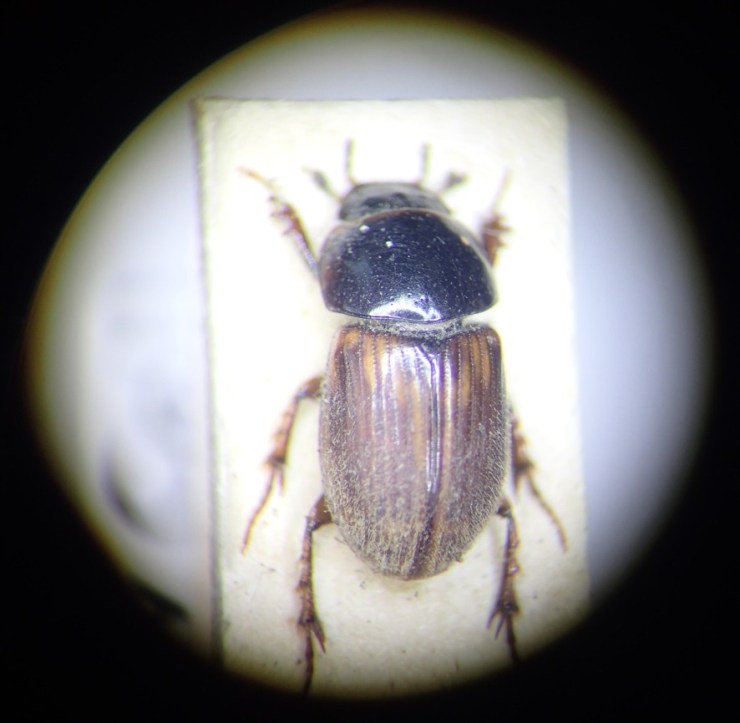
After some searching, Sarah spotted a 5mm insect lurking under a leaf. To the untrained eye it looked rather like any other tiny shiny beetle, but luckily Darren Mann, Head of the Museum’s Life Collections, was visiting as part of the HOPE team. Darren spotted it as something unusually and took it back to the Museum to get a closer look under the microscope. He was then able to identify it as a False Darkling Beetle.

It’s Anisoxya fuscula, which is rated as Nationally Scarce in Great Britain. We seldom see these outside old forest habitats and this is the first beetle of its kind to be added to the collections for around 70 years.

– Darren Mann, Head of Life Collections

The False Darkling Beetle under the microscope and labelled in the Museum’s British Insect Collection as found by Sarah Thomas

The tiny beetle has been labelled with Sarah’s name and the location of her find, and added to the British Insect Collection. Though she’s very excited to have her specimen in the collections, Sarah admits that she hasn’t always been a big fan of insects:

Before Project Insect I didn’t really like insects, but now I really do.

– Sarah Thomas

Everyone at the Museum is really pleased with Sarah’s fantastic find and we hope it spreads the word to inspire others to become budding young entomologists too.

The beetle Sarah discovered will be stored in this drawer in the British Insect Collection.

Argonauts: astronauts of the sea

by Mark Carnall, Life Collections manager

Cephalopods are a remarkable group of molluscs that includes nautilus, octopuses, cuttlefish and various groups of ‘squid’. The other major groups of molluscs includes more familiar shelled animals such as gastropods (snails and slugs), bivalves, and chitons, as well as some less familiar forms.

In natural history museums, molluscs are normally represented by shell collections because the hard shelly parts are easier to preserve and store than the soft tissue. This creates a bias against the soft-bodied cephalopods, such as squids, octopuses and cuttlefish, because aside from the cuttlebones of cuttlefish and the thin gladius in squids there aren’t many hard parts that can be preserved to represent these animals in dry collections. For octopuses it’s normally only the beak and microscopic radulae, a toothed tongue-like structure, that can be preserved. But there is one notable exception: the eggcases of argonauts.

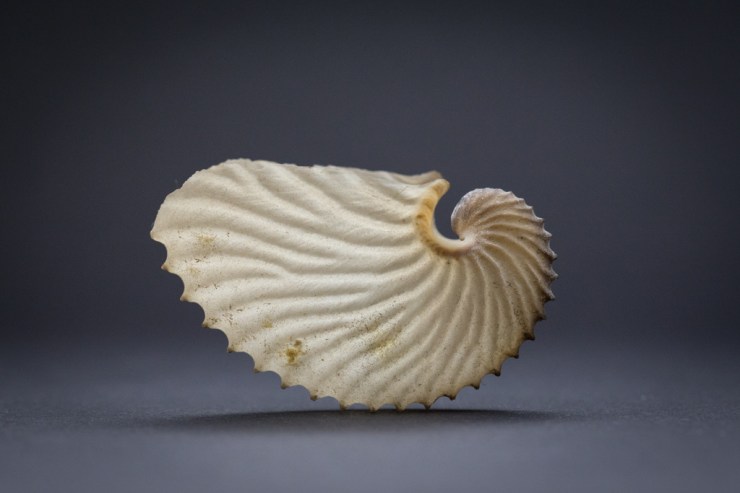
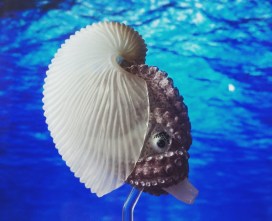
Model of Argonauts argo. Image: Mark Carnall
Model of Argonauta argo. Image: Mark Carnall

Argonauts, four* species of octopuses in the genus Argonauta, are unusual in that they produce a paper-thin eggcase, sometimes referred to as a shell. Unlike a true shell it’s not attached to the body of the argonaut, but secreted by two specialised webbed arms. The eggcases themselves are sometimes called paper nautiluses because they resemble the spiral shells of nautiluses, but they are structurally and functionally very different.

External morphology of a female paper nautilus (Argonauta argo) with egg case. Poli, Giuseppe Saverio. Testacea utriusque Siciliae. (1791-1827).
External morphology of a female paper nautilus (Argonauta argo) with eggcase. Poli, Giuseppe Saverio. Testacea utriusque Siciliae. (1791-1827). http://biodiversitylibrary.org/page/44020354

Argonaut eggcases wash on up shorelines around the world and have been known for centuries. But it’s only comparatively recently that the origin and use of these cases has been described. When eggcases containing live argonauts were first encountered it was supposed that argonauts were reusing empty shells created by another animal, much like hermit crabs repurpose gastropod shells.

Pioneering research by marine biologist Jeaneatte Villepreux-Power in the 19th century led to observations of Octopus and Argonauta, confirming that the eggcases are made and repaired by female argonauts. It wasn’t until 2010 that we understood how argonauts use these cases to float in the ocean. It turns out that they ‘bob’ their shells to gulp a pocket of air. Then, using their second pair of arms, they trap the air in the top of the shell and dive releasing enough air to maintain the required buoyancy.

Only female argonauts make the eggcases, so the free-floating males are tiny in comparison. In addition to providing a home for female argonauts, these structures are used to brood embryos in. One eggcase was described with nearly 50,000 embryos attached to the inside of the shell.

Preparation showing series of argonaut egg cases of varying sizes.

Thanks to their oddity and beauty these eggcases are common in museum collections, but they represent one of the marvels of evolution. Unlike many bottom-dwelling octopuses, female argonauts have evolved this amazing structure to function as an underwater craft to allow them to leave the ocean floor and inhabit the open oceans: the true astronauts of the sea.

To celebrate the pioneering work of Jeaneatte Villepreux-Power, these amazing animals, their eggcases, and a selection of museum specimens are on display in the Museum’s Presenting… case until the 3 July 2018.

Mark writes more about these ‘astronauts of the sea’ on the Guardian’s Lost Worlds Revisited blog.

* Tens of species of living argonauts have been described, however four are currently recognised with a few dubious species.

Odd egg out

This is a great time of year to hear the distinctive call of the Cuckoo (Cuculus canorus) as it spends the summer in the UK. Collections Manager Eileen Westwig recently shared Cuckoo specimens with the public in one of our Spotlight Specimens sessions. You missed it?! No problem, here she is with the fascinating story of this threatened bird…

Cuckoos could be described as absent mothers, laying their eggs into the nest of a ‘host bird’, such as Dunnocks, Meadow Pipits, Garden Warblers, Whitethroats or Flycatchers. When she finds a suitable nest, the female Cuckoo will remove one of the host’s eggs and lay hers in its place. She lays between 12 and 22 eggs in a season, all in different nests. No worries befall her about building a nest, brooding out any eggs or raising her young as she leaves it all to strangers. One challenge for the Cuckoo is to make sure her trickery is not discovered.

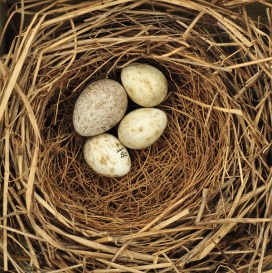
When the female host returns to her nest, she will inspect it for any changes and if she discovers the intruder’s egg, she will simply toss it out. So the female Cuckoo has to be pretty good at forgery and mimic the host bird’s egg ‘signature’, copying the colour, pattern and shape of the original eggs. This is the only way to get away with her ‘brood parasitism’. Around 20% of Cuckoo eggs never make it. In the top picture, you can see the nest of a Garden Warbler with three Warbler eggs and one larger Cuckoo egg, on the top left.

An adult Garden Warbler (Sylvia borin borin) can reach a weight of 16-22g with a wingspan of 20-24.5cm

After twelve days, the Cuckoo hatches and pushes the other nestlings out. As the single remaining occupant of the nest, it has the full attention of the host parents, which try to feed a nestling soon outweighing. An adult Cuckoo is more than 6 times the weight of an adult Garden Warbler. The Cuckoo young will leave the nest after 19 days, but gets fed by the parents for a further two weeks. That is one busy summer.

OUMNH.ZC.11868_Cuculus_canorus_canorus_Eileen_Westwig
An adult Cuckoo (Cuculus canorus) can reach a weight of 105-130g with a wingspan of 55-65cm.

According to the RSPB, there are about 15,000 breeding pairs in the UK and Cuckoos are now included on the Red List, giving them the highest conservation priority. Ten years ago, numbers of this migrant bird fell by 21% and more than half of the population has disappeared in the past 25 years. Threats include damage to the bird’s winter habitats and a decline in large insect species that are its major food source.

Cuckoos migrate to West Africa over the winter months and can be seen in the UK from late March or April through July or August. Young birds leave a month or so later to give them time to grow and prepare for the long journey ahead. Wintering grounds are not exactly known but include Cameroon, Gabon and other African nations.

Deal or no deal

Melinopterus

by Darren Mann, Head of Life Collections

In a previous article on this blog I reported the discovery, in an insect collection, of the 21st British specimen of the ‘Regionally Extinct dung beetle Melinopterus punctatosulcatus. And since then, I’ve been on the hunt for more…

Heading out to numerous other museum collections I discovered more specimens, all collected in the same locality – Deal in Kent. In Ipswich Museum there are six, collected by C. Morley in 1896; there are two in the Natural History Museum, London, collected by G.C. Champion; and in the Museum of Zoology, Cambridge there are two collected by G.C. Hall in 1883.

Ipswich Museum
A view through the microscope of Melinopterus punctatosulcatus held in the collections of Ipswich Museum, collected by C. Morley in 1896

But the earliest and most recent finds are both in the National Museum of Scotland – one from May 1871, in the G.R. Waterhouse collection, and one from 1923, in the T. Hudson-Beare collection. So now we know of 42 specimens of this beetle with data and we know that the species occurred at Deal for about 50 years. But why are there no records after this time?

The Deal sandhills in Kent were famous for their insects, but even as long ago as 1900 entomologists* were discussing the negative impact of “summer camping-out stations and the modern craze for the ‘Royal and Ancient Game of Golf'” on beetles and butterflies in the area.

Today, most of the sandhills are gone and there are no grazing animals other than a few rabbits. Most of the surrounding land is either developed as a golf course or under agricultural management. So, is the possible local extinction of this dung beetle due to habitat loss and a lack of dung?

Deal
Deal, Kent: the original locality for Melinopterus punctatosulcatus, with remnants of the sandhills in the distance

To try and answer this question, naturally I went looking for poop in Deal. In a field in Sandwich Bay I could hear sheep bleating in the distance, although poo was scarce. Eventually I found a few old plops and inside were ten Calamosternus granarius, a small dung beetle. This was good, but my main target was Melinopterus punctatosulcatus.

Melinopterus punctatosulcatus edit
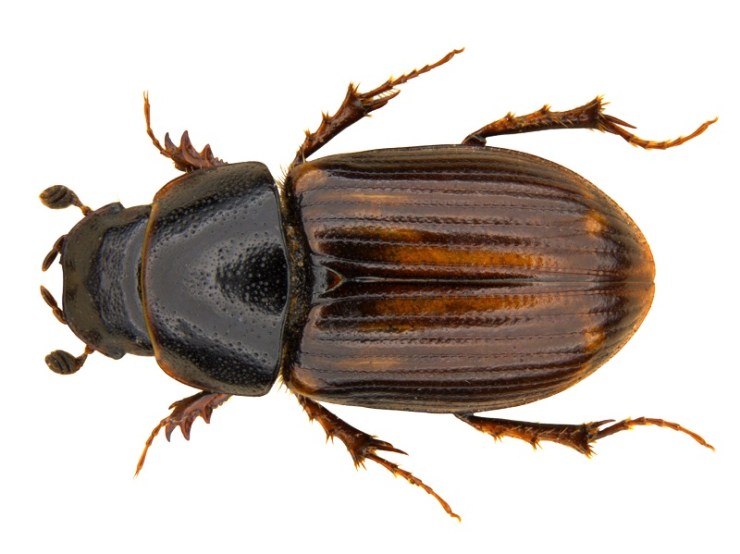
A specimen from the Museum of Melinopterus punctatosulcatus, previously listed as ‘Regionally Extinct’ in Britain, but now rediscovered in Deal, Kent

I probed the poop further. To my delight, crowded in the remaining squishy bit were four other species. On close inspection, one of these was hairy, so a male, and much darker than its close relatives. It fitted perfectly with my expectations for Melinopterus punctatosulcatus after seeing so many examples in museum collections. Success! This beetle, misidentified in museum collections for so long, and not seen since the 1920s in Deal, is indeed hanging on in Kent.

Disappointingly, after a further few days of searching, only a handful more specimens were seen. This suggests that either the species exists at low population levels, or that it was it was not the peak emergence period when I was there. Nonetheless, a species not recorded anywhere in the UK for over 70 years is actually still here.

Now hopefully we can encourage local land owners to help conserve this all-important dung fauna and flora.

* Walker, J.J. 1900. The Coleoptera and Hemiptera of the Deal Sandhill. Entomologist Monthly Magazine 36: 94-101.

Who shot the Dodo?

By Scott Billings, Digital Engagement Officer

If ever the Oxford Dodo were to have squawked, its final squawk may have been the saddest and loudest. For the first time, the manner of death of the museum’s iconic specimen has been revealed: a shot to the back of the head.

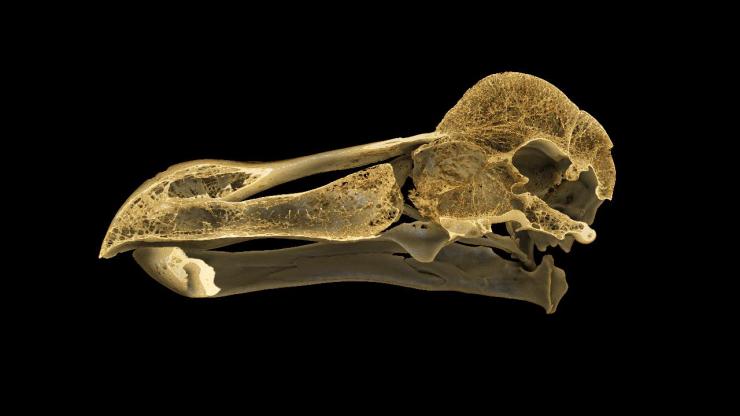
This unexpected twist in the long tale of the Oxford Dodo has come to light thanks to a collaboration between the Museum and the University of Warwick. WMG, a cutting-edge manufacturing and technology research unit at Warwick, employed its forensic scanning techniques and expertise to discover that the Dodo was shot in the neck and back of the head with a 17th-century shotgun.

Mysterious particles were found in the specimen during scans carried out to analyse its anatomy. Further investigation of the material and size of these particles revealed them to be lead shot pellets of a type used to hunt wildfowl during the 1600s.

The Oxford Dodo specimen, as it has come to be known, originally came to the University of Oxford as part of the Tradescant Collection of specimens and artefacts compiled by father and son John Tradescant in London in the 17th century. It was thought to have been the remains of a bird recorded as being kept alive in a 17th-century London townhouse, but the discovery of the shotgun pellets cast doubt on this idea, leaving the bird’s origins more mysterious than ever.

Dodos were endemic to the island of Mauritius in the Indian Ocean. The first European accounts of the bird were made by Dutch explorers in 1601, after they rediscovered the island in 1598. The last living bird was sighted in 1662.

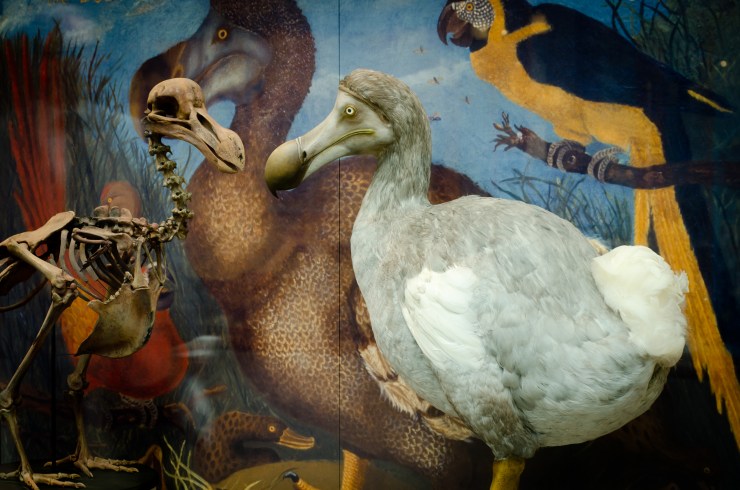
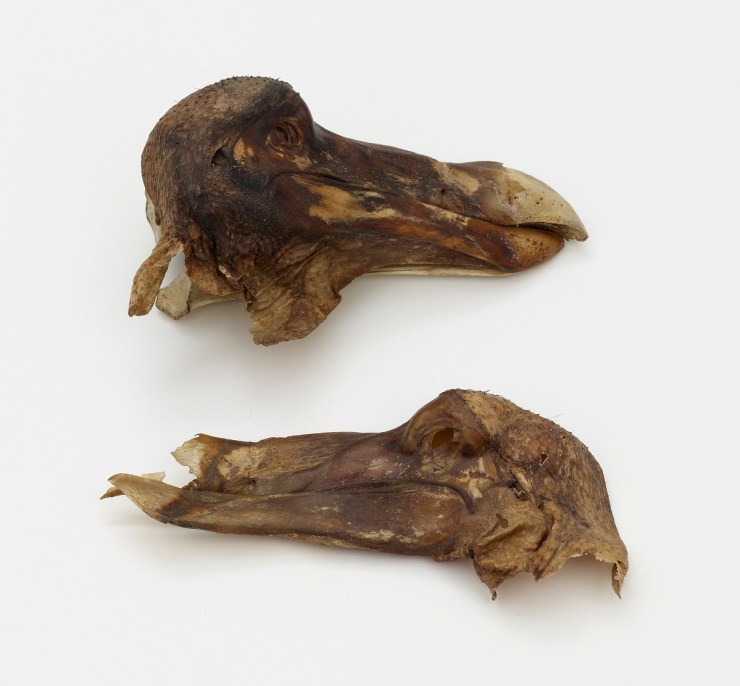
The story of the Oxford Dodo is especially significant because it represents the most complete remains of a dodo collected as a living bird – the head and a foot – and the only surviving soft tissue anywhere in the world.

This discovery reveals important new information about the history of the Oxford Dodo, which is an important specimen for biology, and through its connections with Lewis Carroll and Alice’s Adventures in Wonderland of great cultural significance too.
– Professor Paul Smith, Museum director

The Oxford Dodo represents the only soft tissue remains of dodo in the world. This iconic specimen was taken from the Museum to WMG at the University of Warwick for CT scanning.

WMG’s CT scans show that this famous symbol of human-caused extinction was shot in the back of the head and the neck, and that the shot did not penetrate its skull – which is now revealed to be very thick.

The discovery of such a brutal demise was quite a surprise as the scans were actually focused on discovering more about the Dodo’s anatomy, as well as how it lived and died. This work will continue, but we now have a new mystery to solve: Who shot the Dodo?

What’s the next step? It is possible that the isotope of lead in the shot could be analysed and traced to a particular ore field. This might tell us what country it was mined in, and perhaps what country is was made in, and ultimately reveal who shot the Dodo.

What is a tree of life?

A phylogeny? An evolutionary tree? A cladogram? We see the branching lines of these diagrams in many museum displays and science articles, but what do they tell us and why are they helpful?
Duncan Murdock, research fellow, explains. 

You are a fish.

Starfish, jellyfish and cuttlefish are not fish.

Actually, no, there’s no such thing as a fish. Let’s take a step back…

The Jackson 5 – the ultimate singing family tree?
Credit: Wikimedia Commons

It all comes down to common ancestry. All life is related, and we can think of it in terms of a family tree (or ‘phylogeny’): Jackie, Tito, Jermaine, Marlon and Michael were all Jacksons. United not only by a collective inability to control their feet, but also by common descent – they are all their parent’s children*.

By tracing further and further back in MJs family tree we could define ever larger groups united by common ancestors, first cousins (grandparents), second cousins (great-grandparents), all the way to every human, every mammal, every animal, and eventually all life – we are family (ok, that was Sister Sledge, but you get the point).

In the case of the tree of life, species are at the tips of branches and their common ancestors are where branches meet. A true biological group consists of a common ancestor and all its descendants, and we can use characteristics common between two species to imply common descent. Siblings look a lot like each other because they have inherited much of their appearance via common ancestry (i.e. their parents). In a similar way, two closely related species will share lots of inherited characteristics.

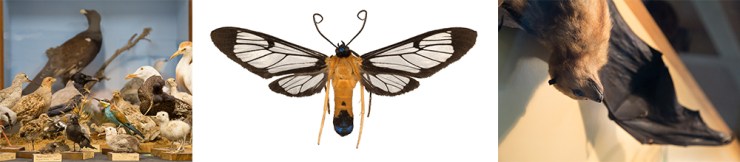
However, things are not quite that simple. Wings of bats, birds and insects are not inherited from a common ancestor but independently evolved for the same purpose, in this case flight. To complicate things further, as species evolve they may lose features inherited from their ancestors that other descendants retain. Snakes have lost their limbs, but still sit in the same group as lizards. These problems can be overcome by looking at many characteristics at once, using genetic information to test predicted relationships, and adding fossils to the tree to track change or loss through time (as in snakes).

Birds, insects and bats have all evolved wings for flight, but did not inherit this feature from a common ancestor. This is a good example of convergent evolution.

So, what about fish? ‘Fish’ is used to refer to pretty much anything that swims in water, but this lifestyle in animals like starfish (a relative of crinoids and sea urchins), jellyfish (a relative of corals) and cuttlefish (a relative of squid and octopus) evolved independently from more familiar fish like cod and carp. So, they’re not really ‘fish’ at all. With that in mind, how can we be fish? Well, the last common ancestor of, say, hagfish, salmon, shark and lungfish, is also the common ancestor of frogs, lizards, cats and us! All four-limbed animals with backbones descend from a fish-like ancestor. To complicate things further some have adapted to life back into the water and look much more like a ‘fish’ again, like dolphins, seals and the extinct ichthyosaur. Without a tree of life, we could not begin to unravel the evolutionary path that lead to all the diversity of life we see today.

The Blue Fin Tuna on display in the Museum is definitely a fish… right?!

You are closer to a chimp than a monkey, closer to a starfish than a snail, and closer to a mushroom than a tree. And, of course, there’s no such thing as a fish, but they still go well with chips.

*Joseph Jackson and Katherine Scruse had ten children, including the members of the Jackson 5, twenty-six grandchildren and several great-grandchildren.