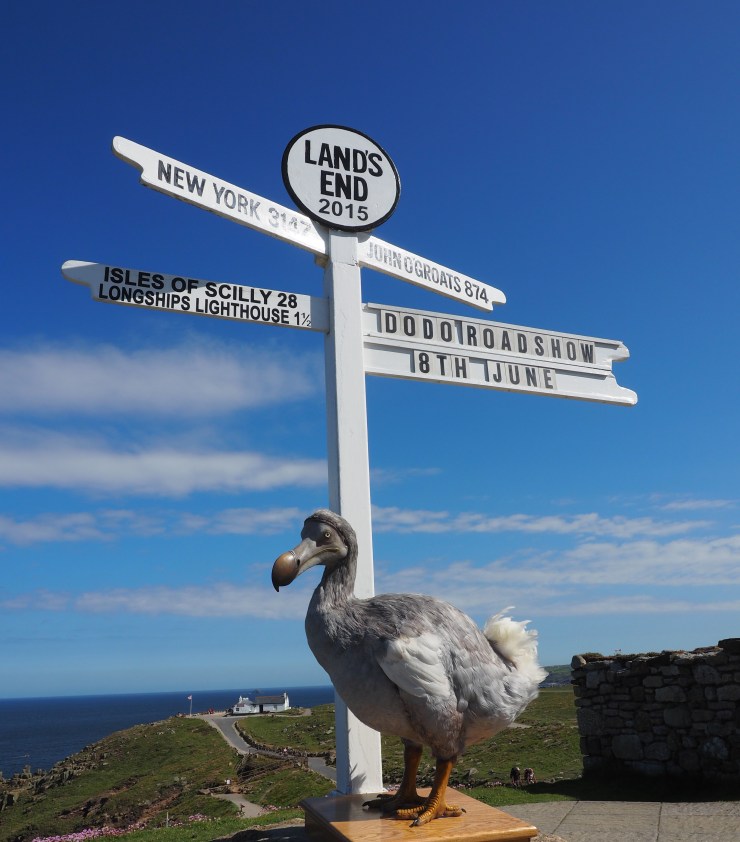
A year ago we came up with a crazy idea. We would take our famous Dodo out on the road, from Land’s End to John O’Groats, calling in at 24 different museums and galleries along the way… and we would get all this up and running just 3 weeks after the initial spark of inspiration. We called it the Dodo Roadshow and an incredible journey across the country began.
The Dodo’s adventure begins…
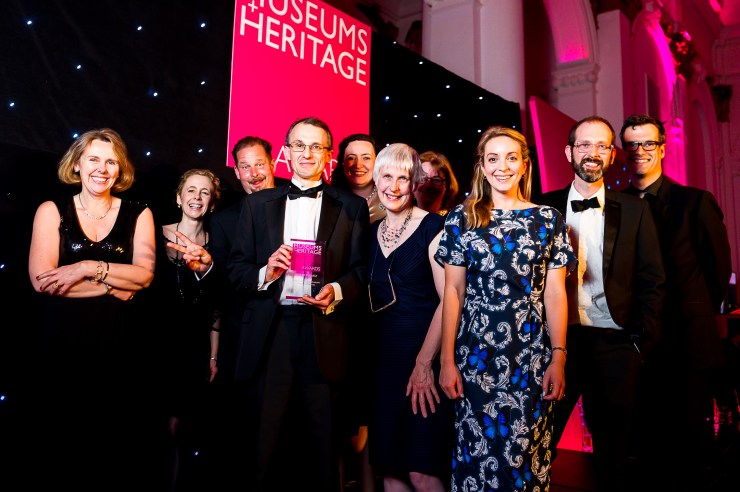
Last night, team Dodo Roadshow was given a hearty pat on the back at the Museums + Heritage Awards for Excellence 2016, walking away with not one, but two awards! We were delighted to be awarded the prize for ‘Project on a Limited Budget’, but there was an extra surprise at the end of the night when the Museum scooped up the top accolade ‘Best of the Best’!
On awarding the accolade for the Project on a Limited Budget, comedian Marcus Brigstocke described the Roadshow as:
A clever, fun and engaging idea, completed in a very short period of time, which celebrated new conversations and partnerships across the country.
Marcus Brigstocke awards the prize for ‘Project on a Limited Budget’.
To understand how modern species evolved, we often turn to the fossil record, but this can be very difficult when the animal you would like to study is small and fragile. For example, the coral-dwelling crab family Cryptochiridae has more than 50 species today and occurs worldwide on coral reefs. These small crabs are less than 1 cm in size and have the unique ability to create little homes,or dwellings, in stony corals. This ability makes them an interesting study object to learn more about how different species cohabitate on reefs.
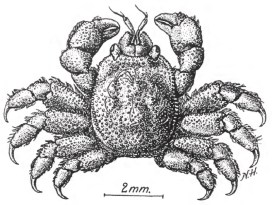
Modern cryptochirid crab in its coral home
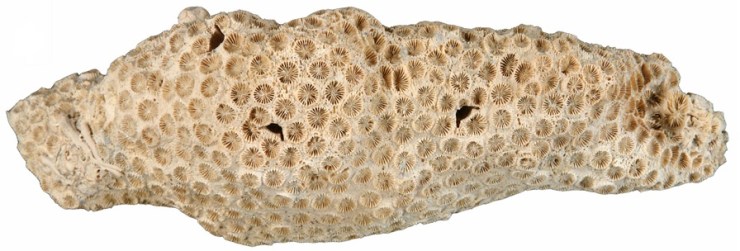
Unfortunately no fossils are known for these crabs; their size and thin carapace (shell) means they probably didn’t fossilise well. But together with colleagues from the United States, I’ve found crab dwellings in fossil corals for the very first time. The corals are several million years old and come from Florida and Cuba. Although we still don’t have fossils of the actual crabs, the holes, which are a type of trace fossil, are very valuable evidence.
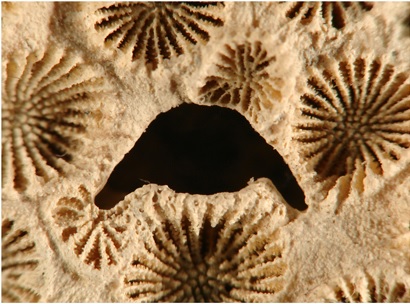
Three dwellings on a fossil coral from the lower-middle Pleistocene, found in Palm Beach County, Florida. A close-up of one pit can be seen at the top of this post.
To sci-fi fans, the dwellings have an extra significance. The shape of the entrance is very similar to the shape of the spaceship in the American science fiction series Battlestar Galactica, so the scientific name of the trace fossils is Galacticus duerri.
Found in a deposit of rocks known as the Herefordshire Lagerstätte, which preserves ancient remains with superb detail, the 430 million year old fossil shows that the marine animal carried its young in kite-like capsules tethered to the parent’s body, earning it the moniker “Kite Runner” after the 2003 novel by Khalid Hosseini.
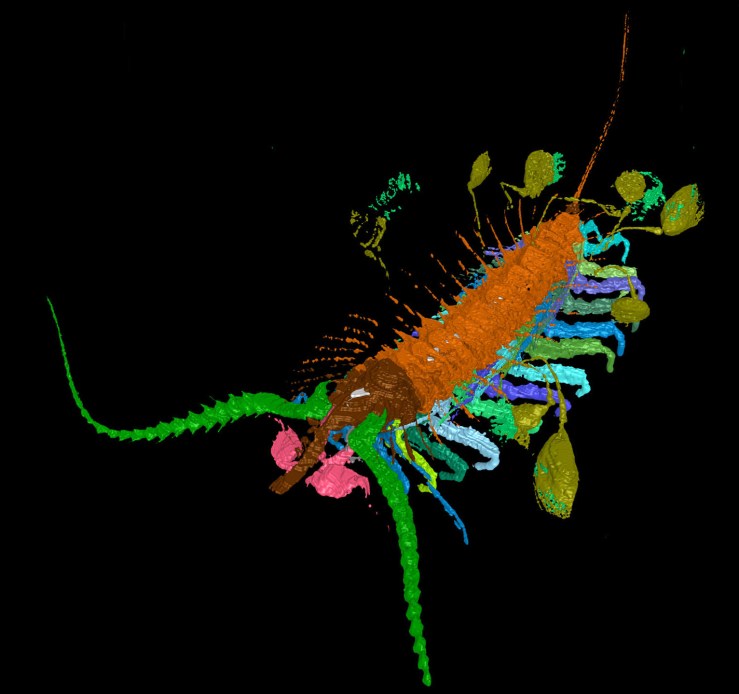
The small creature has been officially named Aquilonifer spinosus, from “aquila”, meaning eagle or kite, and “fer” which means carry. It grew to just over a centimeter long, not including the tail spines, and there is only one known fossil of the animal.
Reconstruction of Aquilonifer spinosus
Modern crustaceans employ a variety of strategies to protect their eggs and embryos from predators — attaching them to limbs, holding them under a carapace, or enclosing them within a special pouch until they are old enough to be released — but this example is unique. We know of nothing alive today which attaches the young by threads to its upper surface; perhaps this strategy was less successful and became extinct.
Two capsules of juveniles tethered to the parent’s body
Aquilonifer spinosus lived on the seafloor during the Silurian period, with a variety of other animals including sponges, brachiopods, worms, snails and other mollusks, a sea spider, a horse-shoe crab, various shrimp-like creatures, and a sea-star.
The researchers were able to describe Aquilonifer spinosus in detail thanks to a virtual reconstruction. They reconstructed the animal and the attached juveniles by stacking digital images of fossil surfaces that were revealed by grinding away the fossil in exceptionally thin increments. You can see this animation here:
The Yale Peabody Museum of Natural History, the Natural Environmental Research Council, the John Fell Oxford University Press Fund, and the Leverhulme Trust supported the research.
Scientists often use DNA to study the position of a species in the tree of life. By sequencing DNA from different species we can begin to see how closely they are related, but sometimes it can be difficult to obtain specimens to carry out this type of research. This is where museum collections become invaluable.
I have been investigating a tiny coral-dwelling crab, Detocarcinus balssi, which is less than 1cm in size and lives in the Atlantic ocean. In a paper just published in the Journal of Zoological Systematics and Evolutionary Research,my co-writer and I show how we have resolved where this crab is placed, taxonomically-speaking.
To establish this we needed DNA, but unfortunately the crab has only been collected on a few occasions since the discovery of the species in 1956. Luckily, the Smithsonian Institution in Washington D.C. houses several specimens of D. balssi that were collected in the 1980s.
Gall crab females carry many, many eggs, so with permission of the curator at the Smithsonian a special DNA protocol for old and degenerated material was used to extract small fragments of DNA from the eggs of a D. balssi specimen collected in 1984.
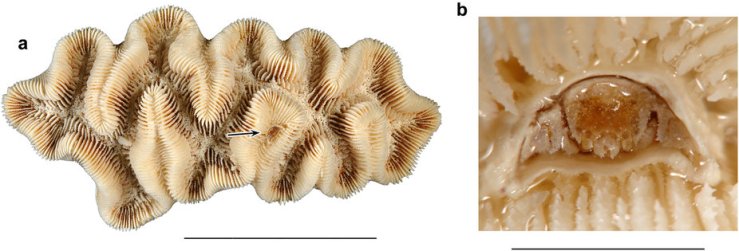
Hapalocarcinus marsupialis, a gall crab similar to Detocarcinus ballsi, with big bundle of eggs
The DNA sequence that was obtained offered a surprise: the Atlantic species D. balssi is more closely related to an Indo-Pacific species Utinomiella dimorpha than any other Atlantic species. This may seem odd at first, but gall crabs probably originated before the Panama Isthmus – the landmass connecting North and South America – was fully closed. At the time, species could freely pass between what we now know as the Pacific Ocean and the Atlantic Ocean.
With this little part of the puzzle solved, the relationship between Atlantic and Indo-Pacific gall crab species can be studied in more detail.
Without the scientific collections held in museums this research could not have been completed. Researchers increasingly use museum collections, including the famous Dodo in this Museum, to answer important questions about where to fit a species in the taxonomic scheme of things – on the grand tree of life.
An exciting new resident arrived at the Museum recently, having lain in the Cambridgeshire earth for around 165 million years. Discovered in a quarry near Peterborough, the skeleton of a 5.5 metre plesiosaur has been donated to the Museum and is now awaiting reconstruction and further study in our labs.
Plesiosaurs were long-necked sea creatures that lived during the time of the dinosaurs, but died out 66 million years ago.
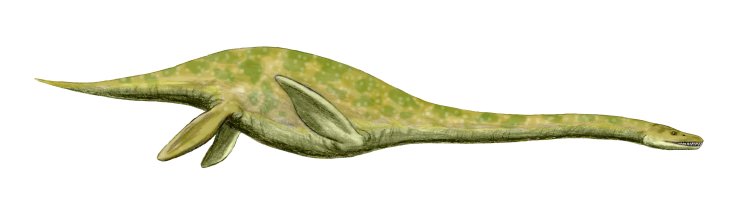
Artist’s impression of Muraenosaurus leedsii, a similar plesiosaur from the Middle Jurassic of Europe. Image by Nobumichi Tamura.
The fossilized remains of the marine reptile were discovered at a site owned by building product manufacturer Forterra, which has kindly allowed the material to be added to the Museum’s collections.
The creature was first spotted by Oxford Clay Working Group member Carl Harrington who noticed a tiny fragment of bone sticking out of the clay. Over the course of four days, Carl and eight others dug up more than 600 pieces of fossilised bone. Carl then spent over 400 hours cleaning and repairing the specimen.
I’d never seen so much bone in one spot in a quarry. As I was digging amongst the wet clay, the snout of a plesiosaur started to appear in front of me. It was one of those absolute ‘wow’ moments – I was the first human to come face to face with this reptile.
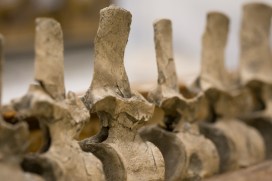
The plesiosaur’s neck vertebrae
The plesiosaur had a 2.5 metre long neck, a barrel-shaped body, four flippers and a short tail. Its skull is still preserved inside a block of clay, and the painstaking task of removing it will now be undertaken here.
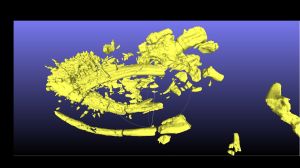
A CT scan of the plesiosaur’s skull, which is still inside a clay block
DrJames Neenan, one of our research fellows, and Professor John Hutchinson from the Royal Veterinary College have already CT-scanned the block to reveal the location of the bones inside. This will help in removing it from the clay.
Next week pupils from a visiting secondary school will get the chance to see the plesiosaur find for themselves and to ask our Earth Collections manager Dr Hilary Ketchum all about it. Hilary says:
We are so excited that the plesiosaur has come to the Museum where it will be used for research, education and display.
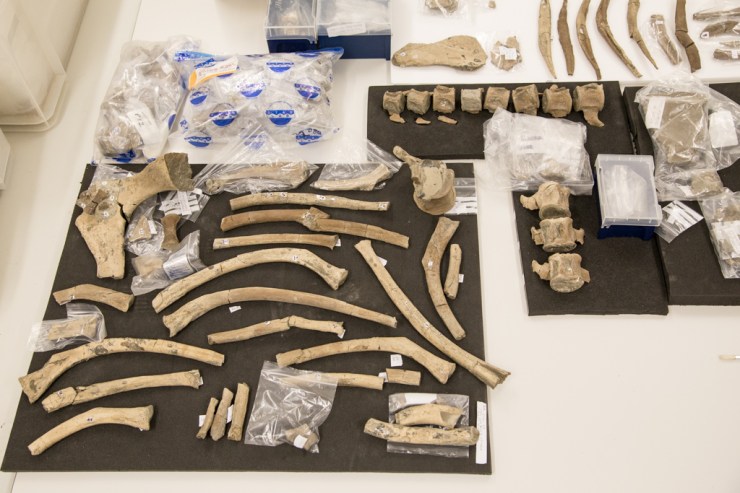
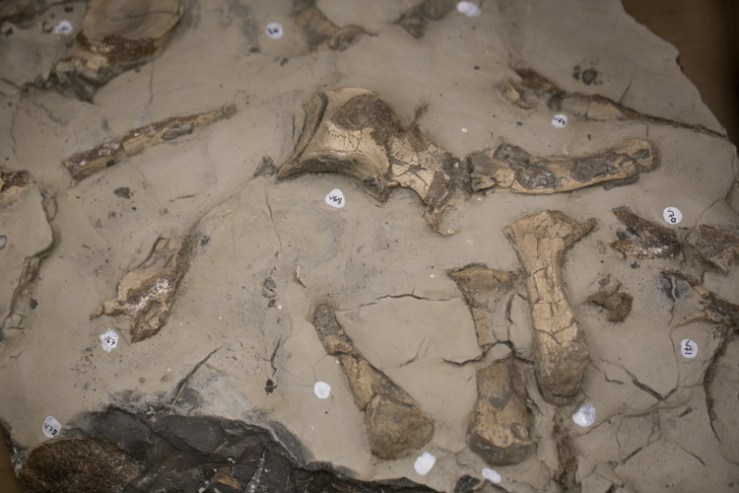
The plesiosaur’s ribs and vertebrae still inside the rock
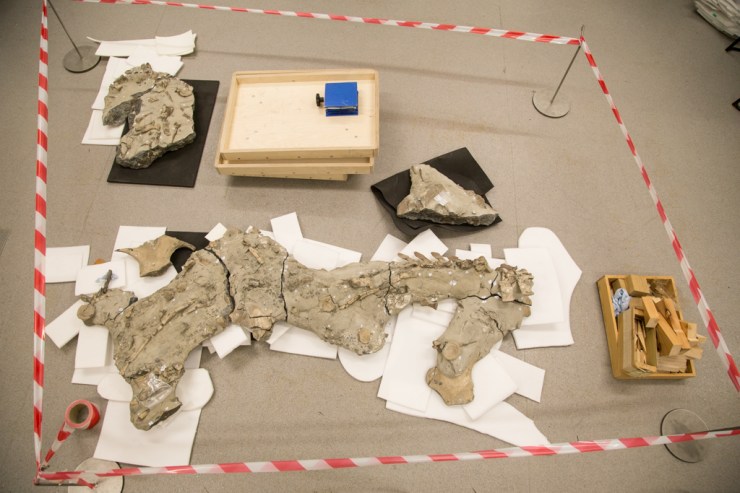
Hilary will now begin the task of reconstructing the plesiosaur from the remains you can see in the photos here – a combination of individual separate bones and those still contained in clay nodules. Ultimately, we hope to articulate and suspend the specimen for public display.
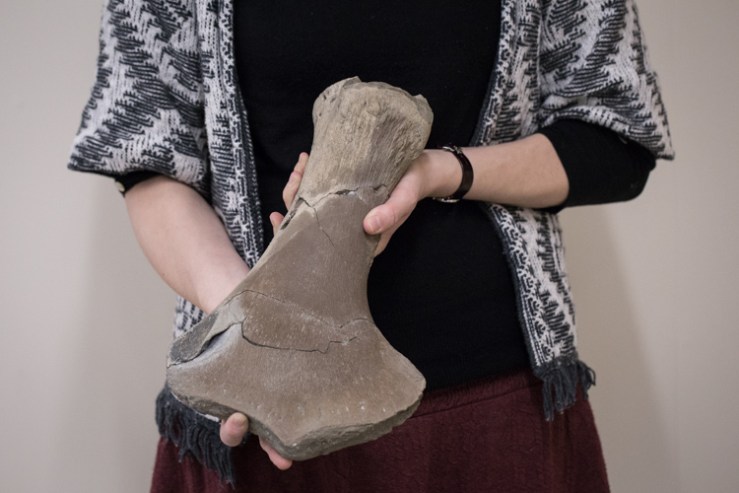
Hilary holds out the plesiosaur’s arm bone (humerus)
Part of the study will be to determine whether this is a known or new species of plesiosaur. Early indications suggest that it might be a species new to science, but more investigation is needed before we will know for sure.
As you can tell from the adornment of our Red Deer, Christmas is upon us, so it’s nearly time to bid farewell to another year. It’s been another remarkable twelve months here at the Museum so here’s a little round up a few highlights from 2015…
As winter gave forth to spring News emerged of a heartwarming thing The Art Fund whispered in our ear
We were nominees for Museum of the Year!
Although eventual winners we were not
It mattered really not one jot
For in celebration we embarked
On the Dodo Roadshow – a tremendous lark
Back in April we’re pleased to say Another award came our way Goes to Town gave creatures free reign
And grabbed a gong for Marketing Campaign
But we weren’t always on the road
In our exhibitions many stories were told
Of evolution, geology and sensory powers
Science and research passed the visitors’ hours
Our doors were open without interruption
While out on the lawn was a volcanic eruption
University scientists had plenty to say
On a really Super Science Saturday
So to our schools, and families, and adults and more
Thank you, cheers, and thank you some more













 More Than A Dodo