Carnivore conservation

A new choose-your-own-adventure board game created by researchers from the University of Oxford’s Department of Zoology puts players centre-stage in a global carnivore conservation challenge. The educational game is launching a Kickstarter fundraising campaign today and here co-designer Dr Cedric Tan tells us all about it…

Have you ever wondered what it’s like being a conservation biologist? We have spent the past year creating and testing a brand new board game – The WildCRU Game: Global Carnivore Conservation – that reveals some of the challenges faced by conservationists, the animals themselves, and the indigenous people who live with them. We’re now looking to get the game out to schools and communities all across the world with a £40,000 Kickstarter funding campaign featuring lots of rewards and discounts for our backers.

The game has been co-designed by Jennifer Spencer and myself to appeal to non-scientists and people of different ages. Players work together cooperatively as WildCRU researchers to gather the resources to complete carnivore conservation projects across the globe.

Stories in the game are taken directly from the real experiences of the WildCRU team. Players must decide what to do in choose-your-own-adventure-style encounters to gather the equipment, personnel, and transport resources they need for their projects.

In developing this game, we chose six varied WildCRU projects including the Hwange Lion Research project, based in Zimbabwe, and the famous water vole study in the UK, to show players the breadth of WildCRU’s research.
– Co-designer Jennifer Spencer, WildCRU

Multiple choice research questions are also based on real WildCRU research; they reveal more about the environment of each project – the flora, herbivores, competitor carnivores, and study species of the study sites. With the additional pressure of Global Events, players will learn about how difficult wildlife conservation projects can be.

It has been great to see that the game appeals to both kids and adults. People have found it to be an immersive experience in which players experience the challenges of real people, real situations and real research. We also hope that the game will provide local families with the opportunity to learn about the wildlife around them, and how to live in harmony alongside it.

Through the game and our other education efforts we’re hoping to increase environmental awareness and to introduce a wide variety of people to the science and processes behind real-world conservation.

Images and video: Laurie Hedges (lauriehedges.com)

What’s in a name?

By Duncan Murdock, research fellow

Whether it’s the Physeter macrocephalus (Sperm Whale) whose jaw greets our visitors, the Apus apus (European Swift) which spend the summer nesting in the tower, or the Raphus cucullatus (Dodo) on our Museum’s logo, all animals, plants, fungi and microbes, living and extinct, have scientific names – or at least once they have been properly described in a scientific paper they do. Usually found tucked away on specimen labels, scientific names carry much more significance than just a convenient means of reference.

The jaw of the Sperm Whale (Physeter macrocephalus)

The scientific name, also known as a binominal or Latin name, consists of two basic parts, and should be written in italics. The first part is the genus (the plural is genera), which refers to anything from one to thousands of kinds of creature that are more closely related to each other than anything else. Genera are always capitalised, such as Panthera (big cats).

The second part is the specific name, written in lower case. Together these define one species; for example a tiger is Panthera tigris. Sometimes, subspecies or varieties are written after the species name, such Panthera tigris tigris, which is the Bengal Tiger. They can also be abbreviated by replacing the genus with just an initial followed by a full stop, hence the ever-popular T. rex, or Tyrannosaurus rex.

T. rex in the Museum’s centre court

Some binomials are pretty easy to decipher: no prizes for working out Gorilla gorilla*. Others can seem pretty cryptic or even positively confusing – Puffinus puffinus anyone? Yep, that’s right, the Manx Shearwater**. Nevertheless, once translated they are often enlightening as to the appearance, distribution, behaviour, or history of the critter in question.

Here are a few examples. Ailuropoda melanoleuca, meaning ‘black and white cat-foot’, describes the appearance of the Giant Panda pretty well; Megaptera novaeangliae, or ‘giant-wing of New England’, alludes to both the anatomy and chequered history of the humpback whale; and while Pteropus vampyrus, or ‘wing-footed vampire’, is a bit of a misnomer for the flying fox, which is a large fruit-eating bat, it does reflects our changing understanding of the animal.

Gorilla gorilla, the Western Gorilla
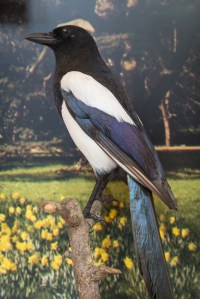
Magpie (Pica pica)

Some names are elegantly concise: Pica pica, the magpie. Some are tongue-twisters: Phalacrocorax carbo, the Great Cormorant. And some, such as Synalpheus pinkfloydiare entertaining. But they are all more than just names; they are the most visible aspect of the science of taxonomy.

Carl Linnaeus (1707-1778) first formalised the system we use today, which has allowed us to divide all the many species into not just genera, but a nested hierarchy of ever-more inclusive groups.

With this system we can not only be sure we are using a common language to precisely refer to the right species, but we can also then ask questions about how the staggering diversity of life that we see evolved. And from this we start to build ‘a tree of life’. But this will be the subject of a future article…

* Bonus points for knowing it’s the Western Gorilla, as opposed to Gorilla beringei, which is the Eastern Gorilla.

** Common Puffins, by the way, go by the delightful name Fratercula arctica, the ‘little friar of the north’.

Bound by blood

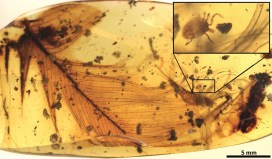
It may sound like we’ve stumbled into a script-writing session for Jurassic Park, but one of our research fellows, Dr Ricardo Pérez-de la Fuente, along with an international team, has discovered a parasite trapped in amber, clutching the feather of a dinosaur. This small fossilised tick, along with a few other specimens, is the first direct evidence that ticks sucked the blood of feathered dinosaurs 100 million years ago. Ricardo tells us all about it…

The paper that my colleagues and I have just published provides evidence that ticks fed from feathered dinosaurs about 100 million years ago, during the mid-Cretaceous period. It is based on evidence from amber fossils, including that of a hard tick grasping a dinosaur feather preserved in 99 million-year-old Burmese amber.

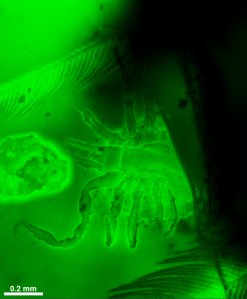
Fluorescence detail of the studied hard tick grasping a dinosaur feather. Extracted from the publication.

The probability of the tick and feather becoming so tightly associated and co-preserved in resin by chance is virtually zero, which means the discovery is the first direct evidence of a parasite-host relationship between ticks and feathered dinosaurs.

Fossils of parasitic, blood-feeding creatures directly associated with remains of their host are exceedingly scarce, and this new specimen is the oldest known to date. The tick is an immature specimen of Cornupalpatum burmanicum; look closely under the microscope and you can see tiny teeth in the mouthparts that are used to create a hole and fix to the host’s skin to suck its blood.

The structure of the feather inside the amber is similar to modern-day bird feathers, but it could not belong to a modern bird because, according to current evidence at least, they did not appear until 26 million years later than the age of the amber.

Feathers with the same characteristics were already present in multiple forms of theropod dinosaurs –  the lineage of dinosaurs leading to modern birds – from ground-runners without flying ability, to bird-like forms capable of powered flight. Unfortunately, this means it is not possible to determine exactly which kind of feathered dinosaur the amber feather belonged to.

But there is more evidence of the dinosaur-tick relationship in the scientific paper. We also describe a new group of extinct ticks, created from a species we have named Deinocroton draculi, or “Dracula’s terrible tick”. These novel ticks, in the family Deinocrotonidae, are distinguished from other ticks by the structure of their body surface, palps and legs, and the position of their head, among other characteristics.

Blood-engorged Deinocroton draculi tick (female). Extracted from the publication.

This new species was also found sealed inside Burmese amber, with one specimen remarkably engorged with blood, increasing its volume approximately eight times over non-engorged forms. Despite this, it has not been possible to directly determine its host animal:

Assessing the composition of the blood meal inside the bloated tick is not feasible because, unfortunately, the tick did not become fully immersed in resin and so its contents were altered by mineral deposition.
Dr Xavier Delclòs, an author of the study from the University of Barcelona and IRBio.

But there was indirect evidence of the likely host for these novel ticks in the form of hair-like structures called setae from the larvae of skin beetles, or dermestids, found attached to two Deinocroton ticks preserved together. Today, skin beetles feed in nests, consuming feathers, skin and hair from the nest’s occupants. But as no mammal hairs have yet been found in Cretaceous amber, the presence of skin beetle setae on the two Deinocroton draculi ticks suggests that their host was in fact a feathered dinosaur.

The hair-like structures, or setae, from skin beetles (dermestids) found attached to two Deinocroton ticks fossilised inside amber, in comparison with extant ones. Modified from the publication.

Together, these findings tell us a fascinating story about ancient tick behaviour. They reveal some of the ecological interactions taking place among early ticks and birds, showing that their parasite-host relationship has lasted for at least 99 million years: an enduring connection, bound by blood.

The paper “Ticks parasitised feathered dinosaurs as revealed by Cretaceous amber assemblages” is published as open access in Nature Communications. Direct link: http://dx.doi.org/10.1038/s41467-017-01550-z

Skeleton keys

by Chris Stimpson, visiting researcher from Queen’s University Belfast

Visitors to the museum will be familiar with the striking parade of mammal skeletons in the court, where they can get a close look at a polar bear’s jaws and peer up through the rib cages of Indian and African elephants, amongst many other things. But these mounted specimens are just a small sample of the animal skeletons that are looked after by the museum.

The main collection of skeletons is carefully stored in behind-the-scenes spaces such as the museum’s Tradescant Room. For researchers who work on animal bones found in archaeological sites, collections like these are not just important – they are essential.

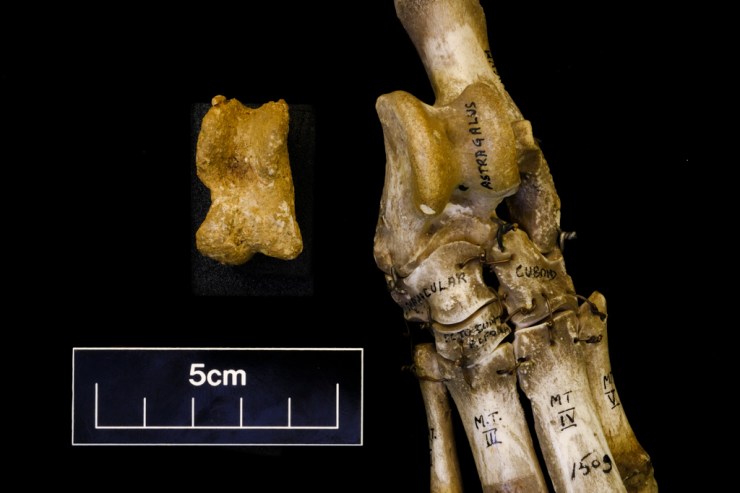
Comparison of an archaeological pig astragalus (ankle bone, left) with an articulated reference specimen from the museum collection (opposite leg, OUMNH.ZC.19948) of an Indonesian wild boar (Sus scrofa). Radiocarbon dating of charcoal indicates the archaeological specimen is over 17,000 years old.

Differences in size, shape, proportion, and the number and arrangement of bones and teeth are a great aid to identification. Teeth in particular often have features that help identify the animal they came from. Bones also have articulations and facets which can be helpful, though identification can be more challenging than with teeth.

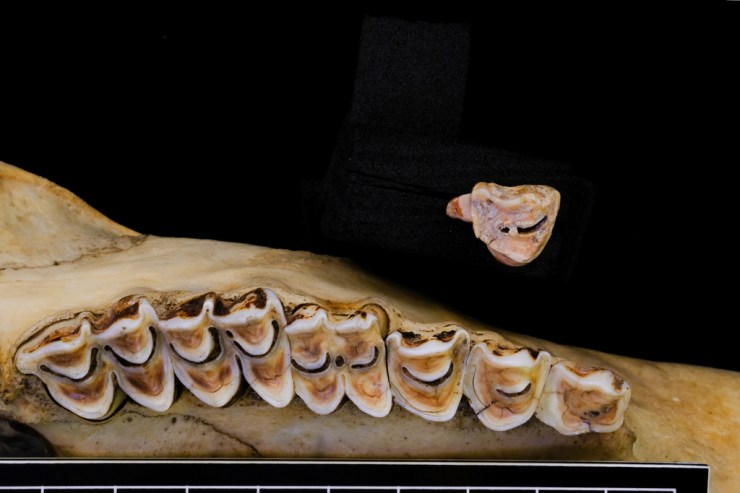
Comparison of an archaeological premolar (top), with the upper right tooth row of a goat-like animal called a serow (Capricornis sumatraensis) from the museum’s collection (OUMNH.ZC.21654). Radiocarbon dating of charcoal from the site indicates the archaeological specimen is over 5,000 years old.

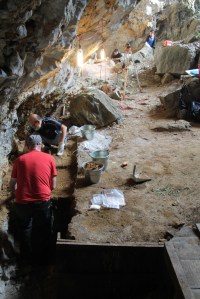
These challenges are part of the work I am doing on the SUNDASIA Project which is undertaking archaeological and palaeoecological investigations in the Tràng An World Heritage Area, in Ninh Binh Province, Northern Vietnam. Working with Vietnamese colleagues, we are investigating climatic and landscape changes that have affected – and may affect – the limestone karst forest over thousands of years. In particular, we’re looking at the responses of human, animal and plant communities to these changes.

The limestone karst landscape of the Trang An World Heritage Area

During our cave excavations we have recovered bones from a variety of birds, mammals, reptiles, fish and amphibians. Radiocarbon dates from charcoal in the cave deposits suggest this material ranges from 30,000 to 5,000 years old. This is great, but what can these bones tell us of animal life and human hunters at different times in the past? What has changed and why? And what could it mean for the future of Tràng An?

Excavations underway in Hang
Moi, a cave site in Trang An

Before we can begin to answer juicy research questions like these, we need to identify the bones. This is where collections like those held in the museum really come into play. Only with access to skeletons of known animals – where there is knowledge of family, genus or species classification – can we compare the excavated material and identify what we have found.

And while old bones and skeletons may smack rather of death, with a little patience and a good comparative collection like that in the museum, it is remarkable what a few specimens can tell you of life in different times and places that we otherwise know little about. Museum collections are a key to the past, present, and perhaps even to the future.

The crucial cortex

Lance Millar_Developmental Anatomy_14Oct2017.jpg-large

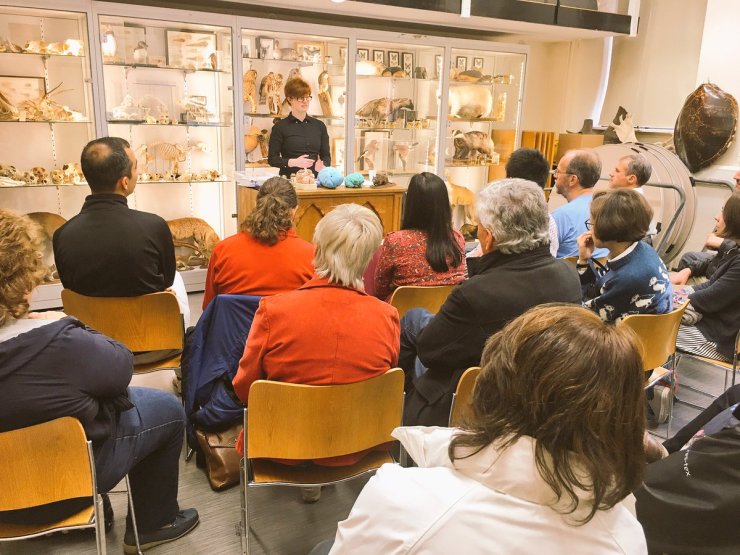
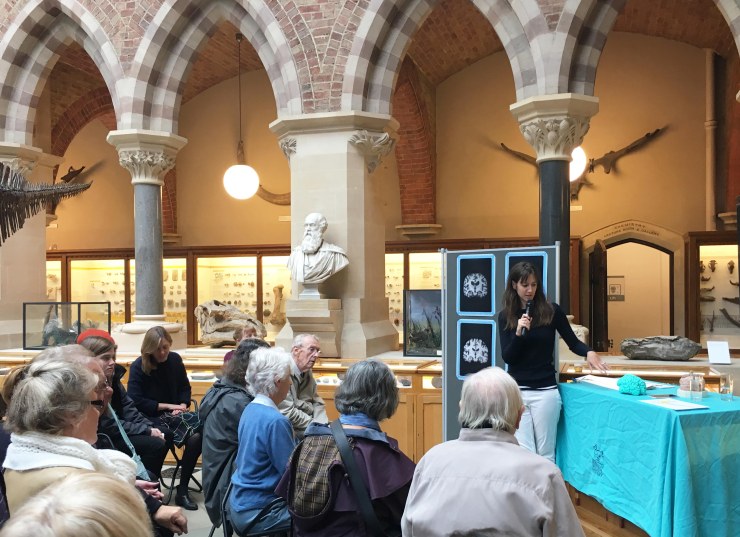
University of Oxford PhD student Lance Millar recently ran one of our Brain Spotlight events as part of the Brain Diaries exhibition programme. Here, Lance explains his research into neurodevelopmental disorders and possible treatments.

The brain has always been a fascinating organ for me. It is the site of our intelligence, our problem-solving and social skills, and it allows us to connect our senses to the world around us.

The large, folded outer part of the human brain is called the cortex, and is responsible for decision-making, language, face recognition, and a lot of the other things that I like to think are what make us human. The word cortex comes from the Greek for husk or outer shell, which underestimates the importance of what the cortex does.

Humans can survive with damage to the cortex, but depending on the part of the cortex that is damaged, a range of disabilities can result. People who have had a stroke can lose part of their cortex, leading to limb paralysis, loss of speech, or loss of memory, depending on the site of the damage.

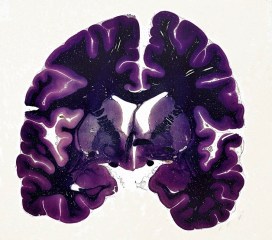
B0009564 Human brain, coronal section, LM
Cerebral cortex – Professor Michael R Peres – Wellcome Images

Some people are also born with a developmental problem in the cortex, and are said to have a neurodevelopmental disorder. Such conditions are thought to include autism, schizophrenia, ADHD, and even dyslexia – all fairly common conditions. The damage to the cortex is subtle and complex in these conditions, and scientists are still working out exactly what happens to the brain during its prenatal development.

I am studying one particular neurodevelopmental disorder caused by lack of oxygen at birth. It is known to medical specialists as neonatal hypoxia ischaemia. The image on the right shows a cross-section MRI scan of a normal newborn human brain, alongside some babies who have been damaged by oxygen deprivation. You can see that the brains are smaller, the cortex is less folded and it takes up less space inside the skull.

Woodward
MRI scans of normal newborn brains alongside those of babies who have been damaged by oxygen deprivation. Image: Woodward et al., New England Journal of Medicine, 2006

Scientists still don’t know how to protect the newborn brain from these injuries. Some are caused by inflammation which is a normal response to illness, but can wreak havoc in the confined space of the skull. Some is caused by the presence of free radicals, which are thought to contribute to ageing and organ failure, as the newborn brain doesn’t have many antioxidants to fight these chemicals. It’s also possible that the electrical signals that neurons within the brain send to each other contribute to the damage when there isn’t enough oxygen to feed them.

So what can we do to treat oxygen deprivation at birth? One breakthrough treatment currently available is known known as hypothermia. In this technique, the baby is cooled to 33℃ which slows down the brain-damaging chemical reactions which in turn protects the brain. This is currently the only treatment available, but I am involved in the study of possible alternatives.

We don’t want to introduce any drugs to the baby’s system as they might be harmful to normal development. So scientists are currently working on treatments which help the baby’s natural body proteins to protect the brain. I do this by looking at neurons under the microscope, and identifying proteins expressed by these neurons using fluorescent probes known as antibodies.

Neurons under the microscope
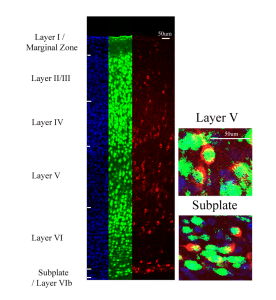
An example of neurons under the microscope. Image: Lancelot Millar

These neurons are expressing neuroserpin, a natural brain protein which decreases inflammation and cell death. I’m looking at exactly where neuroserpin is expressed in the brain, how it can be upregulated in response to oxygen deprivation, and how its chemical reactions could be used to protect the brain.

Another way to help people with neurodevelopmental disorders is to better understand how the cortex connects to other parts of the brain and how it can carry out complicated decisions. There is still so much to understand about the complexity of the human brain, and what seems like fundamental research could generate the springboard for new ideas for neurodevelopmental disorder treatments.

To explore the structure of the human brain and compare it to that of other animals see the Brain Diaries Brain Explorer below.


All about Alzheimer’s

University of Toronto research fellow Jacqueline Zimmermann recently ran one of our Brain Spotlight events as part of the Brain Diaries exhibition programme. To mark World Alzheimer’s Day today, here Jacqueline tells us about the neurophysiology of Alzheimer’s disease and the risk factors we can actively reduce to lead happier, healthier, and longer lives.

Almost all of us have in some way been affected by Alzheimer’s disease, which makes the quest for a cure that much more personal. An estimated one in nine people over the age of 65 will develop the disease, and this risk also increases with age, according to the World Alzheimer’s Report in 2015.

Brain Spotlight
Jacqueline Zimmerman’s Brain Spotlight on Saturday 16 September as part of the Brain Diaries exhibition series of events.

Due to chemical toxins, and increased longevity, the incidence for Alzheimer’s disease is on the rise. But the good news is that there is a lot that you can do to reduce your risk. At the John Radcliffe Hospital in Oxford, hundreds of scientists are currently working towards identifying the cause and the solution to the disease.

At the Brain Spotlight event at the Museum I presented images of ageing brains, and explained how brains affected by Alzheimer’s have reduced volume in the temporal lobe and the hippocampus, regions critical for language and memory respectively. Diseased brains will also often show reduced frontal lobe volume, which may reflect the changes in personality and the ability to engage in planning which area associated with Alzheimer’s. The overall volume of the brain is also reduced in sufferers because cellular changes lead to the death of neurons.

Brain Atrophy in Alzheimer’s disease
Brain Atrophy in Alzheimer’s disease. Note: overall brain volume is reduced, hippocampal regions and frontal regions are particularly affected, and ventricles are enlarged. Image: http://www.lookfordiagnosis.com

Recently, a number of genes have been identified that are related to early onset Alzheimer’s, which is quite rare and much more hereditary than late-onset Alzheimer’s. At the Nuffield Department of Clinical Neurosciences, where I am a visiting researcher, we are investigating a late-onset Alzheimer’s risk gene called Apolipoprotein 4 (APOE4), looking at how it relates to subtle cognitive impairments in middle-aged people. Working with the Oxford Biobank we are trying to determine which cognitive assessments may be most effective in predicting these impairments.

Jacqueline Zimmerman
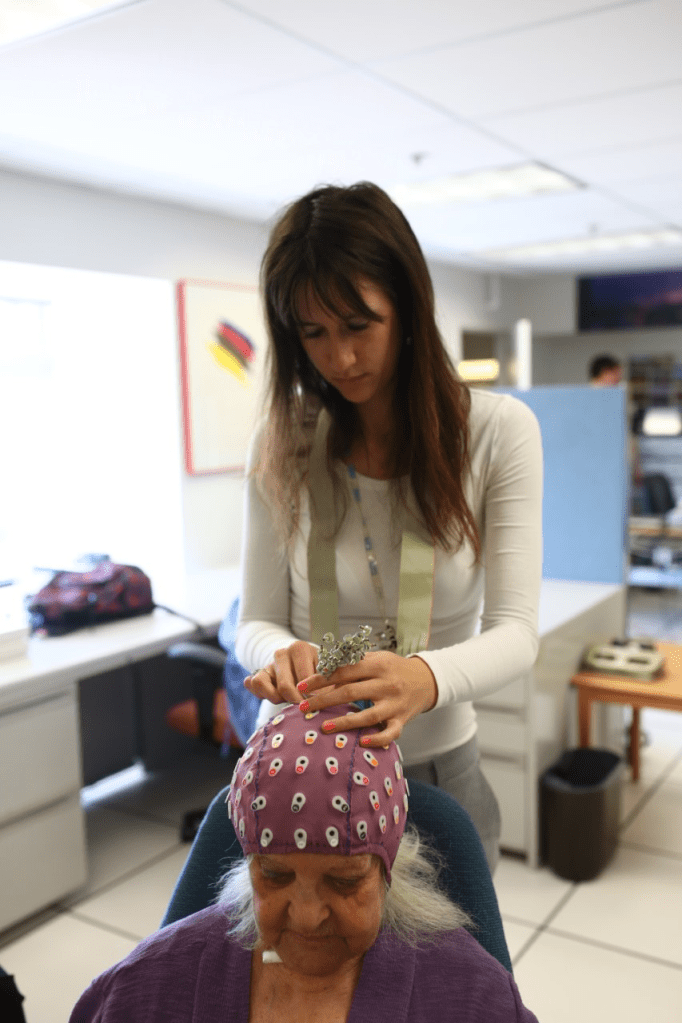
Functional brain imaging using electroencephalography at Rotman Research Institute in Toronto. Image: Rotman Research Institute

Although some of us may be more susceptible to Alzheimer’s than others, there are a number of environmental factors that contribute, including air pollution or additives in our food, like nitrogen-based chemicals which are used to preserve and flavour processed foods. It is important to reduce cholesterol in the diet, eat plenty of fruits and leafy greens, and engage in frequent physical and mental exercise.

Though there is speculation about the effectiveness of ‘brain games’ and how they translate into improvements in cognition in the real world, there are certainly large benefits of keeping your brain active.