Scouring the archives, and receiving an unexpected package, help our documentation officer Sarah Joomun in her investigations into the Museum’s Lyell collection of fossil material.
Read more on the latest post from Past to Present…
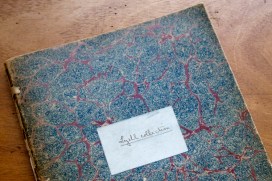
When I started work on the Lyell project in July of this year, I was very keen to know more about the history of the collection, both before and after it arrived at the museum. Collections often arrive at the Museum with associated material such as catalogues, letters or notebooks and after they arrive any activity related to the collection should be documented.
The first step in investigating the history of the collection was to find out what was in the Museum’s records. I began by looking at the donors database; this recorded the date that the Lyell collection arrived (1903) and the donor, Sir Leonard Lyell, Charles Lyell’s nephew. There was a little more information in the donors card index, which mentioned the fact that the collection came in two parts, the bulk of the collection in 1903 and then additional Italian specimens in 1907. The Collections Manager, Eliza…
As you can tell from the adornment of our Red Deer, Christmas is upon us, so it’s nearly time to bid farewell to another year. It’s been another remarkable twelve months here at the Museum so here’s a little round up a few highlights from 2015…
As winter gave forth to spring News emerged of a heartwarming thing The Art Fund whispered in our ear
We were nominees for Museum of the Year!
Although eventual winners we were not
It mattered really not one jot
For in celebration we embarked
On the Dodo Roadshow – a tremendous lark
Back in April we’re pleased to say Another award came our way Goes to Town gave creatures free reign
And grabbed a gong for Marketing Campaign
But we weren’t always on the road
In our exhibitions many stories were told
Of evolution, geology and sensory powers
Science and research passed the visitors’ hours
Our doors were open without interruption
While out on the lawn was a volcanic eruption
University scientists had plenty to say
On a really Super Science Saturday
So to our schools, and families, and adults and more
Thank you, cheers, and thank you some more
Our head of research, Sammy De Grave, is the lead author of a paper published in Scientific Reportslast week. In this paper he and his co-authors propose to remove an entire ‘order’ of crustaceans. But just what is an order, and why would we want to get rid of one?
Biologists organise all life into ranked groups. The most familiar, and at the bottom level, are genus and species. These are recognisable in the format Homo sapiens, where Homo is the genus and sapiens is the species.
One of the higher groupings is called an order. For crustaceans, there are around 70,000 known species grouped into approximately 50 different orders. One of these orders is the subject of the paper mentioned above – it’s called Amphionidacea – and the odd thing about it is that it was created in 1973 for just one species, an enigmatic open-sea creature called Amphionides reynaudii.
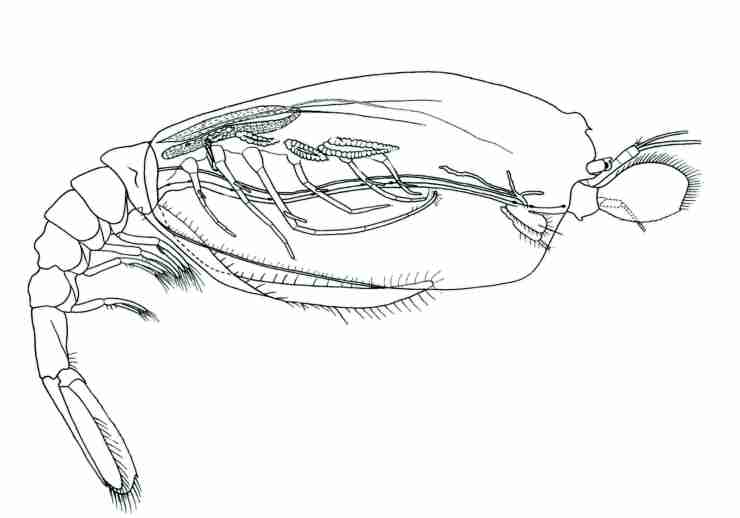
Presumed adult female of Amphionides reynaudii (after Williamson, 1973)
Although the species has been known since 1833, relatively few specimens have been collected and almost none since 1973. Some larval stages have but recognised, but only three adult males have ever been found and no intact adult females have been collected. The reference illustration above is a composite of 43 damaged specimens.
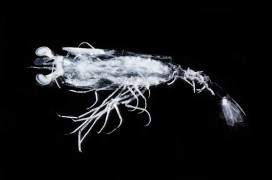
Lacking good research specimens, the status of this creature has long been debated. Luckily, in 2011 Jose Landeira, a biologist on Gran Canaria, collected six specimens. As usual they were extensively damaged (you can see this in the photograph at the top), but a specialist genetic lab at National Taiwan Ocean University was able to extract some small fragments of DNA.
Building on earlier work by a US group, the sequences were analysed and the results show that Amphionides is not a separate order after all, but merely a shrimp. You can see where it fits in the taxonomic scheme of things by clicking the chart below.
Phylogram of the Decapoda order of crustaceans, which includes crayfish, crabs, lobsters, prawns and shrimp. The position of Amphionides indicated in red (click to enlarge)
In keeping with its oddball status, however, many questions remain unanswered. Amphionides larvae have been recorded across all oceans from the tropics to subtropics, but almost no known shrimp species have such a distribution as adults. And although the genetic analysis reveals a strong affinity to a single family of shrimp (Pandalidae), it remains unclear which genus or even species it could be the larvae for.
So Amphionides may be removed from its order, but the mystery of the little shrimp lingers yet…
Dung doesn’t always get a lot of attention, but his week a new project, known as DUMP, has been all over the news. The project team are here to try and convince you that dung really is fun.
**
How often do you think about dung? Possibly not at all, yet without Dung Beetles we would literally be up to our necks in it.
There’s no doubt, Dung Beetles are an important group of insects, particularly for the agricultural environment. Recent research estimated that dung beetles save the UK cattle industry £367 million per year (Beynon et al. 2015). They provide all sorts of ecosytem services, including their famous ‘dung removal’ and others you may not be aware of. For instance, they reduce gastrointestinal parasites of livestock, nuisance flies, and play a key role in improving soil condition through aeration and nutrient recycling.
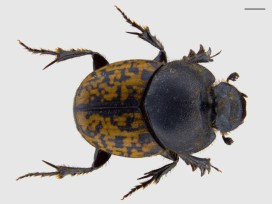
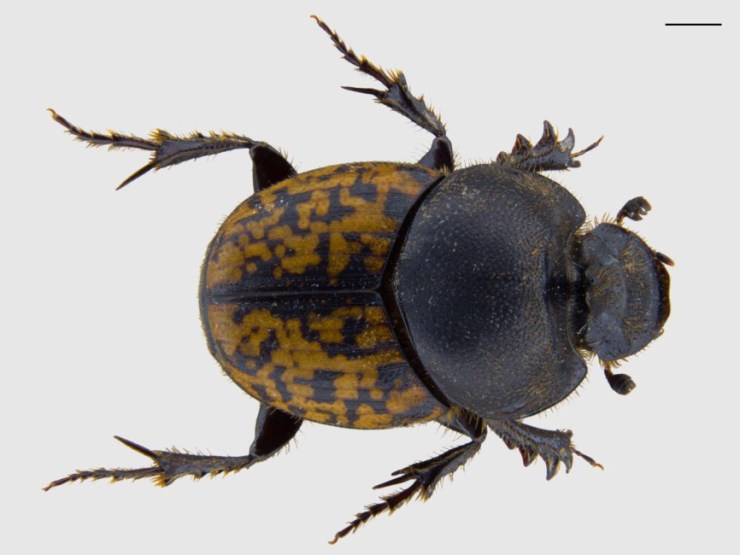
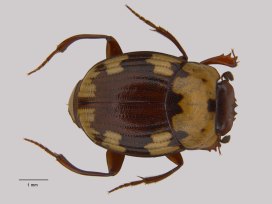
Aphodius subterraneus – possibly extinct in the UK
In the UK there are 100 species of Scarabaeoidea, which includes the Dung Beetles, Chafer and Stag Beetles. Over half of these are dependent on dung. As part of the on-going Species Status Assessment Project with Natural England in collaboration with Buglife , a review of the scarce and threatened Dung Beetles and Chafers is currently in progress (S.A. Lane & D.J. Mann, in prep.). The preliminary results indicate an alarming decline in our Dung Beetle fauna.
Just over 25% of UK Dung Beetles are ‘Nationally Rare’ and four species may even have become extinct in the past 50 years. This project also highlighted the lack of modern records for many of the rare species and that many areas of the UK are severely under recorded.
All this prompted us (Darren J. Mann, Steve Lane, Sally-Ann Spence & Ceri Watkins) to go out and look for beetles and to re-survey sites where rare species were previously known. DUMP was born.
The Dung Beetle UK Mapping Project (DUMP) aims to record Dung Beetles across the UK, provide distributional records and gather information on habitat requirements and ecology. The DUMP team will also engage with landowners, farmers and the general public on the benefits and value of dung beetles.
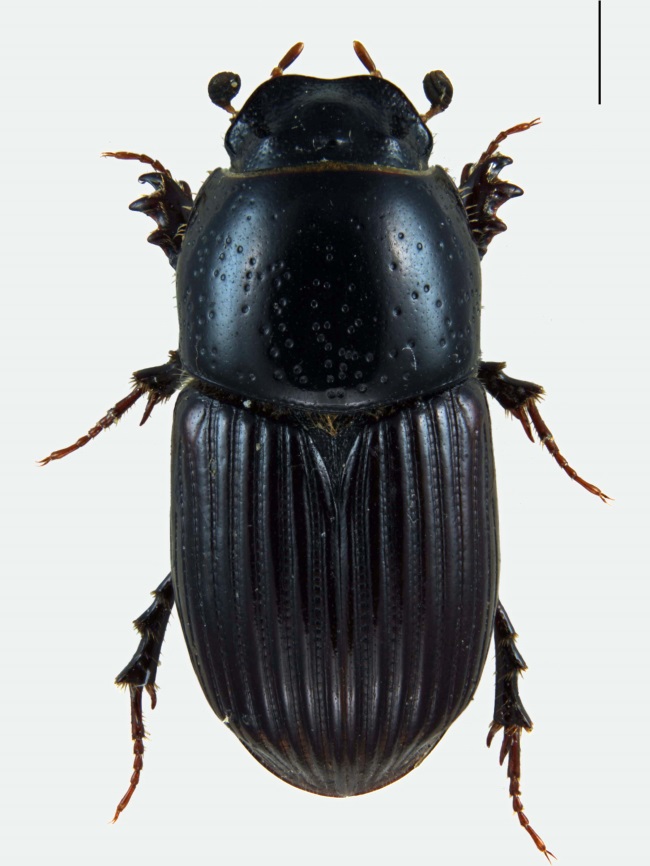
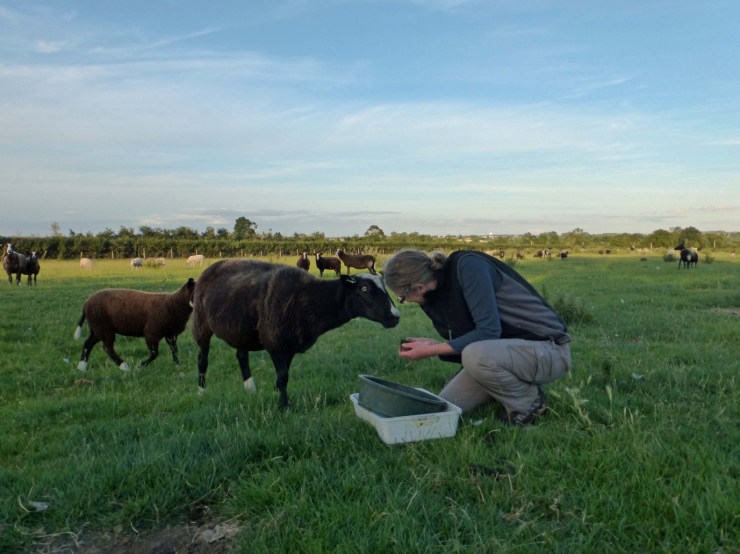
Ceri Watkins making new friends during DUMP fieldworkAphodius lividus
Over the past few years the team has travelled across the country from the Orkneys to the Channel Islands sampling across a range of habitats. A targeted survey for Onthophagus nuchicornis discovered healthy populations in North Devon and South Wales, but highlighted the dramatic decline of this species in its previous strongholds in Norfolk and Suffolk.
We also made some positive new discoveries including finding the rare Aphodius lividus and Aphodius sordidus on the Norfolk–Suffolk border, and Aphodius porcus at a new site in South Wales.
The DUMP project is in its early stages and comprised of a small team of volunteers. In the near future we hope to provide further information, distributions maps, online recording, and advice for management plans to help conserve our dung-inhabiting fauna. You can help out on social media too – tell the world why Dung Beetles matter and why #dungisfun!
Followers of our Once in a Whale blog a while back may be aware of the huge task that faced our Life Collections conservator Bethany Palumbo and her team as they set out to clean, restore and repair the whale skeletons that hang from the Museum roof.
In my first week here, I received an enquiry about the history of these specimens, and digging through the archives I was pleased to find that they are not just ‘prop’ skeletons acquired for the purpose of display – they are important in the history of whale biology too. So this article is something of a postscript to the Once in a Whale project.
Surprisingly, it wasn’t until the mid-19th century that much was understood about the science of the largest animals to have lived on Earth. Some species were known from strandings; others from accounts – varying in reliability – from fishermen.
Yet difficulties in preserving and transporting such large creatures (as well as the penchant for eating stranded whales at community festivals) meant that the biology and behaviour of whales was poorly-described and documented until fairly recently. So much so, that in early scientific literature just a few scientists are singled out as having actually seen the animals they were studying.
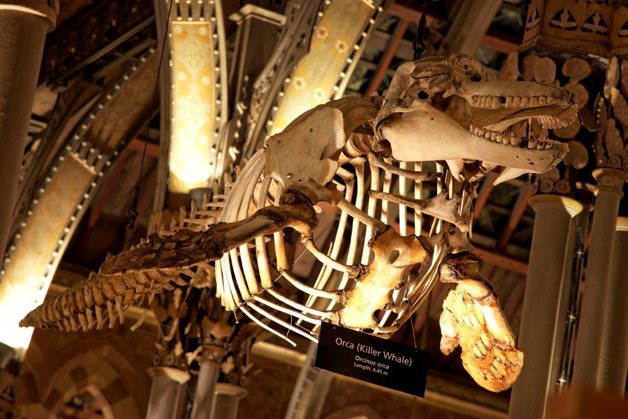
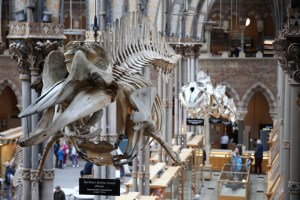
In the Museum there are five whale skeletons suspended from the roof, along with the skull of a Humpback Whale and the mandible of a Sperm Whale. Some of the earliest ‘whaleologists’ made the trip to Oxford to see these specimens in a race to formally describe new species or new aspects of whale biology.
In particular, two 19th-century anatomists competed to make new discoveries about whales. Dr John Edward Gray, keeper of zoology at the British Museum (Natural History), and Professor Daniel Frederick Eschricht, a Danish comparative anatomist, were so competitive that Gray made sniping comments in formal papers, questioning Eschricht’s observations.
John Edward Gray ‘destroying’ Eschricht’s observations. From Gray, J. E. 1864, On the Cetacea which have been observed in the seas surrounding the British islands
But perhaps this competition was more sporting than malicious: Gray did name the gray whale, Eschrichtiusrobustus,in Daniel Eschricht’s honour.
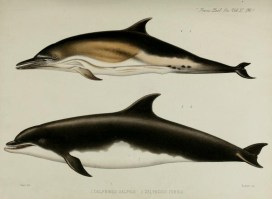
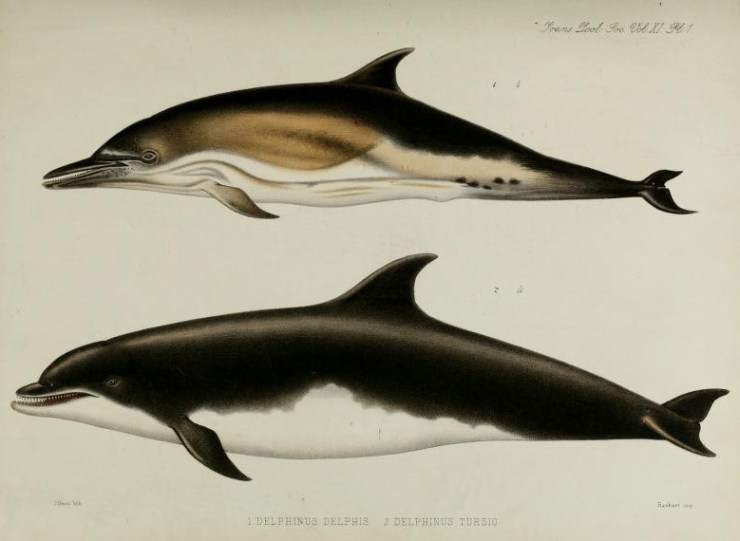
Eschricht actually presented the Museum with two of the specimens now on display: the Humpback Whale skull at the entrance and the suspended Minke Whale skeleton. Of the others, the Bottlenose Dolphin skeleton was caught near Holyhead in 1868 and was drawn by another notable natural historian, William Henry Flower, before being skeletonised for the Museum.
The Orca skeleton is from an individual killed in the Bristol Channel by fishermen in 1872, and the Beluga Whale was collected from Spitsbergen, Norway in 1881 and presented by Alfred Henge Cocks, who donated a range of mammal specimens to the University of Oxford.
The female Northern Bottle-nosed Whale skeleton has been harder to track down. It’s possibly a specimen shot in Weston Super-Mare in 1860 mentioned by Gray, but it isn’t clear. Lastly, there’s the large Sperm Whale mandible that greets visitors at the entrance. It doesn’t have much of a recorded history, but is allegedly one of the largest specimens in the UK according to a ‘researcher’ whom I’ve yet to track down.
William Flower’s drawing of the Bottle-nosed Dolphin (lower); the skeleton from this individual is on display in the Museum
The next time you are in the Museum, do look up: the skeletons there are not simply representing ‘whaleness’ but are also individual animals and important specimens in the early discovery and description of whale biology.
Each summer we host a variety of interns, working both in the collections and with the public. Oxford University student Maria Dance has now come to the end of her placement and reflects on the delights of dung beetles and what they can teach us about ecosystems.
**
Over the past six weeks I have been working in the Hope Entomological collections, home to an estimated 5 million insect specimens. Coming fresh from my second year studying biology at Oxford University, I have been working on a project to sample-sort and identify dung beetles from the SAFE project in Sabah, Malaysian Borneo.
A very short introduction to dung beetles
From the order Coleoptera, sub-family Scarabaeinae, most true dung beetles feed exclusively on dung. Some roll dung away from the main pile and bury it for food or as a brood site, some tunnel below the dung and bury it that way, and others are “dwellers” and simply live in it. All are essential groups for ecosystem functioning and provide indispensable services from which humans benefit; dung beetles recycle nutrients, rework soils, and act as secondary seed dispersers.
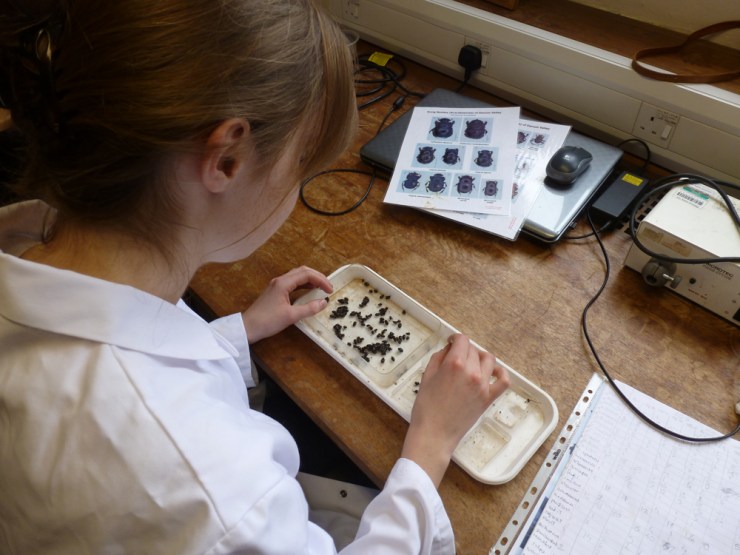
Maria sorting through a dung beetle sample
Dung beetle research at Oxford
Researchers at Oxford are studying the link between dung beetle biodiversity and ecosystem functioning to predict the true environmental consequences of human-driven habitat loss and fragmentation in the tropics. So I have been identifying beetles to calculate diversity, which is then compared across sites with very different human disturbance levels. Dung beetle diversity and community composition are good proxies for ecosystem functions as we know the roles that different groups of dung beetles play.
More than an intern
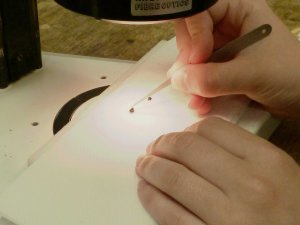
Working on tiny dung beetle specimens
The starting point is for me is material collected from (human) dung-baited pitfall traps, which I search through and extract all dung beetles from; it’s a smelly, tricky job that needs a sharp eye as some beetles can be as small as 2mm in length!
Next comes the hard part: identification. Darren Mann, Head of Life Collections at the Museum and dung beetle taxonomist extraordinaire has guided me through the process. It was particularly difficult to identify the Bornean species due to the lack of good primary literature. A microscope is essential, as many characters used to identify species are not visible with the naked eye.
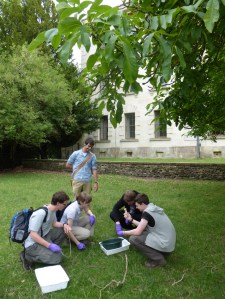
Students sampling for dung beetles at Magdalen College deer park
As my internship draws to a close, I have identified 6851beetle specimens to 56 species. I have also carried out some initial analyses: comparing diversity between habitats, and between data from 2015 and 2011. I want to find out whether differences over time are more significant than differences between habitats.
In my last week I was fortunate enough help run a “Spotlight Specimens” session about silk worms and their fascinating, human-dependent existence. In the sessions, experts from the Museum collections show intriguing objects and specimens that are not usually on display. Visitors were able to interact with live silk worms and see them cocoon-building, while we answered questions.
In September I travel to Borneo for a field course, where I hope to put my newly-learnt identification skills to practice. Over the past six weeks I have become more enthused by taxonomy, tropical rainforest ecology but, most importantly of all, dung beetles!






 Yet difficulties in preserving and transporting such large creatures (as well as the penchant for eating stranded whales at community festivals) meant that the biology and behaviour of whales was poorly-described and documented until fairly recently. So much so, that in early scientific literature just a few scientists are singled out as having actually seen the animals they were studying.

 More Than A Dodo