Striking gold

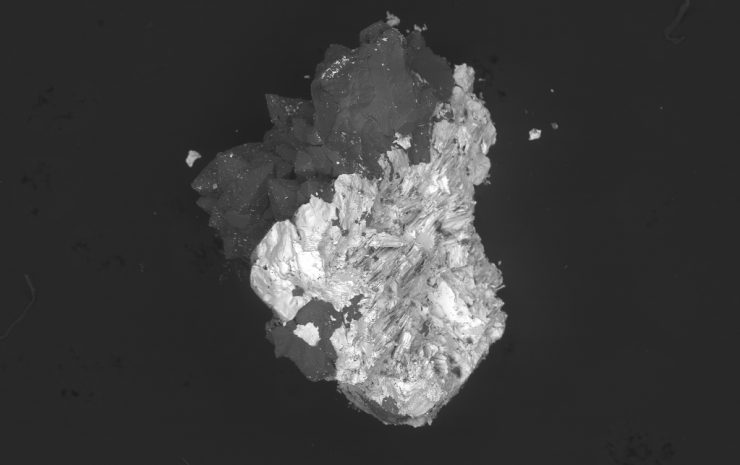
Nagyágite SEM

For the last six weeks, Oxford Earth Sciences undergraduate Charis Horn has been identifying mystery minerals in the Museum’s collections, and she’s struck gold! More precisely, she’s found rare gold-bearing crystals of nagyágite and sylvanite on a specimen which for centuries had been mis-labelled as the common lead mineral galena.

Nagyágite is composed of gold, lead, sulphur, antimony and tellurium and forms metallic grey crystals. Sylvanite is made up of gold and tellurium with a little silver, and is pale, silvery yellow. These minerals and their surrounding rock matrix indicate that the specimen is from the gold mines of Săcărâmb, in Romania, formerly known as Nagyág –  the place where nagyágite was first discovered.

Charis on SEM
Charis using the scanning electron microscope

Charis is one of a number of interns funded by the Higher Education Funding Council (HEFCE) through the University’s Internship Programme to learn more about academic research.

Rocks and minerals have always fascinated me, which is the reason I chose to study Earth Sciences at university. I find it amazing that the history of this planet can be read in the geology beneath our feet.

Many of Charis’s samples were put aside for a bit of extra work many years ago because the minerals on the specimen were potentially more interesting than the labels might suggest. Some can be identified by looking at physical characteristics such as colour and crystal shape, or by testing for properties like hardness and magnetism.

Others are much more challenging, and Charis has been using an analytical scanning electron microscope (SEM) to see close-up images of minute crystals to find out what chemical elements they are made of. There’s an SEM image of the nagyágite crystals, seen in white, at the top of the post.

Another of her discoveries has been a rare lead-bearing silicate mineral called hancockite, which was found on a specimen supposed to be from ‘Glen Coe, Argyllshire’. The orange-red crystals are less than a millimetre long, and hancockite is known from only one place in the world: Franklin mine, in New Jersey, USA.

It seems our specimen comes from Franklin mine too, and is the first sample of hancockite in the Museum’s collections. So both specimens must have had their labels muddled up in past centuries.

I have really enjoyed learning more about mineralogy during my time here at the Museum. Realising that something is far more exciting than it first seemed is definitely a great way to end this internship!

Monica Price – Head of Earth Collections
Drawing on the past

page 3 low

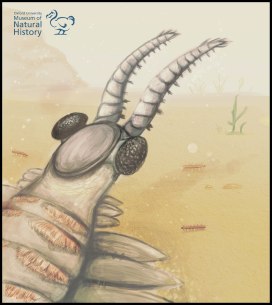
My name is Jasmine Bevis and I’m an Illustration student at Plymouth University. I have a great interest in prehistoric life, so when the Museum of Natural History suggested a project, I just had to get involved. The task was to develop a new reconstruction of Anomalocaris, a 500 million year old predator from the Cambrian era. With input from palaeontologist Allison Daley I came up with a successful design, and was invited to come to the museum for a placement.

Jasmin's Anomalocaris
Jasmine’s Anomalocaris

On my first day I was welcomed with open arms by Allison Daley and Eliza Howlett. I was given a look behind the scenes and shown some extraordinary fossil specimens that brought out my inner child. It got more exciting when I was shown my workstation, a room packed full of fossils and all manner of objects; I would not have to look far for inspiration! Meeting the Public Engagement team was next, where I was given my first project, to draw digital line artworks for education worksheets. These drawings needed to be clear, accurate and easy to photocopy.

Ichthyosaur to be used for education resources

Over the next 5 days I completed line artworks of a turtle, a spider crab, a nautiloid and an Ichthyosaur. I was also given the pleasure of illustrating 3 crustacean fossils for a paper that Allison was working on.

Another of Jasmine's Anomalocaris illustrations
Another of Jasmine’s Anomalocaris illustrations

Allison and I would talk about the Anomalocaris project over lunch and then I’d make improvements to my reconstruction; knowing that she would use it in lectures was a great feeling.

page 4 low

On the last day I met botanical illustrator Rosemary Wise, who filled me in on her career and showed me her wonderful artworks. I took this last day to finish as much as I could, and wander around the beautiful museum doing huge numbers of drawings. It was no  surprise to see the that T. rex, king of the dinosaurs, conquered most of my pages!

Jasmine Bevis, illustration student

Prehistoric parasites

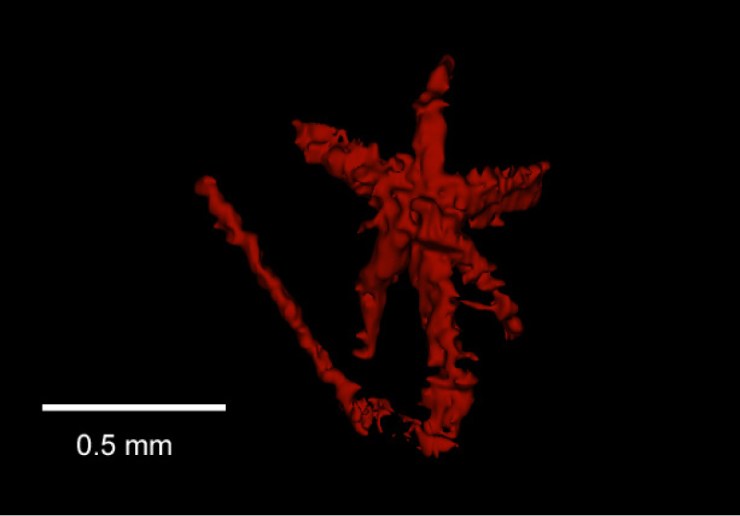
Digital reconstruction of fossil pentastomid, Invavita piratica

Our understanding of very early life is constantly developing. Carolyn Lewis, research technician in the Museum’s Earth collections, describes a recent discovery.

**

Invavita piratica is a new species of fossil parasite, recently discovered at the Museum in a 425 million year old rock from Herefordshire. This tiny creature, which belongs to an unusual group of parasitic arthropods called pentastomids, is particularly exciting because it was found attached to its host, an ostracod crustacean. A paper published last week in the journal Current Biology by Professor Derek Siveter, Senior Research Fellow at the Museum, and his co-researchers describes how this discovery sheds new light on the evolution of pentastomids.

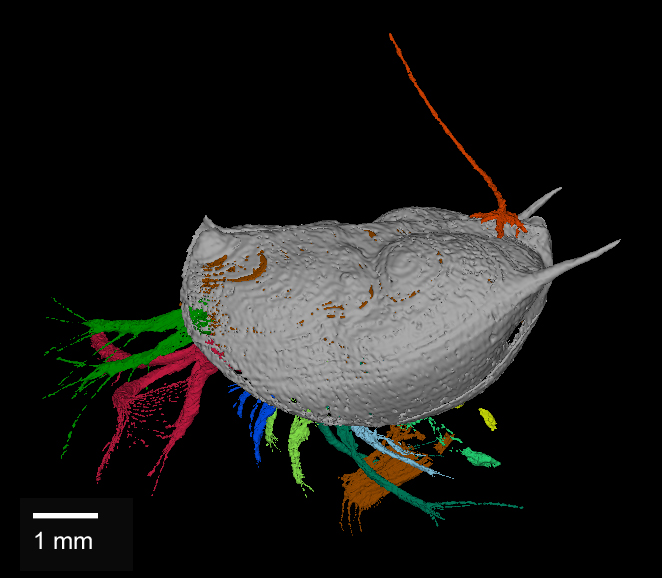
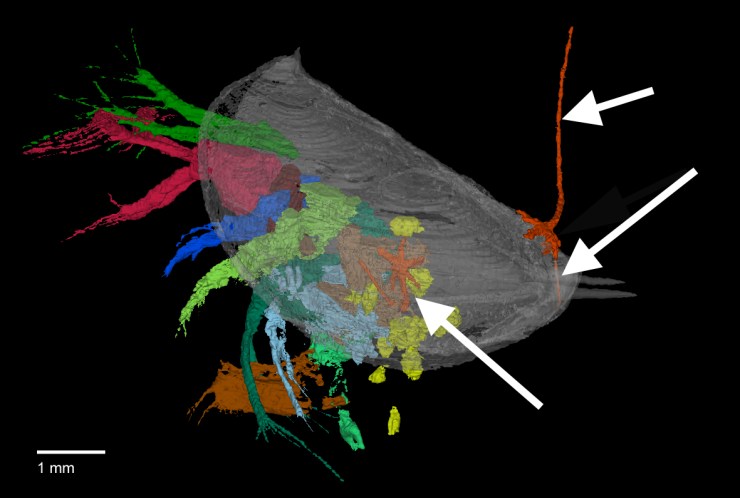
Digital reconstruction of the ostracod Nymphatelina gravida with 2 overlapping specimens of the pentastomid Invavita piratica (artificially coloured orange) attached externally to the shell of the ostracod.

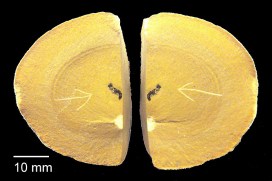
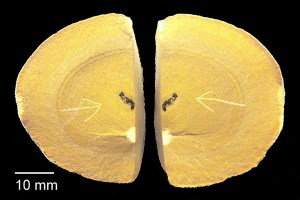
The pentastomid Invavita piratica is the latest new species from the Silurian Herefordshire Lagerstätte, a deposit of exceptionally well preserved marine invertebrate fossils ranging from less than a millimetre up to a few centimetres in length. We investigate the fine structure of the Herefordshire fossils by a process of serial grinding and photography followed by painstaking editing and 3D digital reconstruction of the specimens as ‘virtual’ fossils.

Nodule split and ready for investigation

The many arthropods so far described from the Herefordshire Lagerstätte include four new species of ostracod, tiny bivalved crustaceans that are widespread in the oceans of today. The Herefordshire ostracod fossils are preserved in exquisite detail including limbs, spines, eyes and in one species, Nymphatelina gravida, eggs.

It was while editing a specimen of Nymphatelina gravida, that we spotted three puzzling star-shaped objects: an overlapping pair attached externally to the shell and one inside the body of the ostracod. On further investigation these were identified as adult pentastomids, each with an elongated snout, two pairs of outstretched limbs and a long slender trunk, together forming the star-shape. The eggs of Nymphatelina gravida may have provided a source of nutrition for the internal parasite.

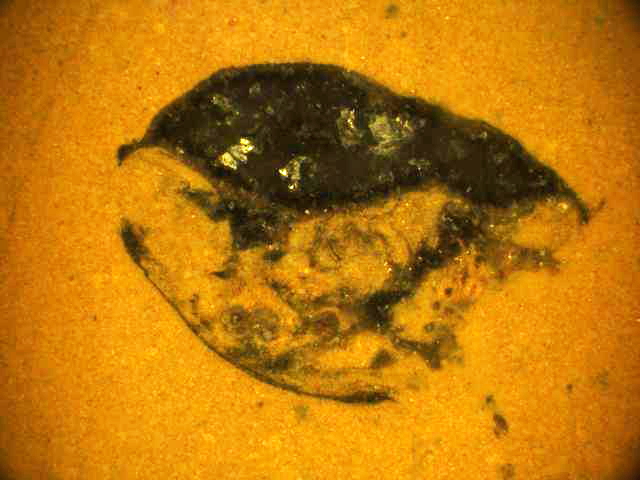
The ostracod Nymphatelina gravida before digital reconstruction

Fossil pentastomids are incredibly rare: Invavita piratica is the first adult fossil pentastomid to be discovered and the fossil pentastomid to be found attached to its host.  Apart from our Silurian specimens, just a few isolated juvenile pentastomid fossils are known from even older Upper Cambrian and Ordovician rocks.

Digital reconstruction Nymphatelina gravida (with shell rendered semi-transparent).  The arrows indicate the 3 specimens of the parasite Invavita piratica (artificially coloured orange) – 2 external overlapping specimens attached to the shell and 1 internal parasite near the eggs (yellow) of the ostracod.

Our discovery of a marine ostracod as the host of Invavita piratica shows that the parasitic lifestyle of pentastomids first evolved in the sea with invertebrates as early hosts. Pentastomids like Invavita piratica may have been transferred to marine vertebrates when their ostracod hosts were eaten by fish or conodonts. The timing of the terrestrialisation of pentastomids is unknown but it may have been in parallel with the subsequent vertebrate invasion of the land.

Living pentastomid species almost exclusively infest the respiratory tract of land-dwelling vertebrates, particularly reptiles but also birds and mammals. Because all known fossil pentastomids lived long before land vertebrates evolved, the identity of these early hosts were something of a puzzle.

Carolyn Lewis – Research Technician


Trowel Blazers

Lottie 8 (2) As the recent winner of the Jan Bergström Young Geoscientist Award, Dr Allison Daley is an inspiration to many budding geologists. Today, to celebrate the birthday of Mary Anning, probably the most famous female paleontologist ever, Allie reflects on the scientists who have inspired her and describes an encounter with a tiny female fossil hunter.

**

This week I received a special visit from a pint-sized friend, who is small enough that she actually arrived in the post. Fossil Hunter Lottie is an aspiration ‘pro girl’ doll who was designed in collaboration with my friend Tori Herridge at Trowelblazers. If you haven’t heard of Trowelblazers, you should definitely check it out. Trowelblazers is a celebration of women and their many contributions to archaeology, paleontology and geology. Articles and blog posts explore the important work of both historical and modern women scientists in these fields.

Special delivery on Allie's desk
Special delivery on Allie’s desk

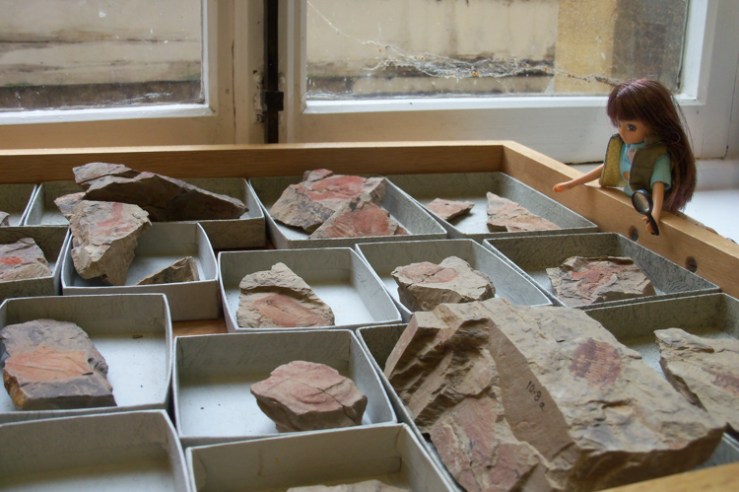
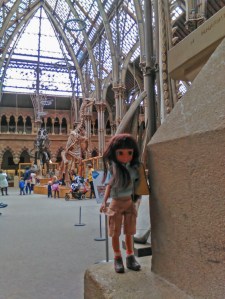
Trowelblazers has organized a UK tour of Fossil Hunter Lottie, leading up to today, her “official” launch day. Lottie is visiting women academics across the country, and blogging photos and videos along the way. During her day with me, Lottie explored the Museum and had a look at the research currently going on here.

Lottie explores the Museum

Fossil Hunter Lottie’s launch day, 21st May, coincides with the anniversary of Mary Anning’s birthday. Considered one of the greatest fossil hunters of all time, Mary Anning discovered some of the earliest specimens of Ichthyosaurus and Plesiosaurus from the Jurassic Coast in Dorset in the early 1800’s. This was a critically important time when ideas about palaeontology and the history of life on Earth were in a state of flux. Although she was not able to participate fully in the male-dominated scientific community, her contributions greatly influenced the thinking of academics at the time. She was intelligent, skilled and had the tenacity to build a name for herself in the face of much opposition. Mary Anning has always been an inspiration for me, as I’m sure she is for many female palaeontologists. It is almost impossible to imagine the kind of challenges Mary Anning faced, solely because she is a woman. I am fortunate to have rarely ever felt any limitations imposed on my work or my career by the fact that I am female.

Allie and Lottie outside the Museum... on a very windy day
Allie and Lottie outside the Museum… on a very windy day

I’ve participated in many field expeditions, and worked globally with wonderful colleagues, both male and female. As a child I always loved science, and my enthusiasm to become a scientist was encouraged and nurtured by my parents, who both studied biology at university. They have both always been a source of inspiration for me (thank you, mom and dad!). During my education and these early stages of my academic career, I’ve had excellent male and female mentors. This kind of support didn’t exist in Mary Anning’s time, making her accomplishments all the more impressive. Hopefully Fossil Hunter Lottie will help inspire more girls to take up science and consider becoming a trowelblazer, just like Mary Anning!

Dr. Allison Daley, Museum Research Fellow

The Iron Snail

5

The Museum has recently received specimens of the enigmatic deep-sea vent snail, Chrysomallon squamiferum, the scaly-foot snail. In this post, Dr Chong Chen explains why this species is so extraordinary.

*

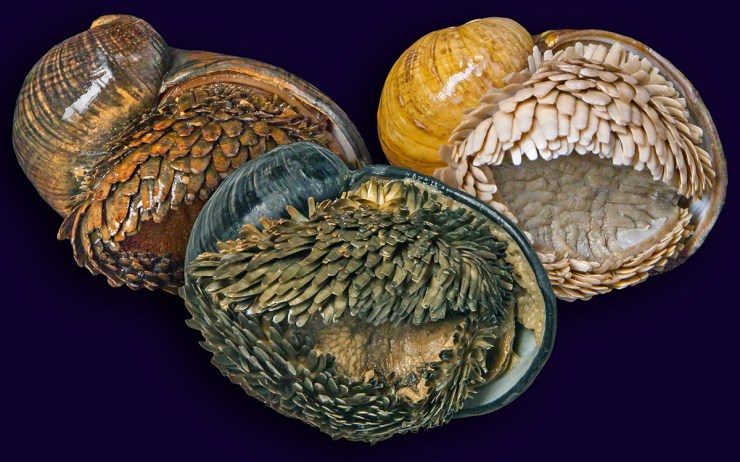
This is no ordinary snail. First of all, it lives in deep-sea hydrothermal vents in the Indian Ocean, more than 2,500 metres deep, just beside black smokers that are churning out superheated water exceeding 350°C. Second, it is the only known gastropod with a suit of scale armour. Thirdly, the scales as well as the shell are mineralised with iron sulfide. That’s right – these snails make a skeleton out of iron, and are the only animal so far known to do so.

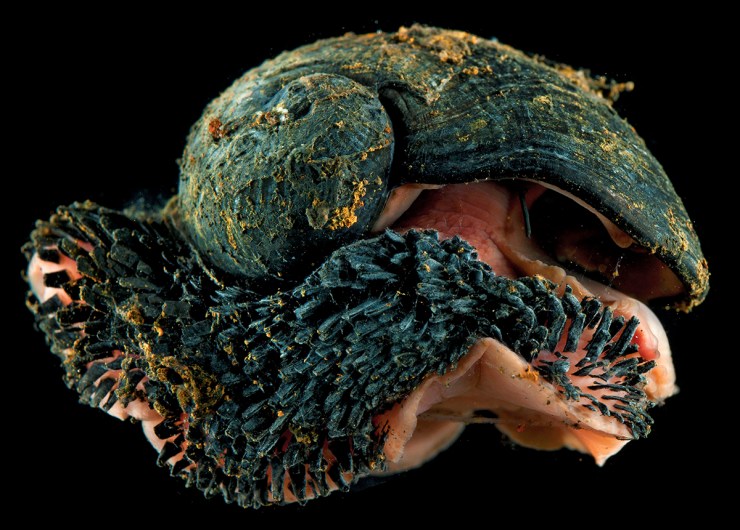
A specimen of Chrysomallon squamiferum photographed live (Photo: David Shale)

Hydrothermal vents were first discovered in the Galápagos Rift as recently as 1977. This is just off the Galápagos Islands whose fauna famously inspired Charles Darwin in the development of his theory of natural selection. Vents are deep-sea ‘hot springs’ fuelled by geological activity; the hot erupting fluid is usually acidic and contains various metals, as well as hydrogen sulfide. This is what makes rotten eggs smell bad, and is toxic to most organisms. Some bacteria, however, are able to use it to produce energy in a process known as chemosynthesis.

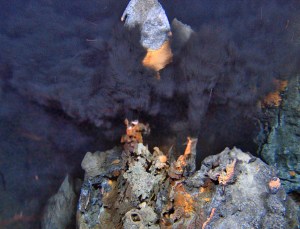
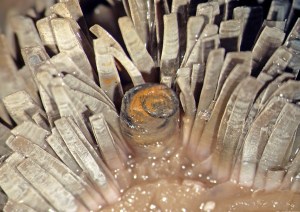
Hydra, an active ‘black smoker’ vent chimney in Longqi field, Southwest Indian Ridge

Over geological timescales many remarkable organisms have adapted to live in these ‘toxic utopia’, and flourish by exploiting the energy produced by these bacteria. The scaly-foot snail has also harnessed the power of chemosynthesis, housing endosymbiotic bacteria – bacteria living inside another creature to mutual benefit – in an enlarged part of its gut. This produces the energy it needs. In another words – it has a food factory inside its body and doesn’t even need to feed! This is likely the reason it can grow to about 45mm in size, when most of its close relatives without endosymbionts are only 15mm or smaller.

Close-up of the scales, also showing the reduced operculum in middle

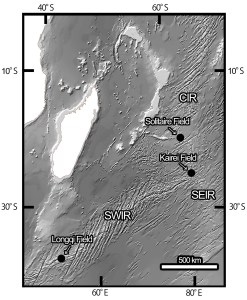
Scaly-foot snails were first discovered in 2001, at the Kairei vent field in the Indian Ocean. Its discovery came as a great surprise as even among those animals specialised for living at vents, it was very, very strange. And cool. Although the shell of a snail is well-known to be modified into a great variety of forms, this is not the case with hard parts on the foot, and apart from an operculum (the ‘trap-door’ serving as a lid when the animal retracts to its shell) no other gastropods have other mineralised structures on the foot. Yet C. squamiferum has thousands of scales!

The shell, although not particularly exciting in form, isn’t exactly ordinary either as the outermost layer is made of iron sulfide. And so are the scales. So this entire animal is covered in iron compound, mainly pyrite (FeS2, or ‘Fool’s gold’) and greigite (Fe3S4). As greigite is magnetic, the animal actually sticks to magnets. The function of the scales is postulated to be either protection or detoxification but their true use remains a mystery.

The three vent fields where Chrysomallon squamiferum is known from

So why blog about the ‘scaly-foot’ now, if it has already been known to science for more than a decade? Well, actually, despite numerous studies and publications on its strange biology this species has never been formally described and named, until now. A recent paper by Dr Chong Chen (Department of Zoology, University of Oxford) and colleagues finally gave it the scientific name you see here – Chrysomallon squamiferum.

The Museum received a set of five specimens as part of the description process, which will serve as key references for scientists who wish to study this extraordinary species in the future.

Here’s a video of the Longqi hydrothermal field featuring Chrysomallon squamiferum in their natural habitat:

‘Dead Shrimp Blues’

SONY DSC

I woke up this mornin’ and all my shrimps was dead and gone

So sang the legendary blues artist Robert Johnson back in 1937. Sadly, it’s a lyric which resonates today, according to a study led by the Museum and the International Union for Conservation of Nature (IUCN).

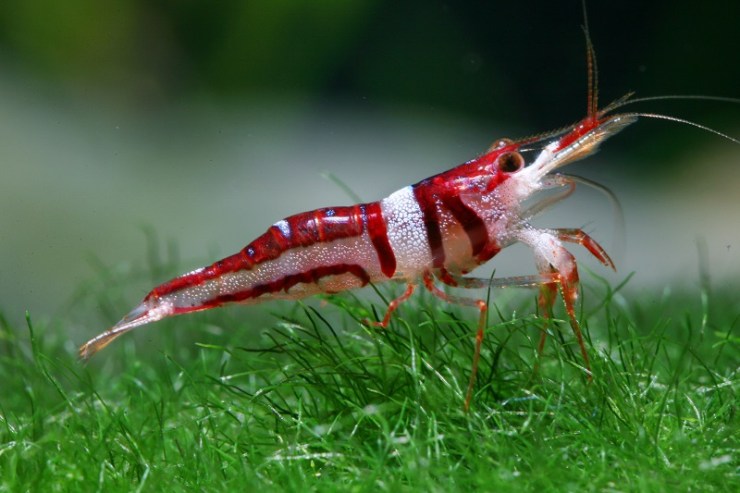
Almost 28% of the world’s 762 freshwater shrimp species, a group which supports the livelihoods of some of the world’s poorest communities, are now threatened with extinction, according to the IUCN Red List of Threatened Species. The main threats include urban and agricultural pollution, human intrusions and disturbance, and invasive species.

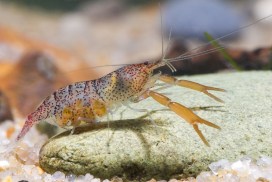
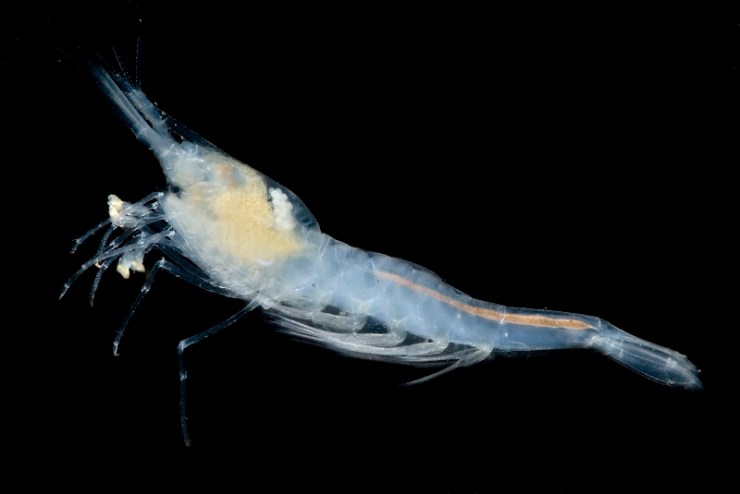
Euryrhynchus amazoniensis, a widespread Amazonian species. Photo: W Klotz

“Freshwater shrimps are extensively harvested for human food, especially by the poorest communities in tropical regions, where they often dominate the biomass of streams and play a key role in regulating many ecosystem functions. However, little is known about the impacts the loss of these species may cause to ecosystem services,” say the Museum’s Sammy De Grave, lead author of the report, which is published in the journal PLOS ONE.

Two species were declared as Extinct and a further ten are also Possibly Extinct, but require field surveys to confirm that status. Several of these species are only known from a single cave or stream in locations which have undergone significant levels of habitat degradation and conversion, and have not been sighted for decades. For example, Macrobrachium purpureamanus is only known from peat swamps on Kundur Island, Riau Archipelago (Indonesia), an area which from 1998 has been extensively converted to an oil palm plantation.

Caridina woltereckae, endemic to Lake Towuti (Sulawesi), currently under threat due to overharvesting for the aquarium trade, pollution and invasive fish species. Photo: C Lukhaup

The research, which collated distribution data for all species, identified areas containing high levels of species diversity in the Western Ghats, Madagascar, the Guyana Shield area, the upper Amazon, Sulawesi and Indo-China.  Additionally, high concentrations of cave-dwelling species were found in areas of China, the western Balkan Peninsula, the Philippines and Cuba.

Palaemonias alabamae. Photo: D Fenolio

Although threatened species are found across the globe, notable concentrations were found in Sulawesi (Indonesia), Cuba, the Philippines and southern China, many of which are restricted to cave habitats. As well as cave-dwelling species, those restricted to lakes and freshwater springs also face higher levels of threat. The Alabama Cave Shrimp (Palaemonias alabamae), for example, is listed as Endangered, and is known from only four cave systems in Alabama, USA that are currently under threat from groundwater abstraction and habitat change.

Global species richness of freshwater shrimps

As well as making a number of recommendations for conservation actions, the report stresses the urgent need for field research to increase understanding of the life histories, threats and distribution of many shrimp species.

“The high levels of extinction threat that the team found for freshwater shrimps have also been found for freshwater crabs and crayfish, and these studies of global faunas highlight the fragile state of freshwater invertebrates across the world,” says Neil Cumberlidge, Chair of the IUCN Species Survival Commission (SSC) Freshwater Crustacean Specialist Group.

“Sadly, the prospect of losing these important species often goes unnoticed. The information on these threatened freshwater crustaceans is readily available on the IUCN Red List and needs to be incorporated into decision making at all levels if we are to protect the world’s rapidly deteriorating freshwater habitats and the amazing but highly threatened species that live there.

Werner Klotz, one of the co-authors of the study collecting a new species of freshwater shrimp in Taiwan.
Werner Klotz, one of the co-authors of the study collecting a new species of freshwater shrimp in Taiwan

The study, Dead Shrimp Blues: A global assessment of extinction risk in freshwater shrimp (Decapoda: Caridea), involved researchers from the UK, Australia, Austria, Brazil, Indonesia, Mexico, Singapore and Taiwan.

Sammy De Grave – Head of Research