Beautiful gemstones are always popular with the public when they’re brought out for Spotlight Specimens. Monica Price talks about some she’s been showing off recently at our daily drop-in sessions.
**
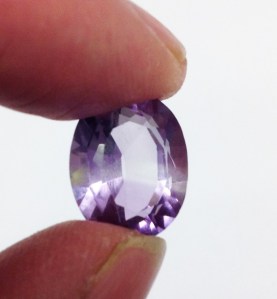
Now here’s a mineral that most people recognise straight away when I bring it out for Spotlight specimens. It is amethyst, and it is the most popular of all purple gem minerals. By a happy coincidence it is very common too, so jewellery made with amethyst need not be very expensive.
But that wasn’t always the case. In the past, fine, large, transparent crystals of amethyst could only be found in Germany, Russia and a few other places in the world. In Europe, the colour purple is traditionally associated with royalty and wealth, and so rare amethyst gems would feature in crowns and jewellery worn by heads of state and religious leaders.
Amethyst is actually a variety of one of the Earth’s most common minerals, quartz. Quartz is composed of silicon dioxide and helps form many different kinds of rock…. it even makes up most beach sands! Amethyst is the kind of quartz that contains a little bit of iron to turn it purple.
So how did amethyst suddenly become so common? During the 18th century, huge flows of volcanic lava were found by explorers in Brazil and Uruguay. Some had air bubbles which were lined with superb purple crystals of amethyst. Soon, these crystal-filled cavities were being sent to Europe, and today, they are sold all over the world. The biggest bubbles were a metre or more in size – huge! Nowadays, nearly all the amethyst you see for sale comes from those 135 million year-old South American lava flows.
My spotlight specimens include an amethyst gemstone and some lovely examples of those gas bubble cavities lined with crystals. One rather curious thing is that the crystals are rarely purple all the way through. The colour typically concentrates towards the tips of the six-sided crystals. If you come when I next show my ‘gas bubble gems’, you will see exactly what I mean!
A birthday, on 12 February, and an ‘inordinate fondness for beetles’ are possibly the only things Charles Darwin and I have in common. In his autobiographical notes (1887) Darwin says that at the age of ten he made the decision to collect, but not kill insects; at the same age I was given, by my junior school teacher, four Madagascan hissing cockroaches (the large male I called Burt). So Darwin and I began a lifelong fascination with natural history at a similarly early age, though with very different results.
Much is written about Darwin and his scientific accomplishments, but did you know he was also an avid beetle collector? The quote below is testament to his enduring enthrallment with beetles.
“I feel like an old war-horse at the sound of the trumpet when I read about capturing of rare beetles… It really almost makes me long to begin collecting again”
Trypocopris vernalis, collected by Darren Mann, North Wales, 1986
Darwin was also a close correspondent of Reverend F.W. Hope, the founder of the entomological collections at the Museum, and the two often set out on insect-collecting expeditions together. These trips regularly resulted in the capture of rare or unusual species, and an occasional publication.
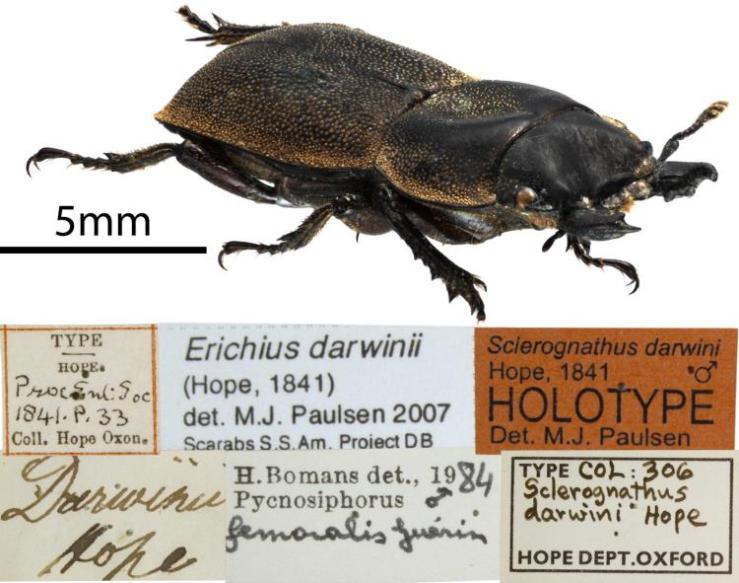
In 1831, Darwin embarked on his famous voyage around the world as naturalist on the HMS Beagle. He returned to England, in 1836, with around 4,000 insects, some of which were donated to his good friend Hope. Hope scientifically described a few of Darwin’s new species of beetles and named them in Darwin’s honour. Examples include the ground beetle Carabus darwinii and the stag beetle Dorcus darwinii.
Dorcus darwinii (Hope, 1841) “The above insect I have lately received from Chili. It is named in honour of Charles Darwin, Esq., who has greatly contributed to our acquaintance with the Entomology of Valparaiso, Chili, and other parts of the South American continent.” Hope, F.W. 1843.
During the Beagle voyage Darwin became the first collector of Tasmanian beetles. Onthophagus australis, collected by Darwin in Hobart Town in Tasmania in 1836, is shown in the photo at the top of this post. Whilst in Hobart Town he was also surprised to find
“Four species of Onthophagus, two of Aphodius, and one of a third genus, very abundant under the dung of cows; yet these latter animals [cows] had then been introduced only thirty-three years. Previously to that time, the Kangaroo and other small animals were the only quadrupeds; and their dung is of a very different quality to that of their successors introduced by man.”
This observation, possibly made on his birthday (and what a great way to spend the day) points to research questions that are ongoing today: the effects of habitat change from forest to pasture, and the impact that introduced farm animals have on native dung beetle populations.
In his 1871 publication, The Descent of Man,Darwin returned to dung beetles, writing about their sexual dimorphism, or differences in appearance between males and females, and arguing that there must be a contest between males and females which drives rapid evolutionary divergence amongst populations. There is now considerable scientific evidence to support these views on sexual selection, some based on dung beetle research.
Phanaeus quadridens from the New World
So we come full circle. I work in the building where, in 1860, there was the first public meeting on Darwin’s then newly-published book, The Origin of the Species, an event now often referred to as the Huxley–Wilberforce debate, or Great Debate. My hobby and research interest focus on dung beetles and their ecology, including the effects of habitat change and loss of dung beetle diversity. And within sight of my office are those dung beetles Darwin wrote of from Hobart Town…
I am fortunate to be part of the curatorial team that looks after Hope’s collection, including those specimens given to Hope by Darwin. We have put a few of these on public display for the first time as part of our ‘Presenting…’ series of temporary exhibitions and to celebrate Darwin’s (and my) birthday I will give an informal short talk in the Museum on Thursday 12 February at 2.30pm, focusing on Darwin material from the collections.
Amo Spooner from the Museum’s Life Collections has been out in the Museum sharing some of her favourite objects. Here’s the latest in our Spotlight Specimens series…
**
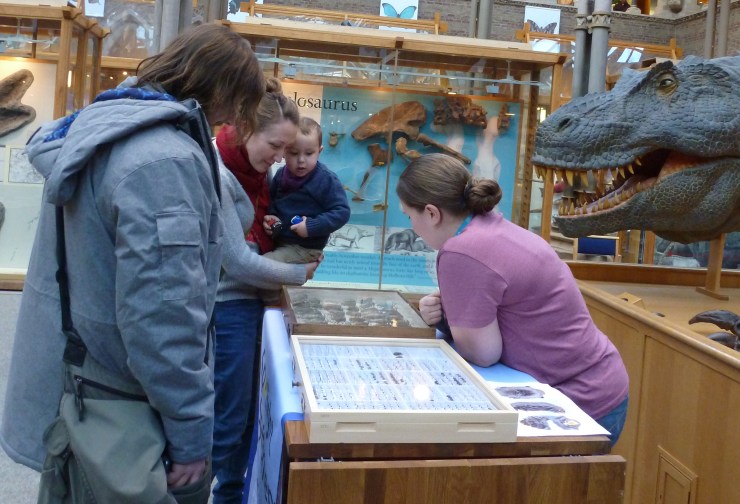
Big impressive beetles or small shiny ones? That is the question. For me it’s all about the small ones, but here I am getting people’s (and the T. rex’s) attention with the big ones. It’s my tactic for engaging their interest before I try to convince them that the small ones are so much cooler!
Monday – Thursday at 2.30pm a member of the Museum’s collections staff can be found out in the Museum talking about something interesting. For my latest session of Spotlight Specimens I chose to show off drawers of my favourite beetles.
The big ones are from a family of beetles called Cerambycidae or Longhorn Beetles. This family is found all over the world and varies greatly in size and colour. These ones are particularly interesting to me because of the historic collection they are from. The vast Baden-Sommer collection, containing many different beetle families, came to the museum via a dealer in 1910 and unusually it is still in its original layout. The labels you can see in the drawer were written by the two entomologists that collected the specimens, J. Baden and M. Sommer.
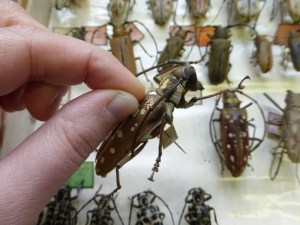
The one you see in my hand (above) is in the subfamily Lamiinae – also charmingly known as Flat Faced Longhorns.
Part of my job is to re-curate and move historic specimens into pest-proof housing – I am currently writing a blog post explaining this, so watch this space! In a nutshell, the Baden-Sommer Longhorns are a good example of drawers in need of some TLC. This leads me nicely on to my second choice of drawer, the Histeridae.
These are my first love when it comes to beetles. The Histeridae, or Clown Beetles, vary a lot in size; the one in my hand (below) is about as big as they get, but they can be as small as 1 mm in length.
I have re-curated all of the Museum’s historic Histeridae specimens and mounted up many modern ones, like you can see above. This modern system of trays and pest proof drawers ensures the longevity of specimens, as well as making them easier to access.
So what makes the little ones so special? During the afternoon I met visitors from home and abroad, young and old. I convinced them to to look a little closer, admiring their shiny black armour and fascinating adaptations. I think they finally agreed that big isn’t always best.
There are many fascinating displays in the Museum, but there’s something special about meeting an expert and chatting to them about the collections they love. Every Monday to Thursday our Spotlight Specimens series gives you the chance to do exactly that.
Taking place under the T. rex in the Main Court at 2.30pm each day, staff from across the collections choose favourite specimens to share with the public. These experts will also be writing a series of Spotlight Specimens blog posts for those of you who can’t make it to the Museum to meet them in the flesh. In this, the first in the series, Gina Allnatt kicks us off with a Halloween special…
**
It’s October, month of falling leaves and trick-or-treating, so what better way to get into an autumnal mood than to talk about two moths with marvellously morbid names?
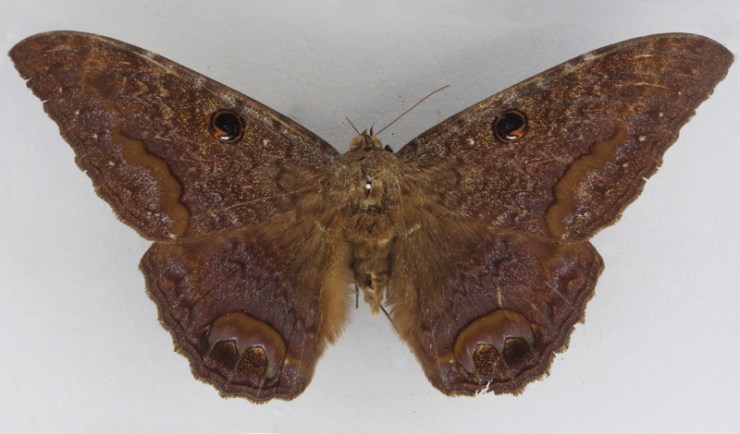
What do the Death’s Head Hawkmoth (Acherontia styx) and Black Witch moth (Ascalapha odorata) have in common? They are both associated with the film and novel Silence of the Lambs. The Death’s Head was used in the film, but the moth in the novel was originally the Black Witch. The moth was changed for the film for two reasons: The producers thought that a moth with a skull on its back would look more sinister, and also because it was almost impossible to get live specimens of the Black Witch moth for filming.
Death’s Head Hawkmoth (Acherontia styx)
The author of Silence of the Lambs, Thomas Harris, may have chosen the Black Witch moth because of the many legends and myths that surround it. In Jamaica it is known as the “Duppy Bat.” In Central and South America it’s known as “Mariposa de la Muerte”, which translates as “Butterfly of the Dead” because there is a myth which claims the moth is a harbinger of death. A less sinister version of this myth suggests that if you find one of these moths in your home it means an ancestor or loved one who recently passed away is paying you a visit.
However, the subtlety of these myths would probably not translate so well on film, so Mr. Death’s Head Hawkmoth took centre stage. The vernacular name of this moth comes from the skull-like markings on its back. There are actually three species of Death’s Head Hawkmoth- A. atropos, A. styx and A. lachesis. Though the moth mentioned in the film is Acherontia styx, Acherontia atropos was actually used instead.
All Acherontia supplement their diet by raiding the hives of bees for honey. The moths achieve this by using their extremely thick cuticle, which makes them impervious to stings. But the moth also uses another tactic: it is able to emit an odour that is chemically identical to the worker bees’ scent. This fools the bees into thinking the moth is one of their own. They also emit squeaking noises while in the hive. Some scientists posit that the squeak is similar to the noise a queen honeybee emits when she wants the workers to freeze. No one has been able to observe this theory, however.
Black Witch moth (Ascalapha odorata)
Despite all the myths and legends surrounding the Death’s Head Hawkmoth and Black Witch moth, both are large and harmless species. It is perhaps the fact that most moths are nocturnal which gives rise to so many legends and misinformation about them. It’s often the case that people will love butterflies but don’t like moths. Moths evolved before butterflies, and it is likely that the butterflies people hold dear evolved from day-flying moths (many day-flying moths exist today and are even more colourful than their butterfly counterparts!).
So remember this when you next see a moth (the original butterfly!) fluttering near a lamp as the sun slowly disappears.
Gina Allnatt, Curatorial assistant (Lepidoptera)
Gina will be talking about the Death’s Head Hawkmoth and Black Witch moth at 2.30pm on 28 and 31 October as part of our Spotlight Specimens series, running Monday to Thursday at 2.30pm.



 Beautiful gemstones are always popular with the public when they’re brought out for Spotlight Specimens. Monica Price talks about some she’s been showing off recently at our daily drop-in sessions.
 Now here’s a mineral that most people recognise straight away when I bring it out for Spotlight specimens. It is amethyst, and it is the most popular of all purple gem minerals. By a happy coincidence it is very common too, so jewellery made with amethyst need not be very expensive.
 So how did amethyst suddenly become so common? During the 18th century, huge flows of volcanic lava were found by explorers in Brazil and Uruguay. Some had air bubbles which were lined with superb purple crystals of amethyst. Soon, these crystal-filled cavities were being sent to Europe, and today, they are sold all over the world. The biggest bubbles were a metre or more in size – huge! Nowadays, nearly all the amethyst you see for sale comes from those 135 million year-old South American lava flows.

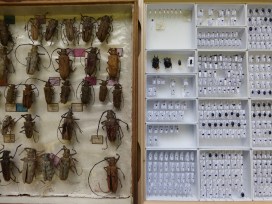
 The big ones are from a family of beetles called Cerambycidae or Longhorn Beetles. This family is found all over the world and varies greatly in size and colour. These ones are particularly interesting to me because of the historic collection they are from. The vast Baden-Sommer collection, containing many different beetle families, came to the museum via a dealer in 1910 and unusually it is still in its original layout. The labels you can see in the drawer were written by the two entomologists that collected the specimens, J. Baden and M. Sommer.
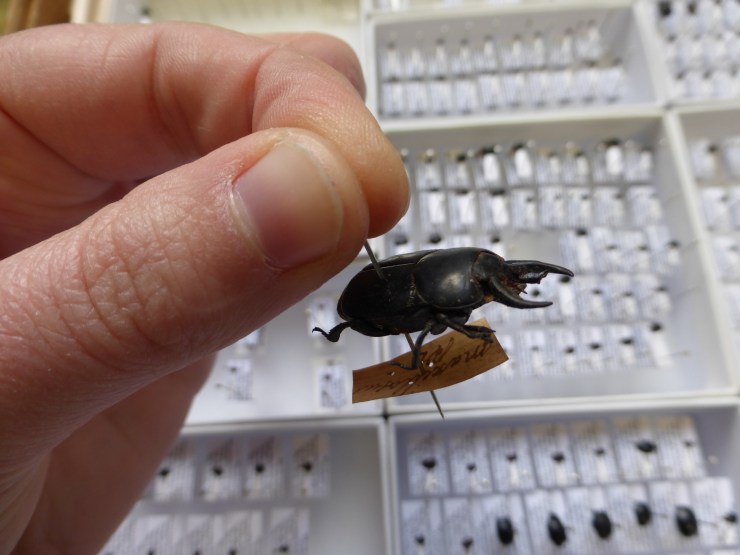 These are my first love when it comes to beetles. The Histeridae, or Clown Beetles, vary a lot in size; the one in my hand (below) is about as big as they get, but they can be as small as 1 mm in length.
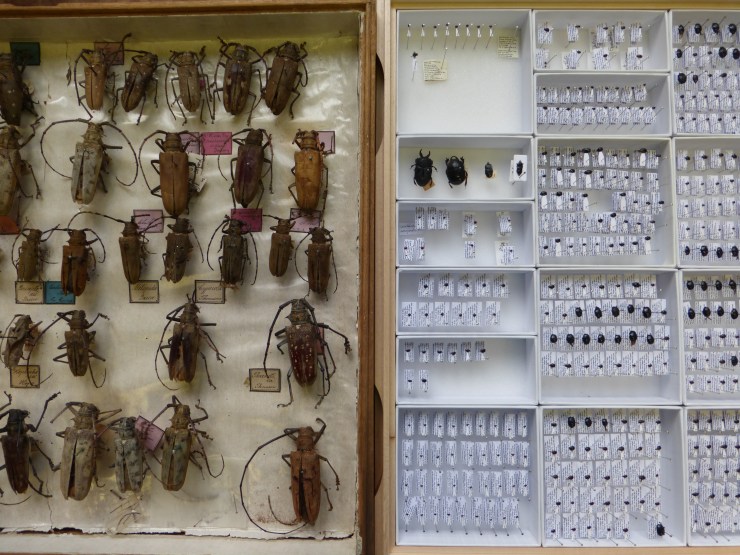 I have re-curated all of the Museum’s historic Histeridae specimens and mounted up many modern ones, like you can see above. This modern system of trays and pest proof drawers ensures the longevity of specimens, as well as making them easier to access.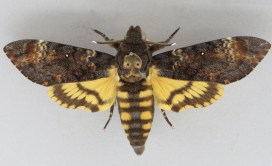

 More Than A Dodo