A little piece of Mars

Meteorite tutorial
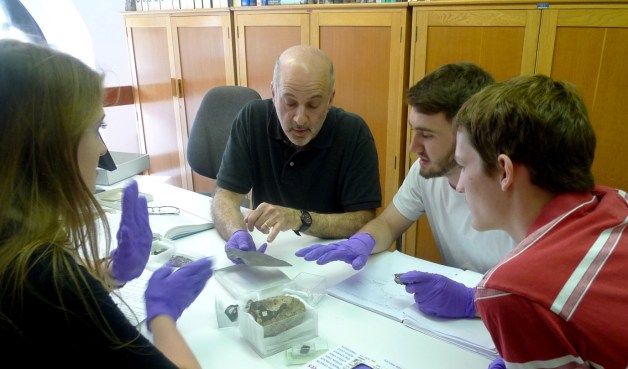
Dr Don Porcelli and his students examining some of our meteorites

Over the last couple of weeks, our meteorites had been having a busy time. On Friday 11th May, groups of Oxford University geology students came across to the Museum to have tutorials with Dr Don Porcelli from the Department of Earth Sciences. It’s a great opportunity for them to handle and study ten of our most interesting meteorites, and is always very popular. As one of them, Freya, wrote in the Oxford Undergraduate Prospectus last year, ‘There can’t be many subjects where you are able to hold an actual piece of Mars in a meteorite tutorial!’.
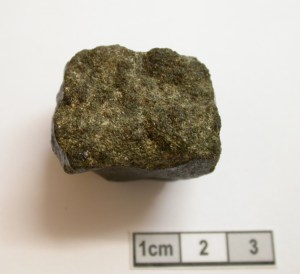
The Nakhla meteorite

Most meteorites come from the asteroid belt, a band of rocky debris between Mars and Jupiter. The lumps of rock keep colliding, and now and again that sends pieces spinning in the direction of Earth. Tiny fragments burn up as they enter the Earth’s atmosphere, and we see them as meteors – shooting stars. Larger pieces reach the surface of the Earth, and they are known as meteorites. Even bigger pieces hit the Earth with such explosive force, they all but vaporise… but that is another story!

The interesting thing about the asteroid belt meteorites is that they are made of the same planetary debris that the Earth itself was formed from, some 4.5 billion years ago. However as Freya pointed out, one of our meteorites has more exotic origins. The Nakhla meteorite fell at Nakhla, in Alexandria, Egypt on 28th June 1911. Isotope and trace element analyses have shown that it is almost certainly from Mars. The fall allegedly killed a dog; as one of my students once put it, the only Earthling to be killed by a Martian. Meteorites from Mars are exceptionally rare, and give a very special insight into the rocks that make up another planet.

Last Tuesday, members of the public had a peek behind the scenes on one of our regular Tuesday afternoon tours. The theme was ‘Rocks from Earth and Space’, and leader, Dr Dave Waters, showed them some historic rocks from Greenland and Everest, as well as those meteorites. Just think of all those people saying this week that they’ve just held a little piece of real Mars rock!

Monica Price, Assistant Curator, Mineral Collections
It’s all relative

_DSC2241

A while back we featured a great little story about some graffiti, which was discovered high up on the Museum roof. You may remember that it was painted by two of the craftsmen responsible for creating our beautiful Victorian building. The graffiti reads “This roof was painted by G. Thicke and J Randall, April 1864″

Roof graffiti
The graffiti in the rafters of the roof

The story picked up quite a lot of press attention, featuring in the Oxford Mail and BBC Oxford, and that blog post is our most-read so far. But one reader’s attention was particularly attracted by the names of the painters. Oxford resident Debbie Moorwood has been tracing her family history for some time, so when she spotted the familiar name G. Thicke, she decided to do some extra digging.

After consulting the Victorian censuses and tracing back through her family tree, Debbie revealed that painter George Thicke was actually directly related to her husband, Steve Moorwood. Steve is George’s great great great grandson!

_DSC2266
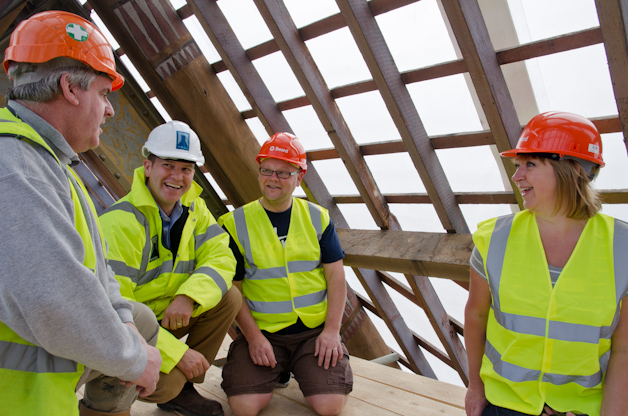
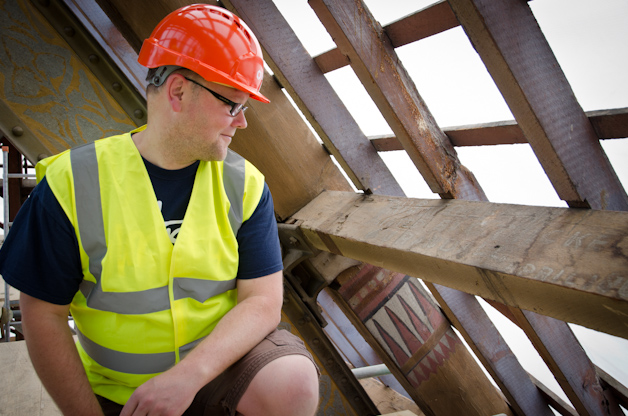
Staff from Beard and Purcell join Steve and Debbie in the roof rafters.

Excited by her discovery, Debbie contacted us directly through this blog and we thought this was a fantastic opportunity for the graffiti artist’s relatives to see his work up close.

So, last week I had the pleasure of meeting Debbie and Steve Moorwood and we joined staff working on the roof project to climb high up into the roof. It was also a good opportunity for Debbie to share her discoveries about her distant relative, George Thicke. He was born in Glastonbury in around 1809, so would have been roughly 55 when he painted the graffiti on our roof. He is first spotted living in Oxford in the 1841 census, when he was a resident of the Cowley Road and, most importantly, listed as a painter! Later he moved around the area, living in St Clements, Headington and finally Shotover, before his death in 1887.

_DSC2231

Debbie said of the experience: “We had an amazing time visiting the Museum roof. We never expected to get a full guided tour of the whole building and Steve loved it, especially the building works. We can’t wait for the roof to be finished and for the Museum to open again, when we’ll be dragging our kids & family in to have a look. I think the museum has become quite a special place for us now.”

We now have a good picture of one of our infamous roof painters, but J Randall remains a bit of a mystery to us. So far, we think he was John James Randall of St Ebbes, Oxford, but we know very little else. Wouldn’t it be wonderful if we could track down one of his relatives next?

Rachel Parle, Education Officer

Gynandromorphs

Very occasionally we come across some rather special butterfly specimens. These are gynandromorphs, individuals which are part male and part female. In many species of butterfly males and females have different colour patterns. In these species spectacular gynandromorphs can sometimes arise where one half is male and the other female. The genetic cause of these bilateral gynandromorphs is complex but essentially an X chromosome is lost very early in cell division of the embryo.

lepidoptera, gynandromorph, butterfly
The Mocker Swallowtail (Papilio dardanus) showing the female (left), male (right) and gynandromorph (center)
lepidoptera, gynandromorph, butterfly
Three specimens of the Common Yellow Glider (Cymothoe egesta). The gynandromorph (center) is slightly asymmetrical as the female half also includes some male cells with the yellow pattern.
lepidoptera, gynandromorph, butterfly
Example of a British Brimstone (Gonepteryx rhamni) gynandromorph (center) from the Mark Colvin collection.

dermaptera, gynandromorph, earwig
Gynandromorphs also occur in other invertebrates, such as this earwig which has one longer male forcep and a short female one.

What’s on the van? – Red fox

L-MNH_073

This week’s What’s on the van? comes from Malgosia Nowak-Kemp, Collections Manager in the Museum’s Zoological Collections.

The Red Fox, scientific name Vulpes vulpes, is a member of the order Carnivora.  Nowadays you can see foxes not only in the wild, but also in towns and cities. Resourceful, cunning, agile, with an ability to climb, they use varied sources of food to sustain them and their families.

They are unusual in having a golden or amber colour eye instead of green like cats, or brown like most other mammals. Their fur varies from yellowish to reddish with the rump often showing white-tipped hairs. The lower parts of the legs and the back of the ears are usually black.

They are highly vocal with barks, howls or yaps and other distinctive sounds with which they communicate between each other. Foxes breed once a year, and live in family groups consisting of a male (dog), female (vixen) and their cubs, and only occasionally, with one or two non-adult females from previous  litters.  Their cubs are born blind after about 53 days gestation, and open their eyes after 10 to 14 days.The males take an active part in caring for the family, by bringing food for the cubs and their mother. They mostly hunt at night for small mammals like voles and rabbits, but also scavenge and explore the contents of dustbins for anything to eat. In summer they would add beetles, and in the autumn, fruit to their diet.

Foxes moult once a year, in the early summer, and during the late summer and autumn months they grow additional hairs so the fur becomes thicker in preparation for the low temperatures of winter. Foxes rarely live longer than 8 years.

What's on the van?

Naturally Curious

Attenborough - Natural Curiosities 2

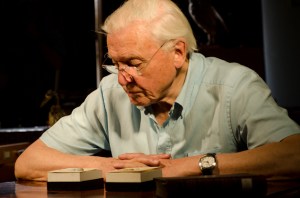
This week we’ve been delighted to welcome Sir David Attenborough to the Museum as he filmed his new television series. He spent three days filming in the Museum’s library, entomology and zoology departments and used many of our specimens in the process. Here you can see him in the library with a cuckoo and eggs.

Attenborough - Natural CuriositiesSir David was working with Humble Bee Films to make a new series of Natural Curiosities for the Eden channel. This will be the second season of the documentary, which explores some of nature’s most extraordinary and baffling species. It is due to be screened later this year; see if you can spot our scenes!

Although TV programmes and films are regularly shot in the museum, it’s always very special when Attenborough’s in the building. Such an important and famous figure adds an extra excitement to the usual film crew fuss. Needless to say, I was rather giddy when I had the opportunity to snatch a quick chat between takes. When I explained to Sir David that I was writing for a blog about our year of closure, he joked that the Museum’s closure actually made it much easier to get the filming done efficiently! Glad we could be of service.

Another exciting moment was popping into the staff room for a cup of tea, only to find a world famous natural history presenter enjoying his lunch!

Attenborough lunch
Staff from the Museum and Humble Bee Films in our staff room… with David Attenborough!

Rachel Parle, Education Officer

EntoModena

by Darren Mann

entomodena, insect fair,
Specimens and equipment for sale at EntoModena

Last week I spent a few days in sunny Italy, visiting my good friends Stefano and Roberta Ziani and timed to coincide with the Italian entomological show ‘EntoModena‘. I had a wonderful few days of dung beetle chitchat and homemade, mouth-watering Italian gnocchi.

vegan, gnocchi, delicious
My vegan gnocchi as made by Roberta Ziani- it was that good it needed a picture all to itself.

Stefano is a dung beetle researcher, specialising in the fauna of the Middle-East. He has published over 40 papers, mostly on faunistics and taxonomy and systematics, and has described a number of new species to sciences from the genus Onthophagus, including some that are associated with nests of small mammals. During my visit I had the chance to study Stefano’s superb collection of Palaearctic dung beetles, which is better than our Museum’s, and with this collection finally managed to get a grasp of the identification of some difficult species.

EntoModena is similar to the Juvisy and Prague shows, a sort of trade fair with a difference- you can buy live and dead insects, as well as books and various items of equipment. Most people go to meet up with old friends and make new ones.

entomodena
Pasta picnic at EntoModena 2013

I met for the first time Giovanni Dellacasa, the world’s leading expert on the small dung beetles in the group Aphodiinae, although we have corresponded over many years and even published a paper together (Dellacasa, G., Dellacasa M. & Mann, D.J., 2010. The morphology of the labrum (epipharynx, ikrioma and aboral surface) of adult Aphodiini (Coleoptera: Scarabeaidae: Aphodiinae), and its implications for systematics. Insecta Mundi 0132: 1-21). I also chatted with Giuseppe Carpaneto and other dung beetle researchers, bought a few bits of equipment and admired the selection of insects for sale.

Coleoptera, scarabaeidae, dung beetles, researchers, entomodena
From left to right: Giovanni Dellacasa. Stefano Ziani, Giuseppe Carpaneto and me, Darren Mann.

My only chance to sit down during the day was by meeting up with Magdelana and Marek from Majkowski Woodworking Company who had a table (and chairs) of their wares; this is the company who supply our wonderful collection drawers, postal boxes and wooden cabinets.

drawers, entomological cabinets, unit trays, entomological and musuem equipment
Magdelana and Marek from Majkowski Woodworking Company.