10th Coleopterists Day


On February 2nd we hosted for the second year the annual national beetle (Coleoptera) enthusiasts day, with the fifty attendees coming from as far as Cornwall and Lancashire. The day kicked off with proper coffee, tea and biscuits and then a series of talks, followed by a tour of the entomology department and a dung beetle workshop. 


The talks presented were a nice mix of professional, student and enthusiast and were enjoyable and entertaining. The talks were: Using traits to evaluate ladybird distributions – Richard Comont, CEH; Prionus coriarius in Richmond Park – John Lock; Suckers & sexual conflict in diving beetles – Dave Bilton, Plymouth University; Studying the ecology of British Oil Beetles – John Walters; New initiatives to support beetle recording in Britain – Helen Roy, BRC.

Coleoptera, beetles, lecture, OUMNH
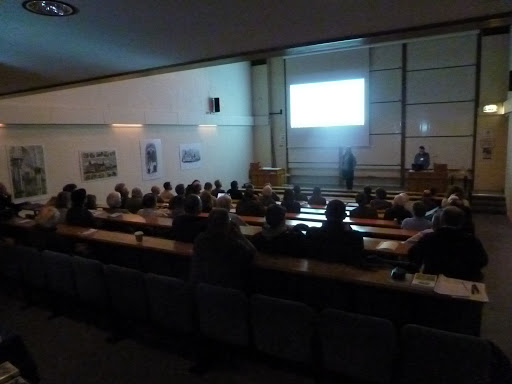
Helen Roy presenting her talk on beetle recording in Britain
The collections (thanks to Amoret Spooner) and Library (thanks to the Librarian Kate Santry) were accessible throughout the afternoon, and many took advantage of using the library (for the first time) and the collections to confirm identifications against our reference material or just to see the more unusual species and extract data. 


The workshop ‘Dung Beetle Identification’ was a bit of squeeze in our teaching area, with a few too many enthusiastic coleopterists wanting to know how to identify the small and often difficult Aphodius. 

Coleoptera, beetles, dung beetles, Scarabaeidae, British, identification
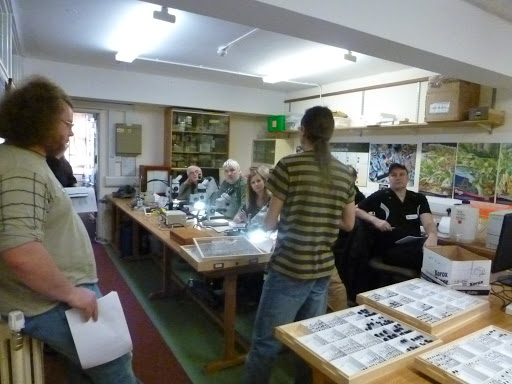
Darren Mann presenting his workshop on dung beetle identification

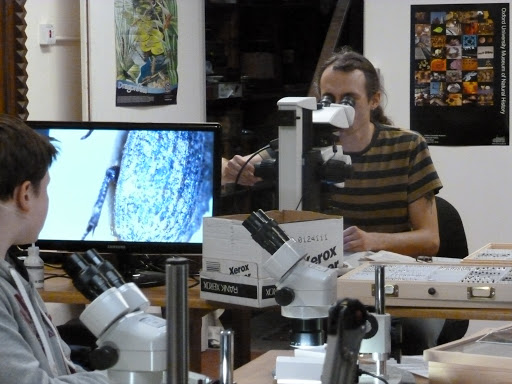
However, using our digital video set-up and monitor we managed to get through the entire dung beetle fauna, giving tips and tricks on their identification and interpretation of the key couplets, the stalwart coleopterists continuing until 8pm.

Coleoptera, beetles, identification, course, Scarabaeidae, characters, morphology
Darren Mann using the video microscope to show characters used in the identification of British dung beetle species

Hello world, goodbye world

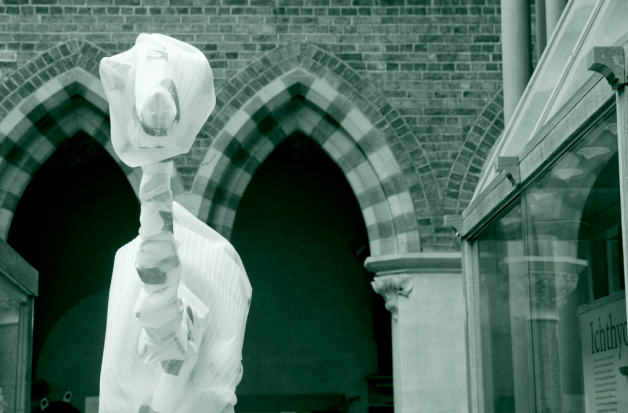
Wrapped camel It is customary to launch into the digital realm for the first time with a tentative yet friendly ‘Hello, world’. A Hello World computer program is one that displays this simple message in confirmation of the novice programmer’s successful coding – “You’ve done it, you’re digital!” it announces.

At the Museum of Natural History in Oxford we have of course already made it on to the internet, and our Entomology team already have their very own bug blog, Hope You Like Insects. In fact,our previous writer in residence, Georgina Ferry, blogged about the Museum’s comings and goings during her tenure too, but this is our first fully in-house Museum-wide blog and so a tentative but friendly ‘Hello, world’ feels just about right to kick things off.

But it’s also a case of ‘Goodbye, world’, for this blog is conceived to document a year of closure to the public. As the Museum becomes clad in board and scaffold – rigged up to enable a painstaking repair of the glass tiled roof – it’s goodbye to the natural world that is normally on display in the courts and galleries: camels, reindeer and dinosaurs are foam-wrapped and huddled together in the south aisle like cartoon outlines of themselves, and many other specimens have been removed from display and placed in safe storage.

So is it a funny time to launch a blog? Hopefully not. We hope that this blog will give people a window into some of the work that is taking place in the Museum throughout the year, including the important cleaning and repair of the roof, but also of some behind the scenes activity in various departments. There are some special public things planned to make up for the closure too – more of that to come.

In the meantime follow the blog, tweet it, or stick it in your RSS reader and we’ll let you know what we’re up to. Right now, whale skeletons are being lowered for cleaning and conservation; our Education team is about to hit the road to visit schools in a resplendent new van; and we’re putting together a special exhibition with the Museum of the History of Science in Broad Street.

Which leads nicely to the last thing, the name of this blog. The building may be thrown into shadow by the large construction hoardings that are consuming the north aisle and central court, and there may be an unusual hush as families, children and other visitors make their way straight to the Pitt Rivers Museum, which remains open as normal, but there is still plenty going on. As we hope to reveal here over the next twelve months, we may be darkened but we are definitely not dormant.

Scott Billings, communications coordinator

Drawing techniques for publication

By Katherine Child

Despite the prevalence of photography in scientific and technical books and papers today, there are still times when a scientific work will call for a more traditional approach. Drawing remains an important part of natural history illustration, and can often provide a more specific and flexible way of communicating information.

Coleoptera, Corylopidae, beetle, drawing
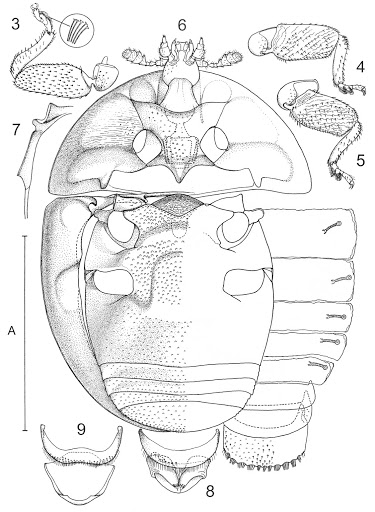
An example of the way key features can be highlighted and isolated to provide clarity in a drawn illustration. Cleidostethus meliponae Arrow, from the genus Cleidostethus Arrow, by Stanley Bowestead.


Stanley Bowestead and Thomas Eccles are both enthusiastic advocates of drawing and have recently published a joint paper on technical drawing for publication in collaboration with the HEC. They argue that the value of drawing lies not only in the end results ability to communicate, but also that the process of drawing is in itself crucial to the better understanding of the subject at hand.  Producing a detailed drawing of a beetle for example, requires rigorous observational skills and after studying the insect, the observer will have gained a unique understanding of the form of that specimen.
Coleoptera, Coccinellidae, ladybird, beetle, drawing

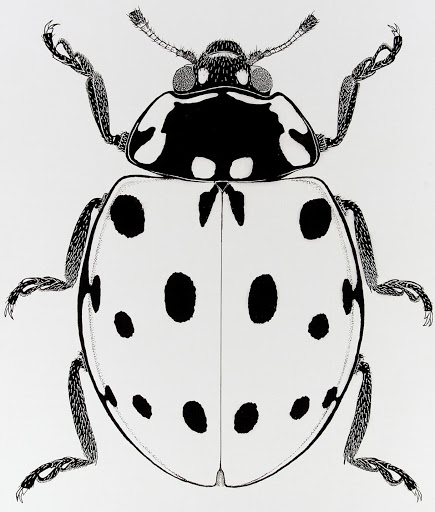
Anatis ocellata (L.) by Stanley Bowestead. White gel pen has been used to highlight the setae on the legs.

In the past it was not only the lack of modern alternatives which made drawing a popular tool for documenting scientific findings. Science, art and religion all used to be closely linked to one another – to the point of being virtually indistinguishable as separate subjects. The study and appreciation of natural history through drawing was thought to bring a person closer to God, as well as being at the height of fashion during the Victorian era.    

So, it is shifting attitudes towards science and art, as well as photographic advances and the development of other imaging techniques such as SEMs, that have lead drawing to decline over the last 50 years or so in the study of natural history.  


Coleoptera, Scarabaidae, Cetoniinae, beetle, scarab, insect
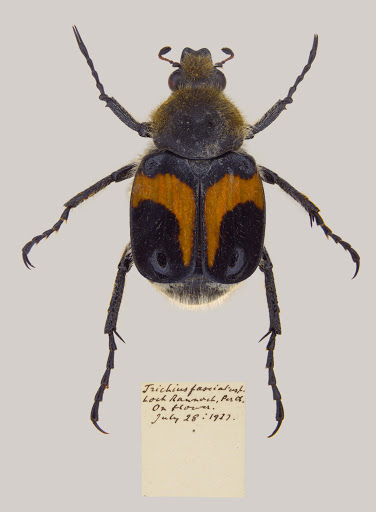
An automontage photograph of a scarab. Photographic equipment and image processing have advanced rapidly in the last 30 years and high quality digital pictures are now becoming normal in scientific publications.
Stan and Thomas’ paper as well as being a practical how to guide on the technical drawing of insects, hopes to promote the value of drawing alongside other contemporary methods of illustration, as being something which remains relevant and invaluable as a learning resource in the field of science today. ­­
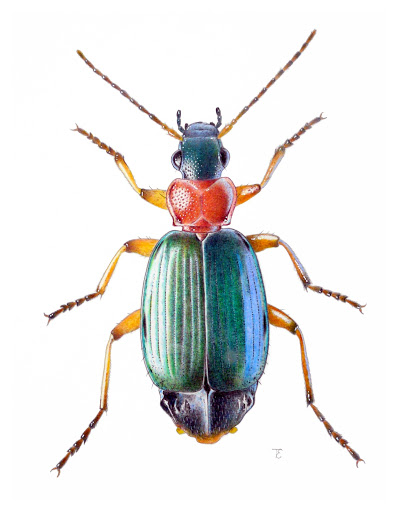
Coleoptera, Carabidae, Harpalinae, ground beelte, drawing

Lebia chlorocephalaby Thomas Eccles. Worked in colour pencil with highlights picked out in white ink.


The paper is available to download for free from the museum’s website.

A new record for a little red Lygaeid

Arocatus longiceps is in the insect order Hemiptera, commonly called ‘true bugs’ and is part of the family called Lygaeidae often referred to as seed bugs, due to their feeding behaviour on plant seeds. This species is not native to the UK and was first discovered in Britain during 2007 on plane trees in the grounds of the Natural History Museum, London. This appearance made the bug quite famous; it even featured on the BBC News in 2008 as a new, apparently unidentifiable species.

Originally this species was determined as Arocatus roselii, however specialist researchers in seed bugs were consulted and the bug was finally identified as Arocatus longiceps an eastern Mediterranean species which has been spreading across Europe over the last few decades.

The species has mainly been recorded in the London area; but on the 30th November 2012 two specimens were found in the basement rooms at the Museum. This is a new record for Oxfordshire (Flanagan & Ryan, personal communication) and is probably the most Northerly record so far.

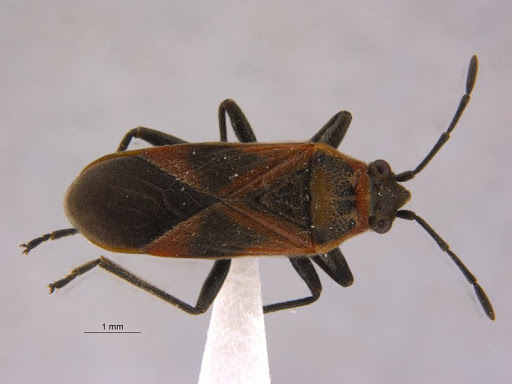
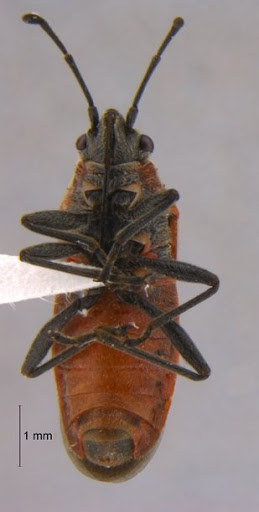
Hemiptera, Lygaeidae, Arocatus longiceps, true bugHemiptera, Lygaeidae, Arocatus longiceps, true bug
Photographs of the Arocatus longiceps taken using the auto-montage system
This bug is commonly found across Europe, and in October Amoret saw quite a few during a visit to Prague. The host plant is the plane tree; when the specimens were found in the museum, it prompted us to see whether there were more. As the photos below show, upon searching the plane trees outside the museum, we found an abundance of this bug.
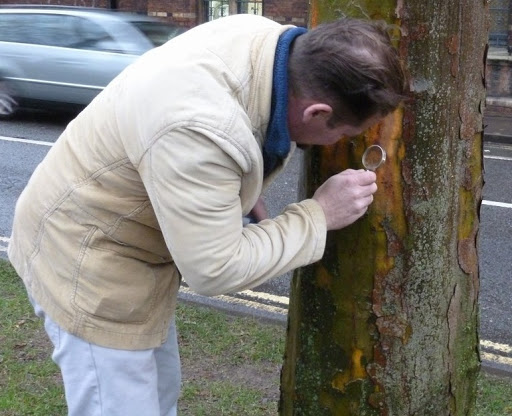
Hemiptera, Lygaeidae, Arocatus longiceps, true bug, entomology, field

Chris Jarvis of the Education Department uses his detective skills to find the bug.

Hemiptera, Lygaeidae, Arocatus longiceps, true bug, field entomology

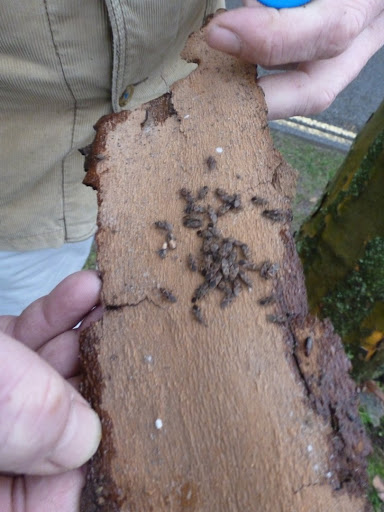
A large number of Arocatus longiceps were found beneath the bark. They overwinter as adults in clusters.


Rediscovered: Meloe mediterraneus

A species of Oil Beetle, Meloe mediterraneus, which was previously thought to be extinct in the UK, has been rediscovered as part of the on-going Oil Beetle conservation project being run by Buglife.

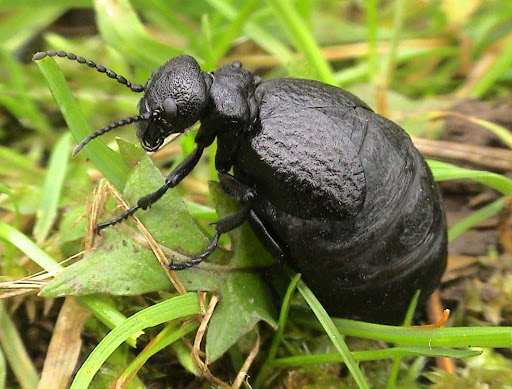
Coleoptera, Meloidae, beetle, Meloe mediterraneus
Female Meloe mediterraneus. Photograph courtesy of John Walters.


The beetles were found at Bolt Head, a National Trust site in South Devon by a local naturalist who was carrying out a study for the Oil Beetle conservation project. The discovery was confirmed by Darren Mann who is a specialist in British Oil Beetles. It is the first record for this species in over 100 years and the first ever for Southwest England. It is currently the only site that this species has been found at but it is hoped that with further survey work more populations can be found in other areas of the county.

Prior to its rediscovery, the Mediterranean Oil Beetle was only known to have ever existed in the east of the country- in Essex and Kent. The beetle was last sighted in Kent in 1906 and was thought to be extinct in the UK until rediscovered this year.

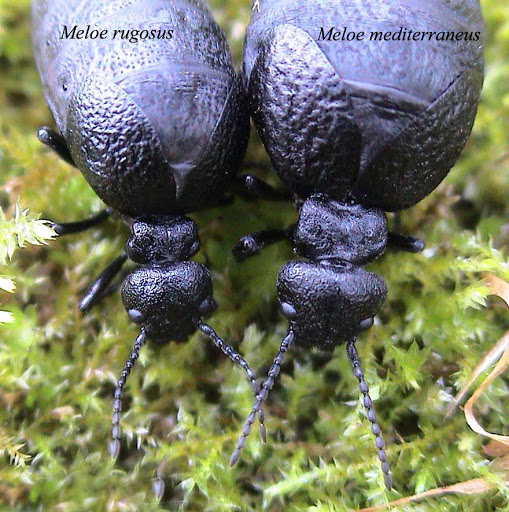
One reason for Meloe mediterraneus remaining undiscovered was that the specimens were mistaken for the similar looking Rugged Oil Beetle, Meloe rugosus (previously blogged about by us here). The adult Mediterranean Oil Beetle is slightly larger than the Rugged Oil Beetle, and has a larger thorax. The Rugged Oil Beetle also has a crease down the centre of the thorax that is absent in the Mediterranean Oil Beetle.

Coleoptera, Meloidae, beetles, rugosus, mediterraneus, Meloe, British
Photograph to illustrate the differences between Meloe rugosus (left) and Meloe mediterraneus. Note the groove on the thorax of Meloe rugosus. Photograph courtesy of John Walters.

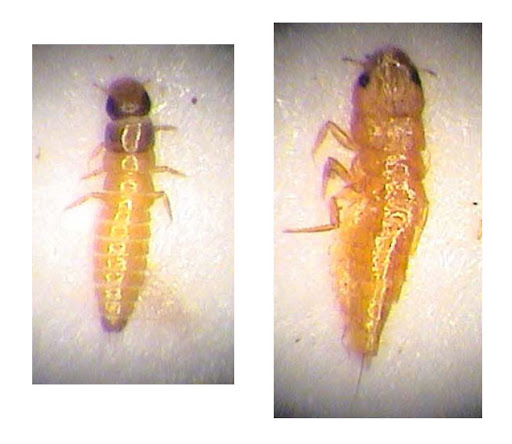
The triungulins (larvae) are possibly even more distinctive, with those of Meloe mediterraneus being entirely orange whilst those of Meloe rugosus have an obvious dark head.

Coleoptera, Meloidae, triungulins, larvae
                    Triungulin of Meloe rugosus (left) and Meloe mediterraneus (right).                   Photographs courtesy of John Walters.

In the news: Buglife, The Telegraph, WildlifeExtra
Mini guide to identifying Oil Beetles