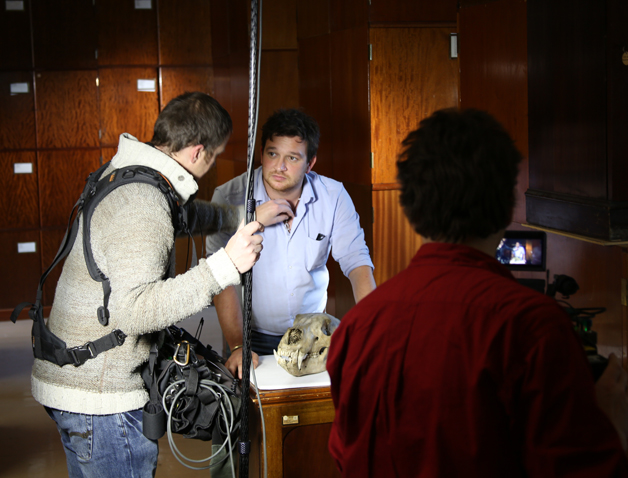
Although the conservation of our whale specimens has drawn to a close, there’s still a hub of activity in the ‘whale aisle’. This week, we had an opportunity to finally uncover the Sperm Whale mandible as it was featured in a new BBC Nature Series, ‘Secrets of Bones’. To see the specimen for the first time, under natural light without the shelter of scaffolding was a real delight.
The conservation team was eager to oversee the action and learn about the process of putting a documentary together. Ben Garrod, evolutionary biologist, used the museum specimens to look at the evolution of the mandible and its diversity in nature. The beautiful Sperm Whale jaw is an excellent example of this.
The series will be televised in February 2014, and we’re excited to see if we made it on-screen!
The re-installation of the remaining skeletons is expected to happen in 2 weeks…
Sir David Attenborough in the Museum with Wallace’s Giant Bee
Sir David Attenborough is arguably the world’s most famous living naturalist and broadcaster. Here he sits in the Museum of Natural History, holding our priceless Wallace’s Giant Bee specimen. So why did a man as important (and busy!) as Attenborough take the time to pose for our photo? It’s because Attenborough, like thousands of other natural history enthusiasts, knows that Alfred Russel Wallace is one of the greatest naturalists, geographers and explorers of all time. So what’s so great about him? Why are we dedicating Wallace Week to celebrating his work?
Chris Jarvis, Education Officer, explain why he thinks Wallace is so special…
Chris Jarvis at the Sedgwick Museum
Last week I gave a talk on Alfred Russel Wallace at the Sedgwick Museum in Cambridge. I was asked ‘Why does Wallace deserve the statue next to Darwin’s, which he’s likely to get in London’s Natural History Museum?’ My answer was that ‘He deserves a statue as an inspiration on the importance of following your own interests, despite the barriers that may stand in your way’.
Unlike Darwin, Wallace was a largely self-made man. Born into a large family (he was the 8th of 9 children) that was always on the edge of financial disaster, Wallace was inspired by his love of the natural world around him and encouraged to explore it. Later he wrote that he could recall virtually every detail of the environment of the river Usk that was his playground but could hardly remember anything of his family, even faces, from that time! His love of the great outdoors led him to teach himself botany and entomology and how to collect, identify and preserve insects. Today, at a time when many children are being diagnosed as suffering from ‘Nature Deficit Disorder’ Wallace is a particularly pertinent example of the benefits of exploring the natural world.
At school, Wallace described himself as a ‘dull, ignorant and uneducated person’. Lessons were basic and dry and he left school finally in 1837 aged 14. Ironically for the father of Biogeography it was Geography that he found the driest of subjects, after Latin grammar!
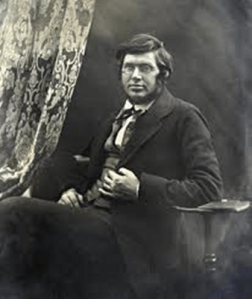
Young Wallace
Despite this, Wallace was a voracious reader and seems to have sought out his own curriculum. His family, although poor in other ways, always had interesting books around the house and Alfred was introduced to libraries, museums and working men’s institutes from an early age. His favourite books as a child included ‘Gulliver’s Travels’, ‘Robinson Crusoe’ and Mungo Park’s ‘Travels in West Africa’ and clearly fuelled the lust for adventure that led to his collecting trips in the tropics.
Wallace’s understanding of the importance of self-education and modest beginnings led him to be a firm supporter of the aphorism that ‘knowledge is power’ and he was involved in advising on setting up public libraries, museums and other free institutions that encouraged education throughout his life. His legacy, as important as all his discoveries and theories are, is surely as an inspiration to all of us to get out into nature, to read about what you find there and then share that knowledge with others, it may lead you to some amazing places and discoveries as it did Wallace!
Over the last couple of weeks our conservation team has been involved in the popular ‘Making Museums’ school project hosted between the Pitt Rivers Museum and Oxford University Museum of Natural History. Bethany, Nicola and I took turns to lead behind-the-scenes tours of our ‘whale aisle’, during which 10-11 year old pupils from East Oxford primary schools were introduced to ‘conservation’ as a wonderful museum profession.
Pupils learned about the importance of specimens to the museum and scientists, what affected the condition of the skeletons, how we conserved the whales, how and why whale anatomy differs between species and about what talents and special interests conservators bring to the profession.
We loved seeing their eyes widen at the size of our enormous Sperm Whale mandible, their disgust at handling a ball of tar-like degraded whale oil, their bewilderment at the fact whales have floating pelvises, and their bemusement at…
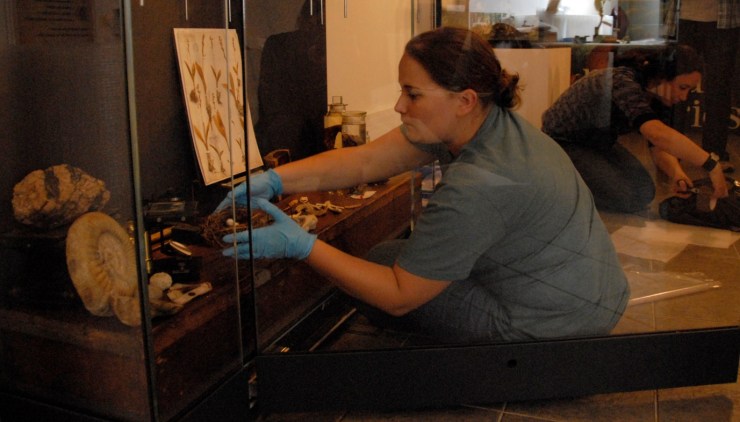
Amoret Spooner (left) and Zoë Simmons (right) dismantling the exhibition
This week we’ve been at the Museum of the History of Science on Broad Street, taking down our temporary exhibition, ‘Natural Histories’. We had some lovely feedback from people who saw the display. They enjoyed seeing old friends from the Museum of Natural History’s displays such as the giant ammonite that people can touch, the jaw of Megalosaurus, the first dinosaur ever to be described by scientists, and the lovely old insect collecting tools used by entomologists.
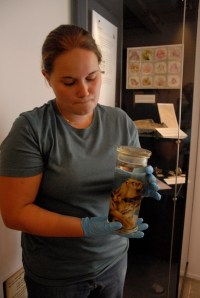
Specimens stored in spirit need very careful handling
The exhibition also had some things we are rarely able to put on display. The beautiful hand-painted butterflies in William Jones’ Icones, and White Watson’s inlaid stone slabs representing the strata of Derbyshire, are just two of the treasures we normally keep in a darkened room because too much light will damage them. We showed crabs collected by Charles Darwin on the voyage of The Beagle, and even a plant from the University’s herbaria that was collected by Linnaeus, the Swedish scientist who devised the system of ‘Latin’ names we still use for plants and animals today.
Every item is being carefully checked and packed up, but don’t worry, they are not staying in our stores for long. We will be taking them to Banbury Museum where ‘Natural Histories’ will be going on show again from 30th November 2013 until late February 2014. So, even if you missed the exhibition in Oxford, you’ll have a last chance to see it in Banbury.
Conservator Gemma Aboe packs away the pigmy anteater
Yesterday BBC Radio Oxford interviewed Bethany Palumbo, Conservator of Life Sciences at OUMNH about our ‘Once in a Whale’ project. Do listen to the broadcast online, before it runs out in 6 days! http://www.bbc.co.uk/programmes/p01fp8r2
Malcolm Boyden’s interview with Bethany lasts 14 minutes- select ‘1:06min’ to listen in on their chat about the whales, the museum renovation, Bethany’s experiences of being a conservator and more!
Project update As we enter into the last 5 weeks on the whale conservation project, we are pressing ahead with re-articulating the skeletons with new screw fixings and stainless steel wire (- our hands end up looking like we had a fight with a sharp clawed cat).
We’ve also been meeting with professional riggers, who once the main scaffolding has been de-assembled, will raise the cetacean skeletons into their NEW positions- watch this space!
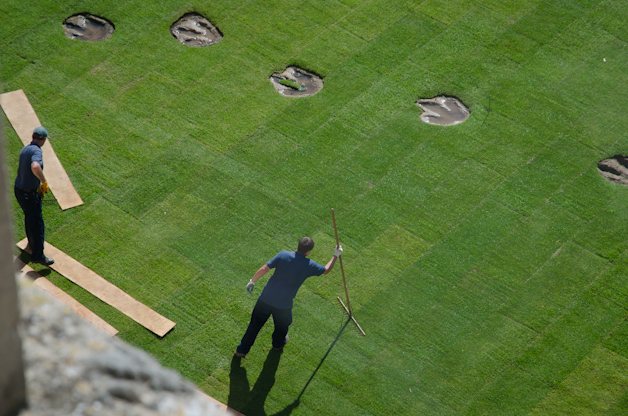
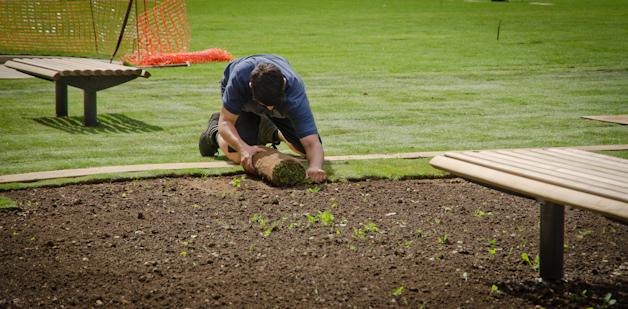
As I explained last week, the outside of the Museum has been getting a make-over, and the finishing touches are now rolling into place. Each day I’ve checked progress through my office window as roll after roll of turf has been immaculately lined up and pressed firmly into place. It took the team just 5 days to transform the space from a dusty wasteland into a spectacular expanse of technicolor green.
Looking out of the window today, the new irrigation system is obviously doing a great job and the grass is lush and getting long. The only problem is the bright orange fence that surrounds the lawn and stops us from testing it out. I can’t wait until that comes down and we can use it for the first time. I just hope there are a few more chances for a picnic lunch on the lawn before Autumn really sets in!







 As I explained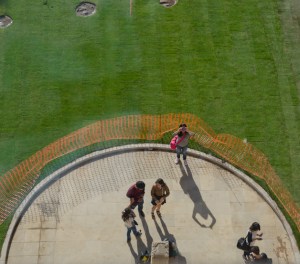
 More Than A Dodo