The latest in our Presenting… series of single-case displays takes a look at one of the world’s most spectacular groups of birds – Paradisaeidae, or the birds of paradise.
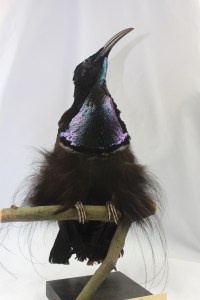
A beautiful male Magnificent Riflebird (Lophorina magnifica)
The first bird of paradise to arrive in Europe was a skin that came to Spain in 1522. Many of these early skins were prepared by native hunters without wings or feet to better show off the bird’s spectacular plumage. Upon arrival in Europe, the apparent lack of wings and legs led to the myth that these birds originated from paradise and floated high in the skies, only to fall down to earth after their death.
Birds of paradise are members of the family Paradisaeidae, which contains more than 40 recognised species. Their closest relatives are crows and jays, of the Corvid family.
They inhabit the rainforests of Papua New Guinea, Eastern Indonesia and Eastern Australia and mainly feed on fruit and some insects. Hybridisation, when two birds of different species crossbreed, is quite common and can explain why many of the early described species were so “rare”.
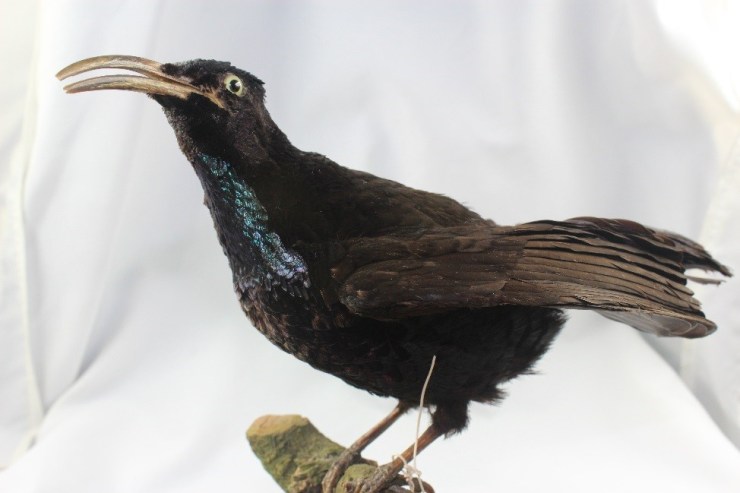
Male Paradise Riflebird (Lophorina paradiseus) showing off iridescent plumage on its chestFemale Paradise Riflebird (Lophorina paradiseus) without colourful plumage, which helps to blend into the environment
Most species of birds of paradise are sexually dimorphic, meaning males exhibit the spectacular plumage these birds are best known for, whilst females have much less ornamentation and coloration. The male’s display feathers are highly specialised and have evolved from basic feathers. Like all feathers, they are shed and regrown every single year, which puts quite a strain on the males.
One of the first few Westerners to see these birds in their native habitat was naturalist and explorer Alfred Russel Wallace. He described the encounter, from a 19th-century Westerner’s point of view, in Narrative of Search after Birds of Paradise (1862) as:
Nature seems to have taken every precaution that these, her choicest treasures, may not lose value by being too easily obtained. […] In […] trackless wilds do they display that exquisite beauty and that marvellous development of plumage, calculated to excite admiration and astonishment among the most civilized and most intellectual races of man…
The Presenting… Birds of paradise case will be on display until 3 September 2019.
This week is Swift Awareness Week and that means it’s time to celebrate our screaming summer visitors – the avian ones, that is.
Here at the Museum we eagerly await the return of these long distance migrants each May. This is not only because for many of us they herald the start of summer, but also because the swifts that nest each year in the Museum tower are part of the longest-running continuous study of any bird species in the world.
Taking the long view of these amazing birds we know that, like all birds, they evolved from a particular group of dinosaurs. Birds, in effect, are living dinosaurs. The earliest fossil swift, the ‘Scania Swift’, is around 49 million years old and shows us that by this time they had already evolved in forms that are virtually indistinguishable from today’s birds. Today, they have diversified into around 100 different species including our Common Swift (Apus apus).
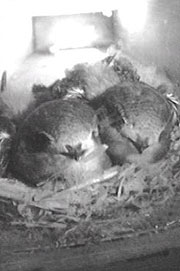
Swift chicks in a nestbox in the Museum tower, shown on the webcam feed
Swifts have taken life on the wing to the extreme. Not only are they the fastest recorded bird in level powered flight, reaching speeds of nearly 70mph, but once launching themselves from the nest that they hatched in they may not land for the next two years of their lives!
They are so adapted to life in the air that they are capable of eating, mating and even sleeping on the wing. During sleep, it is thought that the two hemispheres of the brain take it in turns to nap as the swift slowly circles at heights of up to 30,000 feet. They do not even land to collect nesting material, instead relying on whatever feathers or pieces of plant material are floating in the air to build their nests.
During this two-year flight they will follow their food – the seasonal blooms of flying insects that appear after summer rains – on a 14,000 mile annual migration to southern Africa and back, living in perpetual summer.
Whilst for a long time scientists thought swifts were closely related to similar looking birds, swallows and martins, DNA analysis has revealed that they are the product of another amazing type of evolution – called convergent evolution – where organisms with similar lifestyles independently evolve similar traits. It turns out that whilst swifts may look like swallows, they are actually more closely related to hummingbirds; swallows, on the other hand, are more closely related to kingfishers than to swifts.
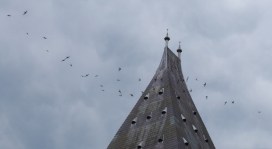
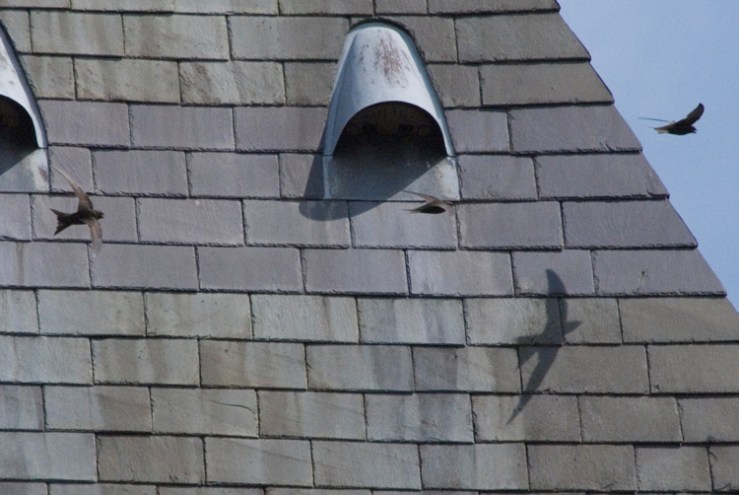
Swifts circle the entrances to the nest areas in the Museum’s tower. Image: Gordon Bowdery
Studies show that the population of breeding swifts in the UK has roughly halved between 1995 and 2016. The causes of this decline are debated: Lack of nest sites, lack of food, and changes to global weather patterns have all been implicated. The truth is that a bird which lands only once a year is extremely difficult to study.
We hope for a successful breeding season here in the tower, but if you would like to observe them yourself you can watch the swifts on our nest cam and compare the ups and downs of their populations over the years on our website.
This article is taken from European research magazine Horizon as part of our partnership to share natural environment science stories with readers of More than a Dodo.
Researchers have found that many internal defence mechanisms that are quiet in rural birds are much more active in those in cities. These biological pathways are pumping out extra antioxidants, immune system cells and detoxifiers – a sign that urban life is challenging their health.
Globally, bird numbers are dropping. According to figures published by conservation organisation BirdLife International last year, 40% of bird species have declining populations while 7% are increasing in number. BirdLife cites urbanisation as a force destructive to many bird species, but a few do well in cities, such as the adaptable great tit, whose population is on the rise.
City wildlife have a different experience of predators, food availability and diseases than those in the country. This may be helpful to them – for example, humans leave food out for birds in their gardens. But they also have to cope with a fragmented habitat and with noise, air and light pollution. Scientists want to understand these forces in order to get a better grasp of the dramatic drop in some bird populations.
A research group in Sweden has been studying great tits living in 500 nestboxes in the city of Malmö, and a similar number in the forest. Great tits were chosen partly because they are well-studied and also because their use of nestboxes makes it easy for researchers to locate and examine them. The researchers check the boxes weekly during spring, weighing chicks with tiny balances, measuring them with adapted rulers, and tapping them for blood, according to Dr Hannah Watson, an ecologist at Lund University in Sweden.
An early study revealed that the urban birds had higher levels of antioxidants circulating in their blood than rural birds – a defence mechanism against attack from free radicals – toxic versions of oxygen atoms.
‘Exposure to air pollution would generate more free radicals (in the body) which can then increase what’s called oxidative stress – a kind of cellular level stress,’ said Dr Watson. ‘The free radicals cause damage to DNA, lipids, proteins – all the macromolecules in the cell.’
Switched on To explore the consequences in more detail, she compared RNA (a counterpart to DNA) samples between the two populations, in a project called URBAN EPIGENETICS.
While genes code for the structure and maintenance of a living thing, they only function if they are switched on – or expressed. This happens via a bit of chemistry, methylation, which can be triggered by environmental factors.
Dr Watson found that genes responsible for the city birds’ immune responses had been upregulated, implying that they were fighting off more infections than rural birds. Similarly, other genes, such as those for neutralising poisons, for inflammation and for antioxidant production to combat free radicals, were also switched on.
‘It’s only the birds of really good quality that are able to actually survive the nestling period in the city.’
Dr Hannah Watson, Lund University, Sweden
‘We showed big differences in terms of the genes that are expressed and the levels they are expressed at,’ she said. ‘We interpret this as being consistent with our prediction that birds living in the city are exposed to more of these environmental stressors.’
But this doesn’t necessarily mean that urban birds are suffering, says Dr Watson. ‘It could just indicate that they’re able to respond and cope.’
To understand whether the birds were taking urban stress in their stride, Dr Watson joined a study led by one of her colleagues in which they measured the caps – telomeres – at the ends of the birds’ chromosomes.
Over the last decade, scientists have shown that telomeres gradually shorten each time a cell divides, and also in response to other stressors, eventually reaching a stage of senescence, or deterioration, which corresponds to an organism’s old age and death. In fact, the length of a creature’s telomeres, it turns out, seems to foretell its lifespan. The team conjectured that, if the urban stresses were actually affecting the great tits’ ability to survive, this would be revealed in the lengths of their telomeres.
They found that city chicks that were ready to fledge had on average shorter telomeres than those of fledgling forest chicks.
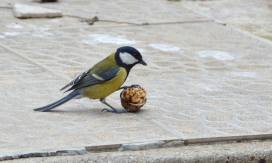
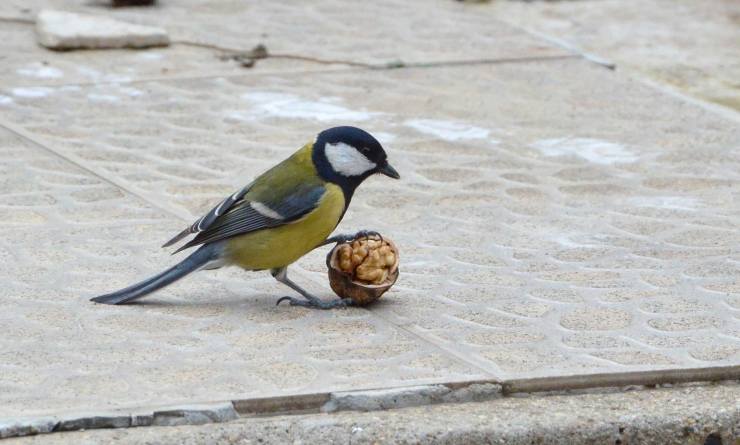
Great tits living in urban areas fight off more infections than their rural cousins. Image Credit – CC BY-SA 4.0
Weeded out Those with the shortest telomeres were less able to cope with urban stresses and died before reaching adulthood. Paradoxically, that meant that adult great tits in the city were likely to be stronger than the average forest adult because the weaker ones had been weeded out.
‘It’s only the birds of really good quality that are able to actually survive the nestling period in the city,’ said Dr Watson.’ In fact, the researchers think that while multiple stressors in the city are wiping out younger, weaker birds, they may not be of much consequence during adult life for those tough enough to make it that far.
Urban living may also mean that the social structures that served a species well in the natural habitat have become no longer necessary or even harmful.
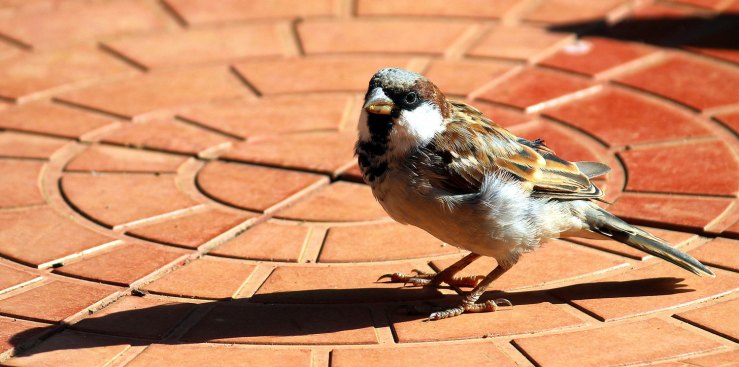
House sparrows in the wild, for example, compete with each other for food according to a dominance hierarchy that is determined largely by size. But in cities, there are two key differences – food is more abundant and house sparrows are smaller, possibly because they don’t need to store body fat since winters are milder. Either factor could undermine the way they normally compete for food.
Likewise, house sparrows are known for the way they cooperate to mob potential predators. But when the danger shifts from a bird of prey to a cat or dog, this behaviour could become redundant.
With their numbers in decline, but still strong at as many as 1.3 billion globally, their toughness, aggression and ability to survive around humans suggests they seem to do well in urban areas.
Dr Lyanne Brouwer, an animal ecologist at Radboud University Nijmegen in the Netherlands, is studying house sparrows in a variety of urban habitats as they engage in their cooperative and competitive behaviours in a project called UrbanBird, which runs until 2020. She is using observations gathered by ordinary people, as well as her own field work to understand the causes and longterm effects of any behavioural change in the way house sparrows interact with each other. Ultimately this could help predict how urbanisation could affect other species and biodiversity.
‘It’s really interesting to see that all the factors that could affect social behaviour, like for example food availability or the predators that are around, are all very different in cities – so how would that affect these social behaviours? It turns out there is basically nothing known about how such behaviours change in cities,’ she said.
The research in this article was funded by the EU.
This is a great time of year to hear the distinctive call of the Cuckoo (Cuculus canorus) as it spends the summer in the UK. Collections Manager Eileen Westwig recently shared Cuckoo specimens with the public in one of our Spotlight Specimens sessions. You missed it?! No problem, here she is with the fascinating story of this threatened bird…
Cuckoos could be described as absent mothers, laying their eggs into the nest of a ‘host bird’, such as Dunnocks, Meadow Pipits, Garden Warblers, Whitethroats or Flycatchers. When she finds a suitable nest, the female Cuckoo will remove one of the host’s eggs and lay hers in its place. She lays between 12 and 22 eggs in a season, all in different nests. No worries befall her about building a nest, brooding out any eggs or raising her young as she leaves it all to strangers. One challenge for the Cuckoo is to make sure her trickery is not discovered.
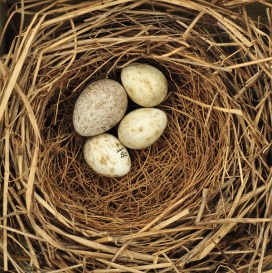
When the female host returns to her nest, she will inspect it for any changes and if she discovers the intruder’s egg, she will simply toss it out. So the female Cuckoo has to be pretty good at forgery and mimic the host bird’s egg ‘signature’, copying the colour, pattern and shape of the original eggs. This is the only way to get away with her ‘brood parasitism’. Around 20% of Cuckoo eggs never make it. In the top picture, you can see the nest of a Garden Warbler with three Warbler eggs and one larger Cuckoo egg, on the top left.
An adult Garden Warbler (Sylvia borin borin) can reach a weight of 16-22g with a wingspan of 20-24.5cm
After twelve days, the Cuckoo hatches and pushes the other nestlings out. As the single remaining occupant of the nest, it has the full attention of the host parents, which try to feed a nestling soon outweighing. An adult Cuckoo is more than 6 times the weight of an adult Garden Warbler. The Cuckoo young will leave the nest after 19 days, but gets fed by the parents for a further two weeks. That is one busy summer.
An adult Cuckoo (Cuculus canorus) can reach a weight of 105-130g with a wingspan of 55-65cm.
According to the RSPB, there are about 15,000 breeding pairs in the UK and Cuckoos are now included on the Red List, giving them the highest conservation priority. Ten years ago, numbers of this migrant bird fell by 21% and more than half of the population has disappeared in the past 25 years. Threats include damage to the bird’s winter habitats and a decline in large insect species that are its major food source.
Cuckoos migrate to West Africa over the winter months and can be seen in the UK from late March or April through July or August. Young birds leave a month or so later to give them time to grow and prepare for the long journey ahead. Wintering grounds are not exactly known but include Cameroon, Gabon and other African nations.
One of the most common questions asked about our specimens, from visitors of all ages, is ‘Is it real?’. This seemingly simple question is actually many questions in one and hides a complexity of answers.
In this FAQ mini-series we’ll unpack the ‘Is it real?’ conundrum by looking at different types of natural history specimens in turn. We’ll ask ‘Is it a real animal?’, ‘Is it real biological remains?’, ‘Is it a model?’ and many more reality-check questions.
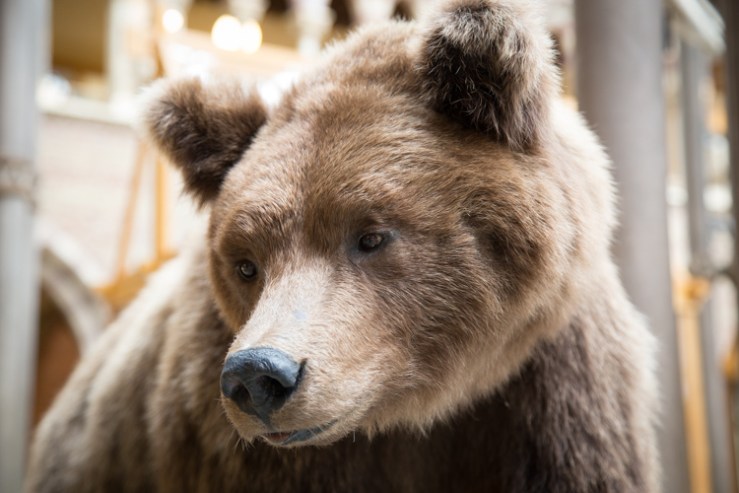
Taxidermy The Museum is well-known for its touchable taxidermy. As of today, we have two large bears, a Black Bear and a Brown Bear, greeting visitors as they enter the main court, as well as taxidermy specimens on our Sensing Evolution touch-tables. For children and adults alike, this close encounter with a taxidermy animal prompts the question – is it real?
Taxidermy, or ‘stuffed’ animals, are specimens that have been specially prepared, preserved and posed to show what the creature may have looked like in life, but real and not real here is tricky. The animal itself is, or was, a real animal – there are no taxidermy unicorns, for example. But the biologically real parts may only be the skin, the skull, and the skeleton inside the paws and feet, depending on the type of animal.
The touchable taxidermy Brown Bear greets visitors to the museum.
Inside taxidermy specimens there may be sculpted statues over which the skin is stretched; for older specimens, a wire and wood framework with paper, wood wool, straw and seeds may be used to fill out the skin. The animal’s squishy parts, which are not easy to preserve –such as eyes, lips and tongues – are normally made of glass or plaster.
Animals that have skins and skeletons that are relatively easy to preserve – including mammals, reptiles, and birds – are generally better suited to taxidermy. Marine mammals such as whales and dolphins, amphibians such as frogs and salamanders, and fish are all less common as taxidermy because their skins are harder to treat and keep stable.
Dogfish and piranha taxidermy which have been painted and varnished in an attempt to make them resemble the living animals. Note the comedic eyes on the shark.
The hard parts of skin, such as crests, wattles and skin patterns in reptiles, are susceptible to discolouring and fading in light, so these areas may be repainted to show what the animals look like in life. This introduces another ‘non-real’ element: paint.
So although there are certainly real parts used in taxidermy, there’s yet another complication in answering the question: the animals are usually posed by a human, so even their posture and appearance could be considered ‘subjective’ and perhaps therefore not quite ‘real’.
In fact, some of our older taxidermy may have been prepared by taxidermists who hadn’t ever even seen a living example of the animal they were working on. This can lead to inaccurate positioning and posing, as in the taxidermy kiwi on display in our main court.