A big part of the HOPE for the Future project is re-curating more than one million British insects.
Tom Greenway, Junior HOPE Collections Assistant, explains how he and the team are making sure the insects that make up the unique HOPE collection will be preserved for future generations.
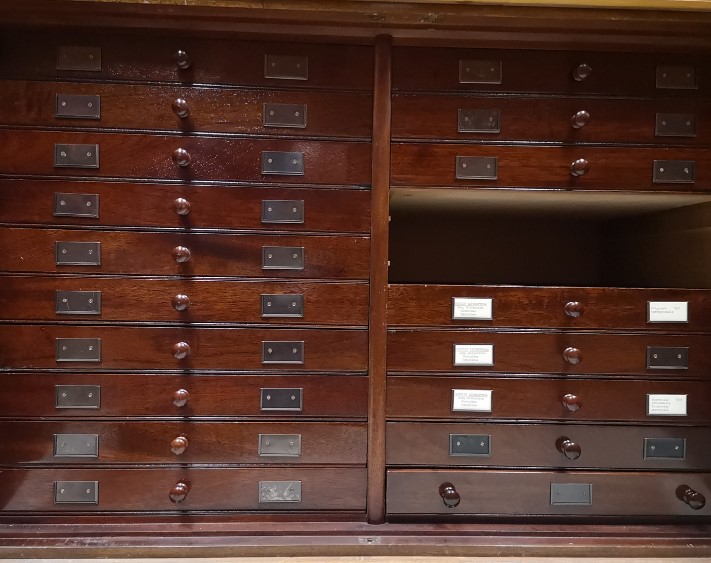
Moving a million insects is a big job! The insects are currently kept in wooden trays inside cabinets in the Westwood Room, upstairs at the museum. We have to move every single insect specimen into new up-to-date storage to preserve the collection for the future. At the moment, we are moving the insects in cabinet 75 which contains members of the order Coleoptera (beetles). There are 151 cabinets in total, each with 20 drawers of insects so although we have already moved around 253,000 insects, there is still a long way to go!
Two of the old drawers done… only another 3,000 to go!
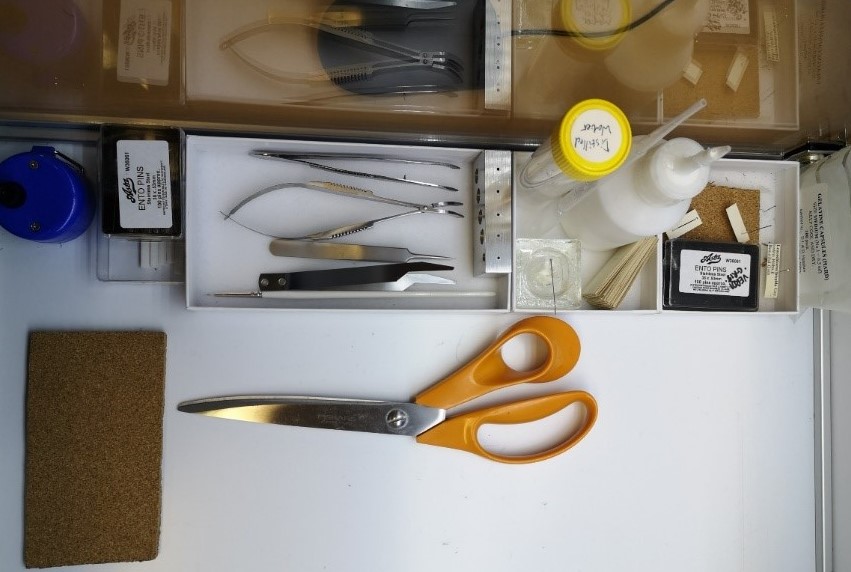
These are some of the tools of the trade!
Tweezers
Forceps
Scissors
Entomology pins
Glue
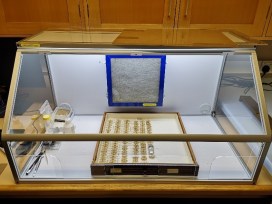
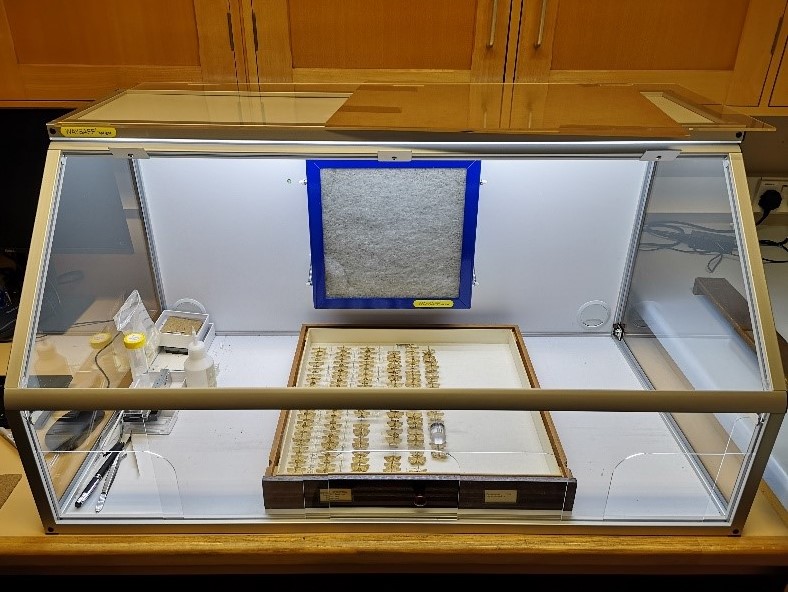
When working on a drawer, we put it inside a fume cabinet like this one to protect us from a chemical called naphthalene. This was used in the past to help stop specimens being damaged by pests, such as moths, which see the collection as a huge banquet!
A fume cabinet provides protecton from napthalene
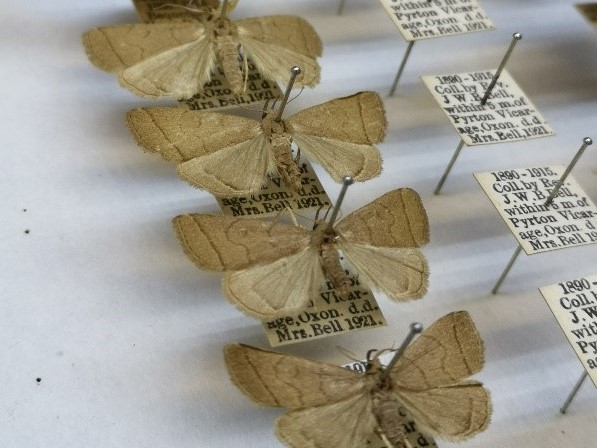
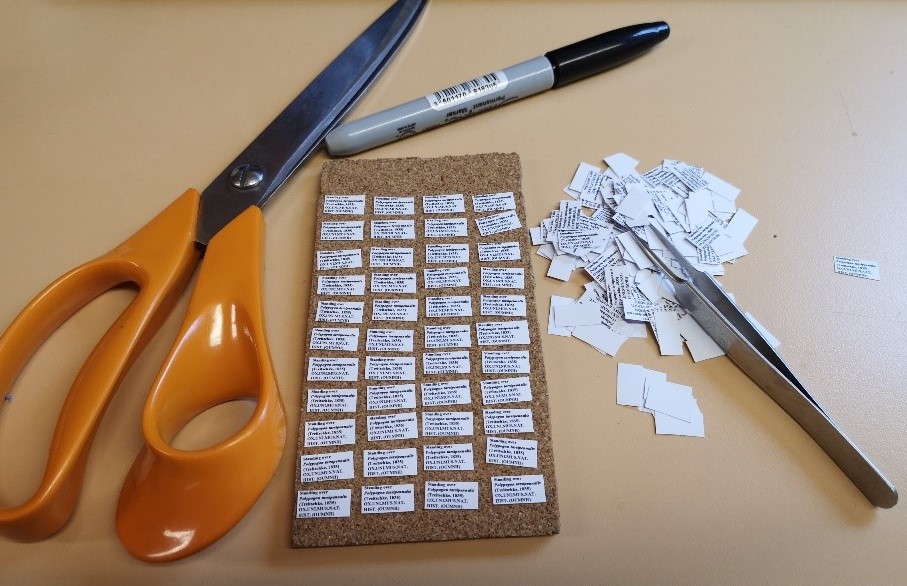
Each specimen we move needs a new label containing vital information about the specimen:
binominal name (Genus / species);
the name of the person who discovered the species;
the year it was first classified; and
a location code.
Watch this video to see how Tom moves the insects
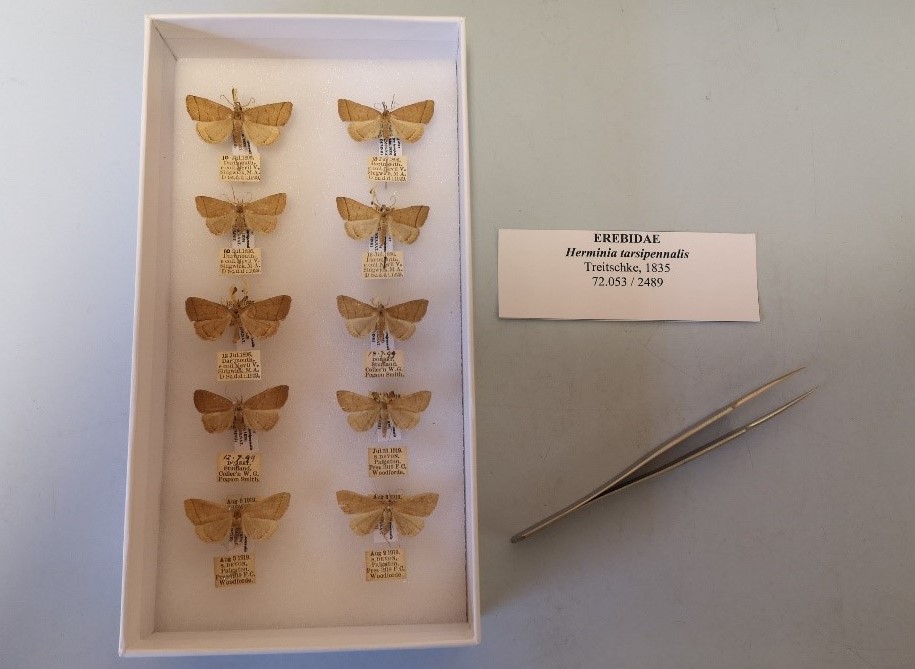
Once a tray is full, we add a data label containing the specimens’ information, along with a checklist number, which in this case relates to the current checklist of classified Lepidoptera (the order that includes butterflies and moths).
A finished tray
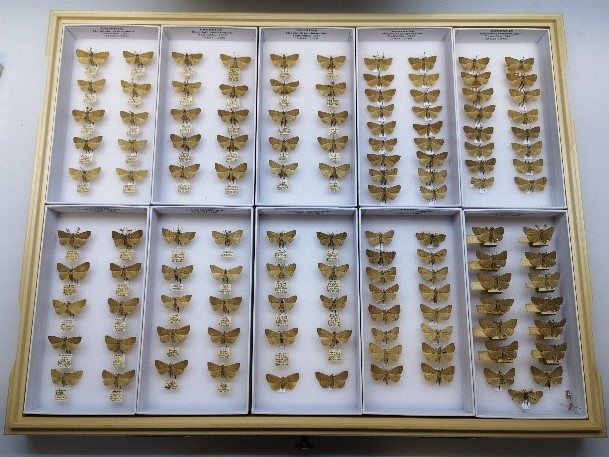
We then add each finished tray to one of the new pest-proof drawers. The completed drawers are then ready to go to their new storage space where it will be accessible for teaching and research.
Crunchy on the outside is a new blog for and by young entomologists.
Interested in insects? Perhaps you saw something we posted online, came to the museum, or maybe we visited you at school for an Insect Discovery Day. However you heard of us, if you’re interested in insects this is the place for you!
We’ll be sharing news about insects and the natural world, people who work insects and help to protect them, what goes on at the museum, and new things for you to make and do. Look out for:
A peek behind the scenes at the museum
Insect related things to make and do
Info about people who work with insects, both past and present
Cool facts and stories about the amazing insects we can find in this country
A chance to have your say regarding what is in this blog and the museum
First dibs on related events
Crunchy on the outside is your opportunity to tell us what you would like from the museum, share your ideas and to get involved. We’d love to hear your ideas so please get in touch using the CONTACT US page if there is something you’d like to see.
Crunchy on the outside is part of the HOPE for the Future project at Oxford University Museum of Natural History. The project is funded by the National Lottery Heritage Fund.
This article is taken from European research magazine Horizon as part of our partnership to share natural environment science stories with readers of More than a Dodo.
Armed with sensitive antennae and wide-angled compound eyes, bees have a sophisticated set of senses to help them search out pollen and nectar as they buzz from flower to flower.
But new research is revealing that bumblebees may employ another hidden sense that lets them detect when a flower was last visited by another insect.
Professor Daniel Robert, an expert in animal behaviour and senses at the University of Bristol, UK, has discovered that bumblebees have the ability to sense weak electrostatic fields that form as they fly close to a flower.
‘A bee has a capacity, even without landing, to know whether a flower has been visited in the past minutes or seconds, by measuring the electric field surrounding the flower,’ Prof. Robert explained.
The discovery is one of the first examples of electroreception in air. This sense has long been known in fish such as sharks and rays, which can detect the weak electrical fields produced by other fish in the water. Water-dwelling mammals such as platypus and dolphins have also been found to use electric fields to help them hunt for prey.
But rather than hunting for fish, bees appear to use their ability to sense electrical fields to help them find flowers that are likely to be rich in pollen and nectar.
Charge Bees develop an electrostatic charge because as they fly they lose electrons due to the air rubbing against their bodies, leading to a small positive electric charge. The effect is a bit like rubbing a party balloon against your hair or jumper, except the charge the bees accumulate is around 10,000 times weaker.
Flowers, by comparison, are connected to the ground, a rich source of electrons, and they tend to be negatively charged.
These electrostatic charges are thought to help bees collect pollen more easily. Negatively charged pollen sticks to the positively charged bee because opposite charges attract. Once the pollen sticks to the bee, it too becomes more positively charged during flight, making it more likely to stick to the negatively charged female part of a flower, known as a stigma.
Bees develop a positive electric charge as they fly, which helps them to collect pollen from negatively charged flowers. Image credit – Pxfuel.com/DMCA
But Prof. Robert and his colleagues wondered whether there could be more to this interaction. When they put an electrode in a flower, they detected a current flowing through the plant whenever a bumblebee approached in the air. Their study revealed that the oppositely charged flower and bee generate an electrostatic field between them that exerts a tiny attractive force.
To study whether the bees are aware of this electrostatic field, they then offered bumblebees discs with or without sugar rewards. Those with sugar also had 30 volts of electricity flowing through them to create an electrical field. They showed that the bees could sense electrical field and learn that it was associated with a reward. Without the charge, bees were no longer able to correctly identify the sugary disc.
Research by another group published shortly after Prof. Robert’s own work also showed that honey bees are also able to detect an electrical field. But exactly how the insects were able to do this remained a mystery, leading Prof. Robert to set up the ElectroBee project.
Very few animals have the capacity to read the stars and use it to find, north, south, east or west.
Professor Eric Warrant, Lund University, Sweden
Hairs
He has discovered that fine hairs on the bees’ bodies move in the presence of weak electrical fields. Each of these hairs has nerves at its base that are so sensitive they can detect tiny movements – as little as seven nanometres – caused by the electrical field.
Prof. Robert believes that when a bee visits a flower, it may cancel out some of the negative charge and so reduce the electrostatic field that forms when bees approach. This change in the strength of the electrostatic field could allow other bees flying past to work out whether a flower is worth visiting before they land, helping to save time and energy.
Other signals, such as changes in the colour and smell of flowers, happen in minutes or hours, while switches in electric potential occurs within seconds.
Prof. Robert and his team are now testing their theory that the electric field helps bees know which flowers to visit by counting visits by bumblebees to flowers in a meadow this summer and measuring electric fields around the flowers.
Their findings could help scientists better understand the relationship between plants and pollinating insects, which may prove crucial for improving the production of many vital fruit crops that rely upon bees for pollination.
Prof. Robert is also investigating whether bumblebees use their electrostatic charge to communicate to their nest sisters about the best places to fly for pollen.
But while bumblebees use their extraordinary sensory power to find food just a few kilometres from their nests, another insect is using another hidden sense to make far longer journeys.
The Bogong moth can travel more than 1,000km to hibernate in caves during the Australian summer. Image credit – Lucinda Gibson & Ken Walker, Museum Victoria/Wikimedia, licenced under CC BY-SA 3.0
In Australia, Bogong moths (Agrotis infusa) flitter steadily from various parts of the country and make their way towards the Snowy Mountains in the southeast. They fly for many days or even weeks to reach the high alpine valleys of the highest mountain range in the country, sometimes travelling over 1,000km. Once there, the insects hibernate in caves typically above 1,800m for the Australian summer, before making the return journey.
The only other insect known to migrate so far is the monarch butterfly in North America. But while the monarch butterfly relies in part on the sun’s position for navigation, the moths fly by night. Professor Eric Warrant, a zoologist at Lund University in Sweden, has been fascinated with how these insects, just a couple of centimetres in length, managed such a feat ever since he was a student in Canberra, Australia.
Moth mystery He suspected that the moths might use the Earth’s magnetic field to find their way, so his team tethered moths to a stalk that allowed them to fly and turn in any direction before surrounding them with magnetic coils to manipulate Earth’s magnetic field.
‘It is a little like how we would go hiking,’ said Prof. Warrant, who is trying to unravel how the moths sense the Earth’s magnetic fields in his project MagneticMoth. ‘We’d take a reading from a compass, then look for something to walk towards in that direction, a tree or mountain peak.’
His research has already shown that the moths check their internal compass every two or three minutes and continue to make for a visual cue ahead. But what are the insects able to see at night?
Further research revealed something remarkable. When Prof. Warrant downloaded an open source planetarium programme called Stellarium and projected the Australian night sky above the moths, he discovered they were using the stars.
‘Very few animals have the capacity to read the stars and use it to find, north, south, east or west,’ said Prof. Warrant. ‘We (humans) learnt how to do it. Some birds do it.’
But insect eyes of bogongs mean they don’t simply follow one guiding star. Rather they are sensitive to panoramic scenes.
‘In the southern hemisphere, the Milky Way is much more distinct than it is here in the northern hemisphere,’ said Prof. Warrant. ‘It really is a stripe of pale light in which there are interspersed very bright stars.’ He believes that the moths are at least in part guided to their cool alpine caves by the light of the Milky Way.
Prof. Warrant believes that Bogong moths naviagte in part by using the Milky Way as a guide. Image credit – Dave Young/Flickr, licenced under CC BY 2.0
The discovery could also lead to the development of new types of navigation for our own species too. GPS, for example, relies upon a constellation of satellites that are vulnerable to disruption. Prof. Warrant believes studying an insect capable of flying 1,000km to a cave using a brain the size of a rice grain, could help us find alternatives too.
‘Animals seem to solve complex problems with little material and low amounts of energy,’ Prof Warrant said.
The research in this article was funded by the EU. If you liked this article, please consider sharing it on social media.
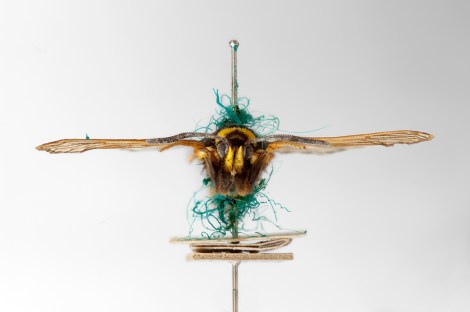
Top image: Fine hairs on bees’ bodies can sense tiny changes in electrostatic fields, enabling them to sense whether another bee has visited a flower before them. Image credit – Unsplash/George Hiles, licenced under Unsplash licence
When working on the dissertation for my MSc in Archaeological Science last year, I explored the medieval craftsmanship of sealing wax. I was interested in the way the medieval wax seals had flaked, as the beeswax dried out. Drawing on my previous education in conservation techniques, I began a close investigation of the prestigious material, beeswax.
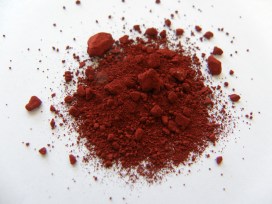
Medieval craftsmen used a range of dangerous materials to make sealing wax. The red pigment cinnabar, a mercury (II) sulphide, and red lead, are now known to be extremely poisonous.
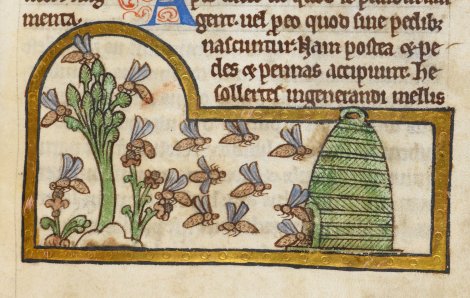
Although some of the ingredients of sealing wax are very hazardous, there is nothing dangerous in beeswax… except the bees! Produced by honey bees, Apismellifera, honey and beeswax were important commodities in the Middle Ages. Beekeeping was a skilful profession, housing colonies in woven hives, known as skeps. Colonies were carefully selected to overwinter for the next season.
Manuscript illuminations provide detailed information on the types and construction of beehives in the Middle Ages.England, 13th century. British Library Royal 12 C XIX f. 45.
Beeswax was also important in the Middle Ages for lighting, and beeswax candles were preferred for their pleasant smell. After the Protestant Reformation in the 16th and 17th centuries, the religious use of candles decreased, so demand for beeswax declined.
Even today, the Catholic and Orthodox Churches still require the candles they use to contain a proportion of beeswax.
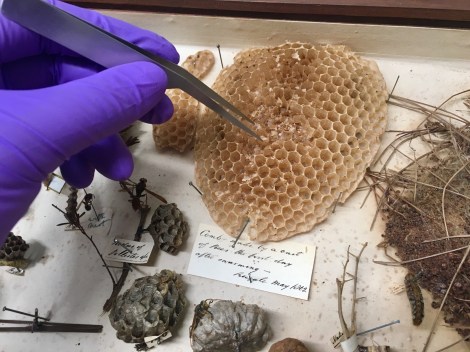
On my quest to understand the degradation of beeswax in sealing wax and write my disseration, I was very lucky to use some samples from the entomological collections from the Oxford University Museum of Natural History. After some early mornings spent amongst the Westwood collection, I found the perfect specimens of natural honeycombs, from the 19th century. The old hand-written labels were also a lovely encounter when exploring the historical collections.
I compared the samples to modern beeswax and medieval seal samples, and learned that the degradation of beeswax is caused by multiple factors, triggered also by storage conditions. The composition of beeswax is very complex, and there are differences caused by the age of the bee in addition to geographical provenance.
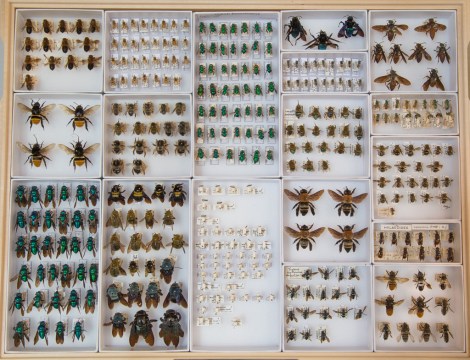
A selection of bee specimens from the Museum’s collection.
The recent catastrophic decline of bee populations has drawn focus to save the bees, and in my PhD research (University of Copenhagen and University of Cambridge) I will explore the recovery of ancient DNA and proteins of bees from beeswax, to cast light on the health of bee populations over time.
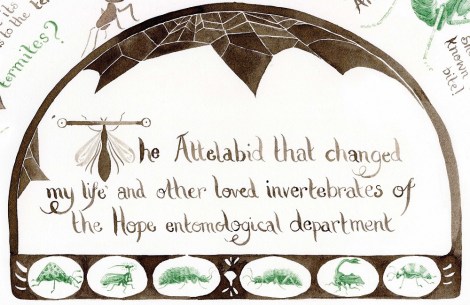
Katherine Child, image technician in the Museum’s Life collections, doesn’t just use photography to capture the beauty of specimens. She is also an artist and has been trying out innovative techniques for her paintings. You may remember her amazing moth illustrations created with deposits of verdigris on pinned insects and she’s now using that technique to explore Museum staff’s favourite insect specimens.
Verdigris is a green corrosion often found on old pins within entomology collections (as well as elsewhere, on things like statues and copper pipes). Last year, after learning that the substance was once used as a pigment, I decided to try and make my own paint.
A clearwing moth before conservation, showing verdigris spreading where metal reacts with insect fats, or lipids.
Verdigris forms when copper or a copper alloy reacts with water, oxygen, carbon dioxide or sulphur. While a beautiful shade of green, the substance is damaging in natural history collections, where it can actually develop inside specimens and if left, split them irreversibly. So as part of the conservation of the Hope Entomological Collections, verdigris is removed.
I started to collect up the substance as it was cleaned from specimens and after about three years (you only get a little bit per pin) I was ready to make my paint! After my first moth project, the only question was, what to paint next…?
Byctiscus populi or ‘The Attelabid that changed my life’, chosen by Zoë (collections manager) who said ‘I saw a pink version of this species in the Natural History Museum in London and that’s when I decided I wanted to study entomology’.
With an estimated 6 million insects and arachnids in the entomology collections, it’s very easy to feel overwhelmed. You can pull open any one of thousands of draws and find astonishing specimens. While I have favourites, my first inclinations as to what to paint still felt a little arbitrary. After mulling over various possibilities, I decided to get help!
Chosen by DPhil student Leonidas, Agalmatium bilobum is a little bug which lays its eggs on tree bark, then covers them with mud to protect them.
I asked my co-workers what their favourite insects were, then opened the question out to regular volunteers and visitors of the Life collections. I loved finding out why people chose the things they did. Answers varied from ‘It was the first spider I ever looked at under a microscope aged 12’ to ‘Because they’re cool’ to ‘Because they have an ingenious way of manipulating spiders!’
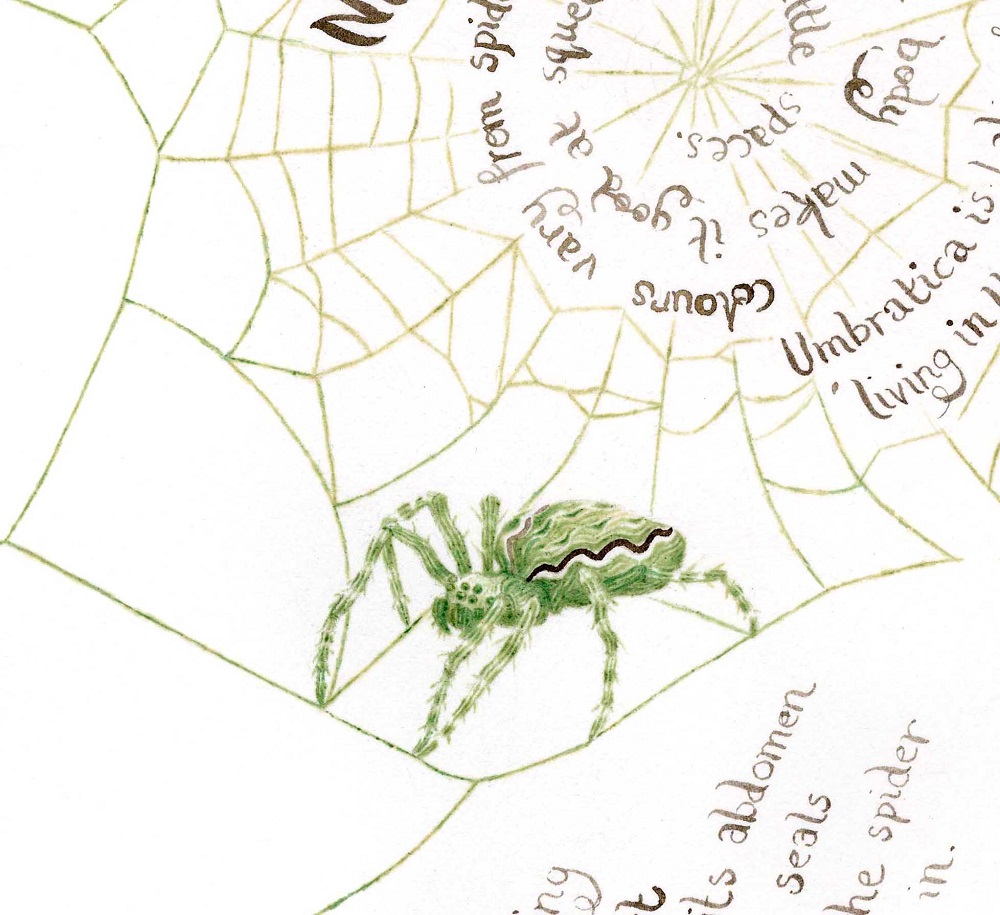
One of arachnologist Russell’s favourite spiders: Nuctenea umbratica. Though common in the UK, umbratica is Latin for “living in the shadows”, and it often hides away during the day. The slight transparency of the paint lends itself to a spider’s glittering eyes.
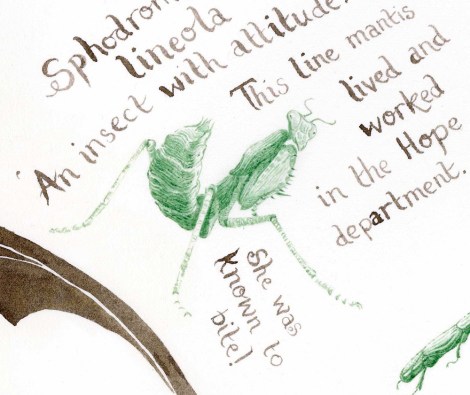
Painting this live African Mantis Sphodromantis lineola (chosen by conservator Jackie) was made slightly more challenging by the fact that the subject thought Katherine’s pencil might be tasty.
Most of the subjects I painted were based on specimens from the Museum’s collections or specimens individuals had brought in from their own collections, but one favourite was a live African Mantis, housed in the department to help with education and outreach. When I began to draw her she was intrigued by the movement of my pencil and came to the front of the tank, to follow every mark I made with her intimidating gaze.
A detail from the final painting
Katherine’s fabulous finished painting, which will be framed and displayed in the Life collections department.
Though time consuming, the painting was loads of fun to research and do. It’s fantastic to be surrounded not only by extremely knowledgeable people, but also by people with a genuine passion for what they do and a love for the insects (and spiders) they study.
Since we posted about ten-year-old Sarah’s amazing beetle discovery, we’ve had lots of queries as to why the insect needed to be caught and pinned. It’s a question we’re often asked, so here’s Darren Mann, Head of Life Collections at the Museum, to explain the value of ‘voucher specimens’.
The Museum’s collection houses over five million insect specimens, amassed over the past 300 years. This collection is, in effect, a biodiversity database, but unlike virtual databases, each data point has an associated ‘voucher specimen’ that was caught, pinned and labelled.
Although technical advances in digital macro-photography do reduce the need for some collecting, it is impossible to dissect an image to confirm an identification. So for many groups, even the best photograph in the world is inadequate for identification purposes.
Shingle CrawlerD18 (Psammoporus insularis Pittino, 2006) one of our few endemic insects.
Unlike plants and birds, many insects can only be identified with the aid of a microscope, to study tiny features that distinguish closely-related species. Some groups even require the dissection of minuscule genitalia to really tell them apart.
Entomologists take voucher specimens to enable this correct identification and these are later deposited in museum collections, making them available for further study in years to come. From an entomologist’s point of view, we believe we need to know what a species is, where it occurs and as much about it as possible, so we can inform biodiversity conservation.
The conservation assessment of UK insects by Natural England in their Species Status Reviews has only been possible with the data provided by entomologists, generated from collecting and identifying voucher specimens.
Entomologists follow a Code of Conduct for responsible collecting, which ensures they don’t remove too many species or damage the environment during their work .
There are numerous examples of the value and use of insect collections in contemporary science, including the discovery of previously unknown species in the UK and population genetics for butterfly conservation. Recently a species believed extinct in the UK was rediscovered. This was only made possible by checking the identification of several thousand museum specimens.
Museum collections also contain numerous examples of species now considered extinct in the UK. Without voucher specimens much of this research would be impossible and our understanding of insect distribution patterns, ecology and conservation would be significantly diminished.
Large Tortoiseshell butterflies, now considered to be extinct in the UK. The voucher specimens act as record in time of its occurrence in the UK.
What is rare? Sarah’s False Darkling Beetle (Anisoxya fuscula) has been described as ‘rare’, but what does that mean in reality? For most invertebrates when we talk about a rare species we are not talking about a tiny number of individuals. This conservation status is based on their known distribution and the level of threat they face. A species can be rare if it is only found at one or two locations, but at those locations there may be many thousands of individuals.
The greatest threats to biodiversity are well known and include habitat loss, fragmentation and degradation and pollution, such as pesticides and light. Taking a small number of voucher specimens to confirm the identification of species has negligible impact on its population. But if we don’t know it’s there because we couldn’t identify it, then a housing development destroys its entire habitat… well you get the picture!












 Since we posted about


