The Museum’s collection of British insects already houses over a million specimens, and now it boasts one more special insect.
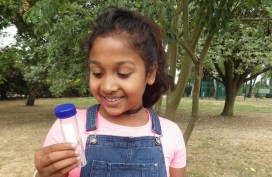
Ten-year-old Sarah Thomas of Abbey Woods Academy in Berinsfield, Oxfordshire discovered a rare beetle in her school grounds while taking part in a Museum outreach session. To Sarah’s excitement, the beetle is so important that it has now become part of the collections here at the Museum – and it is the first beetle of its kind to be added to the historically important British Insect Collection since the 1950s.
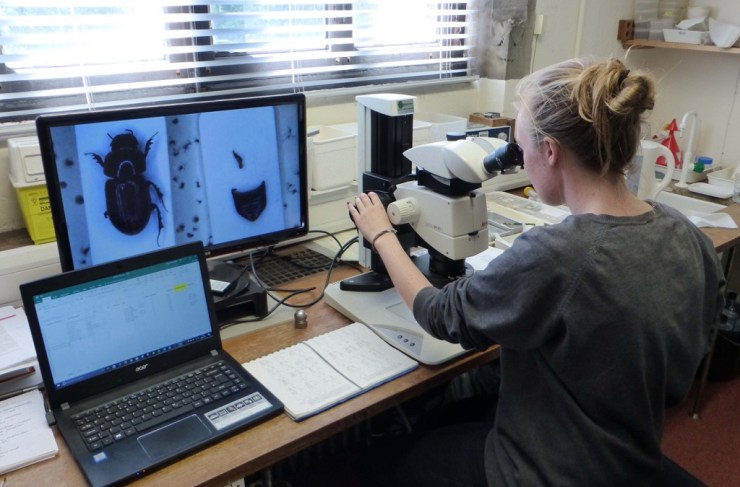
Sarah Thomas examines her beetle under the microscope with Darren Mann, entomologist and Head of Life Collections at the Museum
Sarah’s class took part in a HOPE Discovery Day, where they were visited by a professional entomologist, learnt about insect anatomy and how to identify and classify specimens, and went on the hunt for insects in the school grounds. HOPE – Heritage, Outreach and Preservation of Entomology – is reaching out to students in state primary schools across Oxfordshire, using the Museum’s British Insect Collection to spark curiosity and foster a love of natural history. It’s all part of a bigger project at the Museum, supported by the Heritage Lottery Fund, to safeguard this important Collection for the future and engage people with natural heritage.
Sarah brought her family to the Museum to see her beetle in the British Insect Collection.
After some searching, Sarah spotted a 5mm insect lurking under a leaf. To the untrained eye it looked rather like any other tiny shiny beetle, but luckily Darren Mann, Head of the Museum’s Life Collections, was visiting as part of the HOPE team. Darren spotted it as something unusually and took it back to the Museum to get a closer look under the microscope. He was then able to identify it as a False Darkling Beetle.
It’s Anisoxya fuscula, which is rated as Nationally Scarce in Great Britain. We seldom see these outside old forest habitats and this is the first beetle of its kind to be added to the collections for around 70 years.
– Darren Mann, Head of Life Collections
The False Darkling Beetle under the microscope and labelled in the Museum’s British Insect Collection as found by Sarah Thomas
The tiny beetle has been labelled with Sarah’s name and the location of her find, and added to the British Insect Collection. Though she’s very excited to have her specimen in the collections, Sarah admits that she hasn’t always been a big fan of insects:
Before Project Insect I didn’t really like insects, but now I really do.
– Sarah Thomas
Everyone at the Museum is really pleased with Sarah’s fantastic find and we hope it spreads the word to inspire others to become budding young entomologists too.
The beetle Sarah discovered will be stored in this drawer in the British Insect Collection.
This article is taken from European research magazine Horizon as part of our partnership to share natural environment science stories with readers of More than a Dodo.
Unravelling one of the most elaborate forms of non-human communication – the honeybee’s waggle dance – could help researchers better understand insect brains and make farming more environmentally friendly.
It’s part of a field of work looking at insect neurology which is helping to unravel the complexity of their brains.
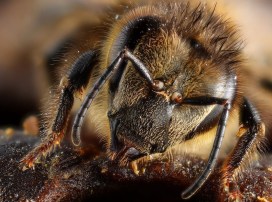
Bees have evolved a unique, and ingenious, way to communicate with each other – the waggle dance. By shaking their abdomens in a particular way, a bee can tell others in its hive the specific direction and distance of a food source or a new site for a nest.
‘If nectar or pollen is in the direction of the sun, a bee will run a figure of eight that is orientated towards the top of the hive. If pollen is found 90 degrees from the sun they will point that way instead,’ explained Dr Elli Leadbeater, a bee expert from the School of Biological Sciences at the University of London, in the UK.
The longer the bees spend dancing corresponds to the better quality of a food source, while the more time spent on each figure eight represents the distance from the pollen or nectar.
Researchers now believe that decoding this information-packed dance further could reveal a link between bees’ brains and how the surrounding environment affects them. In a project called BeeDanceGap, Dr Leadbeater is working to identify the exact genes in the bee brain that play a role in helping the insects understand this waggle dance.
To do this, researchers must first identify the best dancing bees in a test hive and watch them as they reveal a food source to other worker bees. The newly educated bees are then captured as they leave the hive so their brain tissue can be genetically analysed to determine which genes associated with learning and memory were activated from following the waggle dance.
Only a few individuals are used in this way and the genetic data provides a deep insight into the neurology of a bee’s brain – at a time crucial to their future.
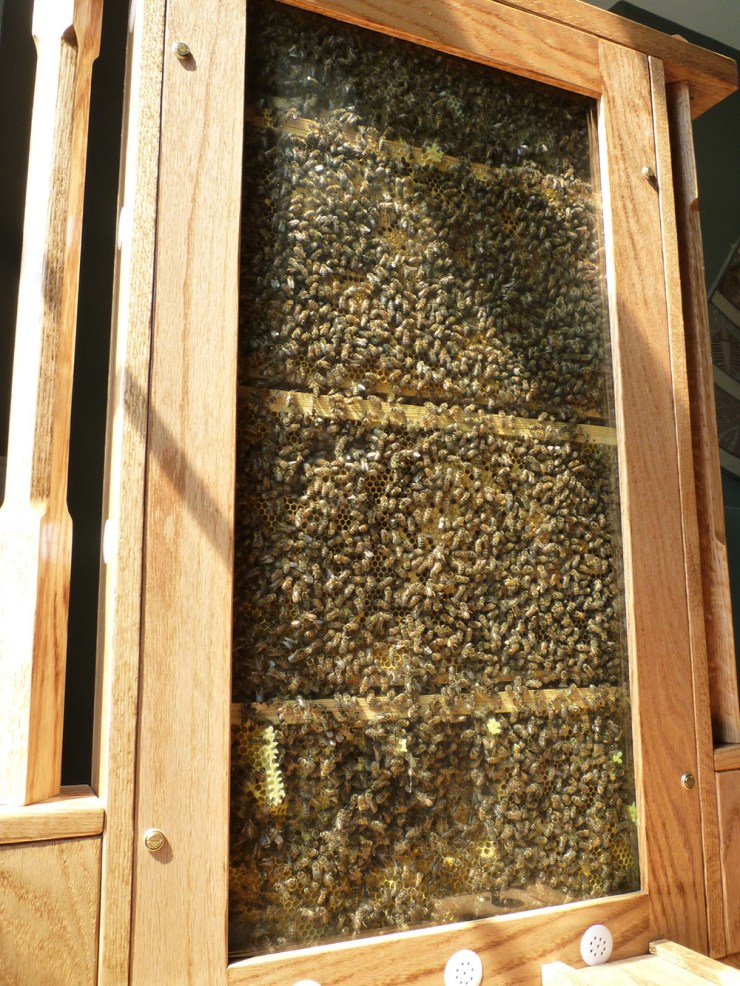
The observation bee hive at the Oxford University Museum of Natural History gives visitors a glimpse into hive life.
Collapse
Beekeepers around the world have reported that many of their bees leave and never come back, causing hives to suddenly collapse. Experts believe there are several factors contributing to this widespread loss of bee colonies, including climate change, parasites and habitat loss. Agrichemicals like pesticides and neonicotinoids, which are used to kill unwanted insects on farms, have also been strongly linked to the problem.
‘The rate pesticides or neonicotinoids are applied to crops don’t necessarily kill bees but they make them worse at foraging,’ said Dr Leadbeater.
If you do damage to just one part of the brain of a lot of individual bees, it can have huge consequences for the whole colony.
Dr Elli Leadbeater, University of London, UK
Neonicotinoid pesticides have been found to bind to parts in the insect brain, disrupting neural transmission. This leads to some brain cells either failing to develop or not functioning properly.
The EU recently banned neonicotinoids, which Dr Leadbeater believes is a huge step forward in protecting bees, but she said governments still need more rigorous ‘long-term environmental safety monitoring’. Without this, there is a risk that other agricultural products used in place of neonicotinoids could impact honeybees in a similar way.
But when the first results of BeeDanceGap are published later this year, they could contribute to building better criteria for testing future agriculture practices or products. Dr Leadbeater believes it will provide a new understanding of a bee’s brain, and so help identify problems sooner.
The impacts of quickly identifying problems go far further than just supporting beekeepers and their insect charges. Protecting honeybees, along with bumblebees and wild bees, is also essential to maintain a healthy and productive environment. These insects pollinate over 80% of crops and wild plants in Europe. According to Professor Martin Giurfa, from the Research Center on Animal Cognition at CNRS in France, ‘preserving little brains is about preserving biodiversity’.
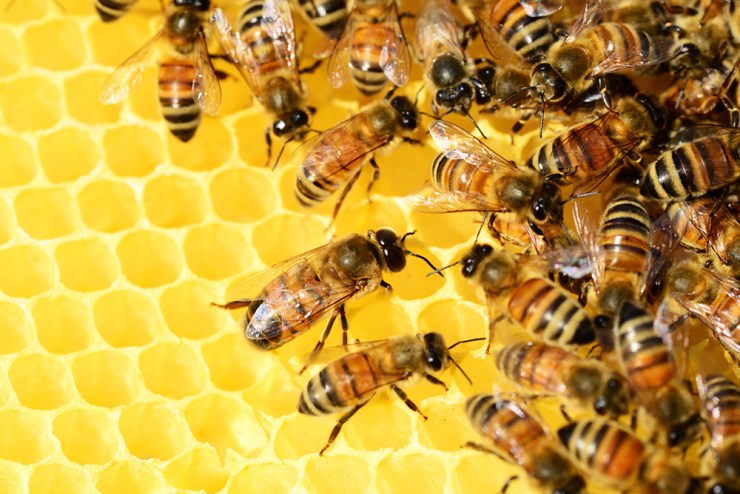
Honey bees working inside a hive
More than machines
Honeybees have a higher social complexity than many other species. Alongside the waggle dance communication, each hive has a division of labour where different workers have responsibility for a variety of tasks – such as foraging for pollen, nursing the young, building hives and even removing the dead.
Prof. Giurfa is co-leading the BrainiAnt project, which looks at how this type of complex social behaviour evolved and how it affected the structure of insect brains. He said that when ‘you understand how bees perceive the world, it is easier to find ways to protect them’.
Through the work of researcher Dr Sara Arganda, the project is investigating a part of the insect brain called the mushroom body, where learning occurs and long-term memories are stored. Researchers analysed bee behaviour and gave them memory tests, such as navigating paths using colour cues, in order to learn more about the structure of insect brains.
The project strengthened the argument that bee brains are more complex than previously thought. ‘Most findings are saying that insects are more than simple machines, which comes from studies in the honeybee,’ said Prof. Giurfa. ‘(But) the entrance region of the mushroom body shows a level of complexity and the studies show that this complexity is not rigid, it is plastic.’
This means its structure is changing all the time, which mirrors how human brains work. ‘(Bee) brains are capable of sophisticated performances such as learning concepts and rules; they are incredible organs and they need to be defended,’ said Prof. Giurfa
To further advance understanding of the mushroom bodies and how they function in different species, the project is being co-led by Professor James Traniello at Boston University in the US, an expert in ant evolutionary neurobiology.
Ants, which are related to honeybees, have brains that may be 100 times smaller, and due to their minute size, provide insights into how insect brains are structured.
‘What happens to neural tissue at an extremely small size?’ asked Prof. Traniello. ‘Are you losing neurons, are neurons becoming more efficient in their actions, how many neurons do you have to string together to form a circuit that enables behaviours as complex as what you would see in ants? How does the collective intelligence of an ant colony impact the structure of the brain?’
If BrainiAnt can answer these questions, it would provide a clearer picture of the evolution and function of ant brains.
‘The next step is trying to understand the genes that are involved in regulating brain size, compartment variability, metabolism and other functions,’ said Prof. Traniello.
He added that a better understanding of neural tissue could also help to guide attempts to genetically engineer bees so their brains are resistant to environmental threats like neonicotinoids. Although far off, it could mean that bees, and the benefits they bring to the environment, will have a more secure future.
The research in this article was funded by the EU.
*
The issue
One in ten pollinating insects is on the verge of extinction, and a third of bee and butterfly species are in decline.
On 1 June, the European Commission launched a proposal to tackle this problem at an EU level. It includes a new monitoring process to collect quality data and identify trends, action plans to protect insect habitats and incentives for businesses such as those in the agrifood sector, to contribute to conservation.
The proposal, known as the EU Pollinators Initiative, has a number of short-term actions to be taken before 2020, at which point the progress will be reviewed.
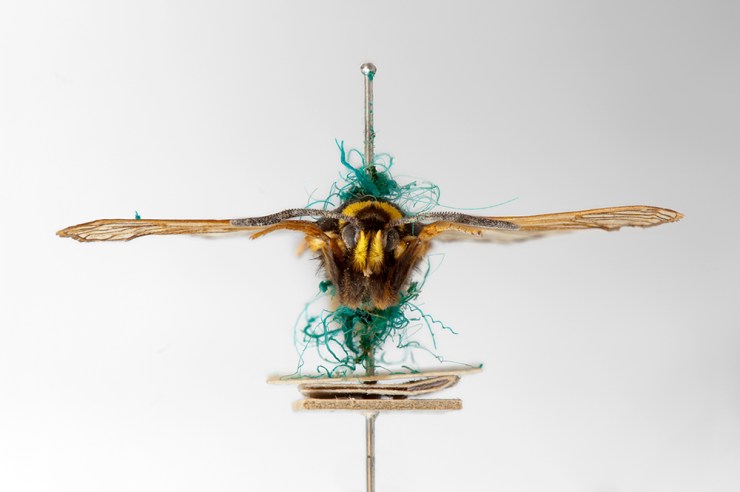
In the process of researching or conserving old pinned insects, it’s common to find a green deposit clustered around the pin. This is known as verdigris and is a natural patina created when the metal oxidizes over time. Katherine Child is Image Technician in the Museum’s Life collections and takes photos of insects for researchers, students, artists and publications. She is also an artist in her own right, so when she witnessed verdigris being removed during a conservation project, she came up with an inspired idea.
A clearwing moth before conservation, showing verdigris spreading where the metal and the insect fats, or lipids, react.
A few years ago I read a book called Colour: Travels Through the Paintbox, by Victoria Finlay, and was interested to learn that verdigris was once used as a pigment. Verdigris, which I now know translates from French as ‘Green of Greece’, is a word that’s been in my vocabulary since I was small. I loved its rich bright blue-green colour, which is often seen on old copper piping or copper statues.
Verdigris forms when copper or a copper alloy reacts with water, oxygen, carbon dioxide or sulphur.
L: Three years’ worth of verdigris, ground and ready to make into paint. R: A second attempt at mixing the paint, this time using linseed oil.
As early as 5thcentury AD, it was used in paint-making, and until the late 19th century it was the most vibrant green pigment available. But it was unstable – Leonardo da Vinci warned that it ‘vanishes into thin air if not varnished quickly.’ These days synthetic pigments provide a more constant alternative.
Despite its past uses, verdigris is a big problem in pinned insect collections. Nowadays stainless steel pins are used, but pins containing copper still remain in old collections and these react with air and insect fats. The more fatty the insect, the more verdigris tends to form and, if left, it can damage a specimen irreparably.
Comprising around five million or so insects, the Hope Entomological Collections here in the Museum take quite a bit of looking after. A few years ago a project to catalogue and conserve many of its butterfly and moth specimens was undertaken and the removal of verdigris and repining of insects was part of this.
With paint-making in mind, I asked that the beautiful, but problematic, substance be saved. About three years on I finally got around to using the pigment, which I had also been adding to while photographing the collections.
I chose a variety of differently shaped moths to paint (most of the verdigris came from moths, so moths seemed the most apt subject). To narrow my options further I went for green moths. Some of the specimens I chose had verdigris on their pin, so I was able to take pigment and use it to paint the very specimens from which it came!
Katherine tested out the newly made verdigris paint in her sketchbook.
After a first failed attempt to make watercolour paint (during which pigment and water remained stubbornly separate due to the greasy insect fats still present), I tried again, this time using linseed oil to make oil paint – and it worked! Traditionally a flat bottomed tool called a muller was used to press pigment into the water or oil. Not having one of these, I used the flat end of a pestle and a mortar which did the trick.
A Miscellany of Moths, the finished verdigris painting.
The paint went surprisingly far and, following on from the 14 green moths, I plan to use up the remainder to paint beetles.
Katherine’s Miscellany of Moths painting can be seen on display in the Museum’s Community Case until 18th October.
New Museum Research Fellow Dr. Ricardo Pérez-de la Fuente talks about his fascinating work with a special collection at the Museum of Comparative Zoology, Harvard University, and what he’ll be getting up to at the Museum of Natural History.
Amber, fossilised resin, has fascinated humanity since prehistoric times due to its mesmerising colour, shine, and fragrance when burned. From a scientific viewpoint however, what makes amber unique is the ability that the resin has to capture small portions of the ecosystem and the organisms living within almost instantaneously, in an unaltered way, preserving them for tens of millions of years. This has an unmatched fidelity among the fossiliferous materials.
Holotype of Fibla carpenteri Engel, 1995, a snake-fly. Credit: President and Fellows of Harvard College.
During a four-year postdoctoral fellowship at the Museum of Comparative Zoology (MCZ) at Harvard University, I had the chance to curate, identify and digitise one of the premier fossil insect collections worldwide. It holds about 50,000–60,000 specimens, including around 10,000 amber inclusions. One of the unexpected outcomes of my time there was helping to rediscover a forgotten loan of about 400 Baltic amber samples that had been brought to the MCZ from the University of Königsberg during the 1930’s. This loan ended up sparing the specimens from being destroyed during the bombardment of the city of Königsberg (renamed Kaliningrad thereafter) in World War Two. The full-story as showcased by the Harvard Gazette can be found here.
Holotype of Lagynodes electriphilus Brues, 1940, a megaspilid wasp. Credit: President and Fellows of Harvard College.
As a researcher specialising in fossil arthropods, one of the most remarkable challenges for me during the digitisation project at the MCZ was to overcome the thrill to learn more about the specimens that we were imaging. In what way were they different from their modern relatives? Were they perhaps new to science? What information were they providing from the ecosystem in which they lived? At present, I can fully embrace these questions and many more thanks to becoming a Museum Research Fellow at the Museum of Natural History.
Cotype of Hypoponera atavia (Mayr, 1868), an ant. Credit: President and Fellows of Harvard College.
My research at the museum focuses on studying interactions between organisms in deep time and their behaviours, particularly in Cretaceous amber, such as plant-insect pollination relationships around 100 million years ago. During that time, a major shift was taking place in terrestrial ecosystems due to the diversification of angiosperms (flowering plants), which ended up replacing gymnosperms (non-flowering plants) as the dominant flora. There was also the appearance of key groups of organisms from the ecological perspective — ants and bees in the case of insects, for instance.
It is a well-accepted fact that preservation in amber is biased towards small organisms because the larger ones tend to escape the sticky resin more easily. But how easy it is for one to get lost in amber when examining its secrets and trying to unravel its mysteries! Becoming forever trapped within.
Some of the most remarkable Baltic amber specimens (about 40 million years old) returned to the Königsberg collection from the MCZ. Pictures: RPF. Credit: President and Fellows of Harvard College.
Many years ago, when re-identifying dung beetles in the collections of the British Entomological and Natural History Society, I found a specimen that I didn’t immediately recognise. So I borrowed it, and after a few hours of checking the European literature back in Oxford, I realised that I’d found a beetle that had not been recorded anywhere in Britain before.
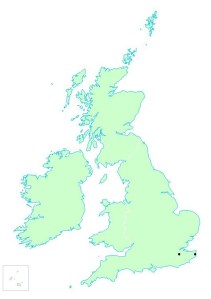
The small black circles show the locations of known records for Melinopterus punctatosulcatus.
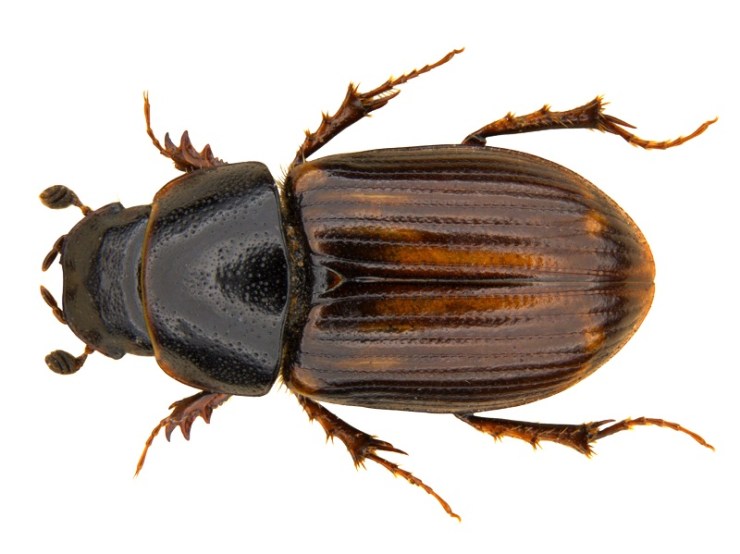
The dung beetle in question was Melinopterus punctatosulcatus, a species widely distributed across Europe but until this discovery unknown in Britain, despite its presence in the BENHS collection. This is because it had been misidentified as a different species: the beetle superficially looks like two closely-related species, and so had been overlooked by beetle collectors for over a hundred years.
Since that initial specimen, I have scoured numerous UK museum collections and to date have found a total of just 20 specimens, distributed across the World Museum in Liverpool, the National Museum Wales in Cardiff, and here in the Museum of Natural History in Oxford. All these specimens are from Deal, Kent and were caught between 1891 and 1910.
The last known record is of a single specimen from Ryarsh, Kent collected in 1938, which just happens to be the first specimen I found some 20 years ago in the BENHS collection.
The male genitalia of Melinopterus punctatosulcatus. The appearance of the genitalia is one of the best ways of identifying one species of beetle from another.
But this week, the 21st known specimen was discovered in our collections by Mary-Emma, a placement student who is with us from the University of Reading. She uncovered the beetle during the re-curation and identification of a collection made by A. J. Chitty. Thankfully the specimen was a male, so we were able to confirm the identification using the genitalia – one of the best ways of determining a species.
It seems that Mr Chitty had a knack for finding this particular species of dung beetle, since 14 of all the known specimens were caught by him at Deal. It’s just a shame that he didn’t realise his amazing discovery at the time.
Mary-Emma identifies Melinopterus punctatosulcatus by examining the dissected genitalia, visible on the right hand side of the monitor screen.
In the recent Conservation Status Review of dung beetles, Melinopterus punctatosulcatus was designated as Regionally Extinct in the UK because there have been no known sightings since that one in 1938. So this species possibly went extinct in Britain before we even realised that it was here. And were it not for museum collections we may never have known it once lived in Britain at all.
The latest display in our changing Presenting… case showcases a wonderful array of dung beetles. Darren Mann, head of our Life Collections, tells us why they are so important.
Worshipped during ancient Egyptian times, dung beetles have a long history of human appreciation. Jean-Henri Fabre (1823-1915), one of the first to popularise insects in his writings, began his Souvenirs entomologiques series with the Sacred Scarab, and even Charles Darwin appreciated the weaponry adorning many dung beetles.
Dung beetles can be divided into three main groups based on their nesting behaviour. The rollers, often seen on television wildlife documentaries, make a ball out of dung and roll it some distance before burying it. The tunnellers dig directly below the dung pile and bury as much as needed for nest construction. Finally, the dwellers nest within the dung pile.
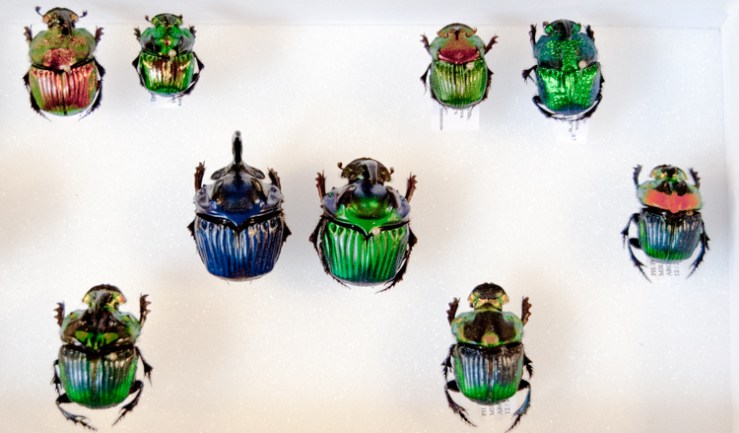
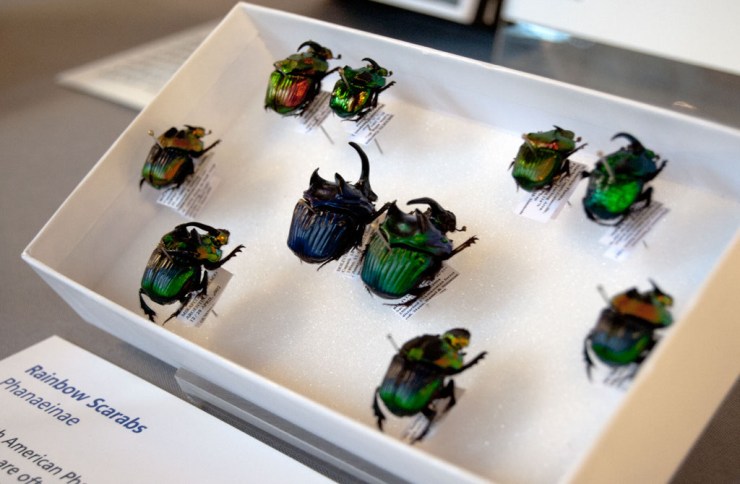
The South American Phanaeinae is one of most colourful groups of beetles. They are often referred to as Rainbow Scarabs due to their bright metallic bodies. We don’t fully understand why these beetles are quite so colourful.
Dung beetles are one of the more popular groups of insects used in ecological and evolutionary research today. They can help us to understand questions about how biodiversity loss impacts on ecosystems, or act as model organisms in the field of evolutionary development.
Unlike the much-publicised importance of bees and their pollination services, dung beetles are relatively unknown, despite their huge ecological and economic value. Their feeding and nesting behaviours provide many useful ecosystem services such as dung removal, pest fly control, parasite suppression, nutrient cycling, plant growth enhancement, improvement of soil structure, secondary seed dispersal, and a possible reduction of greenhouse gas emissions.
Through these activities, one study calculated that dung beetles are worth around £367 million a year to the UK cattle industry alone.
The largest dung beetles belong to the genus Heliocopris, which can reach up to 69 mm (pictured is Heliocopris dominus). These large beetles specialise on elephant and rhino dung. From around 2 mm in length is the oriental genus Panelus. These small beetles probably feed on the ‘dung’ of other insects and fungi.
Ancient Egyptians believed that the dung beetle kept the Sun moving across the sky like a giant ball of dung, linking the insect to the god of the rising sun Khepri. Some historians believe that it was through observing dung beetle behaviour and biology that Egyptians developed ideas about life after death.
The two most widely depicted species in Egyptian art are Kheper aegyptiorum and Scarabaeus sacer. Nowadays, only Scarabaeus occurs in this region of Africa; Kheper is now a more southern species, possibly indicating climatic changes since Ancient Egyptian civilization.
Kheper aegyptiorum on display in the museum’s Presenting… case
The UK has about 60 species of dung beetle and most of these belong to the ‘lesser dung beetle’ subfamily Aphodiinae. The largest of our dung beetles are the Dor Beetles which can reach 28 mm. Our smallest, Plagionus arenarius, is a meagre 2.5 mm. Sadly, over 50 per cent of our dung beetles are in decline due to agricultural intensification, pesticides and habitat loss.