Tales from the Jurassic Coast

marybuckland_philpot_2

Britain’s Jurassic Coast is a famous location for fossil hunters. Dorset’s Lyme Regis in particular was a collecting ground for two very important Victorian palaeontologists – Elizabeth Philpot (1780-1857) and Mary Anning (1799-1847) – and the site yielded some of the earliest specimens of Ichthyosaurs and Plesiosaurs.

Last weekend Channel 4’s Walking Through Time series focused on the Jurassic Coast and featured two members of staff from the Museum, Eliza Howlett and Hilary Ketchum from our Earth Collections. To coincide with the programme, Eliza here delves into the Museum’s Philpot archive to paint a picture of the relationship between Elizabeth Philpot, Mary Anning, and Oxford University’s first Reader in Geology, William Buckland.

*

Elizabeth Philpot moved to Lyme Regis around 1805 with two of her three sisters, Mary and Margaret, where they soon became involved in fossil collecting and where they remained for life. At this time Lyme-born Mary Anning was still a young girl, but so began an affectionate relationship with the Philpot sisters which transcended any barriers of age, social origins or educational background.

Caption
A letter from Elizabeth Philpot to Mary Buckland dated 9 December 1833.

As the Philpots’ fossil collection grew it became known in the geological community. One familiar visitor was William Buckland, whose earliest published reference to the ‘Miss Philpots’ is in his 1829 paper on the pterosaur found at Lyme by Mary Anning.

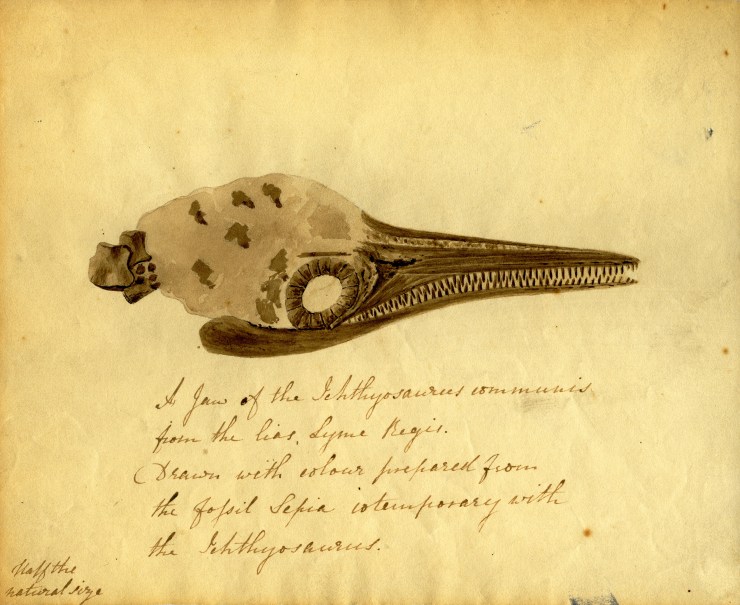
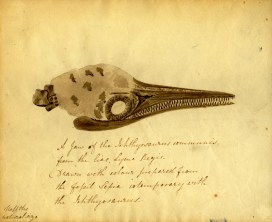
In one letter to Buckland’s wife, Mary, dated 9 December 1833, Elizabeth Philpot enclosed a sketch of an ichthyosaur head that she had painted using ink from a fossil squid of the same age as the ichthyosaur, 200 million years old; this is pictured at the top of the article. The letter also contained a colourful description of Mary Anning’s escapades:

Yesterday [Mary Anning] had one of her miraculous escapes in going to the beach before sun rise and was nearly killed in passing over the bridge by the wheel of a cart which threw her down and crushed her against the wall. Fortunately the cart was stopped in time to allow of her being extricated from her most perilous situation and happily she is not prevented from pursuing her daily employment.

Next, it sends a reminder to William Buckland, a man well-known for forgetting things:

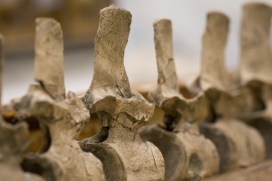
May I beg you to remind Dr. Buckland that he has borrowed from me some Plesiosaurus vertebre. As it is some time since I will mention that it is a section of a vertebre, one with the process, ten others, and a chain set in a box.

These letters from Elizabeth Philpot are now held by the Museum, along with the Philpot collection of around 400 fossils. Mostly from Lyme Regis, this collection includes more than 40 type specimens, the reference specimen for a new species, which is a remarkable total for any collector. A brief list of people known to have examined the collection is practically a roll call of the key figures in 19th-century palaeontology: William Buckland, William Conybeare, John Lindley and William Hutton, Richard Owen, James Sowerby, and (from Switzerland) Louis Agassiz.

But the collection was also made available to the ordinary people of Lyme, and the handwritten labels by Elizabeth Philpot sometimes included detailed explanations of what these extinct animals would have looked like. Both the letters and the specimens remain deeply evocative today, conjuring up visions of what it must have been like to call on these three remarkable sisters.

Because of the risk of light damage the material is not normally on display, but it can be viewed by appointment. Email library@oum.ox.ac.uk or earth@oum.ox.ac.uk for more information.
The fossils of Stonesfield

A Spotlight Specimens special for Oxford Festival of Nature

By Eliza Howlett, Earth Collections manager

There was a time, more than 160 million years ago, when most of Oxfordshire was covered by a warm, clear, shallow sea. Offshore, the waters were agitated by waves and storms, but closer to land these forces were buffered by a submerged sandbank, and calm lagoons developed.

The area that is now Stonesfield was part of this lagoonal environment, and the fossils that have been found there provide a wonderful window into the living world of this Middle Jurassic sea.

So how would these sea creatures compare with British marine life today? Some things would have been very familiar. On the sea bed you would have found a huge variety of bivalves, or clams, along with lobsters, crabs and sea urchins; the waters above would have been full of fish, including several different types of shark.

IMG_9086
This fossilised limpet shell has its original colouration preserved

But there would have been other things too: squid-like belemnites, and nautiloids and ammonites with coiled shells, and tentacles like an octopus. Instead of dolphins and porpoises there would have been sea crocodiles and sea turtles, and in the skies above, flying reptiles known as pterosaurs rather than the usual sea birds.

And there’s more. Stonesfield fossils also include plants and animals washed in from nearby land: the leaves and seeds of conifers and cycads, beetle wing cases, reptile eggs, and the remains of both dinosaurs and mammals.

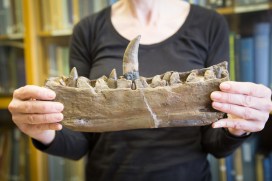
The jaw of the first named dinosaur, Megalosaurus bucklandii, found in Stonesfield, Oxfordshire
The lower jaw of the first named dinosaur, Megalosaurus bucklandii, found in Stonesfield, Oxfordshire in the early 19th century

One particularly spectacular find was the lower jaw of the carnivorous dinosaur Megalosaurus, nine metres long in life and weighing about a tonne. Megalosaurus became the first creature to be named a ‘dinosaur’, in 1824. Less obvious, but equally significant, are the tiny jaws of some of the shrew-like mammals that would have lived alongside the dinosaurs: Phascolotherium, Amphitherium, Amphilestes and Stereognathus – the first Jurassic mammals known to science.

Along with the preservation of delicate items such as dragonfly wings and the leg of a cricket, and the original colour patterns on some sea snails, limpets and barnacles, the fossil material from Stonesfield is really quite special.

OFoN_logo_green block_small

A plesiosaur named Eve

A Spotlight Specimens special for Oxford Festival of Nature

by Juliet Hay, Earth Collections preparator and conservator

I feel myself very lucky to have a job that involves working with the fossil remains of long-extinct animals. One of the things my colleagues and I are currently working on is a plesiosaur – a marine reptile that lived in the sea millions of years ago.

This particular specimen was found in a clay pit near Peterborough by members of the Oxford Clay Working Group in 2014, and is a near-complete example of its kind. The palaeontologists who found the specimen named it Eve, although we don’t know if it was male or female, and perhaps never will.

The discovery of large fossil vertebrates like this is rare, so we are fortunate to have had the specimen donated to the Museum by the quarry owners Forterra.

Juliet at work on the plesiosaur skull

The plesiosaur is 165 million years old and, when alive, was around 5.5 metres long. It had a long neck, a barrel-shaped body, four flippers and a short tail. The find is particularly exciting as the skull was also discovered. It is encased in a clay matrix, which is relatively easy to remove, but the work has to be carried out under magnifying lenses and microscopes.

As the skull is quite small relative to the size of the body, the features are very delicate and it is a painstaking process to remove the sediment without damaging the fossil bone or losing any tiny fragments. Fortunately, pictures of the skull have been produced using CT scanning technology, and the images are proving invaluable as an aid to assist in its preparation. It’s a bit like having a jigsaw puzzle with the picture on the lid to refer to!

sdfsd
A belemnite hooklet at 12x magnification, found with the plesiosaur remains and possibly part of Eve’s last meal

The clay covering the skull is being sieved and examined and tiny hook-shaped fossils have been found. These came from the arms of squid-like creatures called belemnites, which may have formed a large part of the plesiosaur’s diet.

It is too early to say for sure, but Eve could represent a species new to science, as some features, such as the shape of the flipper bones and some of the surfaces of the bone in the skull, are quite unusual. Further research needs to be done before the findings can be published in scientific journals – watch this space.

And if you’re visiting the Museum before 25 July, you can see some of the fossilised remains of Eve for yourself, in our Presenting… display case.

OFoN_logo_green block_small

What’s on the van? – Shark tooth fossil

_Lhwyd-1260-original

This week’s What’s on the van? comes from Paul Jeffery, assistant curator of the Museum’s Geological Collections.

The oldest known collection in the Museum is that of Edward Lhuyd (1660-1709), made during the 1680s-1690s. This collection formed the basis for Lhuyd’s ground-breaking monograph, Lithophylacii Britannici ichnographia – a systematic illustrated catalogue of the collection of fossils he was responsible for as Keeper of the Ashmolean Museum, which at that time was still based in its original building, now the Museum of the History of Science in Broad Street.

Lhuyd’s book set the framework for later works by authors such as Carl Linnaeus (1707-1778) and Gustavus Brander (1720-1787) who further systematised the naming and description of animals, plants and fossils, and introduced a Latin-based naming regime still used today.

Lhuyd also advanced thinking on fossils, recognising them as organic in origin, rather than spontaneous mineral concretions or sports of the devil. This was daring and radical for its time – an era when religious orthodoxy still strongly influenced philosophical and academic thought.

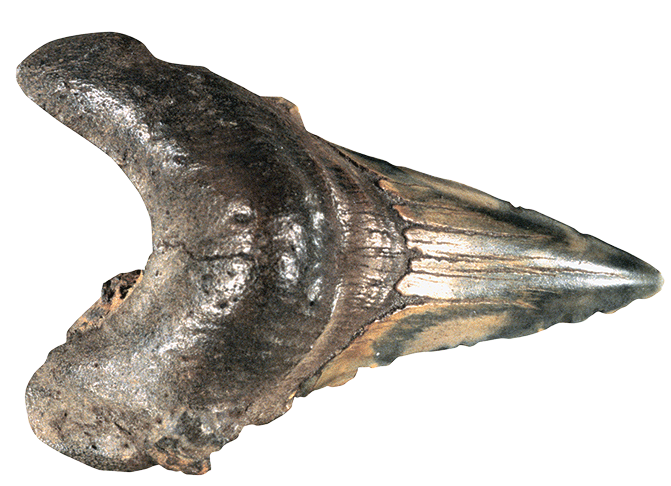
This particular shark’s tooth comes from the extinct species Otodus obliquus. It is from the 50 million year old London Clay (Early Eocene), and was found on the Isle of Sheppey, Kent. Such teeth can still be found on the beaches there today, washed from the crumbling clay cliffs by rain and wave alike.

It is an uncommonly large species of shark – teeth may exceed 75mm in length, and represents one of the earliest steps in an evolutionary “arms race”. During the Palaeogene and Neogene this lineage of lamniform sharks evolved ever larger and more comprehensively serrated teeth, along with proportionately increased body sizes, to keep pace with early whale evolution, as they too increased from modest proportions to the giants of today.

It was a race the whales eventually won in the Early Pleistocene. Otodus’s descendant – the giant Carcharocles megalodon, a 20m long super-predator – disappeared around this time: outgrown by the whales, out-competed by new predatory species and displaced by global climatic cooling.

We will be exhibiting some of Lhuyd’s fossils in Natural Histories, a collaborative exhibition based at the Museum of the History of Science, opening on 14 May. More information about this will follow very shortly.

Paul Jeffery, Assistant curator of Geology

What's on the van?

Presenting… Bruno’s fossil find

Presenting Bruno's fossil find

Limulus polyphemisYou’ve read about it in the press (probably), but now you can see Bruno Debattista’s rare trace fossil find for yourself in our Presenting… display, just inside the entrance of the Museum. Although we are closed, this changing exhibit can be seen by visitors coming through the building to the Pitt Rivers Museum.

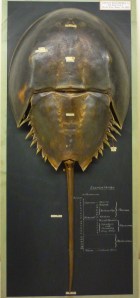
On display we have Bruno’s shale rock, found in Bude, Cornwall last year, which shows faint tracks left by a pair of horseshoe crabs as they crawled up an ancient, muddy shore more than 300 million years ago. Although the species of horseshoe crab which made these tracks is long extinct, we are displaying two modern specimens for comparison. One is around the size of the animal which left the original trackway; the other is a full size horseshoe crab which lives in the Atlantic Ocean – Limulus polyphemus.

We should also point out that horseshoe crabs aren’t really crabs at all. Crabs are crustaceans, but horseshoe crabs are more closely related to the arachnids, such as spiders and scorpions.Fossil and horseshoe crab

Scott Billings – Communications coordinator