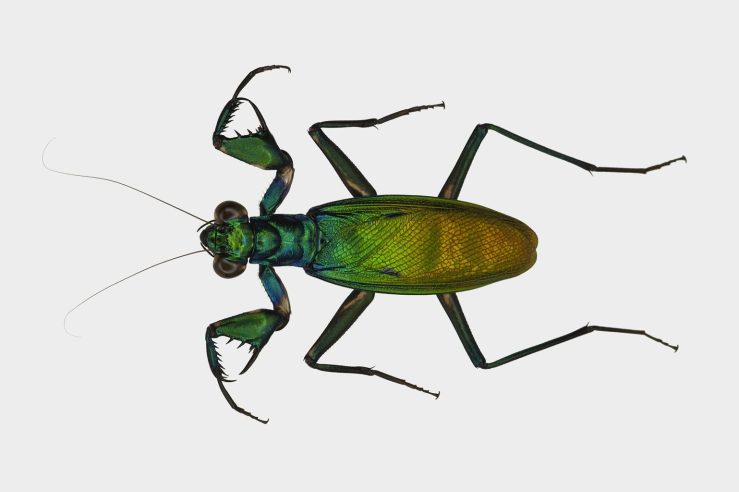
In the latest display in our Presenting… series, collections manager Amoret Spooner takes a look at the wonderful and sometimes strange world of the praying mantis.
Praying mantis is the common name given to an order of insects called Mantodea, a word which derives from mantis meaning prophet, and eidos meaning form or type. The more familiar ‘praying mantis’ refers to the striking way that they hold their large forelimbs, in a ‘praying’ posture.
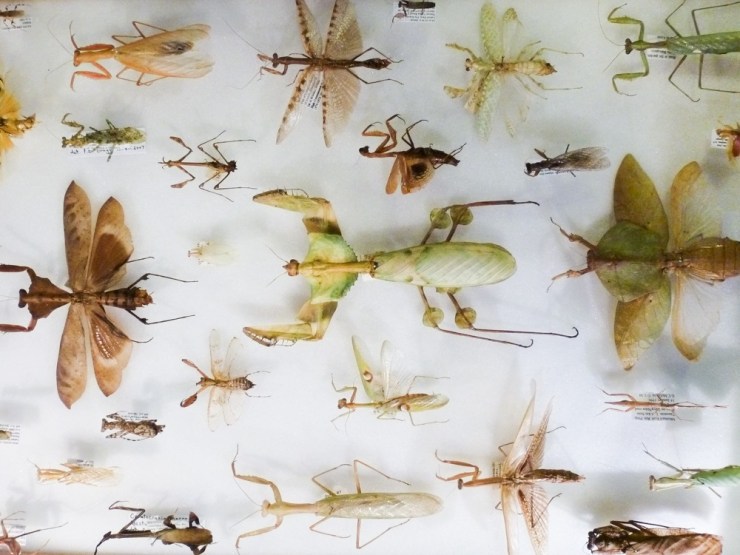
There are over 2,400 species of mantis worldwide, split into 21 different families. The image above shows their incredible diversity of colour, shape and size. But while they may differ in appearance, their biology and many behavioural traits are the same.
Mantis are predators of insects, including other mantis, but larger species will eat small lizards and birds. But they are perhaps best known for being cannibalistic. This behaviour is most commonly seen in nymphs straight out of the egg case, or ootheca, but it can also occur when the female eats the male after mating. However, cannibalism is not required to mate, so when it happens it’s usually because the female is hungry!
The egg case, or ootheca, of mantis vary greatly depending on the size and behaviour of the species.Revisio Insectorum Familiae Mantidarum was one of John Obadiah Westwood’s greatest works. Thankfully he kept all of his drawings, annotated pages and notes for the publication, allowing us an insight into the years of work he put into its production.
Praying mantis are ambush hunters, either camouflaging themselves while waiting for their prey to approach, or actively stalking prey. Their compound eyes are specialised in perceiving motion, and are widely spaced giving them a wide field of vision. Along with powerful front legs and an ability to move the head up to 180°, this makes them successful predators.
The Museum’s archive contains original drawings and annotations by John Obadiah Westwood (1805–1893), the first Hope Professor of Zoology. As a renowned scientist Westwood described many new mantis species, and he was also a talented artist.
The Presenting… Marvellous Mantodea case is on display at the Museum until 1 November 2018.
by Leonidas-Romanos Davranoglou, DPhil student, Animal Flight Group, Department of Zoology, University of Oxford
Anyone walking on a summer day in hot places such as the Mediterranean or the tropics will have heard cicadas singing. Cicadas actually are among the loudest of all animals, singing at up to 120 dB – as loud as a passing freight train. In fact, you can damage your ear if a particularly loud species starts singing next to your head.
Some countries even have health and safety policies which prevent people from working outdoors when cicadas are singing. If a single cicada can sing that loud, you can imagine what a forest filled with them sounds like!
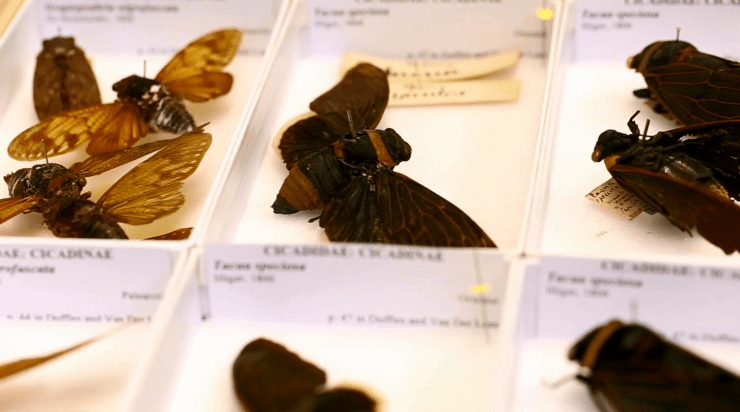
Tropical cicadas from the Museums’ collections
Only male cicadas sing, primarily to attract females, much like a Romeo singing to his Juliet. Females are mute, but they respond to males of their liking by flicking their wings, generating a loud click. Entomologists often mimic the female response by snapping their fingers under a tree containing cicadas. In this way, they can collect males eager to mate, which would otherwise be too high in the tree to reach.
An unpleasant parasitic fungus capitalises on this arrangement: The fungus basically consumes the innards of the male cicadas, causing their private parts to fall off – in effect castrating them. A castrated male may stop singing and as a result, other males try to mate with it, and in this way the fungus is transmitted from male to male.
But how do these famous (or notorious, if you find them annoying) cicadas produce these incredible sounds? This has remained a mystery since the time of the ancient Greeks, who admired these animals. But the matter was settled through a collaboration between Oxford University and Australian scientists. The physical process is not too complex and you can get a good idea how it works by using an empty plastic bottle.
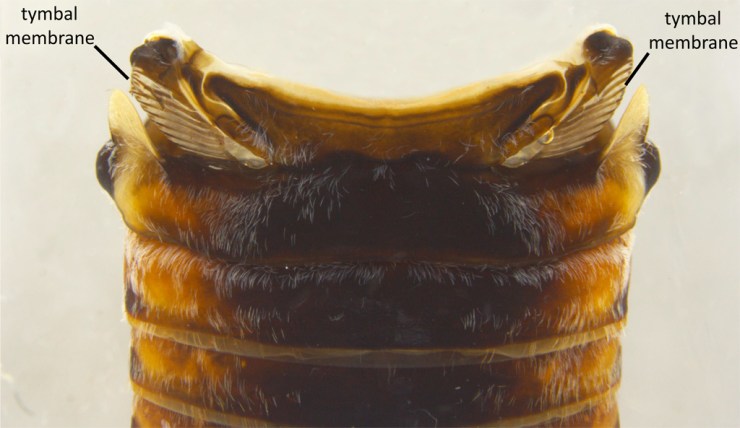
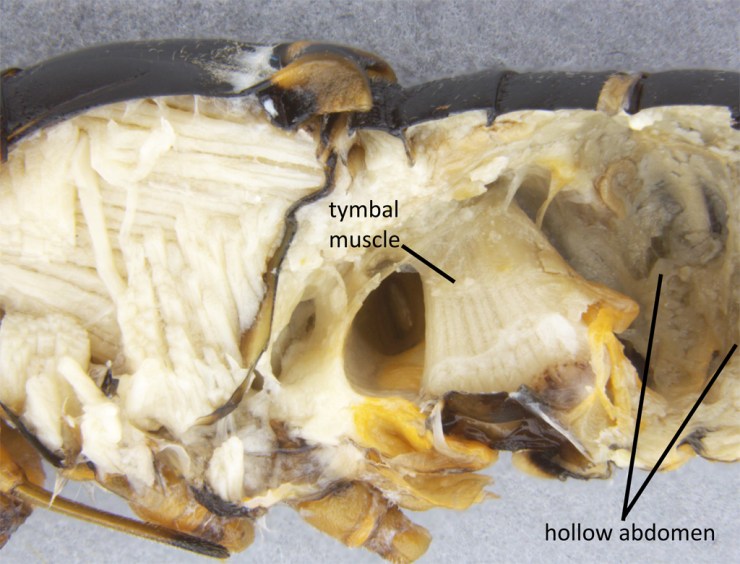
Cicadas have a unique membrane on the sides of their abdomen called the tymbal membrane, which is strong but flexible. Internally, two huge muscles attach to this membrane. When the muscles contract, they pull and buckle the membrane inwards to produce a strong popping sound. You can imitate this by squeezing an empty plastic bottle in and out. Speed up this process by a few hundred buckles per second and you get a cicada’s song.
Dorsal view of the abdomen of the cicada Cicadetta flaveola, showing the two membranes on the sides of the abdomen (tymbal membrane).Lateral view of a dissected cicada, Lyristes plebejus. The huge muscle attaches to the tymbal memembrane, and pulls it inwards to generate a loud click. After the large muscle, the abdomen is largely hollow.
Producing sound however, is not enough. Just like we have to talk with a particular loudness so people can hear us, cicadas must find ways of amplifying their sound, so females can hear them from very far away. The way cicadas achieve this is via something called Helmholtz resonance. You can create this phenomenon by blowing air across the top of the empty bottle you just used to create the pop.
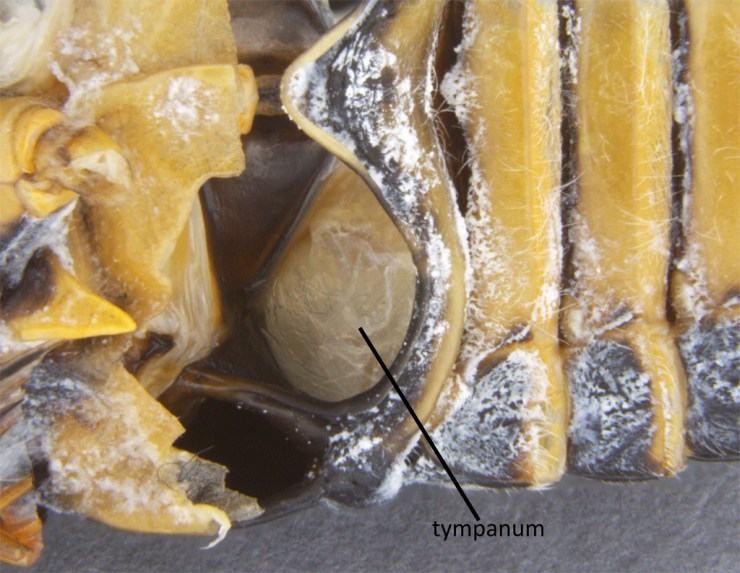
Blowing across a bottle produces sound due to the behaviour of air when it is confined in a container with an open hole. The abdomen of cicadas forms a Helmholtz resonator as well: it is completely hollow, and two openings on the underside, called tympana, act as the top of a bottle and radiate sound in the same way.
Ventral (underside) view of a dissected cicada, Lyristes plebejus. The large opening is the tympanum, which acts as the amplifier for the cicada’s song. The hole of an empty bottle behaves in the same way when you blow air over it.
The singing habits and unique anatomy of the cicadas are perhaps best summarized in a quote by 19th-century entomologist Jean Henri Fabre, who, poetically as always, said:
Assuredly one must be passionately devoted to music thus to clear one’s internal organs in order to make room for a musical box!