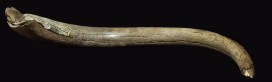
Mammoth tusks and cocktail sticks

By Pete Brown, Move Project Assistant

As part of the Museum of Natural History Move Project Team I have helped move and repackage tens of thousands of specimens since 2017, removing boxes filled at any time over the last 150 years from their old storage location in a deconsecrated church building near Oxford.

At our new facility we have been documenting and repacking the contents in new, clean containers and placing them in environmentally stable, safe warehouses specially adapted for museum storage.

Some objects are trickier to store than others. Things that are long, heavy, curvy and fragile are tricky. Mammoth tusks are long, heavy, curvy, and fragile. This means:

  1. They’re not going to fit in a normal box.
  2. They’re going to be difficult to move around.
  3. That beautiful curve will mean that all the weight of the tusk may be bearing down on just two small contact points where the tusk meets the storage surface.
  4. Because those points are fragile, they’re likely to get damaged.
A lot of weight can rest on small areas of the tusk, putting strain on the specimen and potentially causing damage

The tusk in this article is a prime example. The area nearest the camera in the photo above provided just a tiny point of contact with the floor and was very loose, almost to the point of detaching. It needed to be repaired, and stored in such a way that it wouldn’t get damaged again.

Pete Brown carries out delicate conservation work on the mammoth tusk

I filled some of the missing areas around the fragile area with an easily removable fine acrylic putty to prevent further movement and loss of the original material. A cotton tape sling helped to suspend the fragment in place during the work.

Thick plastazote provided a sturdy, slightly yielding bed for the tusk to lie on in storage, but to prevent the tusk from getting damaged again more needed be done to reduce the pressure on the points of contact.
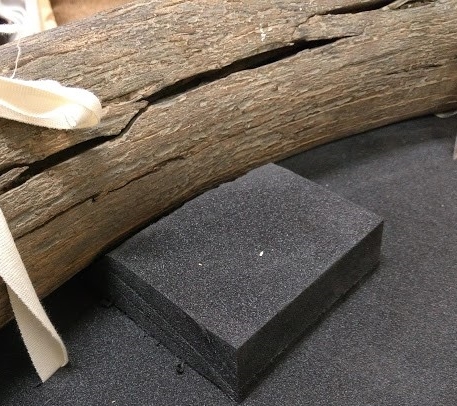
The dark grey foam material, plastazote, is often used as a cushioned support for museum objects

I cut depressions into the plastazote where the tusk naturally lay to increase the total surface area supporting the weight of the tusk, and fixed plastazote wedges and supports in place with cocktail sticks to again increase the contact area and prevent movement. Cotton fabric ties, fed through slits in the plastazote, also helped to guard against unwanted movement.
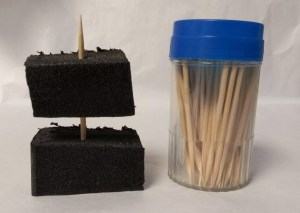
Cocktail sticks: not just for cheese and pineapple

The repaired end of the tusk is now only supporting a fraction of the weight it used to, and once the tusk and the plastazote bed are placed into their new custom-made crate it will be ready for long-term, safe, damage-free storage!
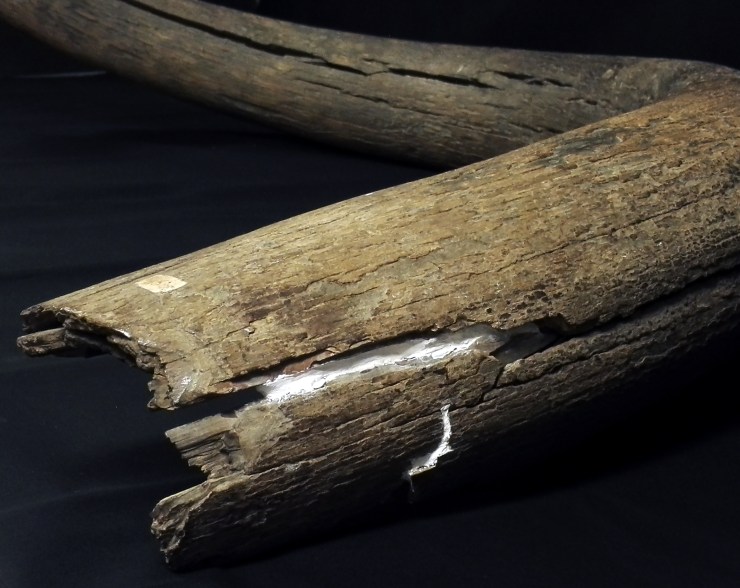
The end of the tusk after treatment

To keep up with all the move project action, follow the museum hashtag #storiesfromthestore on Twitter @morethanadodo.
 

Understanding beeswax

By Tuuli Kasso, PhD in Science Fellow at the Natural History Museum of Denmark, University of Copenhagen. Tuuli is a visiting researcher, who has used the Museum’s collection to help her understanding of beeswax. 

When working on the dissertation for my MSc in Archaeological Science last year, I explored the medieval craftsmanship of sealing wax. I was interested in the way the medieval wax seals had flaked, as the beeswax dried out. Drawing on my previous education in conservation techniques, I began a close investigation of the prestigious material, beeswax.

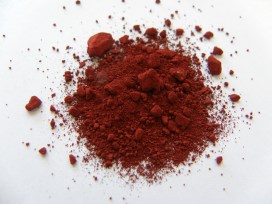
Medieval craftsmen used a range of dangerous materials to make sealing wax. The red pigment cinnabar, a mercury (II) sulphide, and red lead, are now known to be extremely poisonous.

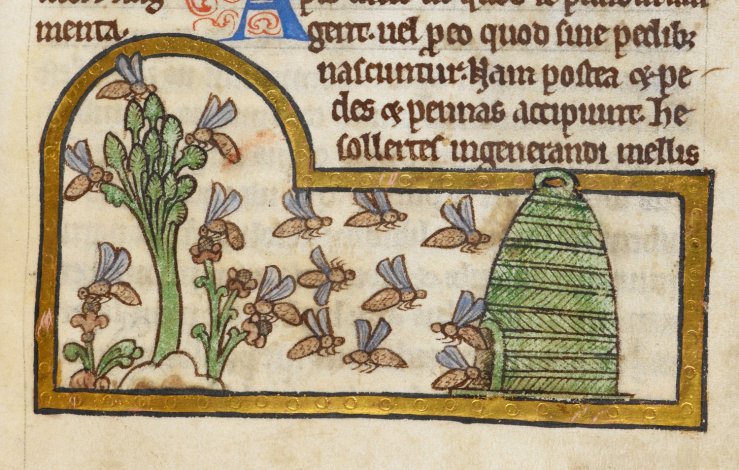
Although some of the ingredients of sealing wax are very hazardous, there is nothing dangerous in beeswax… except the bees! Produced by honey bees, Apis mellifera, honey and beeswax were important commodities in the Middle Ages. Beekeeping was a skilful profession, housing colonies in woven hives, known as skeps. Colonies were carefully selected to overwinter for the next season.

Manuscript illuminations provide detailed information on the types and construction of beehives in the Middle Ages.England, 13th century. British Library Royal 12 C XIX f. 45.

Beeswax was also important in the Middle Ages for lighting, and beeswax candles were preferred for their pleasant smell. After the Protestant Reformation in the 16th and 17th centuries, the religious use of candles decreased, so demand for beeswax declined.

Even today, the Catholic and Orthodox Churches still require the candles they use to contain a proportion of beeswax.

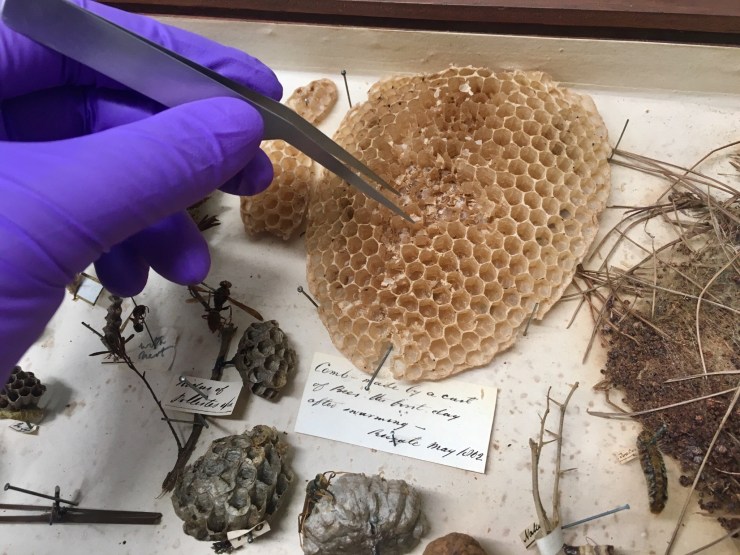
On my quest to understand the degradation of beeswax in sealing wax and write my disseration, I was very lucky to use some samples from the entomological collections from the Oxford University Museum of Natural History. After some early mornings spent amongst the Westwood collection, I found the perfect specimens of natural honeycombs, from the 19th century. The old hand-written labels were also a lovely encounter when exploring the historical collections.

I compared the samples to modern beeswax and medieval seal samples, and learned that the degradation of beeswax is caused by multiple factors, triggered also by storage conditions. The composition of beeswax is very complex, and there are differences caused by the age of the bee in addition to geographical provenance.

A selection of bee specimens from the Museum’s collection.

The recent catastrophic decline of bee populations has drawn focus to save the bees, and in my PhD research (University of Copenhagen and University of Cambridge) I will explore the recovery of ancient DNA and proteins of bees from beeswax, to cast light on the health of bee populations over time.

From pin to paper

Katherine Child, image technician in the Museum’s Life collections, doesn’t just use photography to capture the beauty of specimens. She is also an artist and has been trying out innovative techniques for her paintings. You may remember her amazing moth illustrations created with deposits of verdigris on pinned insects and she’s now using that technique to explore Museum staff’s favourite insect specimens.

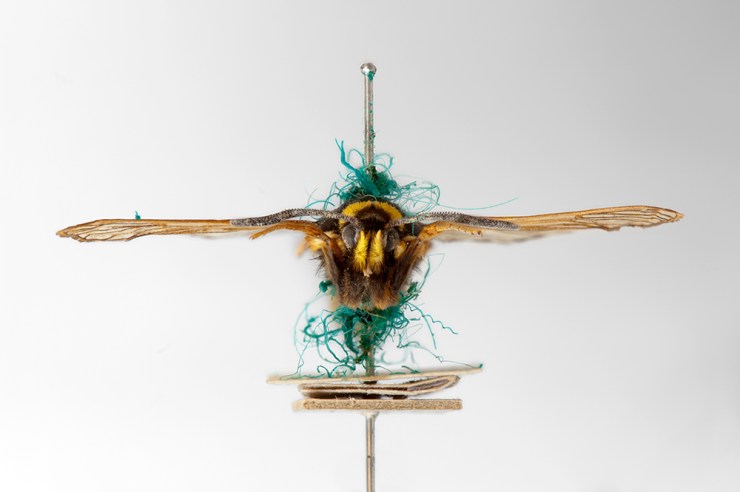
Verdigris is a green corrosion often found on old pins within entomology collections (as well as elsewhere, on things like statues and copper pipes). Last year, after learning that the substance was once used as a pigment, I decided to try and make my own paint.

A clearwing moth before conservation, showing verdigris spreading where metal reacts with insect fats, or lipids.

Verdigris forms when copper or a copper alloy reacts with water, oxygen, carbon dioxide or sulphur. While a beautiful shade of green, the substance is damaging in natural history collections, where it can actually develop inside specimens and if left, split them irreversibly. So as part of the conservation of the Hope Entomological Collections, verdigris is removed.

I started to collect up the substance as it was cleaned from specimens and after about three years (you only get a little bit per pin) I was ready to make my paint! After my first moth project, the only question was, what to paint next…?

Attelabid_small
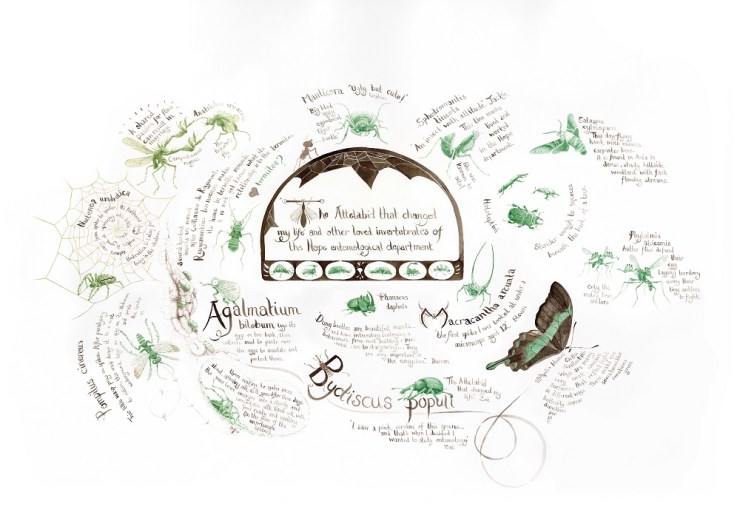
Byctiscus populi or ‘The Attelabid that changed my life’, chosen by Zoë (collections manager) who said ‘I saw a pink version of this species in the Natural History Museum in London and that’s when I decided I wanted to study entomology’.

With an estimated 6 million insects and arachnids in the entomology collections, it’s very easy to feel overwhelmed. You can pull open any one of thousands of draws and find astonishing specimens. While I have favourites, my first inclinations as to what to paint still felt a little arbitrary. After mulling over various possibilities, I decided to get help!

Chosen by DPhil student Leonidas, Agalmatium bilobum is a little bug which lays its eggs on tree bark, then covers them with mud to protect them.

I asked my co-workers what their favourite insects were, then opened the question out to regular volunteers and visitors of the Life collections. I loved finding out why people chose the things they did. Answers varied from ‘It was the first spider I ever looked at under a microscope aged 12’ to ‘Because they’re cool’ to ‘Because they have an ingenious way of manipulating spiders!’

Nuctenea_small
One of arachnologist Russell’s favourite spiders: Nuctenea umbratica. Though common in the UK, umbratica is Latin for “living in the shadows”, and it often hides away during the day. The slight transparency of the paint lends itself to a spider’s glittering eyes.


Painting this live African Mantis Sphodromantis lineola (chosen by conservator Jackie) was made slightly more challenging by the fact that the subject thought Katherine’s pencil might be tasty.

Most of the subjects I painted were based on specimens from the Museum’s collections or specimens individuals had brought in from their own collections, but one favourite was a live African Mantis, housed in the department to help with education and outreach. When I began to draw her she was intrigued by the movement of my pencil and came to the front of the tank, to follow every mark I made with her intimidating gaze.

A detail from the final painting
Attelabid that...
Katherine’s fabulous finished painting, which will be framed and displayed in the Life collections department.

Though time consuming, the painting was loads of fun to research and do. It’s fantastic to be surrounded not only by extremely knowledgeable people, but also by people with a genuine passion for what they do and a love for the insects (and spiders) they study.

Why do we need pinned insect specimens?

Since we posted about ten-year-old Sarah’s amazing beetle discovery, we’ve had lots of queries as to why the insect needed to be caught and pinned. It’s a question we’re often asked, so here’s Darren Mann, Head of Life Collections at the Museum, to explain the value of ‘voucher specimens’.

The Museum’s collection houses over five million insect specimens, amassed over the past 300 years. This collection is, in effect, a biodiversity database, but unlike virtual databases, each data point has an associated ‘voucher specimen’ that was caught, pinned and labelled.

Although technical advances in digital macro-photography do reduce the need for some collecting, it is impossible to dissect an image to confirm an identification. So for many groups, even the best photograph in the world is inadequate for identification purposes.

Shingle CrawlerD18 (Psammoporus insularis Pittino, 2006) one of our few endemic insects.

Unlike plants and birds, many insects can only be identified with the aid of a microscope, to study tiny features that distinguish closely-related species. Some groups even require the dissection of minuscule genitalia to really tell them apart.

Entomologists take voucher specimens to enable this correct identification and these are later deposited in museum collections, making them available for further study in years to come. From an entomologist’s point of view, we believe we need to know what a species is, where it occurs and as much about it as possible, so we can inform biodiversity conservation.

The conservation assessment of UK insects by Natural England in their Species Status Reviews has only been possible with the data provided by entomologists, generated from collecting and identifying voucher specimens.

Entomologists follow a Code of Conduct for responsible collecting, which ensures they don’t remove too many species or damage the environment during their work .

There are numerous examples of the value and use of insect collections in contemporary science, including the discovery of previously unknown species in the UK and population genetics for butterfly conservation. Recently a species believed extinct in the UK was rediscovered. This was only made possible by checking the identification of several thousand museum specimens.

Museum collections also contain numerous examples of species now considered extinct in the UK. Without voucher specimens much of this research would be impossible and our understanding of insect distribution patterns, ecology and conservation would be significantly diminished.

Large Tortoiseshell butterflies, now considered to be extinct in the UK. The voucher specimens act as record in time of its occurrence in the UK.

What is rare?
Sarah’s False Darkling Beetle (Anisoxya fuscula) has been described as ‘rare’, but what does that mean in reality? For most invertebrates when we talk about a rare species we are not talking about a tiny number of individuals. This conservation status is based on their known distribution and the level of threat they face. A species can be rare if it is only found at one or two locations, but at those locations there may be many thousands of individuals.

The greatest threats to biodiversity are well known and include habitat loss, fragmentation and degradation and pollution, such as pesticides and light. Taking a small number of voucher specimens to confirm the identification of species has negligible impact on its population. But if we don’t know it’s there because we couldn’t identify it, then a housing development destroys its entire habitat… well you get the picture!

Further Reading
Ask an Entomologist
Entomological Collections
Natural England Species Status Reviews
To Kill or Not to Kill That is the Question Part 1
To Kill or Not to Kill That is the Question Part 2
To Kill or Not to Kill That is the Question Part 3
– Austin, J. J., & Melville, J. (2006). Incorporating historical museum specimens into molecular systematic and conservation genetics research. Molecular Ecology Notes, 6(4), 1089-1092.
– Colla, S.R., Gadallah, F., Richardson, L., Wagner, D., & Gall, L. (2012). Assessing declines of North American bumble bees (Bombus spp.) using museum specimens. Biodiversity and Conservation, 21(14), 3585-3595.
– Short, A. E. Z., Dikow, T., & Moreau, C. S. (2018). Entomological collections in the age of big data. Annual review of entomology, 63, 513-530.
– Suarez, A.V., & Tsutsui, N.D. (2004). The value of museum collections for research and society. AIBS Bulletin, 54(1), 66-74. Abstract available here
– Wandeler, P., Paquita, Hoeck, E.A. & Keller, L.F. (2007). Back to the future: museum specimens in population genetics. Trends in Ecology & Evolution 22.12, 634-642.

Odd egg out

This is a great time of year to hear the distinctive call of the Cuckoo (Cuculus canorus) as it spends the summer in the UK. Collections Manager Eileen Westwig recently shared Cuckoo specimens with the public in one of our Spotlight Specimens sessions. You missed it?! No problem, here she is with the fascinating story of this threatened bird…

Cuckoos could be described as absent mothers, laying their eggs into the nest of a ‘host bird’, such as Dunnocks, Meadow Pipits, Garden Warblers, Whitethroats or Flycatchers. When she finds a suitable nest, the female Cuckoo will remove one of the host’s eggs and lay hers in its place. She lays between 12 and 22 eggs in a season, all in different nests. No worries befall her about building a nest, brooding out any eggs or raising her young as she leaves it all to strangers. One challenge for the Cuckoo is to make sure her trickery is not discovered.

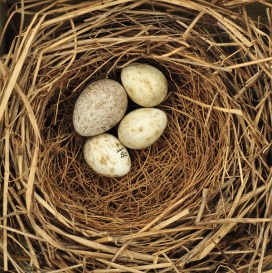
When the female host returns to her nest, she will inspect it for any changes and if she discovers the intruder’s egg, she will simply toss it out. So the female Cuckoo has to be pretty good at forgery and mimic the host bird’s egg ‘signature’, copying the colour, pattern and shape of the original eggs. This is the only way to get away with her ‘brood parasitism’. Around 20% of Cuckoo eggs never make it. In the top picture, you can see the nest of a Garden Warbler with three Warbler eggs and one larger Cuckoo egg, on the top left.

An adult Garden Warbler (Sylvia borin borin) can reach a weight of 16-22g with a wingspan of 20-24.5cm

After twelve days, the Cuckoo hatches and pushes the other nestlings out. As the single remaining occupant of the nest, it has the full attention of the host parents, which try to feed a nestling soon outweighing. An adult Cuckoo is more than 6 times the weight of an adult Garden Warbler. The Cuckoo young will leave the nest after 19 days, but gets fed by the parents for a further two weeks. That is one busy summer.

OUMNH.ZC.11868_Cuculus_canorus_canorus_Eileen_Westwig
An adult Cuckoo (Cuculus canorus) can reach a weight of 105-130g with a wingspan of 55-65cm.

According to the RSPB, there are about 15,000 breeding pairs in the UK and Cuckoos are now included on the Red List, giving them the highest conservation priority. Ten years ago, numbers of this migrant bird fell by 21% and more than half of the population has disappeared in the past 25 years. Threats include damage to the bird’s winter habitats and a decline in large insect species that are its major food source.

Cuckoos migrate to West Africa over the winter months and can be seen in the UK from late March or April through July or August. Young birds leave a month or so later to give them time to grow and prepare for the long journey ahead. Wintering grounds are not exactly known but include Cameroon, Gabon and other African nations.

Seasonal sights

The Museum’s collections are on the move. For decades, a deconsecrated church has been used to house material from our Earth collections, but we now have a new and improved off-site space, and between now and the end of 2018 a huge project is underway to sort and shift these objects. You can find out more about all this in our Stories from the Stores article. 

Chantelle Dollimore, Move Project Assistant, recently emigrated from Australia and has been experiencing her first British autumn. Here she shares a glimpse of the natural encounters the collections move has offered so far.

**

As the project team for the collections move settles into the daily hustle and bustle of work there are extraordinary things happening outside. Winter is coming; we have already wound our clocks back for that extra hour of sleep. Leading up to that time, creatures great and small have been preparing themselves for seasonal changes.

Autumn leaves litter the footpath to the store

Something truly blissful in an English autumn is the deciduous trees shedding their leaves as the days grow shorter and chillier. The crunching underfoot of hues of browns, reds, yellows and oranges adds charm as we make the rounds of our 19th-century church workspace.

A Red Kite soars above the Museum’s offsite collections store

Driving from the Museum to the off-site store, we’re likely to see at least one Red Kite. Less than 30 years ago Red Kites were nearly extinct, but through conservation efforts they have flourished in the Oxfordshire countryside. Their distinct calls and unique silhouette, with long narrow wings and forked tail, are a haunting yet beautiful addition to the skyline.

A Red Kite (Milvus milvus) on display in the Museum

The move project team have also been visited by a different ‘bird’ altogether; the ladybird! At this time of year, when you find one you will most likely see many more close by. When a ladybird finds the perfect place to hibernate for spring it excretes a pheromone to attract more to the area. For some, the perfect place seems to be inside the church itself!

(Lady)birds of a feather flock together

Grey Squirrels and deer are also making appearances throughout the day while we’re working. One cannot help but watch as the bushy tail of the squirrel peeks through the hedges as it forages for food and admire the deer as they stroll through the fields happily unaware of our activities some 50 metres away.

Although it’s great to admire the specimens on display in the Museum, I love that my job allows me to get out and about to appreciate the wildlife of the Oxfordshire countryside. There’s always something unexpected… like a butterfly choosing its resting place on some disassembled storage shelves.

A butterfly (Nymphalidae sp.) in torpor finds shelter from the impending cold

To keep up with all the move project action, follow the museum hashtag #storiesfromthestore on Twitter @morethanadodo.