Dinosaurs amongst us

IMG_1510

Earlier this year we had the pleasure of hosting the BBC iWonder team and evolutionary biologist and presenter Ben Garrod for a filming session all about the evolution of birds. BBC iWonder is a growing series of short but rich guides to subjects as wide-ranging as salt in your diet, the World Cup, and the holocaust, each designed to pique people’s interest and curiosity.
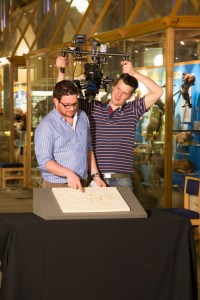
Ben Garrod filming with the Archaeopteryx cast

Ben’s guide is titled ‘Do Dinosaurs Still Live Among Us?’. This is a good question indeed and the answer is (sort of) ‘yes’. You can find out a lot more in the guide itself, which has just been launched here and features some lovely footage of the Museum and our cast of the famous Archaeopteryx fossil, the first found to show the traces of feathers on a dinosaur.

Needless to say we were very pleased when the iWonder team contacted us about their idea to look at the evolution of birds from dinosaurs using specimens in the Museum. The guide’s producer and director Ben Aviss explains how it came about:

We brainstorm ideas for new content for the guides and one of those was to look at dinosaurs, but what question might we ask? The idea of dinosaurs and birds sharing a common ancestry is something that not everyone may know about so we decided to look at that.

Ben Aviss had already seen the Museum on Ben Garrod’s BBC4 series Secrets of Bones and thought it looked great. “The more we chatted about the things we might want access to, the more we realised you offered everything we needed,” he adds.

Ben Garrod tracks along the Iguanodon tail.
Ben Garrod tracks along the Iguanodon tail

It was a third return to the Museum for Ben Garrod who, as well as filming sequences for Secrets of Bones, had also run our Capybara Construction special event earlier in the year. He explains the appeal of returning for the iWonder guide:

This iWonder guide represents a new and fun way to retell a key moment in evolutionary history – the transition from dinosaurs into modern birds and I’m pleased with the final result. It’s informative and interesting but more than that, it looks good and that is in no small part down to the setting in which we filmed.

I keep coming back again and again because I genuinely love the Museum. The collection is laid out in a way that gives the visitor lots of time and space to explore and the specimens themselves are great – I’m still finding new things every time I visit.

There are plans for further iWonder guides that go richer and deeper, with greater interactivity and content. Let’s hope the collections – and Ben’s enthusiasm – brings the team back to tell another story here soon.

Scott Billings – Communications officer
Ento Kids R Us

bee2

As we head towards the end of National Insect Week this year it seems like a very good time to introduce you to one of the hardest-working people in bugworld – Sally-Ann Spence of Minibeast Mayhem. If you’ve ever visited the Museum on one of our bug-handling days you may well have met Sally already, quite probably holding a stick insect.

Through Minibeast Mayhem, Sally does a lot of work to support the budding entomologists of tomorrow, running invertebrate-based educational workshops for schools and public outreach events around Oxfordshire. Sally is also a committee member of the Amateur Entomologists Society’s Bug Club, an entomological club for children.

We asked Sally to tell us a bit more about her work and her desire to encourage bug-loving kids. Here’s what she has to say:

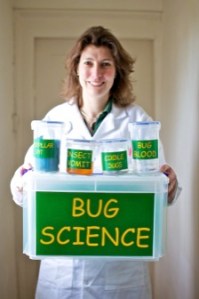
Sally-Ann Spence and her Minibeast Mayhem Bug Science kit

“When I meet a child with a passion for bugs I always suggest to their family that they should join a society such as the AES Bug Club where they can take part in many events and their interest can be nurtured. Sometimes it becomes apparent that a child has more than just a passing interest in bugs; in fact they have a true passion that could extend well beyond childhood. Unfortunately the UK has no BSc in Entomology so the subject is often missed in our schools careers advice. This can leave some children and their families at a loss for how to pursue their interest.

So I decided to set up a voluntary mentoring scheme – the Ento Kids – not only for enthusiastic children but also to support their families. The scheme has been successful, thanks to the incredible support I have received from expert individuals, landowners, universities, entomology-related companies and museums and their staff.

The aim of the Ento Kids is to support children through a CREST Award and a two week work experience placement. We offer advice on GCSE and A level choices and suitable university courses, as well as provide access to sites for research projects (and potential future employers).

Ento Kids hard at work in the Museum

Ento Kids take part in active fieldwork on research experiments to learn practical skills and are introduced to a network of professional entomologists who share their expertise from previous experience.

Theory is also fundamentally important and this is where museums such as the Museum of Natural History in Oxford are vital. Darren Mann, Head of Life Collections, and his team in the Entomology Department encourage the Ento Kids unreservedly. The children are taught about fieldwork in various habitats around the world and about the processes involved for collected specimens. They are taught about active scientific research, the importance of the collections and how to conserve them. Best of all, they learn all of this in a hands-on way with the staff in the Museum itself.

We need our entomologists, both from the past and today, and National Insect Week is a celebration of insects that everyone can take part in.”

Sally-Ann Spence – Minibeast Mayhem

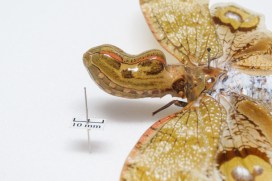
Peanut-Head Bug

IMG_3185

It’s National Insect Week this week, and insects are creatures close to the hearts of many people in the Museum. So to celebrate here’s a Peanut-Head Bug, chosen as a favourite specimen from Hope Entomology Collections by Gina Allnatt in our Life Collections department. Gina explains why:

This species – Fulgora laternaria – is also referred to as the “Alligator Bug” because of the grin-like markings on the head process when viewed from the side. This is probably the biggest specimen of this species I have ever seen in any collection. It was obtained from the Amazon by Rev. A. Miles Moss who presented them to Edward Bagnall Poulton, the second Hope Professor of Zoology at the University of Oxford. The specimen was exhibited at the Royal Entomological Society in 1932.

It's pretty big!
It’s pretty big.

The strange looking head is hollow, and its purpose may be to afford the insect some protection through mimicry. The insect sits on the side of a tree trunk, with its head pointing upwards. When viewed from the side it looks like a lizard. And if this doesn’t deter a predator it will then open its wings to reveal “eye” spots, complete with white markings that mimic light reflection.

Despite its fearsome appearance, the insect is completely harmless, and is a stunning example of adaptation in the insect world.

Gina Allnatt, Life Collections

Taxidermy for all

IMG_2137

Taxidermy has enjoyed a bit of a surge in popularity in the last few years, as surveyed by Alexis Turner in his 2013 book Taxidermy. In the Museum, the touchable taxidermy animals are always popular, especially Mandy the much-stroked pony, the removal of which we fear might cause a public outcry.

photoall
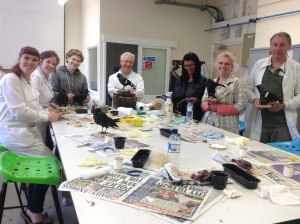
Derek Frampton, centre, leads the workshop

Of course it’s all very well stroking cute, furry taxidermy animals, but have you got the, well, guts to have a go at it yourself? We suspected that plenty of people not only have the guts but also the desire so we set up a workshop with professional taxidermist Derek Frampton, whose work is regularly on display in the Museum. It’s the first time we have offered a taxidermy workshop, but despite the £175 cost for the specimen, materials and tuition, the day was easily oversubscribed.

And what a great session it was. Five excited and enthusiastic members of the public (and one equally excited education officer) were given expert tuition in a step by step guide to create their very own taxidermy jackdaw.

Taxidermy
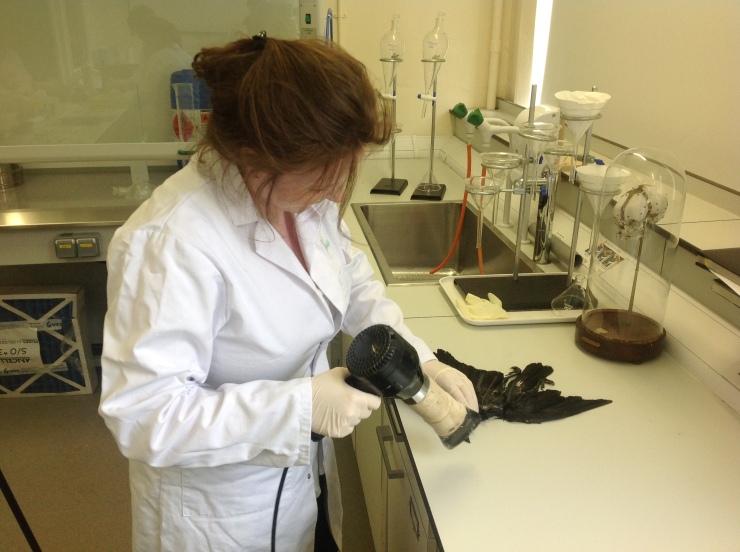
Blow dry in the lab

It wasn’t for the squeamish either because the birds were not pre-skinned, so there was some down and dirty hands-on work to be done before the pretty stuff could begin. The whole process took from 10am until 6.30pm with barely a break. Nonetheless, one participant said that the time flew by (no pun intended, we assume) and another said:

I don’t believe it, I thought we were just going to get a pre-prepared skin, not do the whole thing in a day! That was excellent!

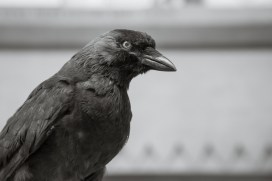
The bird you can see at the top of the post is the creation of the over-excited education officer, Chris Jarvis. He’s named it Scratch because it was made entirely from – yep – scratch. Being a remarkably clever corvid, he (she?) now perches loftily above the rest of the Education team, squawking edicts from time to time.

Given the success of the workshop we may well run another in the future, so keep your eye on our quarterly programme for that. And if you’d like to join our mailing list, email communications@oum.ox.ac.uk and I’ll add your address.

Scott Billings – Communications officer


Trumpery

IMG_2078

Who created the theory of evolution? Why, Mr Darwin of course! Ah, if only the history of science were so neat.

Charles Darwin’s 1859 work, On the Origin of Species, is considered the stake in the ground for intellectual ownership of the theory of evolution by natural selection. But as a play making its UK premiere this week shows, the picture is not so clear-cut.

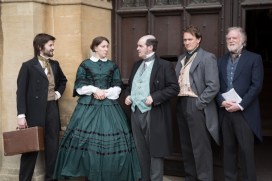
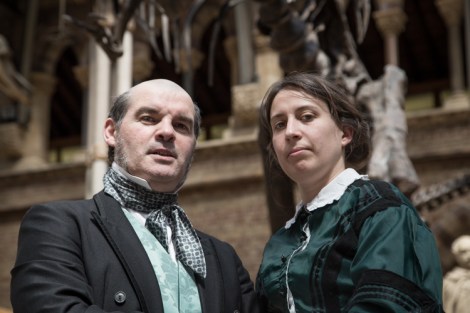
Joe Kenneway as Charles Darwin, beside Charles Darwin

Darwin is evolution’s most famous proponent, but when pressed on the subject some people may also name Alfred Russel Wallace, Darwin’s contemporary and a co-conceiver of the theory of natural selection. Others claim the idea had earlier antecedents.

And so the muddle of priority – and its effects on those involved – is played out in Trumpery, a play by American playwright and West Wing script writer Peter Parnell.

Trumpery is produced by Oxford’s Eleven One Theatre and directed by Helen Taylor, who is keen to note that the script is a dramatisation of events, not a historical record.

The central story of the play is Darwin’s decision to publish the Origin after sitting on it for so many years, when he hears that Wallace has come up with the theory independently. The play is a fascinating exploration of Darwin’s feelings of guilt – not just about Wallace and the issue of priority, but about the impact of his discoveries on religious belief.

As well as holding many specimens collected by Darwin and Wallace in the collections, the Museum was also the site of the famous Great Debate in 1860 between Thomas Henry Huxley, championing Darwin’s ideas, and Samuel Wilberforce, Bishop of Oxford, who defended the biblical account of creation.

So it was a treat to have the cast in full costume parading around the Museum yesterday, regarding the statue of Darwin in the main court (and lamenting the absence of Wallace), checking out the specimens and doing a bit of promo at the same time.

Trumpery opens at the Simpkins Lee Theatre at Lady Margaret Hall in Oxford on Tuesday 10 June with evening performances each day, plus a matinée on Saturday 14 June. It is part of a science season created by Eleven One Theatre in conjunction with the University of Oxford’s Mathematical Institute. Tickets are available via the Eleven One Theatre website.

The first of the three plays in the season was Émilie: La Marquise du Châtelet Defends Her Life Tonight, which ran in February. After Trumpery, the group will stage CopenhagenMichael Frayn’s tightly-constructed play about atomic scientists Niels Bohr and Werner Heisenberg. Of the season Helen says:

 As a non-scientist, my ‘way in’ to these plays is through the human stories: there is so much drama to be found in the lives of people who struggled to break new ground, to push themselves to their intellectual limits, to deal with the constraints placed on them by the beliefs and politics of the times, and with the impact of their work on their personal lives.

Emma Darwin (Ida Persson) and Alfred Russel Wallace (Nathan Grassi)

Viva Volunteers!

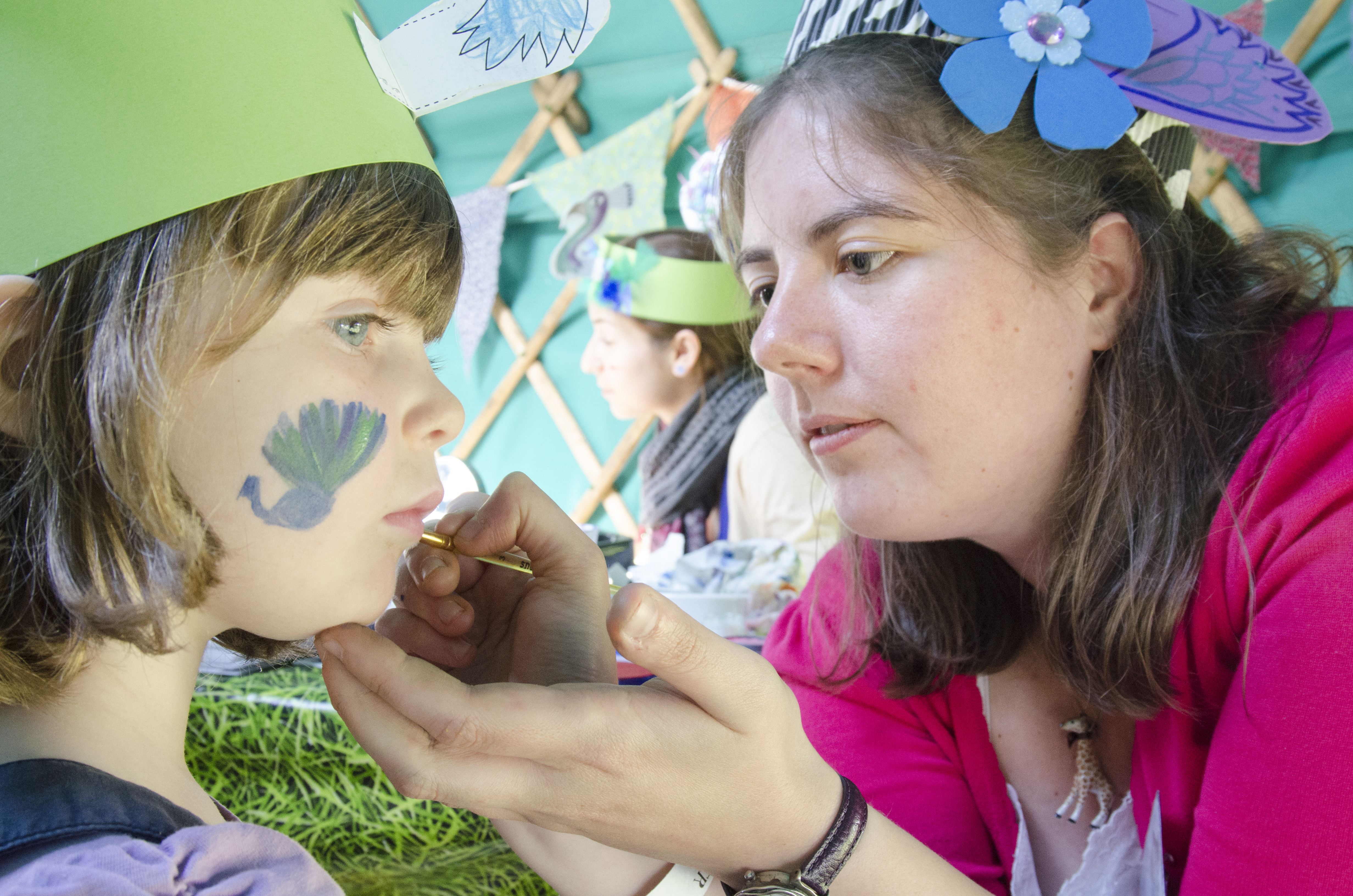
Alice facepaintingThey sort, they scan, they stick, they smile: who are they? Our team of brilliant Collections and Public Engagement Volunteers of course! This week has been the 30th anniversary of Volunteers’ Week, so we wanted to put the spotlight on them…

The majority of our volunteers help with public events, particularly those for our family audience. In 2014 alone, our awesome team of volunteers have given the Museum over 1500 hours of their time to help with public engagement events. This includes painting children’s faces, like the wonderful Alice Wilby (above), leading tours of the Museum’s architecture and running a pub quiz at one of our late night events. IMG_1322

On top of that, we have a team working away behind the scenes supporting our collections staff. Here’s just a sample of the projects they’ve been working on this week…

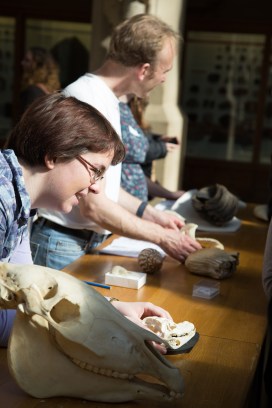
Laura Cotton in the Earth Collections.

– 5 volunteers identifying butterflies from painted images in our Archival Collections.
– 1 volunteer working in the Life Collections sorting and cataloguing bones.
– 4 volunteers tucked away in the Earth Collections cleaning ancient horse fossils or sorting Jurassic fish teeth.

Simone Dogherty is the Museum’s Education Assistant and co-ordinator of Science Saturdays – a weekly family event aimed at older children and led entirely by volunteer scientists. So why does she think volunteers are so valuable?

We’re very lucky here to have such a large quantity and high quality of volunteers. They help us with a huge range of activities and with the increase in visitor numbers that the Museum has been experiencing since re-opening in February, I just don’t know how we’d cope without them.
For Science Saturdays we use volunteers with a specific expertise. This gives children access to enthusiastic and inspiring individuals that they can look up to. And, in return, the volunteers gain valuable science communication skills.

Fancy joining our merry band of volunteers? Whether you’re into making masks or dusting off molluscs, we need you! You can simply sign up to help out on our Volunteers website.

But what’s in it for you? Aside from the glow of knowing you’ve simply helped us do more, you can develop your confidence when working with the public, learn a new skill or get up close with the treasures stashed away behind the scenes. But that’s forgetting the most important part – you’d be joining a fantastic team of people who, like you, think this museum is a pretty exciting place to be!

Rachel Parle, Interpretation and Education Officer