Dodo Roadshow: National Maritime Museum Cornwall
Viking Voyagers NMMC 850px To mark our selection as a Finalist in the Art Fund Prize for Museum of the Year 2015 we’re embarking on a unique and ambitious tour of the country – the Dodo Roadshow. Beginning at Land’s End on 8 June and concluding in John O’Groats one week later, the famous Oxford Dodo will visit more than 20 museums and galleries along the way. At each stop the Dodo will ‘interview’ one of the venue’s star objects.

National Maritime Museum Cornwall: Walrus, Viking Cargo Ship
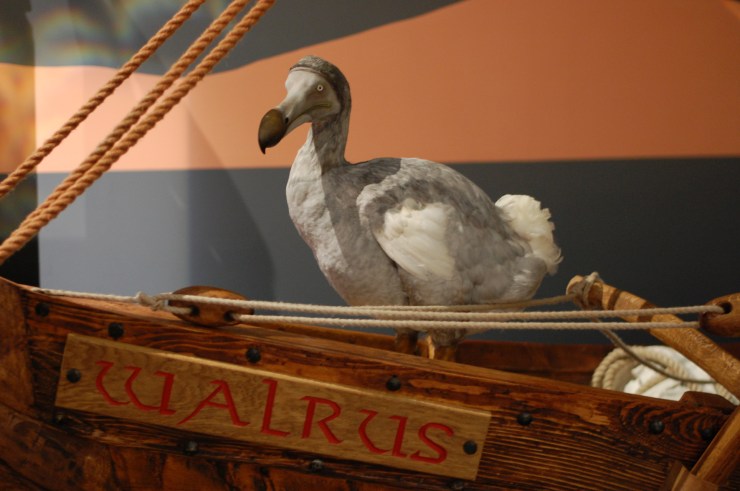
Squawk! I'm on the Walrus, a 14m Viking ship. It's the first stop on my tour and what a way to start!
Squawk! I’m on the Walrus, a 14m Viking ship. It’s the first stop on my tour and what a way to start!

So, tell me about yourself – who are you and where do you come from?
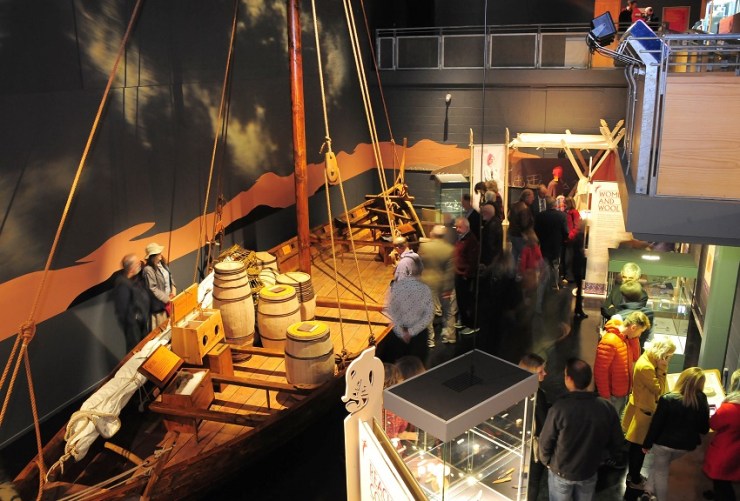
Viking cargo ship built from oak in Denmark in the 11th century. I plied the seas of northern Europe carrying all sorts of wares like furs, antlers, amber, silver and of course walrus ivory, a most desirable item in great demand by those with a bit of spare money to spend. I am 14m long and 3.3m wide and I have a tall mast which can carry a huge square sail made of woven wool.

What is it that makes you so special?
My name is Walrus – or Hrosshvalr in Old Norse meaning horse whale. Everyone who visits the Maritime Museum can climb aboard me and explore my beautiful craftsmanship; from the hand-carved stems to the overlapping planks characteristic of clinker-built ships of the Viking Age. They can discover my cargoes by smelling and feeling the goods stored in the barrels, chests and baskets. The Vikings built the best ships that could cross oceans and go far inland up rivers. I’m more used to hopping from coast to coast and am mainly powered by the wind.

Who looks after you in this place?
I was built and am looked after by the Maritime Museum’s Boat Team.

Do you remember life before the museum?
When I said I was built in the 11th century in Viking Denmark, in fact I have come back from the dead for this very special exhibition, Viking Voyagers. After my trading days I was scuttled – or deliberately sunk – in the Roskilde Fjord around the year 1000 with a few other ships, apparently to create a defence against sea-borne attacks from elsewhere. I don’t know why. I’m just glad to be back again and to have thousands of people marvel at how splendid I am. If they hold my steering oar or styrbord (where your modern word starboard comes from) they might be able to imagine all the adventures I had 1000 years ago.

What does the future hold for you?
I am content here to tell my story for the duration of this very special exhibition Viking Voyagers which will remain at the Maritime Museum until early 2017. Then? Who knows. Perhaps I’ll end up dead as a Dodo again. Stickers small - Dodo Roadshow_crop

Shooting with Martin Parr

PAM2015011G00487

As you may have seen, the Museum was recently shortlisted as a finalist in this year’s Art Fund Prize for Museum of the Year – very exciting news for us. To add to the honour we hosted renowned Magnum Photos photographer Martin Parr, who spent a good few hours photographing the Museum, in the court and behind the scenes, as part of the Museum of the Year campaign.

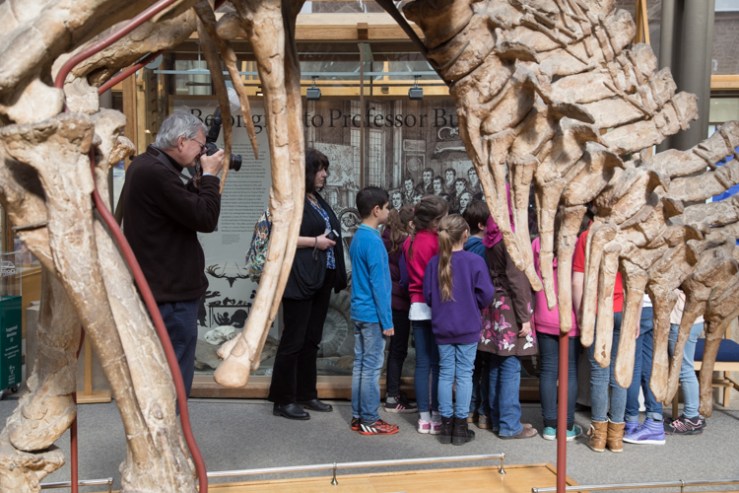
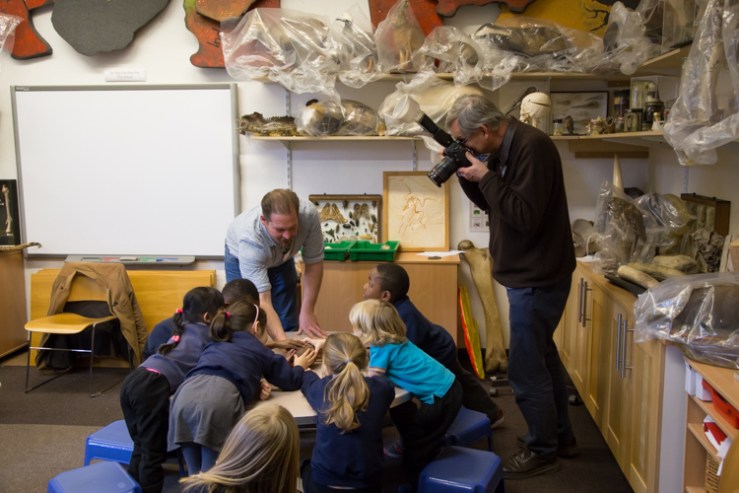
The photograph above was captured by Martin during one of our primary school sessions on dinosaurs: the children have their mitts on a fossilised dinosaur egg – just one of the real specimens used during the session.

Martin Parr photographing some Darwin specimens in our collections

Having a Magnum photographer visit the Museum for a photoshoot isn’t something that happens every day, so it was a real privilege to take Martin Parr around the building and watch the types of things that caught his eye.

I am a keen photographer myself, with an interest in the history of photography as a technical process and as an art form, so it was especially exciting to not only meet Martin and watch him work, but also to photograph the process myself too. You can see a few of those shots here.

Martin Parr scrutinising our vertebrate spirit collections

Photo competition

Now it’s your chance. We’re inviting you to take photographs of the Museum and submit them to the Museum of the Year Photo Competition, with a chance to win a photography holiday in Berlin, photo gear and other prizes. Martin Parr will shortlist six photos, one for each of the six finalist museums, and the ultimate winner will be selected by a public vote.

So get snapping – with a posh camera or your phone; it doesn’t matter. Then either upload your pictures via the Art Fund website, or tweet or Instagram them using the #motyphoto hashtag and don’t forget to tag us in @morethanadodo.

Good luck!

Martin Parr photographing a primary school group for Art Fund Prize for Museum of the Year
Martin Parr, an Iguanodon and young visitors

Scott Billings – Public engagement officer


One for the mantelpiece

Museum_Heritage_Awards_2015_MNH small

If you live in Oxford or have been reading our blog for a while you may remember a project we created called Goes to Town: twelve specimens escaped from the Museum, set themselves up in locations around Oxford city and provided a treasure-hunt style trail around town. They then returned in time for our reopening party in 2014.

It was a fun project with many elements so we are very pleased indeed to say that it picked up the winning trophy in last night’s Museum + Heritage Awards show, in the marketing campaign category. Here’s the first video we made to promote Goes to Town:

The Iron Snail

5

The Museum has recently received specimens of the enigmatic deep-sea vent snail, Chrysomallon squamiferum, the scaly-foot snail. In this post, Dr Chong Chen explains why this species is so extraordinary.

*

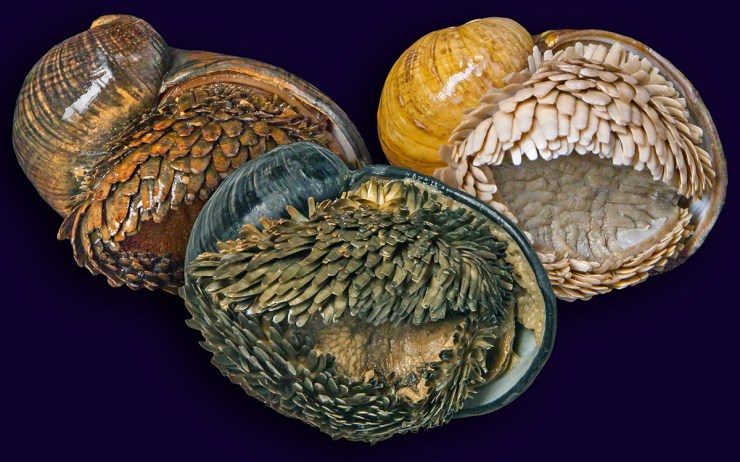
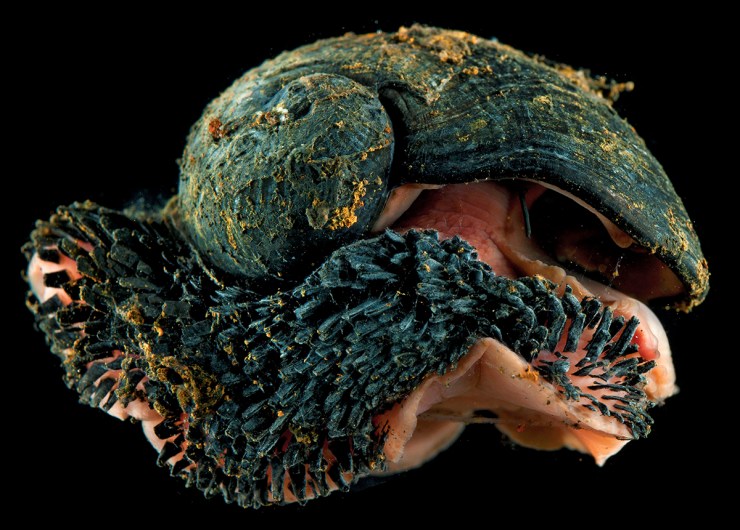
This is no ordinary snail. First of all, it lives in deep-sea hydrothermal vents in the Indian Ocean, more than 2,500 metres deep, just beside black smokers that are churning out superheated water exceeding 350°C. Second, it is the only known gastropod with a suit of scale armour. Thirdly, the scales as well as the shell are mineralised with iron sulfide. That’s right – these snails make a skeleton out of iron, and are the only animal so far known to do so.

A specimen of Chrysomallon squamiferum photographed live (Photo: David Shale)

Hydrothermal vents were first discovered in the Galápagos Rift as recently as 1977. This is just off the Galápagos Islands whose fauna famously inspired Charles Darwin in the development of his theory of natural selection. Vents are deep-sea ‘hot springs’ fuelled by geological activity; the hot erupting fluid is usually acidic and contains various metals, as well as hydrogen sulfide. This is what makes rotten eggs smell bad, and is toxic to most organisms. Some bacteria, however, are able to use it to produce energy in a process known as chemosynthesis.

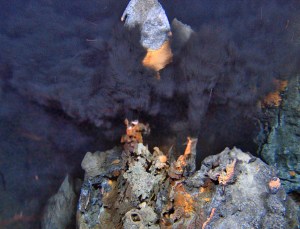
Hydra, an active ‘black smoker’ vent chimney in Longqi field, Southwest Indian Ridge

Over geological timescales many remarkable organisms have adapted to live in these ‘toxic utopia’, and flourish by exploiting the energy produced by these bacteria. The scaly-foot snail has also harnessed the power of chemosynthesis, housing endosymbiotic bacteria – bacteria living inside another creature to mutual benefit – in an enlarged part of its gut. This produces the energy it needs. In another words – it has a food factory inside its body and doesn’t even need to feed! This is likely the reason it can grow to about 45mm in size, when most of its close relatives without endosymbionts are only 15mm or smaller.

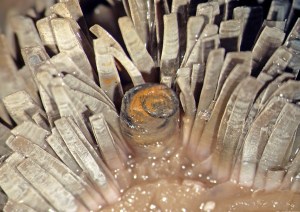
Close-up of the scales, also showing the reduced operculum in middle

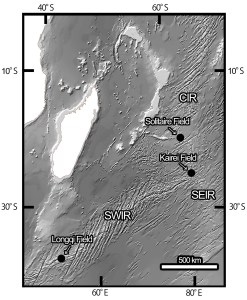
Scaly-foot snails were first discovered in 2001, at the Kairei vent field in the Indian Ocean. Its discovery came as a great surprise as even among those animals specialised for living at vents, it was very, very strange. And cool. Although the shell of a snail is well-known to be modified into a great variety of forms, this is not the case with hard parts on the foot, and apart from an operculum (the ‘trap-door’ serving as a lid when the animal retracts to its shell) no other gastropods have other mineralised structures on the foot. Yet C. squamiferum has thousands of scales!

The shell, although not particularly exciting in form, isn’t exactly ordinary either as the outermost layer is made of iron sulfide. And so are the scales. So this entire animal is covered in iron compound, mainly pyrite (FeS2, or ‘Fool’s gold’) and greigite (Fe3S4). As greigite is magnetic, the animal actually sticks to magnets. The function of the scales is postulated to be either protection or detoxification but their true use remains a mystery.

The three vent fields where Chrysomallon squamiferum is known from

So why blog about the ‘scaly-foot’ now, if it has already been known to science for more than a decade? Well, actually, despite numerous studies and publications on its strange biology this species has never been formally described and named, until now. A recent paper by Dr Chong Chen (Department of Zoology, University of Oxford) and colleagues finally gave it the scientific name you see here – Chrysomallon squamiferum.

The Museum received a set of five specimens as part of the description process, which will serve as key references for scientists who wish to study this extraordinary species in the future.

Here’s a video of the Longqi hydrothermal field featuring Chrysomallon squamiferum in their natural habitat:

We are a finalist!

MOTY15_Digital Assets_Oxford Natural History_All sizes-01

This is very exciting. We’ve been waiting to tell everybody for some weeks that we have been selected as one of six finalists in the Art Fund Prize for Museum of the Year 2015. It’s the top prize for a museum or gallery in the UK and we are delighted that the Museum’s work over 2014 has been recognised to this extent.

The other finalists are Dunham Massey, IWM London, The MAC, HM Tower of London, and The Whitworth. The winner will be announced on 1 July at a ceremony at Tate Modern and will receive £100,000. To drum up the excitement we made a short film with Art Fund as part of the award campaign:

As regular readers of this blog and our previous Darked not dormant blog will know, the Museum undertook a major roof restoration and lighting project during 2014. And while we were closed we spent some time thinking about how we communicate with our visitors and the world beyond, trying out some fun forms of public engagement such as the Goes to Town project (shortlisted for a Museums + Heritage Award).

Photographer Martin Parr's lead image from a shoot at the Museum
Photographer Martin Parr’s lead image from a shoot at the Museum

At the same time our whale skeletons underwent a major conservation and redisplay, documented at Once in a Whale. In other words, 2013 and 2014 were big years for the Museum and it’s wonderful to be celebrating them as Finalists in the Art Fund Prize competition. As our director Paul Smith says:

Our public programme encourages visitors of all ages to understand and engage with the natural environment, and sits alongside our world-class research and teaching.

The museum’s small team and our volunteers are delighted that this transformation has led to being named as a finalist in the prestigious Art Fund Prize for Museum of the Year 2015.

Keep an eye on the blog next week and you’ll see more about Martin Parr‘s photography of the Museum, as well as a photography competition that you can enter yourself, judged by Martin and the public. In the meantime, here’s a sneak preview of Martin Parr at work here, capturing the image you can see above.

Martin Parr captures the lead image in the Art Fund Prize for Museum of the Year 2015 campaign

Scott Billings – Public engagement officer

The first dinosaur

IMG_4410

By Philip Hadland, Earth Collections Assistant

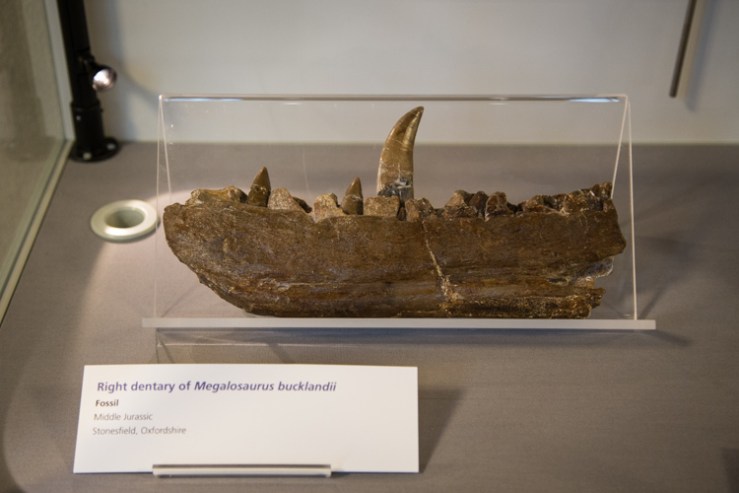
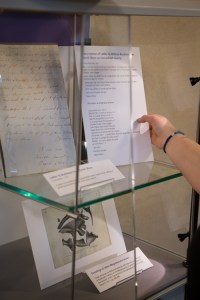
One of the Museum’s most significant specimens is the iconic jaw bone fossil used in the first scientific description of a dinosaur – Megalosaurus – in 1824. For the latest in our Presenting… series of displays we are showing this ‘first dinosaur’ along with some archival material documenting its discovery and description.

The fossil was acquired by William Buckland (1784-1856), Reader in Geology at the University of Oxford, after being found in a slate quarry in Stonesfield, just a few miles north of this Museum. Buckland soon realised it was something out of the ordinary and showed it and other Stonesfield bones to comparative anatomist Georges Cuvier, who noted similarities with living lizards. The name Buckland chose, Megalosaurus, means ‘great lizard’.

The Presenting... display of Megalosaurus bucklandii, on show until 17 May.
The Presenting… display of Megalosaurus bucklandii, on show until 17 May 2015

Later, in 1842, Richard Owen coined the term ‘dinosaur’ to describe a group of animals including Megalosaurus and other recently found ‘great lizards’ such as Iguanodon.

The dentary bone was just the front half of the lower jaw. The blade-like, serrated teeth tell us that Megalosaurus was a meat eater. Its teeth were often damaged, worn out or lost in battles with prey or rivals. Fortunately, Megalosaurus could replace its teeth several times during its lifetime. In this specimen six of the teeth are only partially erupted, with two just emerging along the gum-line and only one fully erupted tooth remaining.

The single-case Presenting… display is located near to the Welcome Desk and the Megalosaurus material will be on show until 17 May – see it while you can. If you miss this, don’t worry as casts of the fossils are on permanent display in the main court.

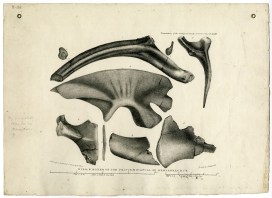
These drawings, by William Buckland’s wife Mary Morland, featured in Buckland’s “Notice on the Megalosaurus or great Fossil Lizard of Stonesfield” in the Transactions of the Geological Society of London, Series 2, vol. 1, pp. 390-396.