The Whales’ Tale

nicolacrompton's avatarOnce in a Whale

036B7584

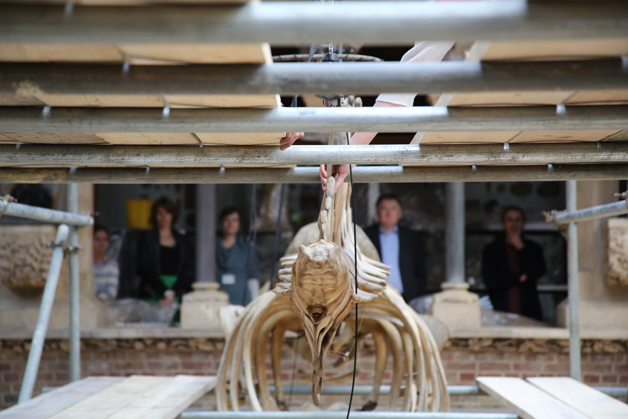
This week, the ‘whale aisle’ was invaded by a hoard of riggers and scaffolders, constructing a safe and simple means to transfer the specimens into their new positions in the gallery.

036B7734

Not moving too far, the specimens are now in size order and are staggered, taking advantage of the vast roof space. The Northern Bottlenose Whale is now at the highest level (7 meters up!) and the Dolphin at the lowest. This new positioning meant transporting the Orca, Beluga and Dolphin out of the aisle on wheels, and then returning them to their new locations, ready to be hoisted.

036B7810

036B7614

As a parting gift we made each specimen an engraved acrylic sign. This included updated taxonomic information and a contemporary, larger font to keep with the museum’s new visual identity. To further engage visitors, we provided all information on both sides of the panel. We also used this opportunity to take…

View original post 84 more words

What’s on the van?… the end of the road

What's on the van banner 2

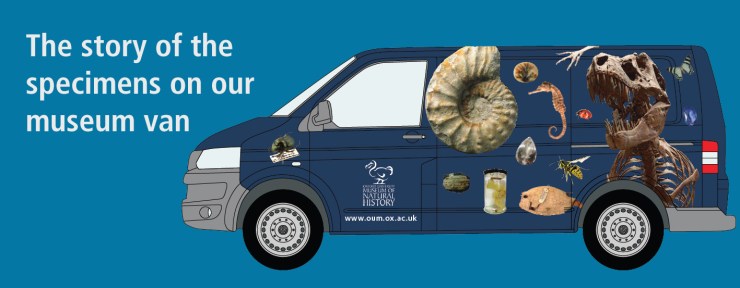
DSC_1230It all started with a question from a member of the public; “What are these things on your van anyway?” Since then, our weekly blog posts have featured the story of 37 specimens from the Museum’s diverse collections.
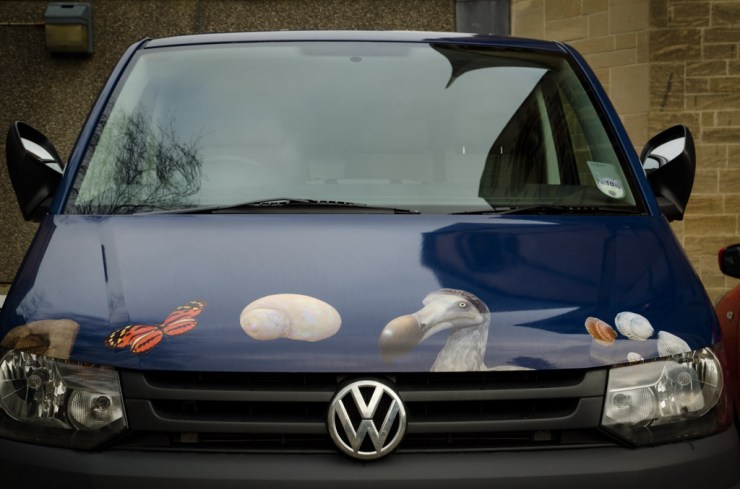
From the Oxford dodo to Darwin’s dung beetle, a gemstone to a T rex, the ‘What’s on the van?‘ series has covered it all. Each week, expert voices from across the Museum (and beyond) have brought insight and intrigue to the images, explaining the secrets behind the specimens that decorate our van.

DSC_1223

DSC_1221We hope you’ve enjoyed the weekly installments and will feel a little bit more knowledgeable if you see us out and about on the road. You can call out “I know what’s on the van!”.
Rachel Parle, Education Officer


Natural Histories: On Tour

Order

In May this year we opened Natural Histories, our collaborative exhibition with the Museum  of the History of Science on Oxford’s Broad Street, who hosted the displays. As we wrote at the time, it was a great opportunity to put on view some lovely and important specimens while we were closed. It also linked nicely with the long history of the museums in Oxford, beginning as far back as 1683.

Lost and FoundIt was a lot of hard work pulling together all the material, themes, and displays for Natural Histories so we were particularly pleased when Banbury Museum, one of the University museums’ development partners, approached us asking if the exhibition might tour there…

And so it has. It’s a short, one-stop tour admittedly, but with a bit of jiggling and reconfiguration here and there, the whole Natural Histories show is now open to the public in Banbury.

Banbury MuseumSo if you missed it at the Museum of the History of Science, head over to Banbury Museum by 22 February 2014 and have a look.

There’s plenty to see, including the jawbone of the Oxfordshire Megalosaurus, the world’s first scientifically-described dinosaur; creatures collected by Charles Darwin; and a meteorite the age of the Earth itself. With touchable specimens too (of course), Natural Histories explores some big themes and ideas that have shaped our understanding of the natural world.

But as the finished exhibition is now on display for all to see, here instead are a few behind-the-scenes shots of the late night measuring, painting, fixing and adjusting that were needed to get everything ready for opening day last Saturday. Thanks very much to everyone who mucked in and helped out.

_DSC1117
Making a few adjustments…
An almost-closed case
Almost ready for closure
_DSC1126
Finding the spot
Glass cleaner at the ready

_DSC1138

Scott Billings – Communications coordinator

What’s on the van? – Ammonite

L-Cretaceous-ammonite

This week’s What’s on the van? comes from Eliza Howlett of the Museum’s Earth Collections.

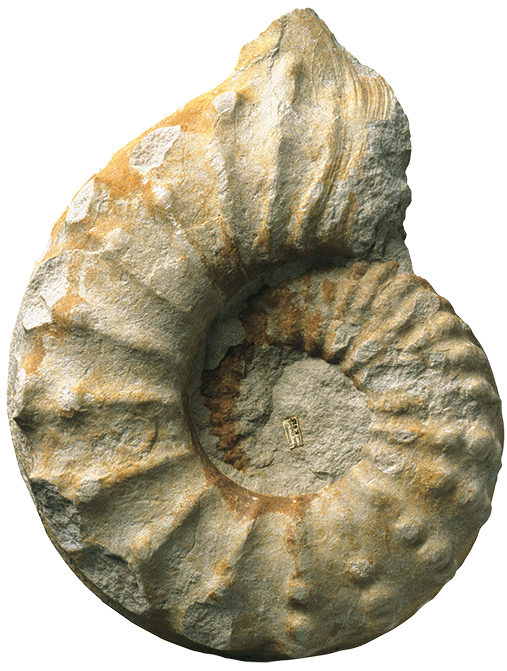
This ammonite belongs to the genus Mortoniceras, introduced by the American palaeontologist F. B. Meek in 1876 in honour of his colleague Samuel Morton (1799-1851). The species name rostratum refers to the rostrum, the curved projection near the opening of the shell.

This specimen was collected by William Buckland (1784-1856), Oxford’s first Reader in Geology. It was originally described and illustrated by Buckland’s friend James Sowerby in 1817 in his Mineral Conchology of Great Britain, the earliest work to describe all of the fossil shells then known from the country. The specimen lived during the Cretaceous Period and is approximately 100 million years old. It was found in a marine rock formation called malmstone at the hamlet of Roke, near Benson, 10 miles southeast of Oxford. Malmstone is a distinctive fine-grained grey green rock, widely used in buildings in the area.

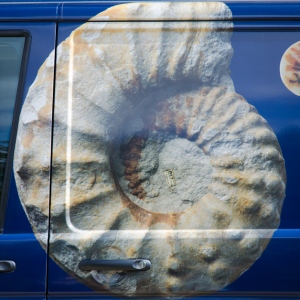
The ammonite on the van

Ammonites are an extinct group of molluscs whose closest living relatives are squid and Nautilus. They had an external shell made up largely of mother of pearl. As in Nautilus, the animal’s body moved forwards periodically as the shell grew, and the back end of the body secreted an intricately folded plate called a septum after each move, so that the shell was divided into a series of chambers with the animal’s body in the last chamber. The rostrum of our specimen tells us it was an adult and had stopped growing. Ammonites floated freely in the water column, probably feeding on plankton. Although they are traditionally illustrated with the body chamber at the top, in life they were actually the other way up, with the body chamber at the bottom.

Though originally described from Oxfordshire, Mortoniceras rostratum floated its way around the Cretaceous world, and specimens are known from Texas, Japan, South India, Madagascar, South Africa and elsewhere.

What's on the van?

Scaffolding sketches

P1020231_cropped

The Museum has a long history as a source of inspiration for artists; from the involvement of the Pre-Raphaelites in the building’s construction, to the thousands of art students that visit each year. This year’s closure period has been particularly interesting for one artist, Kate Kay.

Kate Kay in the Museum

Kate, who lives locally in Oxford, is doing a continuing practice course through Ovada, an Oxfordshire contemporary arts organisation.

An architectural background and interest in drawing in large internal spaces led Kate to the Museum. She said “I’m particularly interested in framed structures through which one can see. The Museum of Natural History certainly provides this, with its dramatic and innovative structure, and its remarkable collection of skeletons adding further layers of interest. When I heard that the Museum was to be closed for renovation works, I realised that the scaffolding, and the protective wrapping of the skeletons would add yet more layers.”

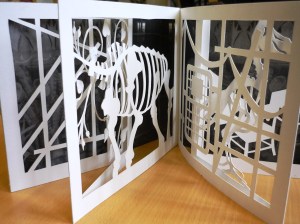
Cut paper work inspired by the layers in the Museum

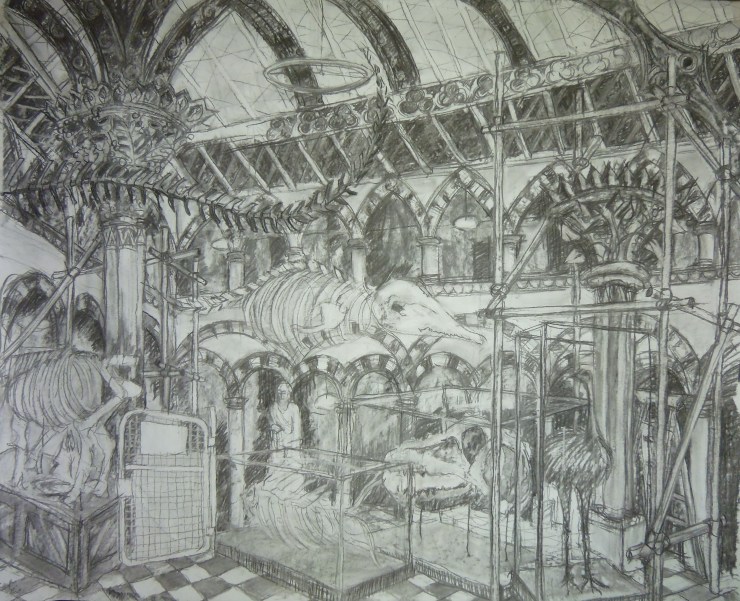
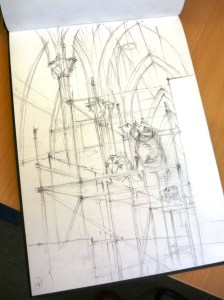
During the early part of the year, Kate visited regularly and was welcomed on site by the contractors. With hard hat and high-vis jacket, she was allowed to  go anywhere on the site, and she made numerous sketches and took photos. From May she then worked on a very large charcoal drawing (top of this post), incorporating various elements of the Museum and the renovation project in one image. She also produced a work in cut paper (right) combining several ‘see-through’ images. These were exhibited in an end-of-year show at the Oxfordshire Museum in Woodstock.

P1030503“Now that most of the scaffolding is down, one can see how the Museum has been transformed. I’ve really appreciated the opportunities that this project has provided, particularly in exploring up in the roof structure. I look forward to drawing in the Museum again, once it’s back in action in the spring, possibly focusing more closely on some of the other exhibits.”

It’s important that this special year of closure has been documented in Kate’s drawings. When we re-open, I hope that more artists than ever will be inspired by the Museum, as sunlight floods through our sparklingly clean roof.

Rachel Parle, Education Officer

What’s on the van? – Bumble bee

_HL2#Helicon-M=B_R=16_S=4-Retouched-Edit2

This week’s What’s on the van? comes from Dr. James Hogan, of the Museum’s Hope Entomological Collections.

Bumblebees and honeybees busily working away are one of the iconic visions of summer. Bumblebees and honeybees are also closely related, both belonging to the order Hymenoptera, family Apidae.

In the UK 28 species of bumblebee (species of Bombus) have been recorded, although several species are sadly now extinct or have been seen only a few times.

The short-haired bumblebee (Bombus subterraneus) has been the focus of recent conservation efforts. Although extinct in the UK, descendants of some British short-haired bumblebees still survive– in New Zealand! These bees originate from a deliberate introduction to New Zealand in the late 19th Century for pollination of clover crops. Unfortunately, attempts to re-introduce these New Zealand bees have been unsuccessful because they are too inbred, but by introducing short-haired bumblebees from Sweden the species is establishing again in Kent (more details about the short-haired bumblebee re-introduction can be found at http://www.rspb.org.uk/ourwork/projects/details/299380-shorthaired-bumblebee-reintroduction )

Although we have lost some species we have recently gained one more, the tree bumblebee (Bombus hypnorum). This species is believed to have colonised the UK naturally from France and since its arrival about 10 years ago is spreading rapidly across Britain. We first became aware of this new bee in Oxford in 2008 when Steven Williams, one of our regular volunteers, brought in a strange-looking bumblebee which none of us recognised. It had a colour pattern unlike any other British species, with a red-brown thorax and a black abdomen with a white tip.

After a bit of detective work (and some help from local bee expert Ivan Wright) the arrival of the tree bumblebee in Oxford was confirmed. This bumblebee is now a common sight in Oxford gardens –look out for it next spring!

What's on the van?