Seaside Minerals

Russell Society

Last week, members of the Southern Branch of the Russell Society came to visit the Museum. They especially wanted to see some of the minerals in our collection that came from the South Coast of England. The Russell Society, in case you are wondering, runs lectures, museum visits and fieldtrips for people who enjoy finding out about minerals. It is named after Sir Arthur Russell, one of Britain’s most gifted amateur mineralogists. I’m a member and so is one of our volunteers, Jane Randle.

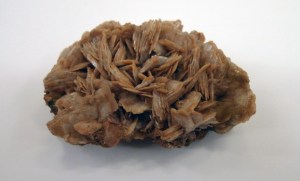
Baryte from Babbacombe, Devon (80mm across)

Now, Jane and I know the Russell Society folk are a very knowledgeable lot, so we put our heads together a devised a challenge for them. We got out from the stores a whole lot of interesting minerals from quarries, mines, beaches and cliff exposures all along the coast from Kent round to south Devon, and laid them out in a random way. Then came the fun bit; we took away all the labels!

The task was to work as a team and organise the minerals according to where they were found, from west to east. Easy? Well, that depends on how good you are at recognising the different kinds of minerals and where they come from.

One of the fun things about minerals is that each kind  – calcite, quartz, gypsum, etc, – can look very different according to where it is found. Some are very easy to recognise but some are not. After much debate, looking at maps, and rearrangement of specimens came the moment of truth as Jane and I put the labels back with their specimens, and everyone could see whether or not they were right.

Fossil sponge preserved in chalcedony from Brighton beach (110mm across)

Our Russell Society folk certainly showed they know their local minerals!  They recognised the little round masses of baryte crystals from the Isle of Sheppey,  large transparent  gypsum crystals from Battle, powdery white masses of aluminite from Newhaven, rare blue vivianite crystals from near Southampton, sparkling pointed crystals of calcite from Charmouth, branching crystals of real gold from near Torquay, and many more. Others did elude them, and came from surprising places. Our beautiful polished slices of fossil sponges, for example, came from pebbles collected on Brighton beach in the 19th century!

Monica Price, Head of Earth Collections

Secrets of Bones

nicolacrompton's avatarOnce in a Whale

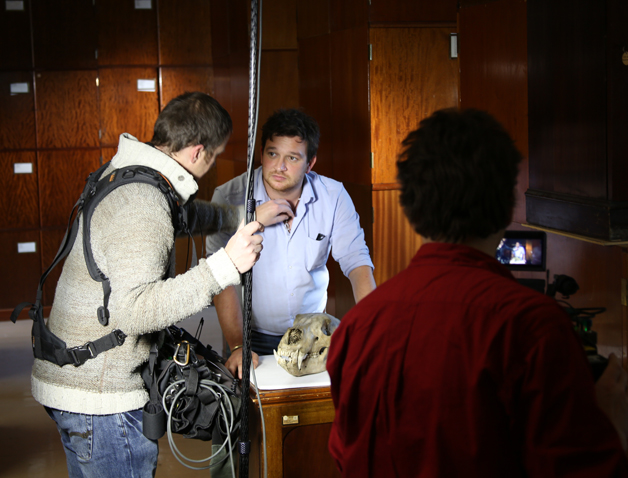
Although the conservation of our whale specimens has drawn to a close, there’s still a hub of activity in the ‘whale aisle’. This week, we had an opportunity to finally uncover the Sperm Whale mandible as it was featured in a new BBC Nature Series, ‘Secrets of Bones’. To see the specimen for the first time, under natural light without the shelter of scaffolding was a real delight.

036B7200small

The conservation team was eager to oversee the action and learn about the process of putting a documentary together. Ben Garrod, evolutionary biologist, used the museum specimens to look at the evolution of the mandible and its diversity in nature.  The beautiful Sperm Whale jaw is an excellent example of this.

036B7278small036B7274small

The series will be televised in February 2014, and we’re excited to see if we made it on-screen!

The re-installation of the remaining skeletons is expected to happen in 2 weeks…

View original post 19 more words

A blur of activity

Blur

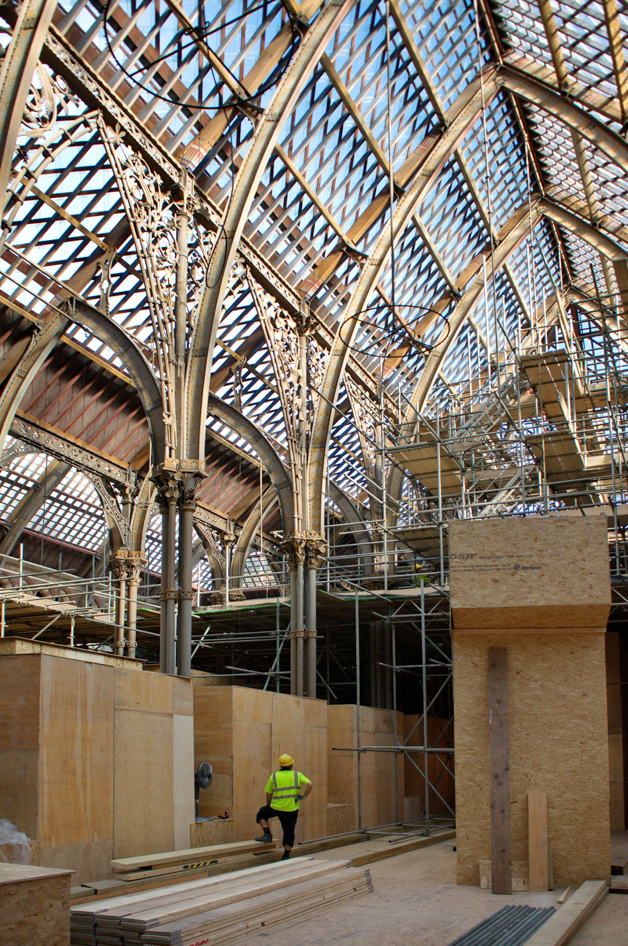
After almost a year of being ensconced in metal scaffolding and boarded hoardings the working structure inside the Museum was brought to ground with impressive rapidity – and a whole lot of noise – last week.

The tiles before cleaning!

The blurry figure you can see above is one of a number of construction staff who struck the scaffold in a matter of days, throwing sunshine on the north aisle once again. Now only the central column of scaffolding remains, with just 80-odd glass tiles still to be fitted. Once this section comes down the roof again becomes an inaccessible domain, populated with secret graffiti and the newly-installed plaque.

The cleaned glass tiles waiting to be reinstalled

Down on the ground the light is flooding in to the Museum, as you can see in the picture below. To the left you can see why: this is an example of the state of the tiles before they were cleaned, so you can imagine how much light was being blocked by a century or so’s grime.

Now our attention is starting to turn to the task of repopulating all the empty aisles and cases. It’s a big job that requires a lot of careful planning, but we’ll keep you posted along the way.

OUM Project 2013 (2)
Photo: Mike Peckett

Scott Billings – Communications coordinator

What’s on the van? – Beryl gemstones

Beryls

This week’s What’s on the van? comes from Monica Price, Head of Earth Collections.

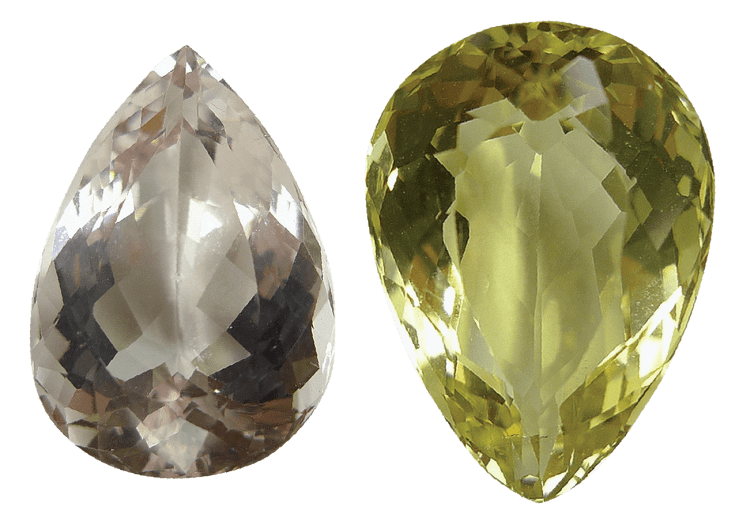
This time, it’s a special double issue of ‘What’s on the van?’! Two gemstones, that look very different, turn out to be exactly the same mineral, beryl. On the right is a greenish yellow variety of beryl called ‘heliodor’. It gets its name from the Greek word for the sun, and is coloured by a trace of ferric iron. The stone on the left is absolutely colourless because it has no impurities colouring it. This kind is known as ‘goshenite’ after Goshen in Massachusetts, USA, where it was first found.

Beryl is composed of beryllium, aluminium, silicon and oxygen (Be3Al2(SiO3)6 to be precise) and it is not very common. Flawless transparent crystals are rare, and as they are also very hard and durable, they are ideal for cutting into gemstones. Heliodor and goshenite are not often seen in jewellers shops, and nor is the pretty pale pink variety called ‘morganite’. There are two kinds of beryl which are much better known, ‘aquamarine’ and ‘emerald’. Aquamarine is  coloured light blue or green by a trace of ferrous iron, while rare and highly prized emerald is vibrant green because it contains a little bit of chromium.

We talk about ‘cutting’ gemstones, but in fact the faces are ground away on a flat fast-revolving flat metal plate charged with abrasive powder, called a lap. The faces are then polished using finer and finer grades of abrasive powder. Each face is cut at a very precise angle to get the maximum amount of sparkle in the gem.

Our heliodor and goshenite gems are from a beautiful collection generously presented to the Museum by Mr Bernie Peel in 2004. You will be able to see lots more cut stones from the Peel collection in the Museum’s gemstone display when the Museum reopens in February 2014.

What's on the van?

Two pints of lager and a puffin, please

FFTMC Puffin Bar

Seen anything unusual in town recently? If you’re a resident or visitor in Oxford you may have noticed that some strange things have popped up around the city centre. A naked ape-man on the corner of Broad Street and Cornmarket, for example; or a Utahraptor dinosaur in Blackwell’s children’s section. You see, the Museum has had some escapees while we’ve been closed, in a project we’ve called Goes to Town.

Every night, as everyone knows, the specimens in the Museum come alive. And they got talking. And they soon realised they were jealous of their colleagues who had escaped to gallivant around town. In fact, they got so restless being pent up inside the closed Museum, that in the end we thought it best to take them out for a pint.

Have you seen our beer mats advertising Goes for a Pint?

So, over the past four weeks, members of the Education team and some super volunteers have been heading out to local Oxford pubs, armed with some great specimens to show off to unsuspecting pub-goers. But that’s not all – for Museum Goes for a Pint we’ve also been hosting our very own natural history-themed pub quiz!

Each week, we have either joined a pub’s regular quiz, or compiled our own special event. We arrive around 7pm and chat to people in the bar about the Museum and its collections, before diving into the quiz around 8pm. Quiz rounds have been roughly based on the pubs themselves (‘rusty’ coloured animals at the Rusty Bicycle; oak tree teasers at the Royal Oak…you get the idea). We’ve had just as much fun writing the quizzes as we hope the quiz-goers have taking part.

Barny gets a stroke from a quiz-goer.

The idea for Museum Goes for a Pint came from Kathy Clough, a project volunteer, shortly before the Museum closed for the roof repairs. It fit perfectly into our plans to get out and about in the city during the year.

We would like to thank the wonderful pubs who have hosted us so far: The Rusty BicycleFar From the Madding CrowdJames St TavernThe Royal Oak and The Royal Blenheim.

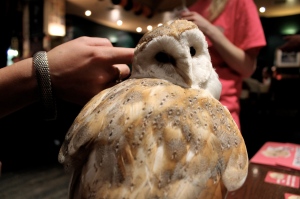
But we’re still only half way through. We’ve got three pubs left to visit. So if you find yourself in the Eagle & Child next Wednesday, the Cape of Good Hope on Tuesday 26 November, or the Big Society on Monday 2 December, look out for some pink t-shirted individuals juggling barn owls and entomology trays.

If you’ve no other plans then do come along and join us. The quizzes are free, and different each week. And where else are you going to get a pint and a puffin?

Simone Dogherty, Education officer

What’s on the van? – Trilobite

Trilobite

This week’s What’s on the van? comes from Dr David Legg, Post-doctoral Research Fellow in the Museum’s Earth Collections.

This particular trilobite specimen (Acaste inflata) was collected and named by John William Salter during the Ledbury Railway Tunnel cutting in 1864. Salter worked with many famous scientists during his career; he was an apprentice of the famous mineralogist James De Carle Sowerby, before becoming a curator for Adam Sedgwick at the Woodwardian Museum in Cambridge (now the Sedgwick museum), and in his later years he assisted Roderick Murchison on his work on Siluria. During this time, Salter developed an interest in the trilobites of Wales and was considered a world expert on this group.

Trilobites are a group of arthropods (the group that includes spiders, scorpions, crustaceans, insects, etc.) characterised by the possession of a hard exoskeleton composed of calcium carbonate. They are some of the first animals with hard parts found in the fossil record. The first trilobites appeared roughly synchronously on various continents around 520 million years ago, and went extinct during the largest mass extinction of all time at the end of the Permian (c. 251 million years ago), nearly 20 million years before the first dinosaurs appeared.

Acaste inflata belongs to a group of trilobites called the phacopids. The eyes of phacopid trilobites are unlike any others in the animal kingdom. The eye may consist of over 50 lenses, each separated from the next by a thick interlenticular cuticle. Because there are no modern animals with similar eyes it is unclear how they functioned to produce a clear visual image, however, the shape of each individual lens meant it was capable of focussing on objects of varied distance without the need for any additional focal mechanism (like the human lens which needs to change shape in order to see objects of different distances).

This picture is a bit strange because the trilobite is enrolled (curled up like a woodlouse) and the view is of the top of the head. We assume that this was a form of defence used by most trilobites.

What's on the van?