Over the last couple of weeks our conservation team has been involved in the popular ‘Making Museums’ school project hosted between the Pitt Rivers Museum and Oxford University Museum of Natural History. Bethany, Nicola and I took turns to lead behind-the-scenes tours of our ‘whale aisle’, during which 10-11 year old pupils from East Oxford primary schools were introduced to ‘conservation’ as a wonderful museum profession.
Pupils learned about the importance of specimens to the museum and scientists, what affected the condition of the skeletons, how we conserved the whales, how and why whale anatomy differs between species and about what talents and special interests conservators bring to the profession.
We loved seeing their eyes widen at the size of our enormous Sperm Whale mandible, their disgust at handling a ball of tar-like degraded whale oil, their bewilderment at the fact whales have floating pelvises, and their bemusement at…
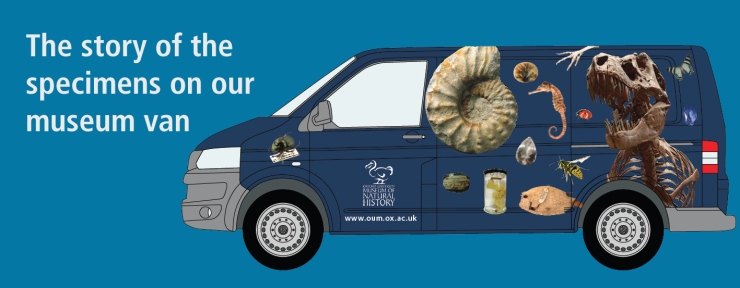
This week’s What’s on the van? comes from Monica Price, Head of Earth Collections.
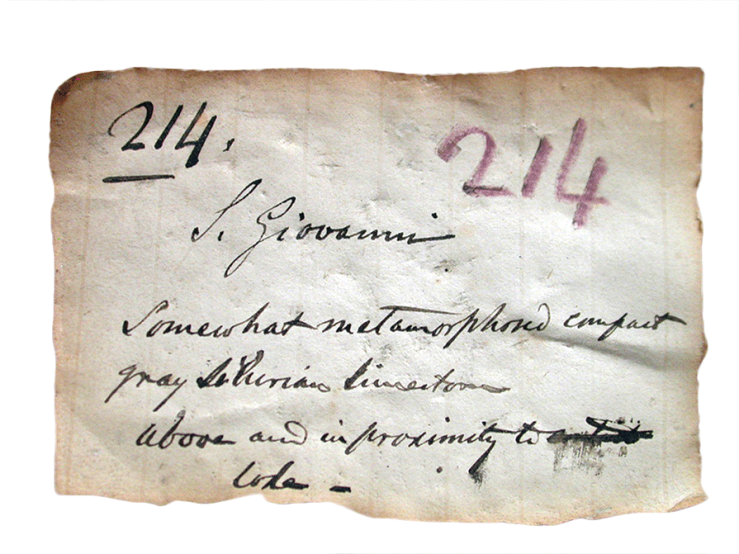
A story to tell Each of the millions of different objects in our Museum has a story to tell – what it is, where it is from, who collected it, when and why. All that information is collected together on the specimen’s label, and museum curators look after labels like this just as carefully as they do the specimens themselves.
Some of the labels in the Museum are very old, but the handwriting can be distinctive. Although this label does not say who wrote it, we can tell from the handwriting, the style of number, and the Italian locality, that it was written by an Englishman called William Jervis. He was a geologist who worked at the Museo Industriale Italiano (Italian Industry Museum) in Turin during the second half of the 19th century.
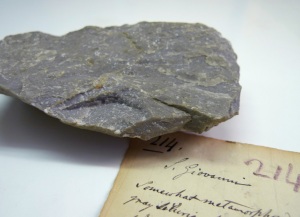
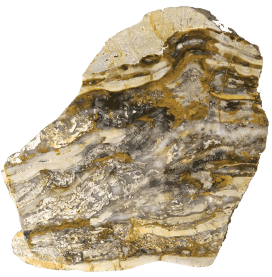
William Jervis wrote books on the rocks and minerals of Italy that are important for ores, building materials and water supplies. He also put together sets of rocks samples to be sold to other museums and universities. He trimmed each one to a neat rectangular shape and gave it a number. On the label, he’d write the number, what the rock was, and exactly where it was collected. Some of his labels are very detailed indeed and show that his samples came from places no longer accessible today. The specimen accompanying this label is one of a set of Sardinian rocks. It comes from San Giovannni mine, near Iglesias, and shows the kind of grey limestone that was found close to the ‘lode’, the vein of lead and zinc ore minerals which was being worked by the miners.
Do you have a collection of geological specimens, or maybe shells, plants or insects? It is always a good idea to do what William Jervis did, put a number on each specimen (maybe using a little paper label), and then write all the information about it on a label. It’s also a good idea to keep that information all together in a book or on a computer so that if a label goes missing, the information is kept safe. Don’t forget to keep a back-up of your computer file though, just in case!
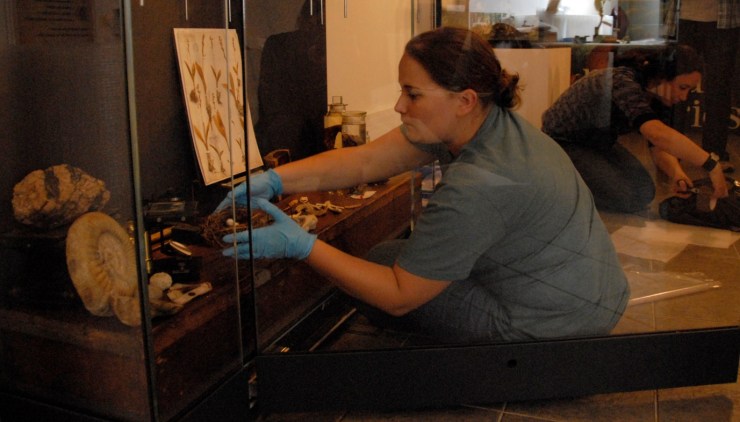
Amoret Spooner (left) and Zoë Simmons (right) dismantling the exhibition
This week we’ve been at the Museum of the History of Science on Broad Street, taking down our temporary exhibition, ‘Natural Histories’. We had some lovely feedback from people who saw the display. They enjoyed seeing old friends from the Museum of Natural History’s displays such as the giant ammonite that people can touch, the jaw of Megalosaurus, the first dinosaur ever to be described by scientists, and the lovely old insect collecting tools used by entomologists.
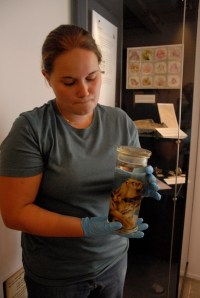
Specimens stored in spirit need very careful handling
The exhibition also had some things we are rarely able to put on display. The beautiful hand-painted butterflies in William Jones’ Icones, and White Watson’s inlaid stone slabs representing the strata of Derbyshire, are just two of the treasures we normally keep in a darkened room because too much light will damage them. We showed crabs collected by Charles Darwin on the voyage of The Beagle, and even a plant from the University’s herbaria that was collected by Linnaeus, the Swedish scientist who devised the system of ‘Latin’ names we still use for plants and animals today.
Every item is being carefully checked and packed up, but don’t worry, they are not staying in our stores for long. We will be taking them to Banbury Museum where ‘Natural Histories’ will be going on show again from 30th November 2013 until late February 2014. So, even if you missed the exhibition in Oxford, you’ll have a last chance to see it in Banbury.
Conservator Gemma Aboe packs away the pigmy anteater
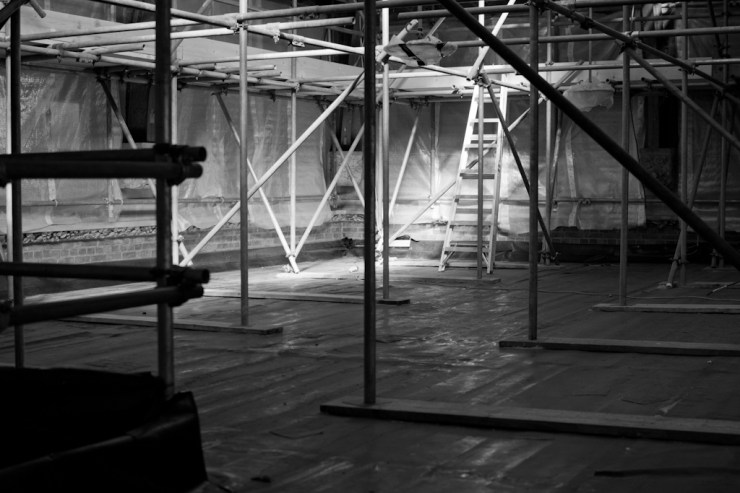
The picture above gives some impression of the latticework of scaffolding and ladders that have grown to occupy the spaces inside the Museum. In places the density of the scaffolding is visually impenetrable as you can see in the black and white photograph below.
A dense structure of lines and levels cuts across the upper gallery level of the central court.
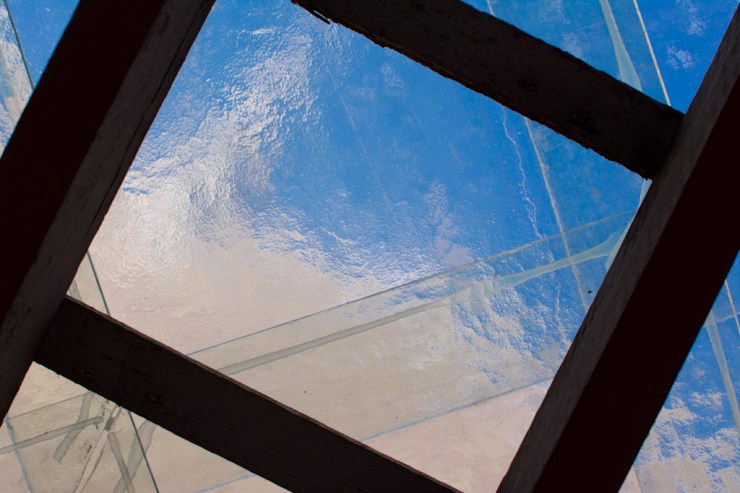
Some of the very top layers of this scaffold are set to come down now that the tiling on the central apex is completed. Where tiles have been cleaned or replaced the sunlight pours in to the upper spaces and the sky is clearly visible beyond. Previously, the tiles offered only a murky view of the outside world, obscured by decades of dirt and organic growth.
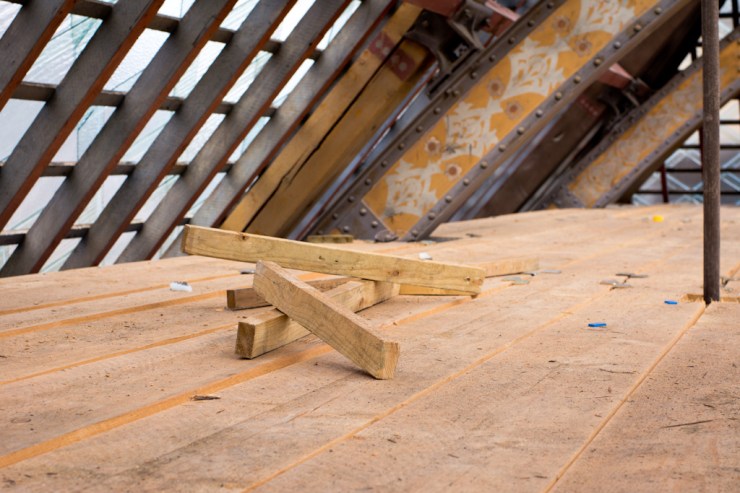
It is a great experience poking around in the normally sequestered heights of the Museum’s architecture. I have been lucky to be able to get up there a number of times during the construction work, photographing the different phases and the unexpected finds that have been uncovered in the process.
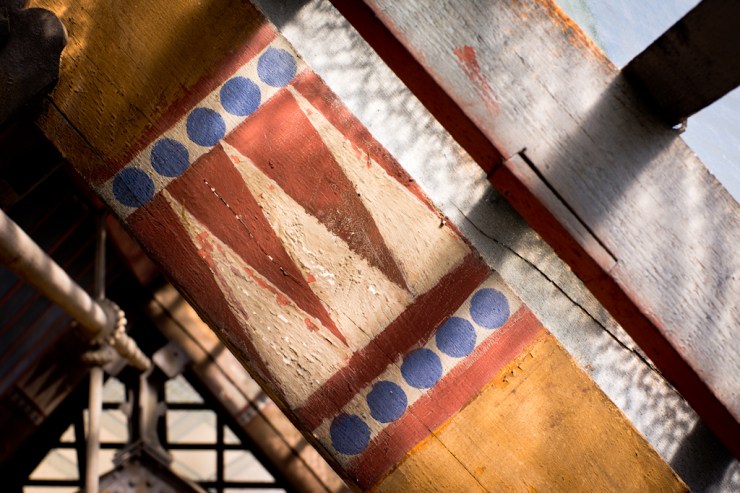
One thing you notice up in the roof is the level of intricate detailing that was applied right to the very top of the structure. Beams are painted with strikingly colourful geometric patterns; finials and capitals offer ornately-sculpted flora, each distinct from its neighbour; and even the pipework carries little decorative flourishes here and there.
The story of the design and construction of the building is recounted in articles available in the Learning More section of our website. These are worth a read if you’d like to know more about the thinking and work behind the Museum building, which originally opened in 1860. There are also plans for an exhibition that will reveal the Pre-Raphaelites’ influence on the design of this so-called ‘cathedral to science’, following a period of research by Dr John Holmes.
As the scaffolding is struck and the building contractors descend back to the lower levels, so the secrets of the Museum return to their hiding places. We have already discovered a number of names and dates scrawled, painted and even carved into the structures – more on that soon. But perhaps there are more messages from the past, overlooked during the current roof work. If so, could it be another century or more before anyone claps eyes on them?
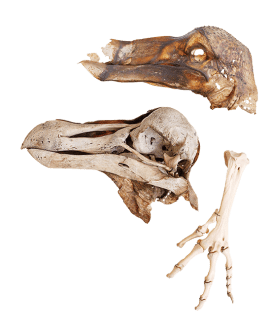
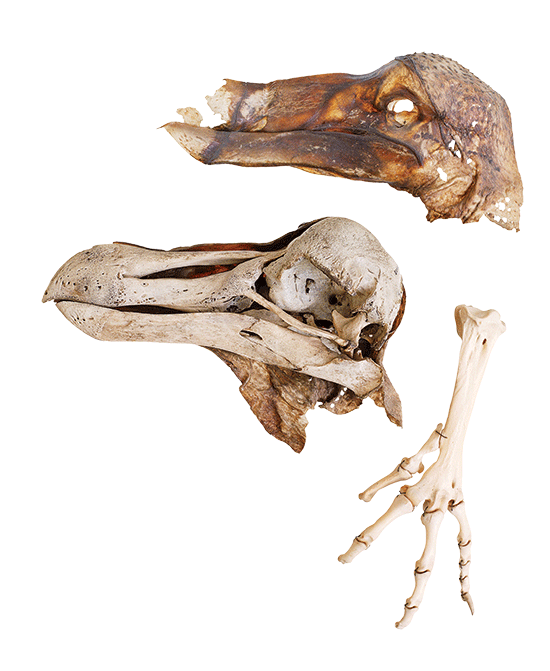
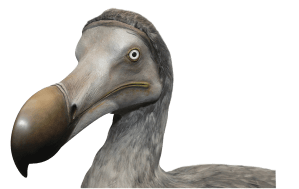
It’s time for one of the stars of the Museum’s collection! One of our most famous specimens, the dodo even features on our logo.
This week’s What’s on the van? comes from Malgosia Nowak-Kemp, Collections Manager in the Museum’s Life Collections.
The Dodo of Mauritius was discovered in the late sixteenth century by Dutch sailors stopping on the island for water and fresh food supplies. Because of its inability to fly, the Dodo was considered a great exotic curiosity and a few of the birds were shipped to Europe, India and Japan. One of them ended up in London, in the Tradescant collection. This collection, widely known as the “Ark”, was assembled in the seventeenth century by gardeners to the royalty and aristocracy, father and son John Tradescant. The stuffed Dodo was displayed to the public and described in the Tradescants’ catalogue as “Dodar, from the island of Mauritius. It is not able to fly, being so big”.
After the death of the Tradescants, the “Ark” was presented by its new owner, Elias Ashmole, to the University of Oxford, and in 1683 placed in the newly built Ashmolean Museum. Over the years, the specimens suffered from damage inflicted by insect pests and too frequent handling by visitors, and by 1756 only the Dodo’s head and one of its feet remained.
In 1848 it was firmly established that the Dodo was a member of the pigeon order: Columbiformes. In 2002, with application of DNA analysis, the Oxford Dodo yielded even more information about its origin. We now know that several million years ago its ancestors arrived in Mauritius from the Nicobar Islands, off India. Finding no natural enemies in their new habitat, and no competition for food, the lineage evolved in size and gradually lost its ability to fly. But in the end its size was not enough protection to stop humans, and animals introduced by them, like pigs, rats and monkeys, from causing the Dodo’s extinction.
The roof is what this is all about. Our beautiful canopy of 9,000 glass tiles has been admired since the Museum first opened, but has caused 153 years’ of worry by letting the rain drip through into the interior. The determination to clean and seal the roof is the whole reason for this year’s closure.
Stephen French high up in the roof
To get this job done effectively we needed a great team, so Beard Construction appointed Stephen French as Site Manager, drawing on his years of experience as a roof tiler. Despite all his experience Stephen has never worked on a project quite like this one before…
I caught up with Stephen for a chat about how he and his team are getting on. Stephen describes the Museum building as “completely individual”. But the opportunity to work in such a unique piece of architecture has certainly provided some challenges along the way.
All the glass tiles are being removed, cleaned, re-fitted and sealed with mastic to keep the water out. Below you can see some tiles back in place, held firmly by plastic struts, while the mastic dries.
“There’s no manual for this job; we’ve had to work out what the original designers were thinking as we’ve gone along,” Stephen explained. “There’s no second chance with a project like this,” he adds. Indeed, once the scaffolding comes down and the Museum reopens we can’t get back up to the tiles without starting all over again.
Les Smith and Stuart Knapp
It will come as no surprise that one of the biggest challenges facing the Beard team was the great British weather. The heat of the summer forced the guys to take regular breaks from the scorching temperatures; at one point, high up inside the glass roof, the thermometer read over 50°C! Then downpours of rain brought work to a complete stop because the mastic won’t adhere to the glass when it’s wet.
Jamie Bennett and Pete Hutt
Stephen speaks very highly of his team. Usually there are around nine people working on site at any one time, and several of them have been involved since the first phase of the roof refurbishment back in 2011-12. There is a wide variety of skills needed for this project, so the staff includes roofers from Attley’s Roofing and specialist carpenters from RS Carpentry and Building Services. Some of the men even come down from Middlesborough each week to work in the Museum!
Despite the weather, the complicated roof design and the unique materials involved, Stephen is very positive about the whole project. He loves the building, and compares the roof to a dinosaur’s skeleton, going so far as to say “This is the kind of job that gets you up in the morning!” Up into the rafters indeed.