Reports from the rafters
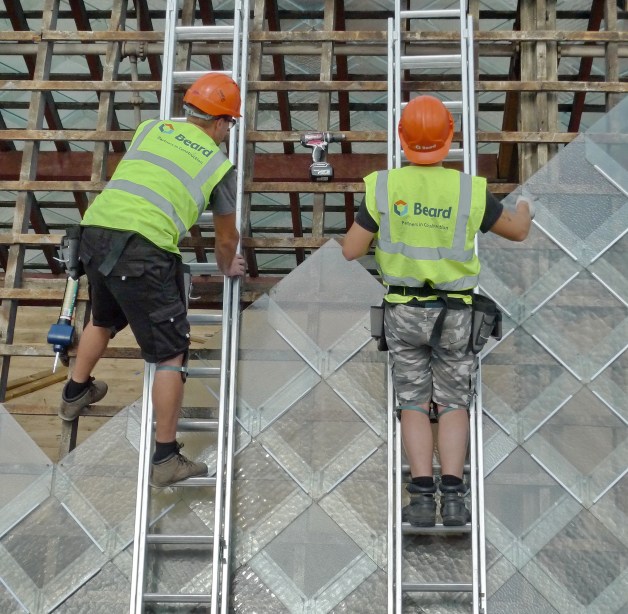
The roof is what this is all about. Our beautiful canopy of 9,000 glass tiles has been admired since the Museum first opened, but has caused 153 years’ of worry by letting the rain drip through into the interior. The determination to clean and seal the roof is the whole reason for this year’s closure.

To get this job done effectively we needed a great team, so Beard Construction appointed Stephen French as Site Manager, drawing on his years of experience as a roof tiler. Despite all his experience Stephen has never worked on a project quite like this one before…
I caught up with Stephen for a chat about how he and his team are getting on. Stephen describes the Museum building as “completely individual”. But the opportunity to work in such a unique piece of architecture has certainly provided some challenges along the way.
All the glass tiles are being removed, cleaned, re-fitted and sealed with mastic to keep the water out. Below you can see some tiles back in place, held firmly by plastic struts, while the mastic dries.
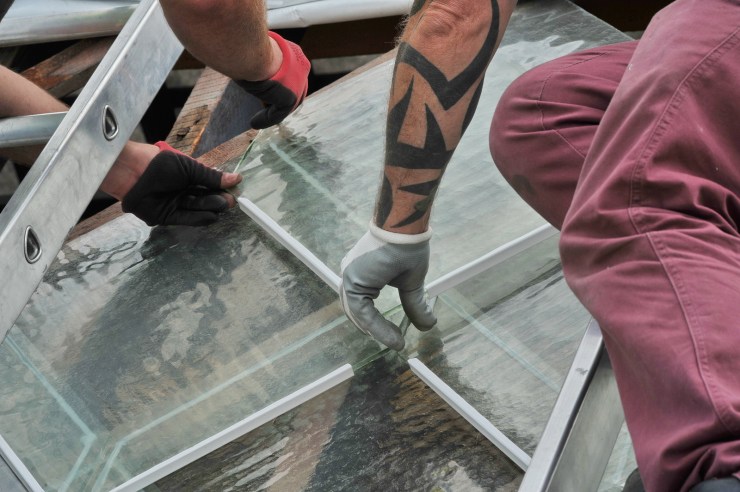
“There’s no manual for this job; we’ve had to work out what the original designers were thinking as we’ve gone along,” Stephen explained. “There’s no second chance with a project like this,” he adds. Indeed, once the scaffolding comes down and the Museum reopens we can’t get back up to the tiles without starting all over again.

It will come as no surprise that one of the biggest challenges facing the Beard team was the great British weather. The heat of the summer forced the guys to take regular breaks from the scorching temperatures; at one point, high up inside the glass roof, the thermometer read over 50°C! Then downpours of rain brought work to a complete stop because the mastic won’t adhere to the glass when it’s wet.

Stephen speaks very highly of his team. Usually there are around nine people working on site at any one time, and several of them have been involved since the first phase of the roof refurbishment back in 2011-12. There is a wide variety of skills needed for this project, so the staff includes roofers from Attley’s Roofing and specialist carpenters from RS Carpentry and Building Services. Some of the men even come down from Middlesborough each week to work in the Museum!
Despite the weather, the complicated roof design and the unique materials involved, Stephen is very positive about the whole project. He loves the building, and compares the roof to a dinosaur’s skeleton, going so far as to say “This is the kind of job that gets you up in the morning!” Up into the rafters indeed.
Rachel Parle, Education Officer
Photo credit: Mike Peckett
![_LEPI1997l[1]](https://morethanadodo.com/wp-content/uploads/2013/09/lepi1997l1.png?w=740)




 As I explained