What’s on the van? – 7 spot ladybird

_5450712_xl_ladybird2

This week’s What’s on the van? comes from Richard Comont of the Centre for Ecology and Hydrology.

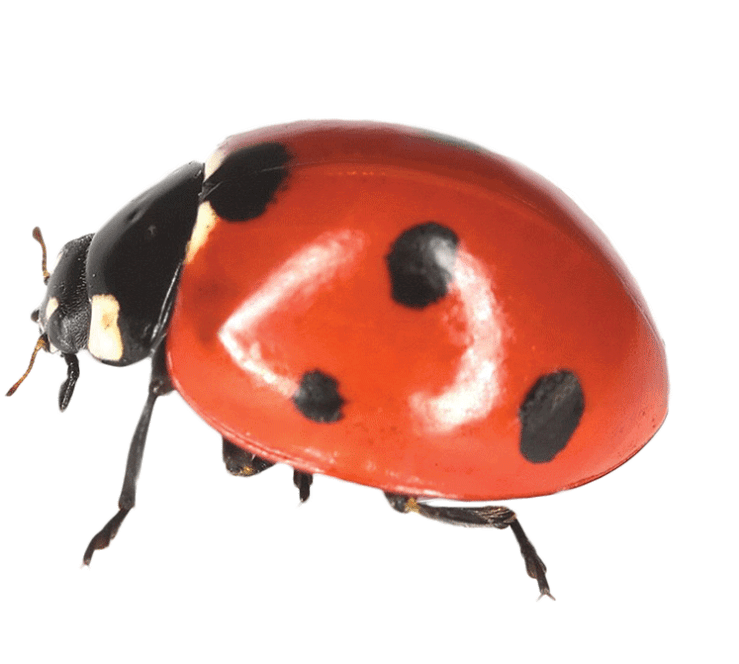
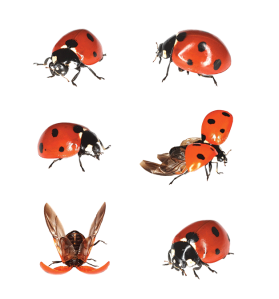
The 7-spot ladybird, Coccinella septempunctata, is one of the most iconic examples of British wildlife. Probably our best-known beetle, its image has been used as the logo for books, clothes, and much more.

It’s one of our largest ladybirds, up to 8mm long, and it can be found almost anywhere – it’s not fussy about habitat and usually arrives shortly after an aphid colony has established. Gardens and rough ground are good areas for the species – they especially love nettle patches!  Their bright red colouration makes them easy to spot, but is actually a warning to predators – ladybirds practice chemical warfare by producing a foul-tasting yellow liquid from their knee joints when disturbed.

_5450712_xlThe 7-spot has been familiar to farmers and gardeners throughout history as a brightly-coloured guardian against greenfly, and it’s from this that ladybirds get their slightly odd name. Bright red in colour (matching the cloak of the virgin Mary in early biblical illustrations) and with seven black spots recalling the seven sorrows of Mary, these tiny predators were clearly a gift from the gods to farmers suffering from aphids on their crops, and so they became known as ‘Our Lady’s birds’, which became shortened to ‘ladybirds’.

Most people recognise the 7-spot, but are surprised to hear that there are actually 47 different ladybird species in Britain alone! The UK Ladybird Survey team have published a new ladybird handbook to help people learn about and identify these fascinating insects – why not submit your next sighting at www.ladybird-survey.org?

What's on the van?

Seeing prehistoric life in 3D

3d trilobite

On 22nd August, Eliza Howlett and I joined in the London press launch of ‘GB3D Type Fossils’, an exciting project to make images and information about some of our most important fossils freely available online. It is a major collaboration between the Museum of Natural History at Oxford, the National Museum of Wales, the Sedgwick Museum in Cambridge, and the British Geological Survey, and is funded by Jisc, a charity that champions the use of digital technologies in UK education and research.

Type fossils are the specimens used to define each species of plant or animal. They are the ‘heritage specimens’ of the geological world, and need to be preserved carefully for future generations of scientists. The GB3D Type Fossil project is a rather clever way to let researchers, collectors and enthusiasts see our type specimens up close, wherever they are in the world, without any risk of damage to the specimens.

Some of the fossils have been scanned using a 3D laser-scanner. Their images can be enlarged up, rotated and viewed online using free software such as Meshlab. They can also be printed out on a 3D printer, and the one running at the press launch generated a lot of interest! Other fossils were photographed as ‘3D anaglyphs’ so that if you wear cyan-red 3D specs, the fossils appear in three dimensions. The remainder can be seen in really good conventional photographs that show lots of detail. There’s plenty of information about the fossils too, for example how old they are and where they are from.

3D ElizaAbove you can see a 3D anaglyph (stereoscopic) photo of the type specimen of Barrandia bianularis, a trilobite that lived around 464 to 467 million years ago. It appears on the website in 3D when viewed using cyan-red viewing glasses. Have a look here.

Eliza is our Manager of Earth Collections, and has been managing the project to scan and document around 2,000 British type fossils in the Oxford collection. Her work is nearly complete, and the Oxford fossils will ‘go live’ on the website http://www.3d-fossils.ac.uk/ over the next couple of months.  Have fun exploring it!

Monica Price, Head of Earth Collections

The Flame-Shouldered Blister Beetle – re-discovered at last!

Image

One of Britain’s rarest beetles is the secretive, endangered Flame-shouldered Blister Beetle Sitaris muralis – belonging to the family Meloidae (oil and blister beetles). This attractive 8-14 mm long beetle was last found in Oxfordshire up until 1969, but then it was rediscovered in Brockenhurst, Hampshire in 2010 (the last New Forest record before that was in 1947) on a brick wall over 100 years old. However, they are seldom seen outside the nest burrows of the Hairy-footed Flower Bee Anthophora plumipes in old mortar [the entry / exit point looks rather like bullet holes].

Image

It is not clear why this parasitic beetle is so rare as the host is widespread throughout Britain and common in the south in spring; the larvae feed on the bee’s brood.

Paul and Helen Brock have found the beetle each year since 2010 mainly in August, mostly dead with at least one apparently evicted from the nest (the latest finds though, on 20-21 August 2013 were alive). Others may be trodden on by passers by, as these clumsy insects fall to the pavement in a busy village site. The slightly brighter males have much longer antennae than females; both sexes have strange-shaped wings designed to enter a bees nest.

Image

The bright orange is presumed to be a warning. In addition to sporting warning colours, during perceived danger such as attack by a possible predator, males curl up in defence, remaining in the position for up to a minute.

Image

This elusive insect could turn up almost anywhere, but is most likely in southern England on a brick wall- so keep an eye out next time you are out and about!

Our thanks to Paul and Helen Brock for supplying the content and photographs for this post.

Walk this way

DMC-LX3 - 0013
Credit: Mike Peckett

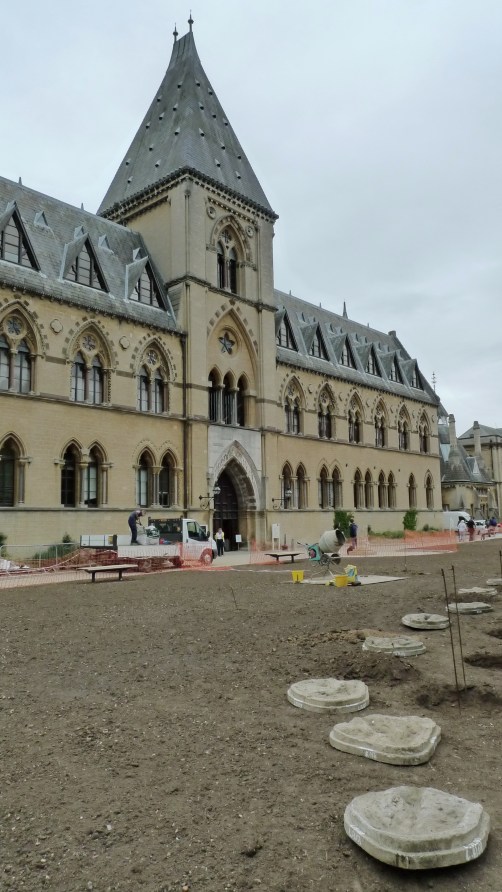
During our closure year, we’ve been having a little landscaping done to our outside space. One of the things I missed while the lawn was being dug up is seeing children hopping, skipping and jumping along the dinosaur footprint casts which cross the grass.

The dinosaur prints provide a lovely introduction to geology, even before you step through the door, so I was delighted to hear that they were included in the new landscaping plan. Even better news was that they were due to be put back in a new formation, which more closely represents the way the dinosaur moved.

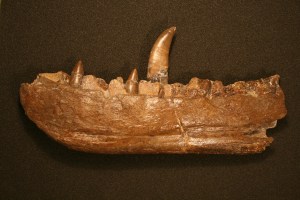
The lower jaw of Megalosaurus Bucklandii
The lower jaw of Megalosaurus bucklandii

The prints are casts taken from a fossilised trackway discovered at Ardley Quarry near Bicester in 1997. It is believed they may have been made by the large three-toed carnivore Megalosaurus bucklandii, which roamed the lagoons of Jurassic Oxfordshire some 166-168 million years ago.

The world-famous lower jaw found by William Buckland in the village of Stonesfield, and pictured here, is one of the treasures of the Museum’s Earth Collections. You can see the Megalosaurus jaw for yourself in our Natural Histories exhibition which is running at the Museum of the History of Science until 29 September.

_DSC4457


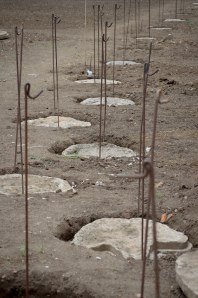
For the past few weeks, Juliet Hay, Preparator and Conservator in the Earth Collections, has been seen diligently measuring and arranging the prints in front of the Museum. Juliet began by plotting out a ‘walking phase’, with a short stride length, and then used research based on an article published in the journal Nature to add in a ‘running phase’. Although the walking and running phases are actually separated at the quarry, GPS data has revealed that they are very likely to have been a continuous trackway, made by the same dinosaur.

Juliet needed to take into consideration the number of casts she had to play with, as well as the lawn’s new sprinkler system, so she emphasises that our trackway is an illustration of the dinosaur’s movements, rather than an exact replica. So now, our lawn footprints show the theropod dinosaur walking at around 4.23mph, breaking into a run reaching 18.14mph, then slowing back down to a walk at the end of its journey.

DMC-LX3 - 0022
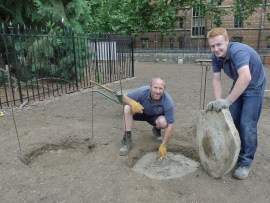
Carl and Richard lower the prints into place. Credit: Mike Peckett

Juliet asked me to thank the University Parks team who helped her to shift the heavy casts into position with good grace. So, thanks go to Walter Sawyer and his intrepid team Carl, Richard, Nolan and Michael. She says “The casts are an important feature as they represent evidence of the first known theropod trackway to show dual speed and an associated change in gait. A pair of Mallard ducks that often visit in the summer seem to enjoy paddling in them too!”

Once our lawn is looking lovely again, do pop along, put your feet in the prints and see if you can keep up with a sprinting, three-toed, meat-eating dinosaur.

Rachel Parle, Education Officer

What’s on the van? – Portuguese Man-of-War

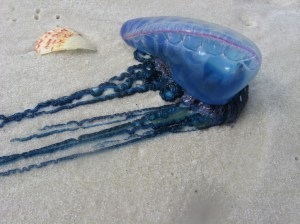
_Physalia-sp-No31

This week’s What’s on the van? comes from Kate Pocklington. Kate was the Museum’s Zoology Conservator, before moving to Singapore to work at the Raffles Museum of Biodiversity Research.

Physalia physalis is commonly known as Portuguese Man-of-War or in Australia, Blue Bottle. Despite often being labelled as jellyfish, physalids are actually siphonophores, which are colonies of many morphologically different individuals attached to each other and working together as a single entity. Physalia captures prey using venomous cells, which shoot out stinging barbs when disturbed.

Physalia washed up on a beach

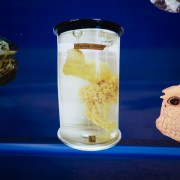
They appear translucent blue when alive, but unfortunately due to death and method of preservation this one has lost its brilliant colour. I value this specimen because of its preparation.

Great care would have been taken to collect and preserve it as, even when dead, physalids remain venomous. The techniques of preservation used here help to display the natural form. This has been done using glass floats attached to the pneumatophore (the individual polyp at the top, a gas filled ‘balloon’) which replicates the natural position of the specimen in the sea. This also helps to show the length of the tentacles.

_DSC4553
Physalia on the van

Without fluid preservation it would be almost impossible to use invertebrates such as this for educational purposes. This method of preservation captures not only the specimen but the development of techniques used over many years incorporating scientific and educational values together. This specimen is just one of approximately 25,000 jars of fluid preserved specimens in the Museum’s collections.

This piece is taken from the Museum’s 2010 exhibition A Few of our Favourite Things.

What's on the van?

Where’s Wallace? There’s Wallace!

Wallace 3

The Museum’s Hope Entomological Collection is pushing five million specimens. We have room after room, with row after row of cabinets packed full of insects from all over the world. Our collection includes the oldest pinned insect in the world, beetles collected by Darwin and Dr Livingstone’s tsetse fly. It’s packed full of treasures. But even now, some of its gems remain hidden.

So, this week’s rediscovery of several hundred priceless specimens is pretty incredible. But what makes it even more remarkable is the fact that they were found by one person… who is 17 years old!

Athena MartinAthena Martin goes to Wood Green School in Witney and is spending four precious weeks of her summer holiday in the Entomology collection. She is taking part in the Nuffield Research Placement programme, which supports young people studying science to gain practical experience in the workplace. Athena applied to the Museum because she would like to study zoology at university and wanted to see what that might involve.

Her enormous task was to search 3,340 drawers like the one she’s holding here on the hunt for specimens collected by the famous Victorian natural historian, Alfred Russel Wallace.

This year marks the centenary of Wallace’s death and is a chance to celebrate his incredible achievements in collecting and research. The Museum has decided to seize this opportunity to catalogue and rediscover the large number of specimens collected by the Wallace. Darren Mann, Head of Life Collections, explained: “We knew we had 1000s of Wallace’s specimens in there, but we needed clarity. Our accession register goes back more than 160 years, but is listed by species, not collector.”

 - Kite swallowtails
Kite swallowtails

So, Athena began searching through the Lepidoptera (moth and butterflies) cases, reading tiny little labels, hoping to read the magic word…Wallace. Some days were completely fruitless, but she soon built up a lengthy list of the precious specimens. In total, in just three weeks, Athena has rediscovered more than 300 of Wallace’s finds. Her favourites are these beautiful kite swallowtail butterflies, but perhaps the most significant is a Dismorphia butterfly found in the Amazon. Almost all of Wallace’s Amazon specimens were lost on his journey home, when his boat is thought to have caught fire. Nobody at the Museum knew we owned this valuable specimen.

On top of the many Wallace beetles that were rediscovered last year, the Museum is now building up a very clear picture of just how many precious Alfred Russel Wallace specimens it has and, thanks to Athena’s diligent work, we now know exactly where to find them!

If you are interested in more stories from our Entomology collection, follow their brilliant blog, Hope you like insects.

Rachel Parle, Education Officer