Viva Volunteers!

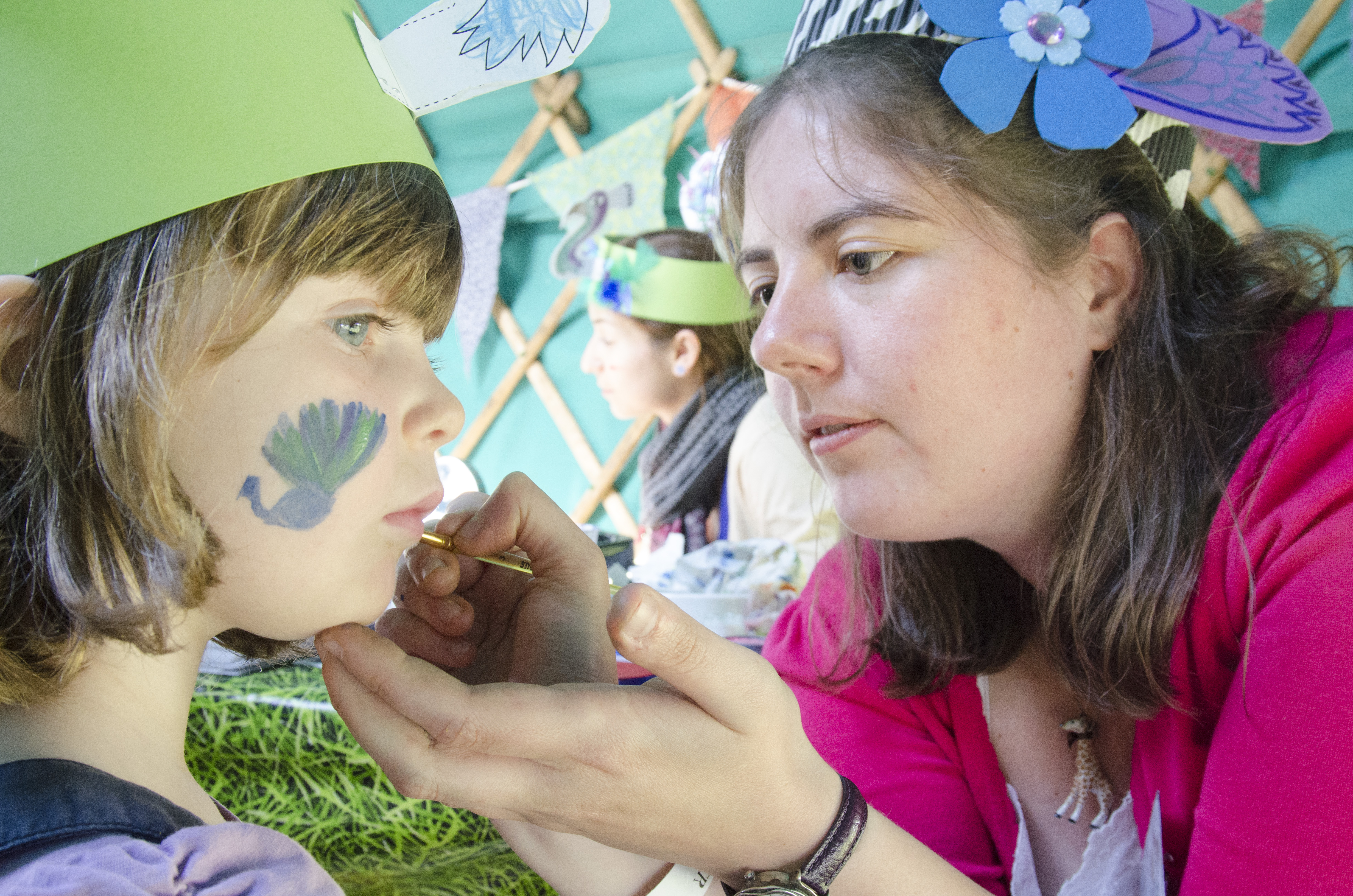
Alice facepaintingThey sort, they scan, they stick, they smile: who are they? Our team of brilliant Collections and Public Engagement Volunteers of course! This week has been the 30th anniversary of Volunteers’ Week, so we wanted to put the spotlight on them…

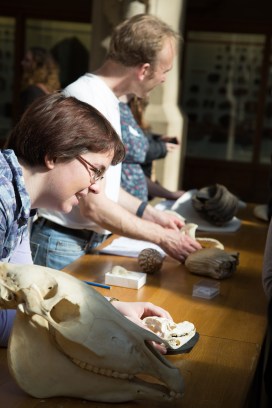
The majority of our volunteers help with public events, particularly those for our family audience. In 2014 alone, our awesome team of volunteers have given the Museum over 1500 hours of their time to help with public engagement events. This includes painting children’s faces, like the wonderful Alice Wilby (above), leading tours of the Museum’s architecture and running a pub quiz at one of our late night events. IMG_1322
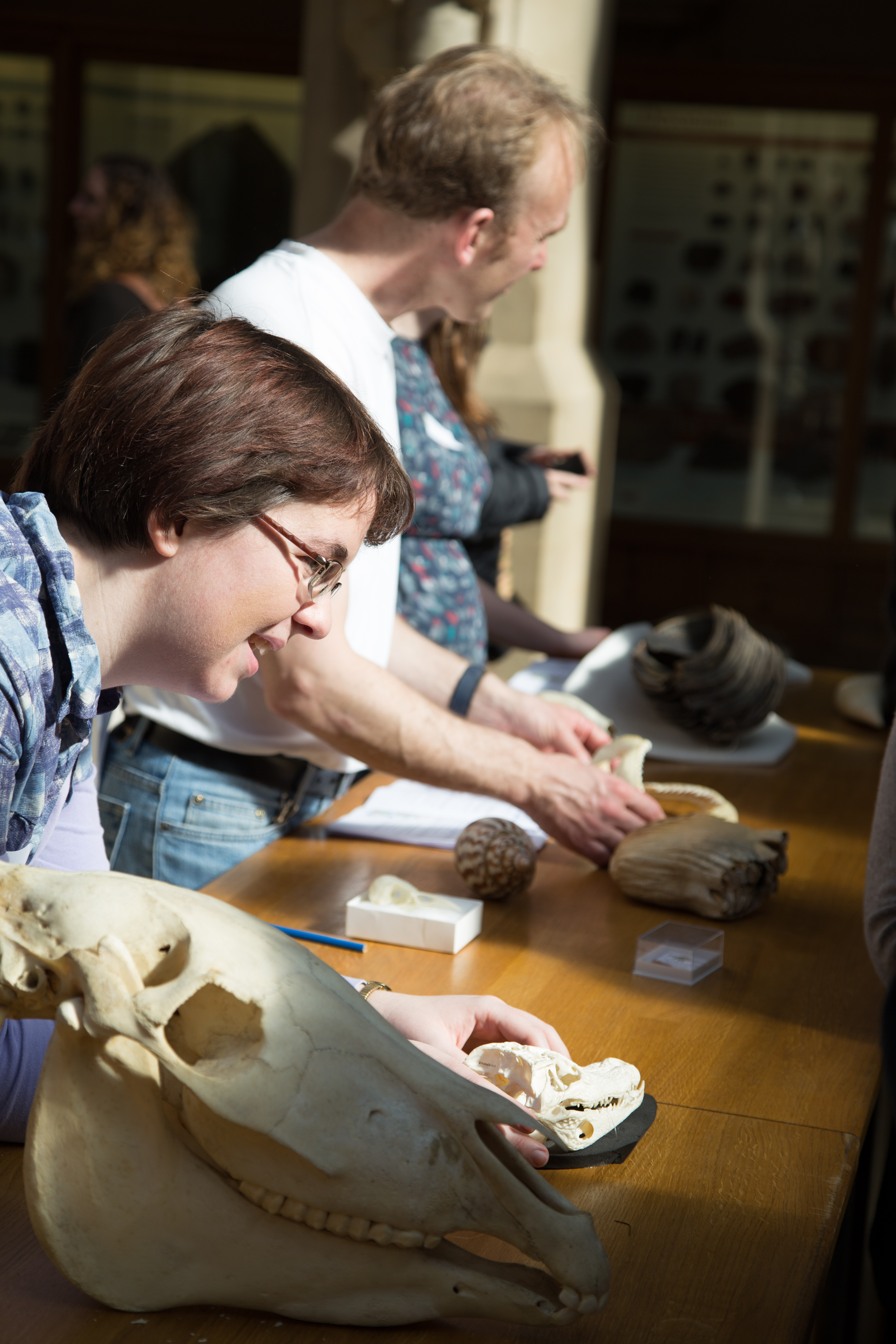
On top of that, we have a team working away behind the scenes supporting our collections staff. Here’s just a sample of the projects they’ve been working on this week…
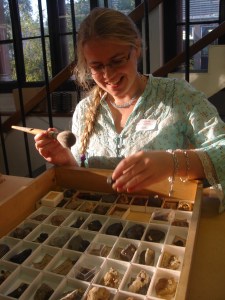
Laura Cotton in the Earth Collections.

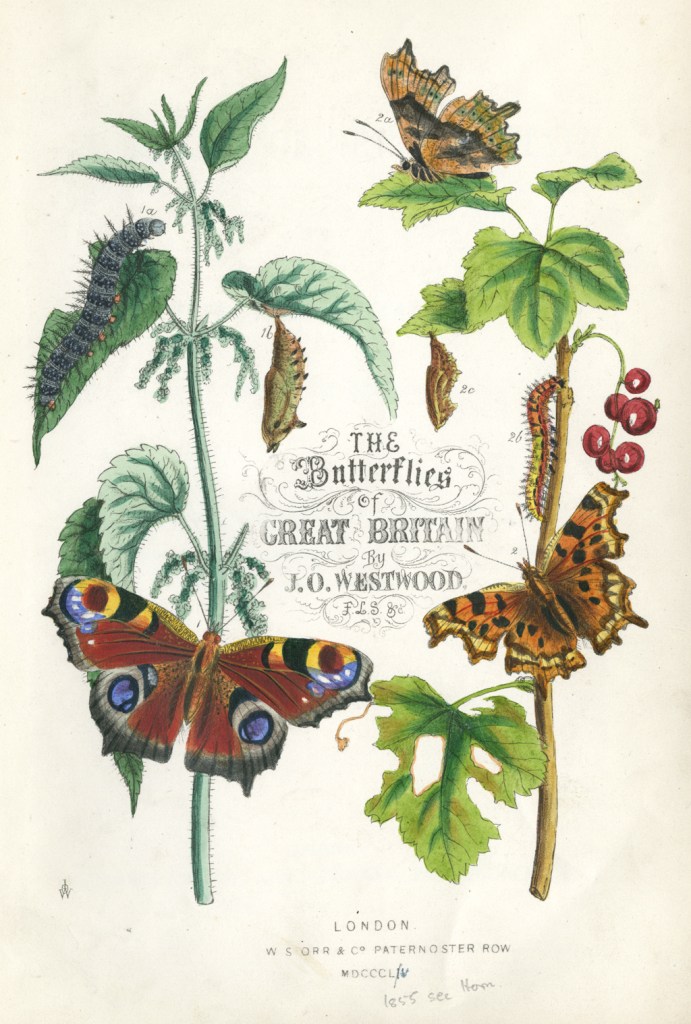
– 5 volunteers identifying butterflies from painted images in our Archival Collections.
– 1 volunteer working in the Life Collections sorting and cataloguing bones.
– 4 volunteers tucked away in the Earth Collections cleaning ancient horse fossils or sorting Jurassic fish teeth.

Simone Dogherty is the Museum’s Education Assistant and co-ordinator of Science Saturdays – a weekly family event aimed at older children and led entirely by volunteer scientists. So why does she think volunteers are so valuable?

We’re very lucky here to have such a large quantity and high quality of volunteers. They help us with a huge range of activities and with the increase in visitor numbers that the Museum has been experiencing since re-opening in February, I just don’t know how we’d cope without them.
For Science Saturdays we use volunteers with a specific expertise. This gives children access to enthusiastic and inspiring individuals that they can look up to. And, in return, the volunteers gain valuable science communication skills.

Fancy joining our merry band of volunteers? Whether you’re into making masks or dusting off molluscs, we need you! You can simply sign up to help out on our Volunteers website.

But what’s in it for you? Aside from the glow of knowing you’ve simply helped us do more, you can develop your confidence when working with the public, learn a new skill or get up close with the treasures stashed away behind the scenes. But that’s forgetting the most important part – you’d be joining a fantastic team of people who, like you, think this museum is a pretty exciting place to be!

Rachel Parle, Interpretation and Education Officer
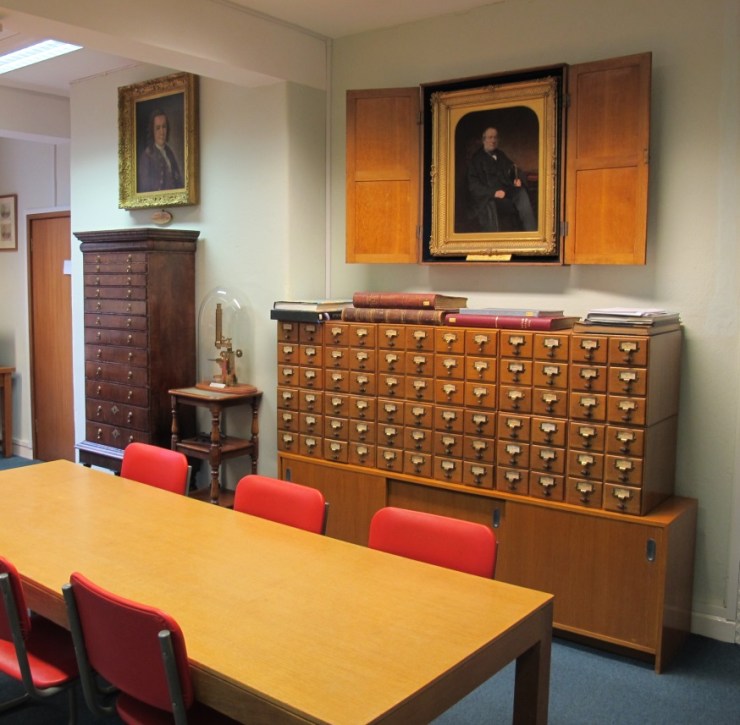
Reading room

Library Reading Room

This past year may have been darkened for our court displays, but we have been working hard to make sure the Library and Archives start to emerge from their dusty shelves and cupboards to see the light of day (figuratively speaking of course: too much light is very bad for books and archives!).

With generous funding from Arts Council England and the Heritage Lottery Fund, there have been two large-scale digitisation projects underway to make two important collections available online: the maps of William Smith, dubbed the ‘Father of English Geology’, and the Flying Icons project to make freely-available scans of the Jones’ Icones, a manuscript of Lepidoptera paintings by William Jones of Chelsea.

Archives
A sneak peak at our new online archive catalogue.

These projects have allowed us to develop an online catalogue for the Archive Collections, making access simpler and more widely available than ever. Watch this space to find out about the catalogue’s launch early in 2014.

There is also work underway to upgrade the facilities in our Reading Room, which you can see in the photograph at the top. We’ll have more computer workstations and more work space for readers.

The Library and Archive are open to anyone with a research interest in our collections, and we’re proud to be one of the few Oxford University Libraries with such an open policy.

We’re planning to improve our services during 2014 too and we’d really like a bit of help from you. We have set up this quick survey and would very much appreciate any info people are able to provide.

To visit our Library and Archive Collections, you can make an appointment at library@oum.ox.ac.uk, or follow us on Twitter @morethanadodo to find out about tours and workshops coming up in the New Year.

Kate Santry, Head of Archival Collections

Natural Histories: On Tour

Order

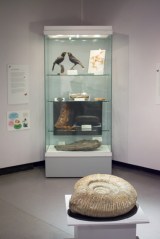
In May this year we opened Natural Histories, our collaborative exhibition with the Museum  of the History of Science on Oxford’s Broad Street, who hosted the displays. As we wrote at the time, it was a great opportunity to put on view some lovely and important specimens while we were closed. It also linked nicely with the long history of the museums in Oxford, beginning as far back as 1683.

Lost and FoundIt was a lot of hard work pulling together all the material, themes, and displays for Natural Histories so we were particularly pleased when Banbury Museum, one of the University museums’ development partners, approached us asking if the exhibition might tour there…

And so it has. It’s a short, one-stop tour admittedly, but with a bit of jiggling and reconfiguration here and there, the whole Natural Histories show is now open to the public in Banbury.

Banbury MuseumSo if you missed it at the Museum of the History of Science, head over to Banbury Museum by 22 February 2014 and have a look.

There’s plenty to see, including the jawbone of the Oxfordshire Megalosaurus, the world’s first scientifically-described dinosaur; creatures collected by Charles Darwin; and a meteorite the age of the Earth itself. With touchable specimens too (of course), Natural Histories explores some big themes and ideas that have shaped our understanding of the natural world.

But as the finished exhibition is now on display for all to see, here instead are a few behind-the-scenes shots of the late night measuring, painting, fixing and adjusting that were needed to get everything ready for opening day last Saturday. Thanks very much to everyone who mucked in and helped out.

_DSC1117
Making a few adjustments…
An almost-closed case
Almost ready for closure
_DSC1126
Finding the spot
Glass cleaner at the ready

_DSC1138

Scott Billings – Communications coordinator

Am feeling quite jolly!

"Many thanks for kind congratulations – am feeling quite jolly!"
“Many thanks for kind congratulations – am feeling quite jolly!”

This lovely example of Alfred Russel Wallace’s beautiful handwriting and cheerful nature was written to chemist and Wallace’s good friend Raphael Meldola. He wrote it on his 90th (and sadly last) birthday. It is particular favourite of Annette Lord, who has scanned and transcribed the Museum’s collection of 300+ Wallace documents.

Fungus weevils (Anthribidae) collected by Wallace

Today marks 100 years since Wallace’s death and provides a good opportunity to reflect on his achievements. We’ve set up a display in the Museum to mark the occasion and show some of the most impressive Wallace specimens in our collection. Wallace travelled to remote, dangerous parts of the world in search of new and fascinating species. He was a meticulous and careful collector; you can’t help but marvel at how the incredibly long antennae of these beetles survived the journey back to Britain!

Wallace is now credited by many as co-author of the theory of evolution through natural selection, so it is very exciting to hear that today Sir David Attenborough is due to unveil a statue to the great man at the Natural History Museum in London.

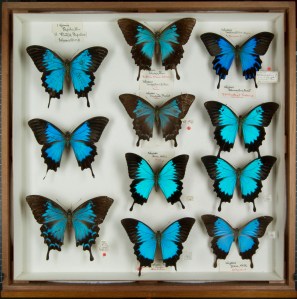
Ulysses Butterflies (Papilio Ulysses)
Ulysses Butterflies (Papilio Ulysses) collected by Alfred Russel Wallace

Wallace is not a household name like his collaborator Charles Darwin, but naturalists and Wallace fans all over the world will appreciate this gesture and the new interest in his work that this will promote.

If you would like to know more about Alfred Russel Wallace, you may like to see this new slideshow that the BBC have released today. It tells the story of his life and works and is narrated by Sir David Attenborough, one of Wallace’s greatest supporters.

Rachel Parle, Education Officer


Wallace in his own words

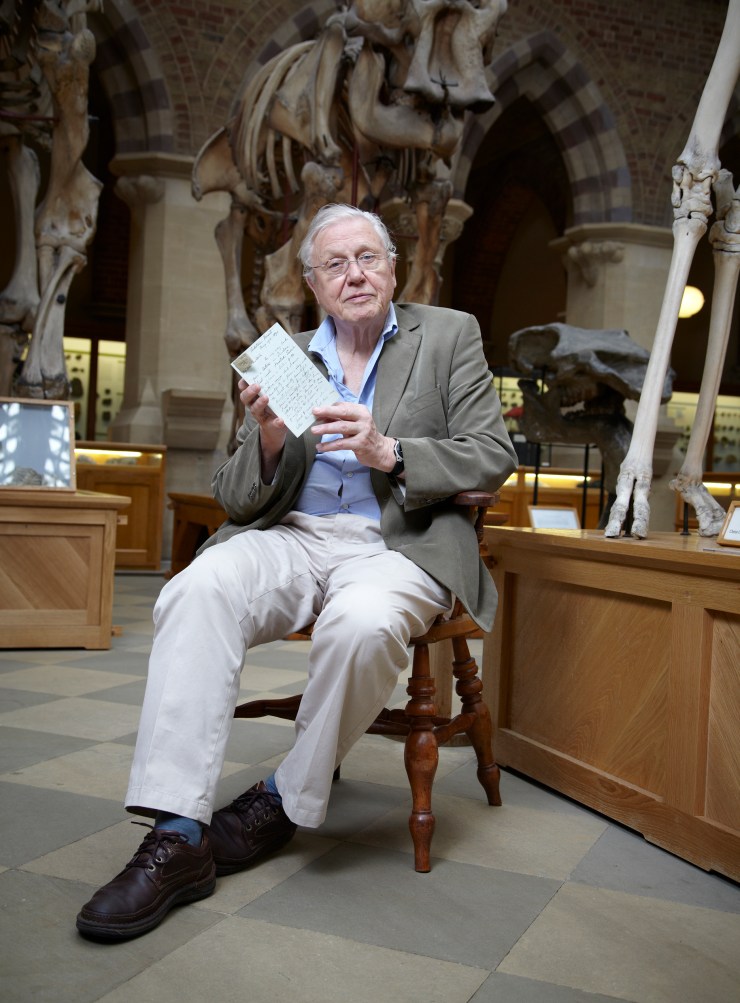
Sir David Attenborough in the Museum with a Wallace letter

Here in the Museum of Natural History’s archives, we proudly house over 300 of Alfred Russel Wallace’s documents. Letters, notes and postcards written by the great naturalist himself. Here you can see Sir David Attenborough holding one of his favourites.

Over the past two years, all of the Wallace paper items in our collection have been scanned, transcribed and uploaded to Wallace Letters Online, a worldwide documentation project that’s part of the Wallace 100 celebrations. But the most remarkable thing is that all this work was done by one woman!

Annette Lord
Annette Lord

Annette Lord has been a volunteer at the Museum for 3 years and has helped with many family friendly activities, but one day she popped up to the Entomology Department to ask about Wallace’s letters. Her curiosity was piqued and she soon set to work on the enormous task of making them accessible to Wallace fans across the world.

The bulk of the letters are from Wallace to Edward Bagnall Poulton, the Hope Professor of Zoology, based at the Museum. Wallace sent Poulton specimens that he collected on his travels and they were good friends, sharing advice and anecdotes. Annette told me about one of the most memorable letters, which revealed Wallace gave Paulton some tips on setting up a display on mimicry in the Museum. In return, Wallace asked for tips on the best microscope to buy for his young daughter Violet… sadly, before he could decide on the final choice, Violet decided she didn’t want a microscope after all!

Wallace signatureAnnette said that she has found the project incredibly satisfying; “It’s given me a real insight into what he was like – I’ve seen his human side and his excellent sense of humour”. She also praised his lovely handwriting, which she’s found relatively easy to read for the transcripts. As part of the project, Annette has given talks in Bournemouth and here in Oxford, where I’m sure her enthusiasm and knowledge help to spread the love of Wallace.
I also spoke to Kate Santry, Head of Archival Collections, who was singing her praises; “Annette’s enthusiasm for the project is un-shakable. Every time you think she must have had enough of reading Wallace’s letters, she’s still right in there in the thick of it. She really has become one of the Museum’s greatest Wallace experts! The material that Annette has recorded gives us an invaluable glimpse into the close relationships between the early natural scientists.”

Tomorrow, to mark the centenary of Wallace’s death, I’ll reveal Annette’s favourite letter of all!

Rachel Parle, Education Officer

Getting about

Westwood

With our Goes to Town exhibits in place all over Oxford city centre, we are keeping our collections hard at work even while the Museum is closed. But it isn’t just our specimen collections that are getting all the action – material from the Archives has journeyed outside the Museum walls too…

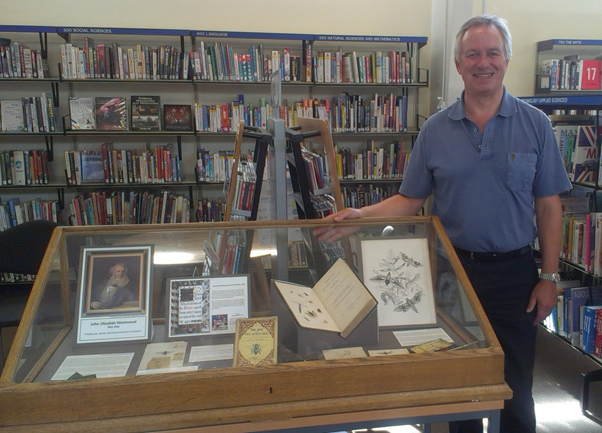
In association with the Friends of Summertown Library, we have put together a display from our archival collections celebrating former Summertown resident and Museum scientist John Obadiah Westwood. Westwood was the first Hope Professor of Zoology at the University in the late 19th century, and in addition to being a leading figure in the development of entomology as an academic discipline, he was also an amazing artist.

Westwood was so well known for his ability to accurately capture the details of insect specimens in his own work that he was commissioned to complete illustrations for a number of important entomological texts of his time.

Chairman of the Friends of Summertown Library, Marcus Ferrar, with the display at Summertown Library

Our archive is full of examples of Westwood’s talents, though most of his drawings have never been on display to the public before. This first-of-a-kind display for our Archive features a number of original copies of his work, including drawings of butterflies, beetles and even medieval manuscripts. It also features lots of interesting facts about Westwood, including his love of gardening and his fascination with biblical texts.

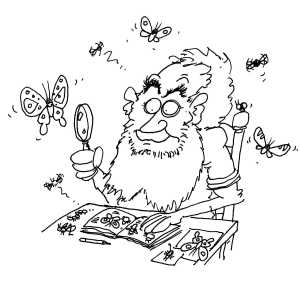
Westwood by Chris JarvisThe exhibit in Summertown Library runs until 18 October 2013 and can been seen during library opening hours. If you’re there with children don’t forget to ask for a Museum of Natural History colouring sheet, featuring this drawing of Westwood in action by our other talented Museum artist and Education Officer, Chris Jarvis.

A big thanks goes to the Friends of Summertown Library for working with us to make this unique opportunity happen. Do let us and the library know what you think.

Kate Santry, Head of Archival Collections