Treasure hunters

dsc_64661

The many nooks, crannies, corridors and cupboards of the Museum are often home to fascinating historical material, long-since filed away for safe keeping and sometimes half-forgotten. Rummaging around in towers and basements is therefore quite an exciting prospect.

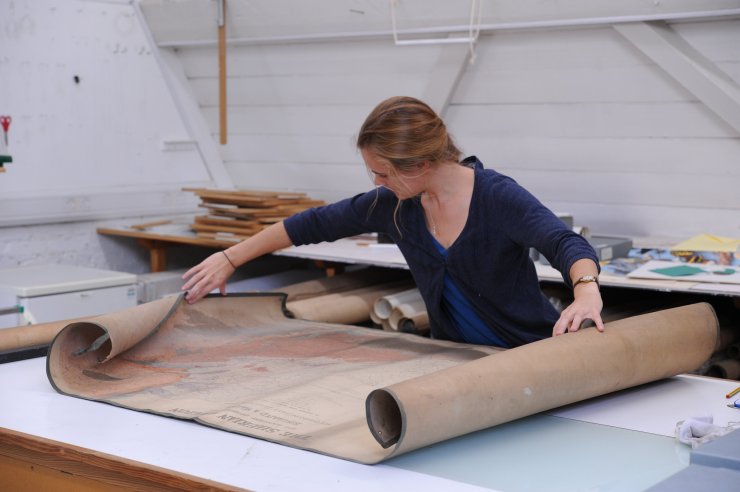
Cecilia Karlsson, one of the twelve interns who joined us recently, had the enviable task of doing just this kind of rummaging, high up on one of the top levels of the building. Here Cecilia tells us a bit more about what she was doing and what she found.

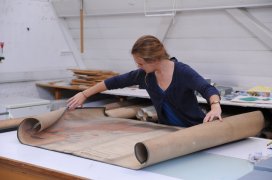
“At the start of my internship I worked in the Library archive with the more well-used material that is already collated and stored by author. But later I got the chance to sort through the archive of maps and charts that is hidden away in the old paper conservation studio.

Excitingly, the first thing we pulled out was a signed map by Roderick Impey Murchison, produced between 1831 and 1838, depicting the Silurian region and adjacent counties of England and Wales – the first geological map produced of that region!

Murchison was a Scottish geologist who in 1831 started studying the greywacke rocks underlying the Old Red Sandstone at the border of England and Wales. He subsequently grouped them into a new order of succession, which he called the Silurian System, a period lying between the older Ordovician and younger Devonian periods, and with its own distinct organic remains and unique rock formations.

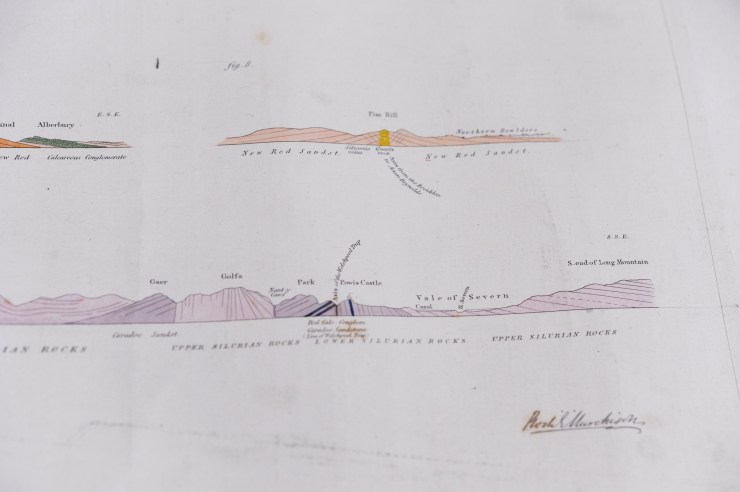
I later found three watercolours of numerous geological sections from the Lower and Upper Silurian, signed by Murchison but owned by William Buckland, Oxford’s first Reader in Geology.
dsc_64631
A watercolour signed by Murchison.

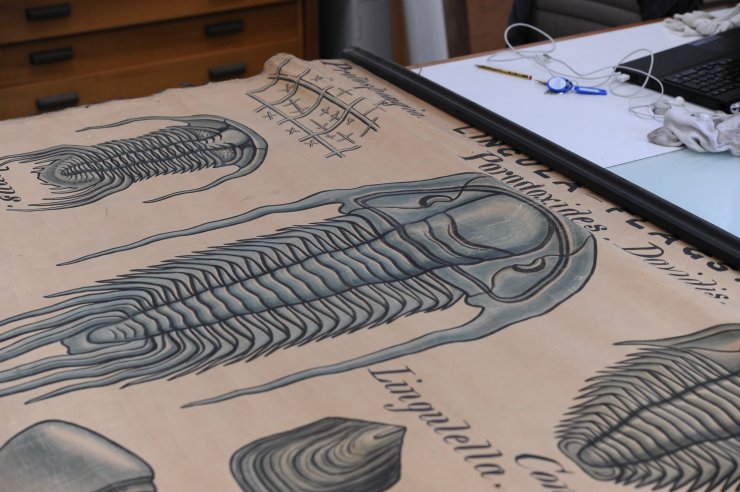
I’ve since encountered a whole array of maps of various parts of the world, from regional maps of the Nile basin in Egypt, to small parishes in the UK, through to maps of continents and the world, all dating between 1836 and 1924. Other finds in the archive have included numerous lecture diagrams depicting mainly fossil shells and trilobites from Silurian and Devonian rock deposits. These are in the style of English geologist John Phillips, who was William Buckland’s successor as Reader of Geology. Phillips may have used the displays as lecture aids during his time at the University, from 1853 to his death in 1874.
dsc_6473
A lecture poster depicting trilobites, in the style of, and possibly used by John Phillips, Reader in Geology at the University of Oxford, 1853-1874.

Most of the maps and charts are in need of some conservation care, including cleaning and storage in conservation-grade boxes. I have also been cataloguing them with descriptions so that they can be uploaded to the new content management system for later searching online. These descriptions include information on the author, date, and dimensions of an item, as well as an outline of its key features, language, location and condition.

However, the majority of the material has no associated authors or dates, so the next stage would be to trace their origins so that this information can be added.”

A job for another treasure hunter perhaps?

Cecilia Karlsson – EPA Cephalosporin Fund intern, 2014
Scott Billings – Public engagement officer
Not Just Dead Bugs

A glimpse from behind the scenes in our Life department to see what the interns are getting up to.

morethananintern's avatarMore Than An Intern

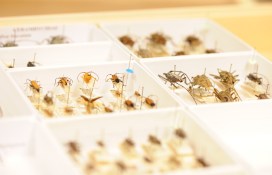
Longhorn4Not many people know that the Oxford University Museum of Natural History doesn’t just consist of the specimens on display – it also houses the Hope Entomological Collection: the second largest entomological collection in the UK. The space contains thousands of incredible pinned specimens as well as some live ones too (Geraldine the stick insect on the right). Entomology is the study of insects, and so the department is responsible for the curation of thousands of invertebrate specimens collected over hundreds of years by biologists such as Darwin and Wallace. We have all sorts in the collection – from beetles and flies (Coleoptera and Diptera) to bees and ants (Hymenoptera).

The collection consists of over five million specimens, which keeps the staff, volunteers and interns well occupied.  Each person working in the department has their own role and

Max6often their own speciality. Not only are the permanent staff experts, but the…
View original post 220 more words

Ento Kids R Us

bee2

As we head towards the end of National Insect Week this year it seems like a very good time to introduce you to one of the hardest-working people in bugworld – Sally-Ann Spence of Minibeast Mayhem. If you’ve ever visited the Museum on one of our bug-handling days you may well have met Sally already, quite probably holding a stick insect.

Through Minibeast Mayhem, Sally does a lot of work to support the budding entomologists of tomorrow, running invertebrate-based educational workshops for schools and public outreach events around Oxfordshire. Sally is also a committee member of the Amateur Entomologists Society’s Bug Club, an entomological club for children.

We asked Sally to tell us a bit more about her work and her desire to encourage bug-loving kids. Here’s what she has to say:

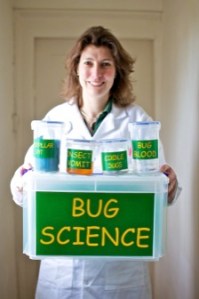
Sally-Ann Spence and her Minibeast Mayhem Bug Science kit

“When I meet a child with a passion for bugs I always suggest to their family that they should join a society such as the AES Bug Club where they can take part in many events and their interest can be nurtured. Sometimes it becomes apparent that a child has more than just a passing interest in bugs; in fact they have a true passion that could extend well beyond childhood. Unfortunately the UK has no BSc in Entomology so the subject is often missed in our schools careers advice. This can leave some children and their families at a loss for how to pursue their interest.

So I decided to set up a voluntary mentoring scheme – the Ento Kids – not only for enthusiastic children but also to support their families. The scheme has been successful, thanks to the incredible support I have received from expert individuals, landowners, universities, entomology-related companies and museums and their staff.

The aim of the Ento Kids is to support children through a CREST Award and a two week work experience placement. We offer advice on GCSE and A level choices and suitable university courses, as well as provide access to sites for research projects (and potential future employers).

Ento Kids hard at work in the Museum

Ento Kids take part in active fieldwork on research experiments to learn practical skills and are introduced to a network of professional entomologists who share their expertise from previous experience.

Theory is also fundamentally important and this is where museums such as the Museum of Natural History in Oxford are vital. Darren Mann, Head of Life Collections, and his team in the Entomology Department encourage the Ento Kids unreservedly. The children are taught about fieldwork in various habitats around the world and about the processes involved for collected specimens. They are taught about active scientific research, the importance of the collections and how to conserve them. Best of all, they learn all of this in a hands-on way with the staff in the Museum itself.

We need our entomologists, both from the past and today, and National Insect Week is a celebration of insects that everyone can take part in.”

Sally-Ann Spence – Minibeast Mayhem

Taxidermy for all

IMG_2137

Taxidermy has enjoyed a bit of a surge in popularity in the last few years, as surveyed by Alexis Turner in his 2013 book Taxidermy. In the Museum, the touchable taxidermy animals are always popular, especially Mandy the much-stroked pony, the removal of which we fear might cause a public outcry.

photoall
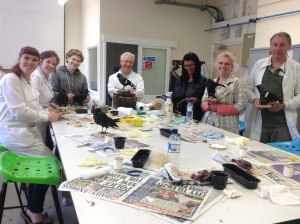
Derek Frampton, centre, leads the workshop

Of course it’s all very well stroking cute, furry taxidermy animals, but have you got the, well, guts to have a go at it yourself? We suspected that plenty of people not only have the guts but also the desire so we set up a workshop with professional taxidermist Derek Frampton, whose work is regularly on display in the Museum. It’s the first time we have offered a taxidermy workshop, but despite the £175 cost for the specimen, materials and tuition, the day was easily oversubscribed.

And what a great session it was. Five excited and enthusiastic members of the public (and one equally excited education officer) were given expert tuition in a step by step guide to create their very own taxidermy jackdaw.

Taxidermy
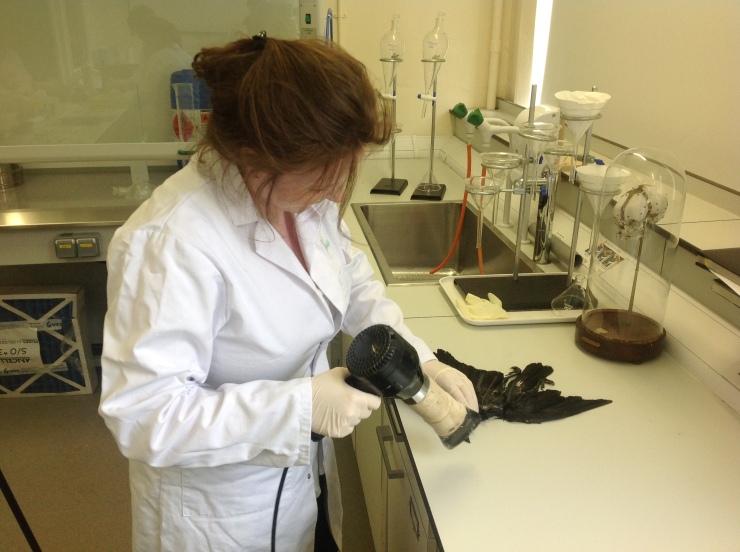
Blow dry in the lab

It wasn’t for the squeamish either because the birds were not pre-skinned, so there was some down and dirty hands-on work to be done before the pretty stuff could begin. The whole process took from 10am until 6.30pm with barely a break. Nonetheless, one participant said that the time flew by (no pun intended, we assume) and another said:

I don’t believe it, I thought we were just going to get a pre-prepared skin, not do the whole thing in a day! That was excellent!

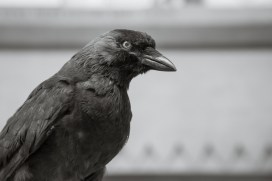
The bird you can see at the top of the post is the creation of the over-excited education officer, Chris Jarvis. He’s named it Scratch because it was made entirely from – yep – scratch. Being a remarkably clever corvid, he (she?) now perches loftily above the rest of the Education team, squawking edicts from time to time.

Given the success of the workshop we may well run another in the future, so keep your eye on our quarterly programme for that. And if you’d like to join our mailing list, email communications@oum.ox.ac.uk and I’ll add your address.

Scott Billings – Communications officer


Lost & Found

Lost & Found

One of the tasks of a University museum – and indeed all museums – is to communicate often complex and detailed academic knowledge to a non-specialist audience. There are lots of creative ways for us to go about this, from capturing children’s interest in nature and natural history through well-structured schools and family sessions, to the careful interpretation of specimens and subjects in exhibition displays. Another route is to collaborate with artists who can respond to and present the collections in a different manner.

We’ve been running a collaboration like this in our Life Collections since 2011, working with local artist Jane King. Jane has more recently teamed up with another Oxford-based artist, Neil Mabbs, and together they have formed Pale Blue Dot, a not-for-profit arts-science partnership that aims to raise public awareness about environmental and social concerns through exhibitions, publications and events.

IMG_1599
Jane picks out a great yellow bumblebee (Bombus distinguendus)

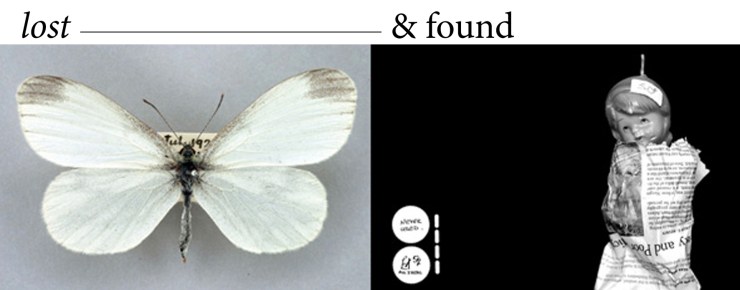
The first of these events is a multimedia installation called Lost & Found, running at the North Wall Arts Centre in Oxford from 28 May – 13 June. For this project Jane and Neil have worked with head of Life Collections Darren Mann and Amoret Spooner in the Museum, along with Professor Dave Goulson at the University of Sussex.

The Lost & Found exhibition asks whether consumerism is causing the extinction of millions of the planet’s species and the ecosystem services they provide. It uses a variety of material, including mixed media prints, photography, film and projection, 3D display, live planting, textiles, and artists’ books.

Artwork is supported by ‘Evidence Tables’ containing specimens from the Museum’s collections, as well as the results of the latest scientific research in the area. It is part of an effort by Pale Blue Dot to communicate complex scientific messages to a wider public audience.

Amoret explains the idea behind the project:

It focuses on the pollinators and decomposers that provide humans with some of the most tangible benefits in terms of ecosystem services.

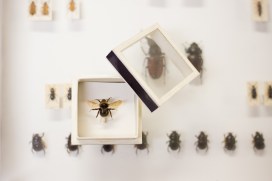
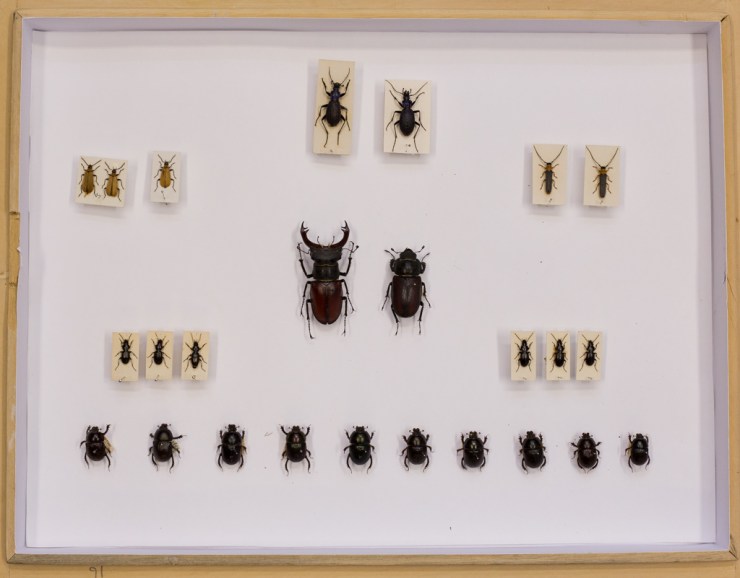
The pollinators are a group of almost 500 species of UK bees, hoverflies, butterflies and moths. Specimens from the collection are being displayed in cases to represent many of the species, as well as being utilised as source material for the artwork.

Pale Blue Dot’s Lost & Found aims to raise awareness of some of the research carried out by scientists here at the Museum that visitors wouldn’t normally hear about.

Jane and Amoret researching bee specimens

Darren’s photographs of dung beetles and his research papers on the role of dung beetles in the environment are featured. Dung beetles’ daily task of dung recycling helps increase crop yields by speeding up the release of nutrients into the soil, as well as reducing the spread of farm animal parasites and infections caused by biting insects. One of the pieces made by Jane is an artist’s book – Beetle Book – which highlights this vital ecosystem service that beetles provide to humans.

Many of our beetle, bee, moth and butterfly specimens will be on display in the Lost & Found exhibition at the North Wall, so head over there from 28 May to check it all out.

IMG_1615

Baleen at the Ball

nicolacrompton's avatarOnce in a Whale

The whales suspended for all to see The whale aisle once more open to the public

It is with much happiness (and a lot of satisfaction) we can announce that the ‘Once in a Whale’ project has been shortlisted for a Museums and Heritage Award for Excellence 2014, in the ‘Restoration or Conservation’ category. The glitzy ceremony is to be held at 8 Northumberland Avenue in London on May 14th 2014. We will be competing with some other amazing projects, including the Staffordshire Hoard Conservation Outreach Programme and the Mary Rose Trust. We are extremely grateful for the opportunity and feel that even to be shortlisted is a huge accomplishment for our little project. With thanks to the Museums and Heritage show, details of which can be found here: http://www.museumsandheritage.com/

Project Conservators: Nicola Crompton, Gemma Aboe and Bethany Palumbo Project Conservators: Nicola Crompton, Gemma Aboe and Bethany Palumbo

We’d also like to thank the Arts Council England for the Preservation of Industrial and Scientific Material…

View original post 27 more words