Bound by blood

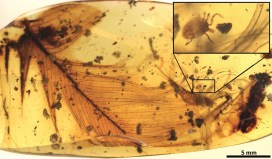
It may sound like we’ve stumbled into a script-writing session for Jurassic Park, but one of our research fellows, Dr Ricardo Pérez-de la Fuente, along with an international team, has discovered a parasite trapped in amber, clutching the feather of a dinosaur. This small fossilised tick, along with a few other specimens, is the first direct evidence that ticks sucked the blood of feathered dinosaurs 100 million years ago. Ricardo tells us all about it…

The paper that my colleagues and I have just published provides evidence that ticks fed from feathered dinosaurs about 100 million years ago, during the mid-Cretaceous period. It is based on evidence from amber fossils, including that of a hard tick grasping a dinosaur feather preserved in 99 million-year-old Burmese amber.
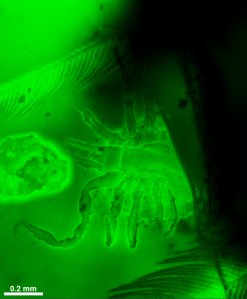
Fluorescence detail of the studied hard tick grasping a dinosaur feather. Extracted from the publication.

The probability of the tick and feather becoming so tightly associated and co-preserved in resin by chance is virtually zero, which means the discovery is the first direct evidence of a parasite-host relationship between ticks and feathered dinosaurs.

Fossils of parasitic, blood-feeding creatures directly associated with remains of their host are exceedingly scarce, and this new specimen is the oldest known to date. The tick is an immature specimen of Cornupalpatum burmanicum; look closely under the microscope and you can see tiny teeth in the mouthparts that are used to create a hole and fix to the host’s skin to suck its blood.

The structure of the feather inside the amber is similar to modern-day bird feathers, but it could not belong to a modern bird because, according to current evidence at least, they did not appear until 26 million years later than the age of the amber.

Feathers with the same characteristics were already present in multiple forms of theropod dinosaurs –  the lineage of dinosaurs leading to modern birds – from ground-runners without flying ability, to bird-like forms capable of powered flight. Unfortunately, this means it is not possible to determine exactly which kind of feathered dinosaur the amber feather belonged to.

But there is more evidence of the dinosaur-tick relationship in the scientific paper. We also describe a new group of extinct ticks, created from a species we have named Deinocroton draculi, or “Dracula’s terrible tick”. These novel ticks, in the family Deinocrotonidae, are distinguished from other ticks by the structure of their body surface, palps and legs, and the position of their head, among other characteristics.

Blood-engorged Deinocroton draculi tick (female). Extracted from the publication.

This new species was also found sealed inside Burmese amber, with one specimen remarkably engorged with blood, increasing its volume approximately eight times over non-engorged forms. Despite this, it has not been possible to directly determine its host animal:

Assessing the composition of the blood meal inside the bloated tick is not feasible because, unfortunately, the tick did not become fully immersed in resin and so its contents were altered by mineral deposition.
Dr Xavier Delclòs, an author of the study from the University of Barcelona and IRBio.

But there was indirect evidence of the likely host for these novel ticks in the form of hair-like structures called setae from the larvae of skin beetles, or dermestids, found attached to two Deinocroton ticks preserved together. Today, skin beetles feed in nests, consuming feathers, skin and hair from the nest’s occupants. But as no mammal hairs have yet been found in Cretaceous amber, the presence of skin beetle setae on the two Deinocroton draculi ticks suggests that their host was in fact a feathered dinosaur.

The hair-like structures, or setae, from skin beetles (dermestids) found attached to two Deinocroton ticks fossilised inside amber, in comparison with extant ones. Modified from the publication.

Together, these findings tell us a fascinating story about ancient tick behaviour. They reveal some of the ecological interactions taking place among early ticks and birds, showing that their parasite-host relationship has lasted for at least 99 million years: an enduring connection, bound by blood.

The paper “Ticks parasitised feathered dinosaurs as revealed by Cretaceous amber assemblages” is published as open access in Nature Communications. Direct link: http://dx.doi.org/10.1038/s41467-017-01550-z

Seasonal sights

The Museum’s collections are on the move. For decades, a deconsecrated church has been used to house material from our Earth collections, but we now have a new and improved off-site space, and between now and the end of 2018 a huge project is underway to sort and shift these objects. You can find out more about all this in our Stories from the Stores article. 

Chantelle Dollimore, Move Project Assistant, recently emigrated from Australia and has been experiencing her first British autumn. Here she shares a glimpse of the natural encounters the collections move has offered so far.

**

As the project team for the collections move settles into the daily hustle and bustle of work there are extraordinary things happening outside. Winter is coming; we have already wound our clocks back for that extra hour of sleep. Leading up to that time, creatures great and small have been preparing themselves for seasonal changes.

Autumn leaves litter the footpath to the store

Something truly blissful in an English autumn is the deciduous trees shedding their leaves as the days grow shorter and chillier. The crunching underfoot of hues of browns, reds, yellows and oranges adds charm as we make the rounds of our 19th-century church workspace.

A Red Kite soars above the Museum’s offsite collections store

Driving from the Museum to the off-site store, we’re likely to see at least one Red Kite. Less than 30 years ago Red Kites were nearly extinct, but through conservation efforts they have flourished in the Oxfordshire countryside. Their distinct calls and unique silhouette, with long narrow wings and forked tail, are a haunting yet beautiful addition to the skyline.

A Red Kite (Milvus milvus) on display in the Museum

The move project team have also been visited by a different ‘bird’ altogether; the ladybird! At this time of year, when you find one you will most likely see many more close by. When a ladybird finds the perfect place to hibernate for spring it excretes a pheromone to attract more to the area. For some, the perfect place seems to be inside the church itself!

(Lady)birds of a feather flock together

Grey Squirrels and deer are also making appearances throughout the day while we’re working. One cannot help but watch as the bushy tail of the squirrel peeks through the hedges as it forages for food and admire the deer as they stroll through the fields happily unaware of our activities some 50 metres away.

Although it’s great to admire the specimens on display in the Museum, I love that my job allows me to get out and about to appreciate the wildlife of the Oxfordshire countryside. There’s always something unexpected… like a butterfly choosing its resting place on some disassembled storage shelves.

A butterfly (Nymphalidae sp.) in torpor finds shelter from the impending cold

To keep up with all the move project action, follow the museum hashtag #storiesfromthestore on Twitter @morethanadodo.

Is it real? – models, casts and replicas

One of the most common questions asked about our specimens, from visitors of all ages, is ‘Is it real?’. This seemingly simple question is actually many questions in one and hides a complexity of answers. 

In this FAQ mini-series we’ll unpack the ‘Is it real?’ conundrum by looking at different types of natural history specimens in turn. We’ll ask ‘Is it a real animal?’, ‘Is it real biological remains?’, ‘Is it a model?’ and many more reality-check questions. Here’s your final installment…

There’s nothing like standing under a huge T.rex skeleton, staring up at its ferocious jaws, to get the blood pumping. Visitors often ask “Is it real?” and look rather deflated when they find out it’s a cast. So why do we include casts, models or replicas in our displays, if they don’t have the same impact as the real deal? The truth is that they’re valuable additions to museum displays, allowing the public to engage with specimens that would otherwise be hidden behind the scenes.

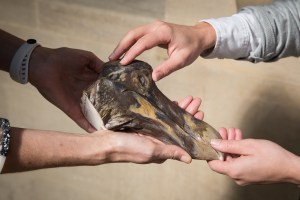
Please touch! A cast of the famous Oxford Dodo helps visitors explore this fragile specimen.

On any visit to the Museum, you’ll come across labels that tell you the object you’re looking at is a cast. It could be a dinosaur skeleton, a brightly coloured fish, an amphibian specimen or even the head of the Oxford Dodo. But what is a cast? Casts are made by taking a mould of bones, or sometimes whole animals, then filling that mould with resin, plaster or fibre glass to make a copy. They can be incredibly accurate or lifelike.

It’s extremely rare to find whole dinosaur skeletons, and very difficult to mount heavy fossils (weighing tonnes) onto large armatures. Our Tyrannosaurus rex is a cast of the famous Stan, found in South Dakota, USA, and one of the best preserved skeletons of its kind in the world. But the “real” Stan is kept at the Black Hills Institute of Geological Research, so the only way we can offer the breath-taking experience of standing beneath a T. rex here in Oxford is by using a cast.

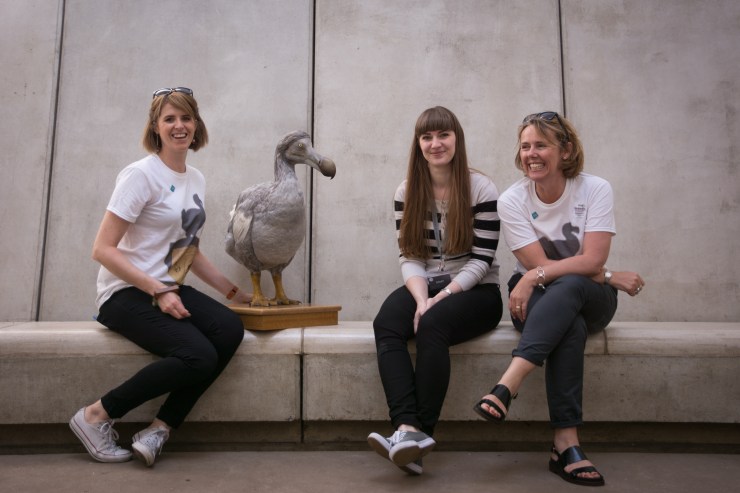
The Dodo Roadshow in 2015 would have been a lot less fun without our life-size dodo model

Even Stan has some bones missing, so sometimes casts are made up of several individual skeletons. Copies can also be made to give the impression of a more complete skeleton. For example, if a left bone is missing, a mirror of the right hand bone can be created. We call these specimens “composites”.

Animals such as fish and frogs aren’t easy to taxidermy; their skins shrivel, dry out, lose their colour and crack. Painted casts are a good way to show what these animals look like.

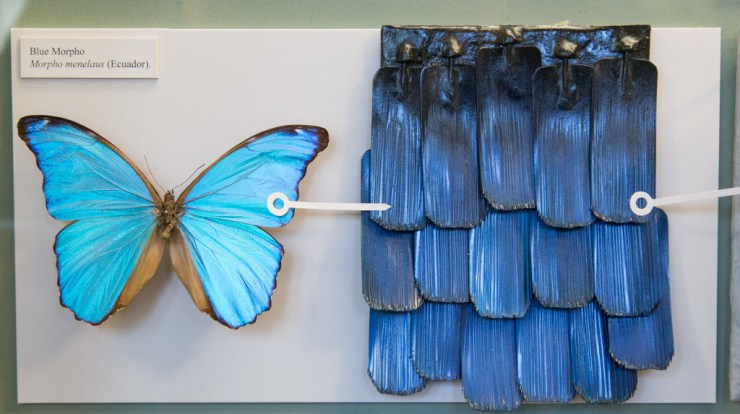
A model allows us to show the intricate scales of this Blue Morpho butterfly up close.

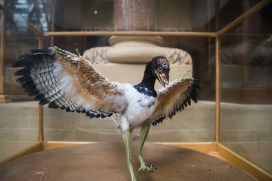
Models, such as the giant insects on the upper gallery and the Archaeopteryx in the Evolution of Flight display (at the top of this post), are very clearly not real. These are made by model makers to show something that can’t be seen or shown with real specimens. The giant insects are a way of showing the detail of very small creatures. The palaeontological models show what we think extinct animals might have looked like in life. They’re hypothetical models based on the latest scientific research, which can change very quickly, and always have an element of artistic assumption or speculation in the details.

In this series we’ve talked about taxidermy, skeletons, fossils and more, but these are just a few of the kinds of specimens we have on display. There are also nests, plastinated models, microscope slides and dioramas, which all have a mix of real and non-real elements. When you are looking around the Museum try to think about which specimens are real and which aren’t… and how does that make you think about the specimen?

Read the other posts in the Is it real? series here.

The ancient mariner

Helen J. Bullard is a PhD candidate at the University of Wisconsin–Madison whose research aims to tell the historical and cultural stories of the horseshoe crab. After visiting the museum, and reading the story of our Natural History After-School Club member’s horseshoe crab fossil find, Helen offered to write a guest post for the blog about these amazing, ancient mariners…

You’re reading this, so I’m guessing you like museums. But have you ever heard of living fossils? Animals such as sharks and crocodiles are often referred to as ‘living fossils’ because they appear pretty unchanged from their ancient fossilized relatives. Of course, by definition, you can’t be both alive and a fossil. But fossils allow us to become primary eyewitnesses to ancient life; we can literally see what life used to look like, how cool is that? They can also dole out some pretty valuable advice, if we just choose to listen.

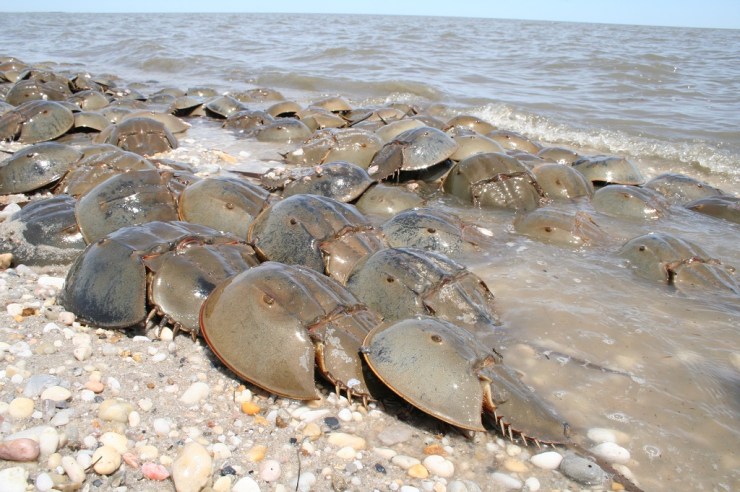
This summer during a visit to England, I spent some time at the Museum studying another so-called living fossil, the horseshoe ‘crab’. The horseshoe crab is not actually a crab, but is instead more closely related to spiders, scorpions and ticks. In fact, they are the closest living relatives of the extinct trilobites. But unlike their famous trilobite cousins, horseshoe crabs have survived all five of Earth’s major mass extinction events. Today, as a direct result of their ability to survive, the four remaining species of horseshoe crab play a vital role in global medical safety.

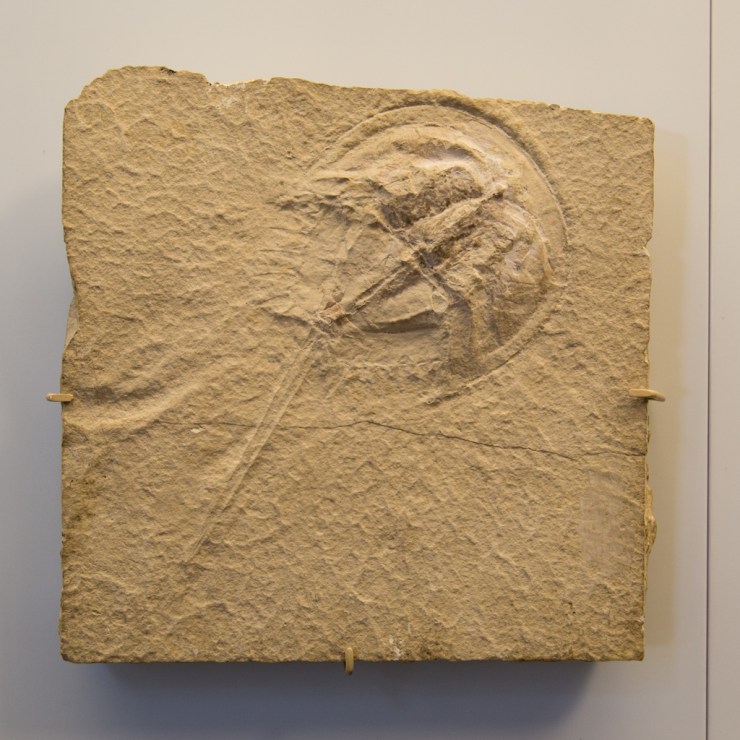
The Museum’s fossil specimen of Mesolimulus walchi, from the Upper Jurassic (163-145 million years ago), Solnhofen Germany, shows how little the form of the horseshoe crab has changed since

Not only do living horseshoe crabs look very similar to their early relations, they are also able to survive surprisingly severe injuries that often leave them missing body parts. Being able to see, through fossil evidence, how little their form has changed over time has helped to uncover the answer to this secret superpower. It lies in a very special life-saving trick that the crabs have kept for millions of years: a coagulating blood protein.

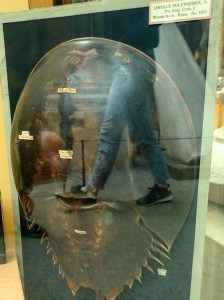
Horseshoe crabs on display in the Museum may provide food for thought for visitors

The blood of the horseshoe crab is able to clot quickly if bacteria are introduced, preventing infection, and saving the crab’s life. Since this discovery in the 1970s, this life-saving protein has been extracted from horseshoe crab blood and used in human medicine to test the safety of vaccines, medical laboratories, intravenous drugs, implants, and much, much more. The chances are that you owe a great deal of gratitude to the horseshoe crab.

But after all that surviving, horseshoe crabs, like many species, are now struggling for survival. They are losing their spawning grounds because of coastal development, industry, housing, marinas and coastal defense structures; they are collected and killed by the millions for bait, and bloodlet in their hundreds of thousands for medical use every year. It is likely that horseshoe crabs will not survive much longer.

But don’t despair. Museums are critical because they hold collections that can unlock knowledge about environmental change, and we can use that knowledge to protect life. Of course, horseshoe crabs are not alone in telling their stories through the fossils they leave – natural history museums are full of stories in stone, bones, pollen, and other traces. If you want to learn about and protect biodiversity, visit your local museum, or support organisations like Oxford’s Environmental Change Institute.

And to help the ancient horseshoe crab itself, join in with the efforts of the Ecological Research and Development Group – the crabs have saved us, so let’s return the favour.


Stories from the Stores

by Hannah Allum, Move Project Manager

Museums are space-hungry places. There’s rarely enough room to properly house the collections we currently hold, never mind finding space for new material. Roughly 90% of museum collections are not on public display, so many museums use storage beyond their main building, in offsite stores.

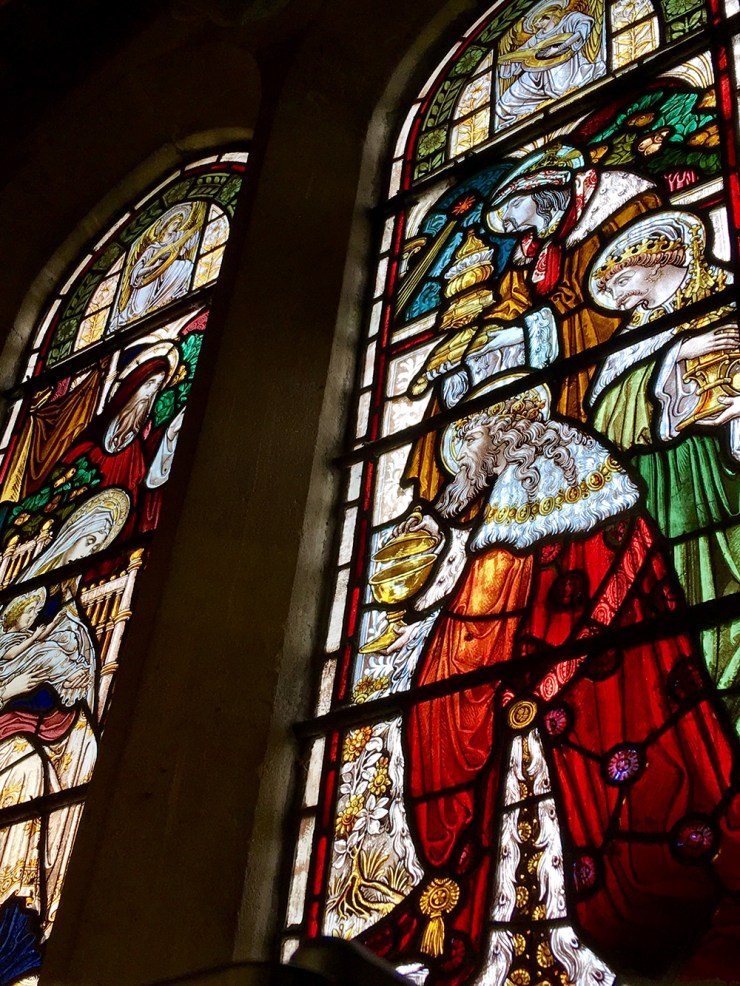
The Museum of Natural History has faced the same challenges and, for the past few decades, has found a solution in a somewhat surprising building. Where might you least expect to find a vast collection of rocks and fossils dating back millions of years? How about a nineteenth century church, complete with beautiful stained glass windows?!

Stained glass windows in the former church

As atmospheric as it is, this deconsecrated church is no place for good quality museum storage. To do the collections justice they need a monitored and controlled environment, suitable containers and pest prevention measures. Plus, it’s always a bonus to be able to access specimens without playing a very nerve-wracking game of Jenga or Tetris!

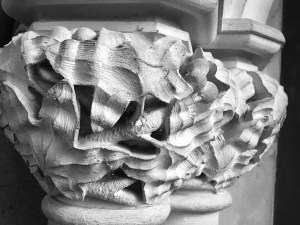
Carving detail in the former church

So, once again we are faced with the most terrifying and exciting of museum tasks; a collections move project! In 2016 we successfully relocated approximately 17,000 specimens from some of our old offsite stores and showed you some behind the scenes secrets along the way with the hashtag #storiesfromthestores. This time we have a team of eager beavers (also known as project assistants) who can’t wait to share glimpses of the project as we go, so make sure to keep an eye on @morethanadodo on Twitter.

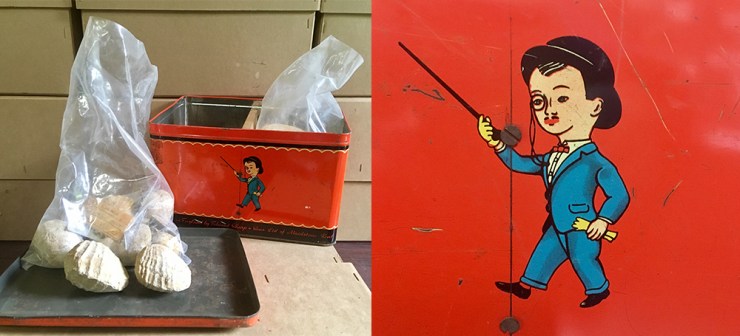
An oats box made an unusual storage solution for Earth materials

After a much needed clean of the church, we’re starting to prepare the material to be moved. Alongside the specimens, we’re already coming across some interesting historical packaging. It seems that the mass consumption of Oxo cubes was a pre-requisite for collectors of old, as many specimens are stored in these retro tins. A few other repurposed boxes include; Quaker oats, Sharp’s toffee, Fry’s chocolates, marmalade, mustard oil and even wine crates. Quite the picnic!

A toffee tin for storing fossils – just one of the interesting choices for collections tins over the years.

Once removed from the church, the project team will be working on processing these collections in a dedicated space, as well as giving them some TLC and new homes (boxes). This will take place at a specialist heritage storage site until the end of 2018. Keep your eyes peeled for more on the treasures from this trove.

Drawing amongst the dinosaurs

For the past few years the Museum has been working with second year students on the BA (Hons) Illustration course at the University of Plymouth. As part of a module on interpreting information, students are given information on research that is going on in the Museum or related departments and asked to interpret this information visually. This year one of the students, Sally Mullaney, took on the project ‘Key to the Past: exploring the life and work of Charles Lyell’. Sally continued her work with the museum on a week’s placement during the summer, and was supervised by Eliza Howlett, Earth Collections Manager.

Sally Mullaney talks about how she interpreted the project and her experience here at the Museum.

Charles Lyell Map FINAL small
Illustrated map of Lyell’s European travels on which we can mark the fossil localities by Sally Mullaney

“For the past two months on my illustration course at Plymouth University, I’ve been working with the Museum of Natural History on an illustrated timeline of geologist Charles Lyell. At first I was pretty daunted at the amount of travelling and ‘geologising’ he did in his life throughout the Victorian era. But after I spent time reading his letters and journals, I really got a feel for what Lyell was like. His musings and good humour shine through in his many letters to various siblings, professors and his wife, Mary. This really made the Charles Lyell project a pleasure for me to do, and I was thrilled when the museum asked me back to work for a week’s placement continuing with Lyell.”

LBEC003 small
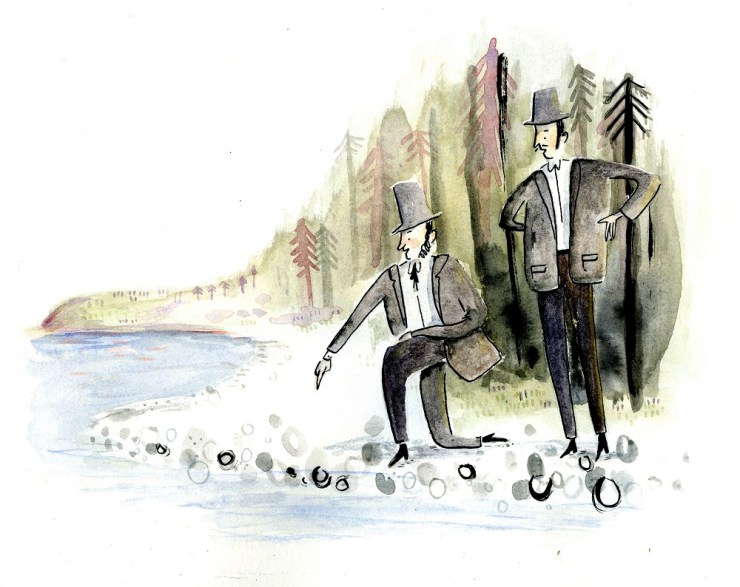
Charles Lyell and Captain Cooke spend a night in a shepherd’s hut in the Pyrénées, 1830 by Sally Mullaney

After a weekend of sightseeing Oxford’s many attractions (the museum being one of them!), Jade, a fellow student from Plymouth, and myself reported to the front desk to begin our week.  We were welcomed warmly with a cup of tea overlooking the main court of the museum, and were briefed about the week to come. I was also given the opportunity to work with the Public Engagement team to create a new logo for the Family Friendly Sunday events, as well as the continued work on Lyell which would be a map illustrating his travels and collections.

MuseumLogo BW small
New logo for family friendly activities by Sally Mullaney


The week really flew by and I managed to complete the projects with a little time to spare, which I spent sketching in the court amongst the dinosaurs! The building is such an incredible place to work in, and it has been a pleasure to be working in such a fantastic museum – I’ll definitely be visiting again!”

sketchbook 1 small
Pianist and the T. rex, 30 July 2017 by Sally Mullaney

Sally’s characterful and charming illustrations of Charles Lyell’s bring his geological travels across Europe to life. Charles Lyell (1797-1875) was a student of William Buckland at Oxford, and went on to become the foremost geologist of his day. The Museum is lucky to house a large proportion of the Charles Lyell Collection, comprising of over 16,000 documented fossil specimens. A number of the specimens in the collection would have been collected in Europe during his travels. LBEC004 small

Lyell was a close and influential friend of Charles Darwin. Lyell’s important Principles of Geology was one of the few geological books that Darwin took with him on his voyage with HMS Beagle, and it helped shape his hypothesis for the mechanism of coral atoll formation amongst other things.

Last year the Museum undertook the large task of starting to make Lyell’s collection publicly accessible by cataloging and taking high resolution images of the specimens. The collection will be available online via a user-friendly database in the foreseeable future – watch this space!

You can learn all about the project, the collection and the man himself via this dedicated blog.