Taxidermy for all

IMG_2137

Taxidermy has enjoyed a bit of a surge in popularity in the last few years, as surveyed by Alexis Turner in his 2013 book Taxidermy. In the Museum, the touchable taxidermy animals are always popular, especially Mandy the much-stroked pony, the removal of which we fear might cause a public outcry.
photoall
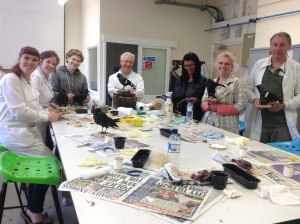
Derek Frampton, centre, leads the workshop

Of course it’s all very well stroking cute, furry taxidermy animals, but have you got the, well, guts to have a go at it yourself? We suspected that plenty of people not only have the guts but also the desire so we set up a workshop with professional taxidermist Derek Frampton, whose work is regularly on display in the Museum. It’s the first time we have offered a taxidermy workshop, but despite the £175 cost for the specimen, materials and tuition, the day was easily oversubscribed.

And what a great session it was. Five excited and enthusiastic members of the public (and one equally excited education officer) were given expert tuition in a step by step guide to create their very own taxidermy jackdaw.
Taxidermy
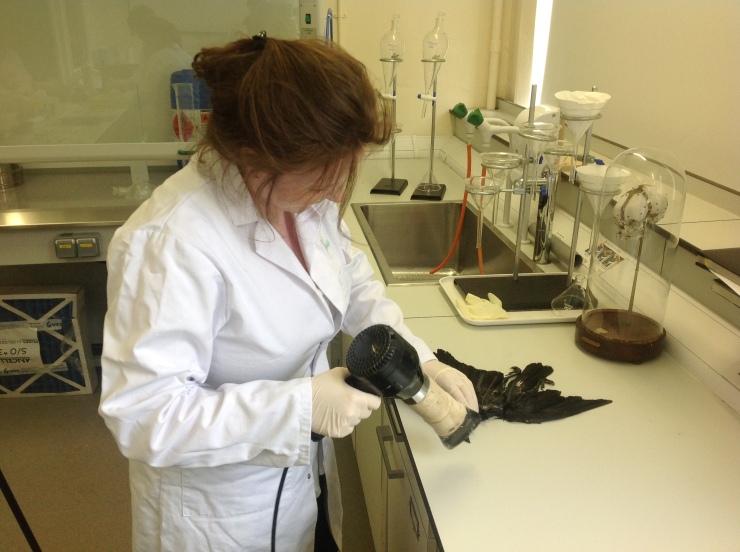
Blow dry in the lab

It wasn’t for the squeamish either because the birds were not pre-skinned, so there was some down and dirty hands-on work to be done before the pretty stuff could begin. The whole process took from 10am until 6.30pm with barely a break. Nonetheless, one participant said that the time flew by (no pun intended, we assume) and another said:

I don’t believe it, I thought we were just going to get a pre-prepared skin, not do the whole thing in a day! That was excellent!

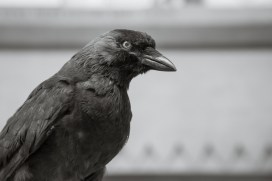
The bird you can see at the top of the post is the creation of the over-excited education officer, Chris Jarvis. He’s named it Scratch because it was made entirely from – yep – scratch. Being a remarkably clever corvid, he (she?) now perches loftily above the rest of the Education team, squawking edicts from time to time.

Given the success of the workshop we may well run another in the future, so keep your eye on our quarterly programme for that. And if you’d like to join our mailing list, email communications@oum.ox.ac.uk and I’ll add your address.

Scott Billings – Communications officer


Trumpery

IMG_2078

Who created the theory of evolution? Why, Mr Darwin of course! Ah, if only the history of science were so neat.

Charles Darwin’s 1859 work, On the Origin of Species, is considered the stake in the ground for intellectual ownership of the theory of evolution by natural selection. But as a play making its UK premiere this week shows, the picture is not so clear-cut.

Joe Kenneway as Charles Darwin, beside Charles Darwin

Darwin is evolution’s most famous proponent, but when pressed on the subject some people may also name Alfred Russel Wallace, Darwin’s contemporary and a co-conceiver of the theory of natural selection. Others claim the idea had earlier antecedents.

And so the muddle of priority – and its effects on those involved – is played out in Trumpery, a play by American playwright and West Wing script writer Peter Parnell.

Trumpery is produced by Oxford’s Eleven One Theatre and directed by Helen Taylor, who is keen to note that the script is a dramatisation of events, not a historical record.

The central story of the play is Darwin’s decision to publish the Origin after sitting on it for so many years, when he hears that Wallace has come up with the theory independently. The play is a fascinating exploration of Darwin’s feelings of guilt – not just about Wallace and the issue of priority, but about the impact of his discoveries on religious belief.

As well as holding many specimens collected by Darwin and Wallace in the collections, the Museum was also the site of the famous Great Debate in 1860 between Thomas Henry Huxley, championing Darwin’s ideas, and Samuel Wilberforce, Bishop of Oxford, who defended the biblical account of creation.

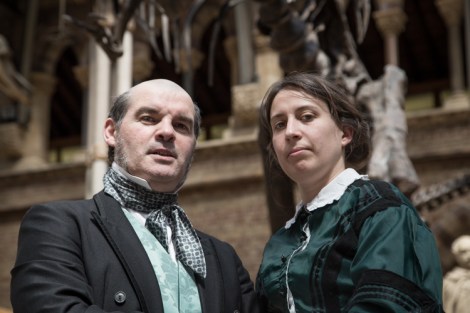
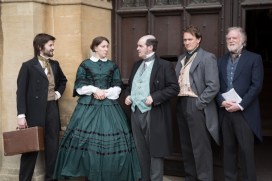
So it was a treat to have the cast in full costume parading around the Museum yesterday, regarding the statue of Darwin in the main court (and lamenting the absence of Wallace), checking out the specimens and doing a bit of promo at the same time.

Trumpery opens at the Simpkins Lee Theatre at Lady Margaret Hall in Oxford on Tuesday 10 June with evening performances each day, plus a matinée on Saturday 14 June. It is part of a science season created by Eleven One Theatre in conjunction with the University of Oxford’s Mathematical Institute. Tickets are available via the Eleven One Theatre website.

The first of the three plays in the season was Émilie: La Marquise du Châtelet Defends Her Life Tonight, which ran in February. After Trumpery, the group will stage CopenhagenMichael Frayn’s tightly-constructed play about atomic scientists Niels Bohr and Werner Heisenberg. Of the season Helen says:

 As a non-scientist, my ‘way in’ to these plays is through the human stories: there is so much drama to be found in the lives of people who struggled to break new ground, to push themselves to their intellectual limits, to deal with the constraints placed on them by the beliefs and politics of the times, and with the impact of their work on their personal lives.

Emma Darwin (Ida Persson) and Alfred Russel Wallace (Nathan Grassi)

Viva Volunteers!

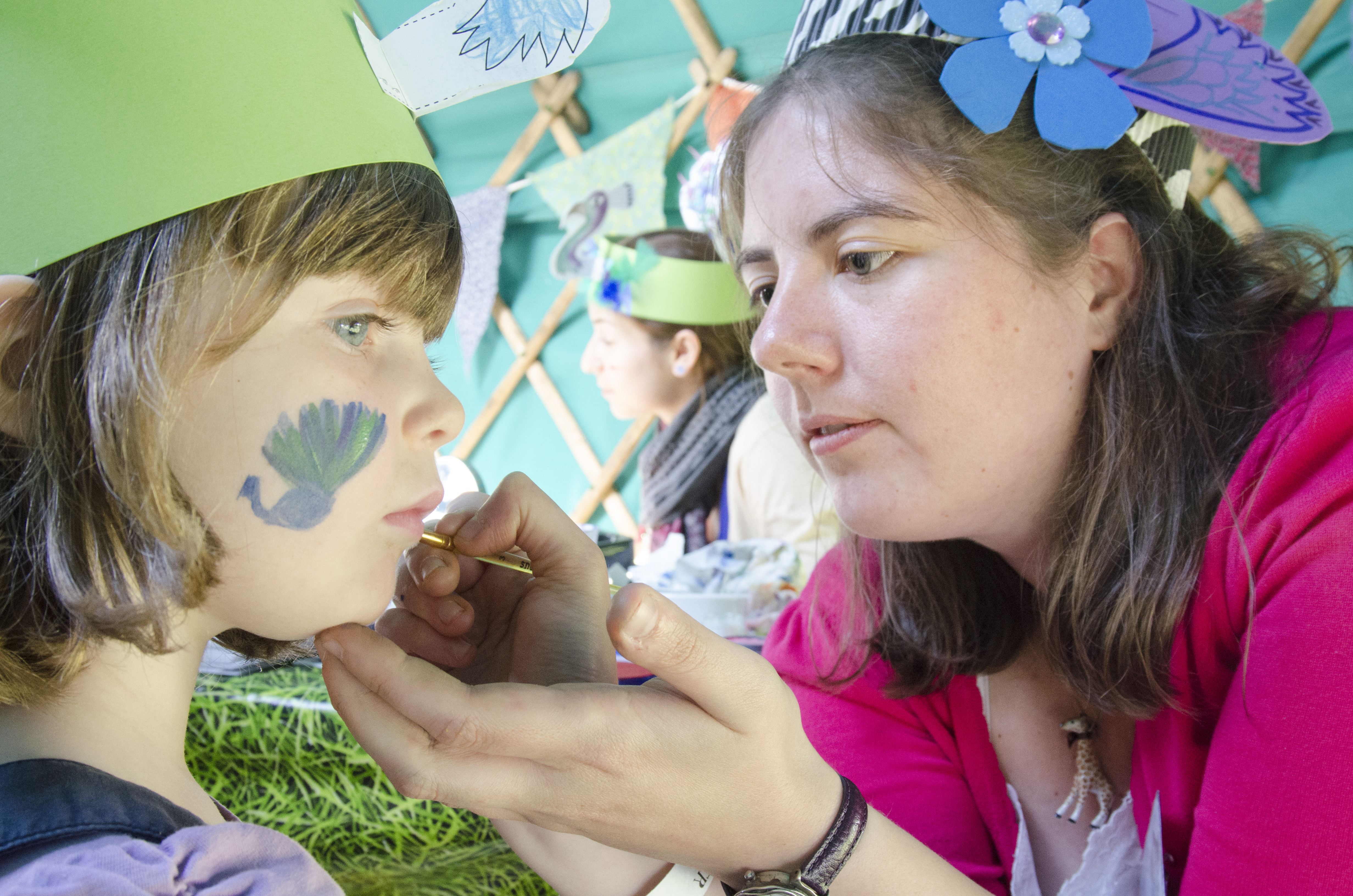
Alice facepaintingThey sort, they scan, they stick, they smile: who are they? Our team of brilliant Collections and Public Engagement Volunteers of course! This week has been the 30th anniversary of Volunteers’ Week, so we wanted to put the spotlight on them…

The majority of our volunteers help with public events, particularly those for our family audience. In 2014 alone, our awesome team of volunteers have given the Museum over 1500 hours of their time to help with public engagement events. This includes painting children’s faces, like the wonderful Alice Wilby (above), leading tours of the Museum’s architecture and running a pub quiz at one of our late night events. IMG_1322

On top of that, we have a team working away behind the scenes supporting our collections staff. Here’s just a sample of the projects they’ve been working on this week…

Laura Cotton in the Earth Collections.

– 5 volunteers identifying butterflies from painted images in our Archival Collections.
– 1 volunteer working in the Life Collections sorting and cataloguing bones.
– 4 volunteers tucked away in the Earth Collections cleaning ancient horse fossils or sorting Jurassic fish teeth.

Simone Dogherty is the Museum’s Education Assistant and co-ordinator of Science Saturdays – a weekly family event aimed at older children and led entirely by volunteer scientists. So why does she think volunteers are so valuable?

We’re very lucky here to have such a large quantity and high quality of volunteers. They help us with a huge range of activities and with the increase in visitor numbers that the Museum has been experiencing since re-opening in February, I just don’t know how we’d cope without them.
For Science Saturdays we use volunteers with a specific expertise. This gives children access to enthusiastic and inspiring individuals that they can look up to. And, in return, the volunteers gain valuable science communication skills.

Fancy joining our merry band of volunteers? Whether you’re into making masks or dusting off molluscs, we need you! You can simply sign up to help out on our Volunteers website.

But what’s in it for you? Aside from the glow of knowing you’ve simply helped us do more, you can develop your confidence when working with the public, learn a new skill or get up close with the treasures stashed away behind the scenes. But that’s forgetting the most important part – you’d be joining a fantastic team of people who, like you, think this museum is a pretty exciting place to be!

Rachel Parle, Interpretation and Education Officer

Lost & Found

Lost & Found

One of the tasks of a University museum – and indeed all museums – is to communicate often complex and detailed academic knowledge to a non-specialist audience. There are lots of creative ways for us to go about this, from capturing children’s interest in nature and natural history through well-structured schools and family sessions, to the careful interpretation of specimens and subjects in exhibition displays. Another route is to collaborate with artists who can respond to and present the collections in a different manner.

We’ve been running a collaboration like this in our Life Collections since 2011, working with local artist Jane King. Jane has more recently teamed up with another Oxford-based artist, Neil Mabbs, and together they have formed Pale Blue Dot, a not-for-profit arts-science partnership that aims to raise public awareness about environmental and social concerns through exhibitions, publications and events.

IMG_1599
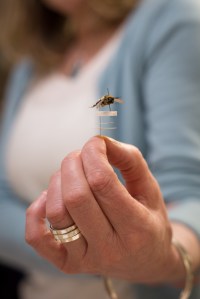
Jane picks out a great yellow bumblebee (Bombus distinguendus)

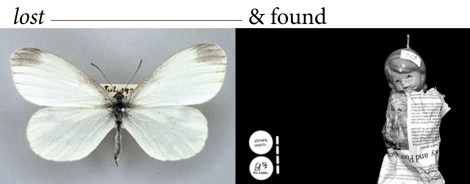
The first of these events is a multimedia installation called Lost & Found, running at the North Wall Arts Centre in Oxford from 28 May – 13 June. For this project Jane and Neil have worked with head of Life Collections Darren Mann and Amoret Spooner in the Museum, along with Professor Dave Goulson at the University of Sussex.

The Lost & Found exhibition asks whether consumerism is causing the extinction of millions of the planet’s species and the ecosystem services they provide. It uses a variety of material, including mixed media prints, photography, film and projection, 3D display, live planting, textiles, and artists’ books.

Artwork is supported by ‘Evidence Tables’ containing specimens from the Museum’s collections, as well as the results of the latest scientific research in the area. It is part of an effort by Pale Blue Dot to communicate complex scientific messages to a wider public audience.

Amoret explains the idea behind the project:

It focuses on the pollinators and decomposers that provide humans with some of the most tangible benefits in terms of ecosystem services.

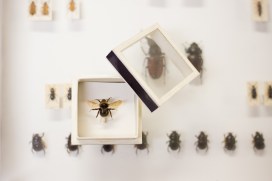
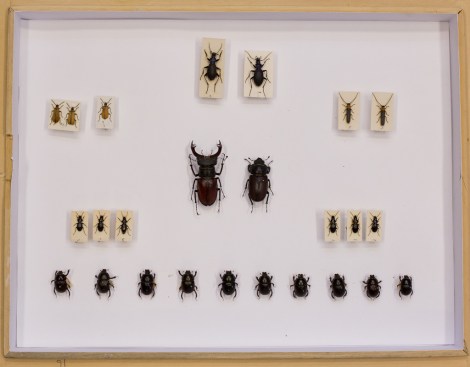
The pollinators are a group of almost 500 species of UK bees, hoverflies, butterflies and moths. Specimens from the collection are being displayed in cases to represent many of the species, as well as being utilised as source material for the artwork.

Pale Blue Dot’s Lost & Found aims to raise awareness of some of the research carried out by scientists here at the Museum that visitors wouldn’t normally hear about.

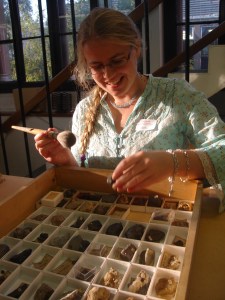
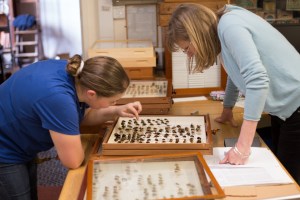
Jane and Amoret researching bee specimens

Darren’s photographs of dung beetles and his research papers on the role of dung beetles in the environment are featured. Dung beetles’ daily task of dung recycling helps increase crop yields by speeding up the release of nutrients into the soil, as well as reducing the spread of farm animal parasites and infections caused by biting insects. One of the pieces made by Jane is an artist’s book – Beetle Book – which highlights this vital ecosystem service that beetles provide to humans.

Many of our beetle, bee, moth and butterfly specimens will be on display in the Lost & Found exhibition at the North Wall, so head over there from 28 May to check it all out.

IMG_1615

Get on your soapbox


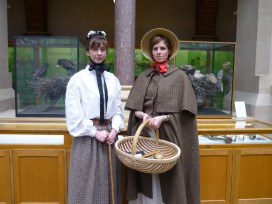
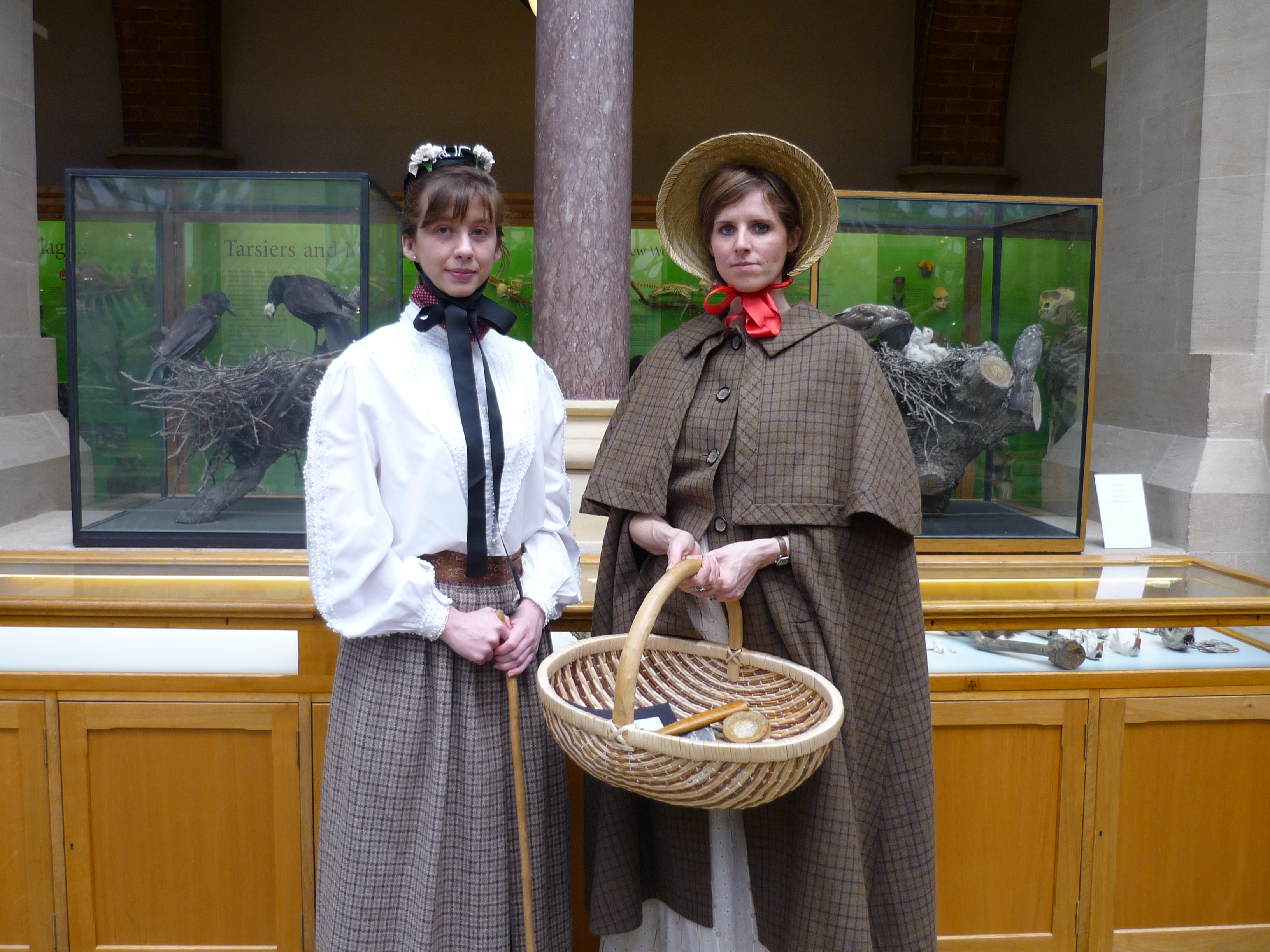
Mary Kingsley (l) and Mary Anning (r) prepare for their appearance in Soapbox City
Mary Kingsley and Mary Anning prepare for their appearance in Soapbox City

As April draws to a close, Oxford prepares for the traditional May Morning celebrations. Alongside the choir singing on Magdalen Tower, the reckless students leaping from the bridge and morris dancing in the medieval streets, you will find staff from Oxford University Museums joining in with the revelries.

An early-morning dung beetle will be taking to the soapbox

The Museums have taken charge of a one hour slot, from 8-9am, with staff from the Museum of the History of Science, Pitt Rivers Museum and, of course, the Museum of Natural History taking to the stage during the hour. If you’re willing to get up bright and early, you’ll be able to see a giant dung beetle arguing the value of his species, a T rex in a rap battle with a dodo, and two dignified ladies visiting from the past to remind everyone just how significant they really were.

Ellena Smith, ASPIRE Assistant across the Museums, is co-ordinating the Museums’ slot. She says;

Soapbox City is a fantastic opportunity to share knowledge and insight from Oxford University Museum staff in a fun and exciting way, and a great chance for the Oxford University Museums to reach out to a new audience.

Here’s the full timetable for the Museums’ shift:

08:00 Shooting Holes in Pitt Rivers Myths, Helen Adams (Pitt Rivers Museum)

08:05 Music in the Museum, Kelly Smith (HLF Trainee)

08:10 Conservation Station, Bethany Palumbo (Museum of Natural History)

08:15 Cockroaches: Pets or Pests, Darren Mann (Museum of Natural History)

08:20 Why the World needs Dung Beetles, Chris Jarvis (Museum of Natural History)

08:25 Natural History Stand-up, David Legg (Museum of Natural History)

08:30 T rex Vs the Dodo Rap Battle, Steven Williams (Museum of Natural History)

08:35 A Tale of Two Marys, Caroline Cheeseman and Rachel Parle (Museum of Natural History and Joint Museums Volunteer Service)

08:40 Why older people are radical, Helen Fountain (Museum of Oxford)

08:45 Geek is Good, Scott Billings (Museum of the History of Science)

08:50 When History Goes Wrong, Stephen Johnston (Museum of the History of Science)

08:55 You think you are smart?! Silke Ackermann (Museum of the History of Science)

If you’re up early for the festivities (or still awake from the night before!), do join us on Broad Street for a little May Morning museum madness.

Rachel Parle, Interpretation and Education Officer


He’s behind you…

Dino Zoo

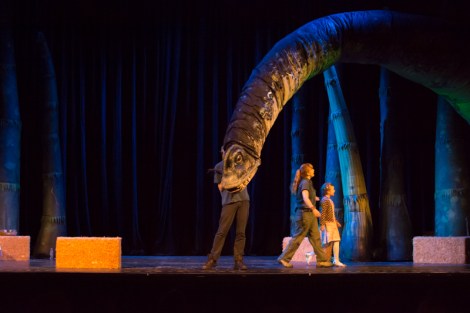
Last weekend the dinosaurs rumbled into town; a whole menagerie of them. Indeed, it was a veritable Dinosaur Zoo. They’d come a long way too – all the way from Australia – and so their names were not so familiar to us: the Australovenator, the Titanosuar (above), the Dryosaur, and the cutely-named Leaellynasaura, so-called after the discoverer’s daughter Leaellyn (Leaellyn’s lizard, see?).

If you didn’t catch it, these creatures were all part of a show at Oxford’s New Theatre. There was a sneak preview of this in the Museum earlier in the year. Produced by Australian company Erth Visual and Physical, the Dinosaur Zoo Live production mixes the thrill of brilliant puppetry with facts and explanations about the adaptations, environments and possible behaviours of these long-lost Australian lizards.

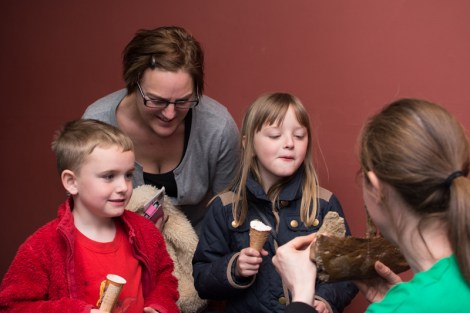
This wasn’t an opportunity to be missed, so we teamed up with the New Theatre and the show’s production team to bring some of our own fossil specimens to the event. With a handling table set up in the theatre’s bar area, families spent up to an hour before the show examining our selection of theropod and sauropod material, getting up close to teeth, eggs, jaws, and more.

We had the lower jaw and fossilised tooth from Oxfordshire’s very own Megalosaurus, famous for being the first dinosaur to be scientifically described, by William Buckland in 1824 (actually the term Dinosauria came later, coined by Richard Owen in 1842). As it was Easter we had some ancient eggs too, including the fossil of an egg laid, probably, by a sauropod dinosaur, cracks in the shell still clearly visible.

A family enjoy pre-show ice creams while learning about the Megalosaurus

To represent the the Cretaceous period, which is when the Australian beasts in the show were around, we brought the teeth and a hefty vertebra of an Iguanodon. Unlike the still-serrated Megalosaurus tooth fossil, the flat Iguanodon teeth show that this dinosaur was a herbivore. There’s a nice story, possibly apocryphal, that these teeth were actually spotted not by Gideon Mantell, the geologist who described Iguanodon in 1825, but by his wife Mary Ann as she waited in their carriage for her husband to visit a patient in Sussex.

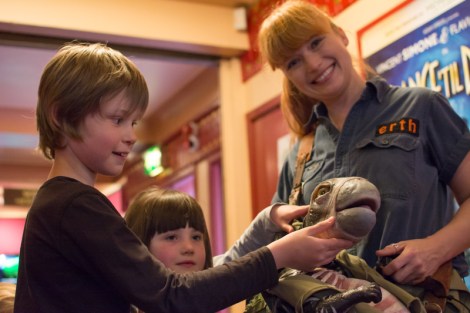
Meeting the stars after the show with brilliant host Lindsay Chaplin
Meeting the stars after the show with brilliant host and zoo-keeper Lindsey Chaplin

We threw in a couple of tricksy things too. On the handling table there were two non-dinosaur specimens – could people work out which they were? In many cases, yes they could: if there’s one thing we learnt it’s that young kids know a heck of a lot about dinosaurs. The two red herrings were an ichthyosaur skull, because ichthyosaurs were marine reptiles rather than dinosaurs; and the fossil imprint of a leathery egg, probably laid by a prehistoric crocodile or turtle.

All in all, everyone had a great big dinosaur overdose. Still, better that than chocolate eggs.

Scott Billings, Communications coordinator