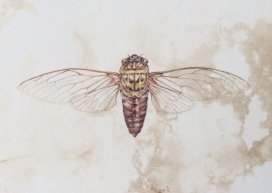
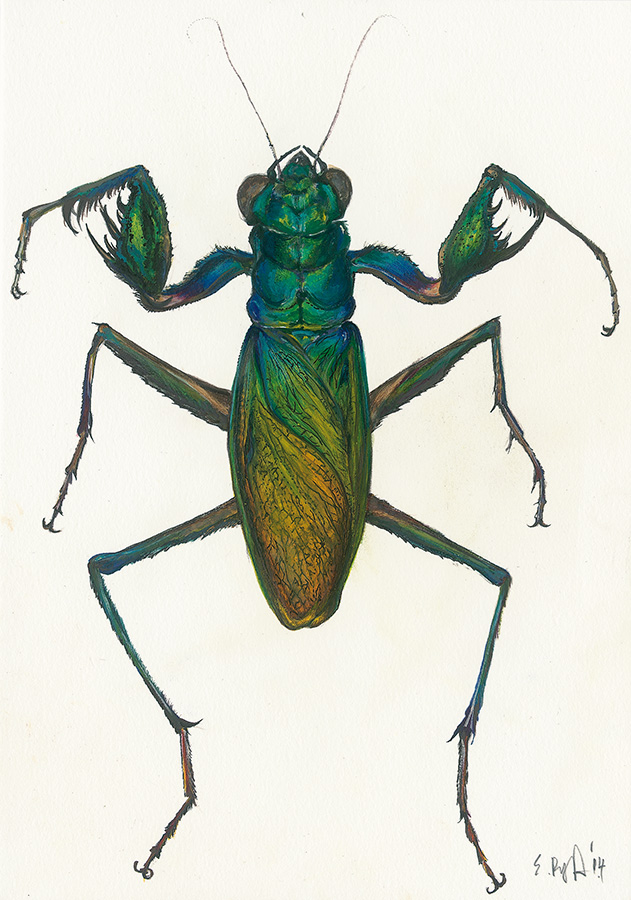
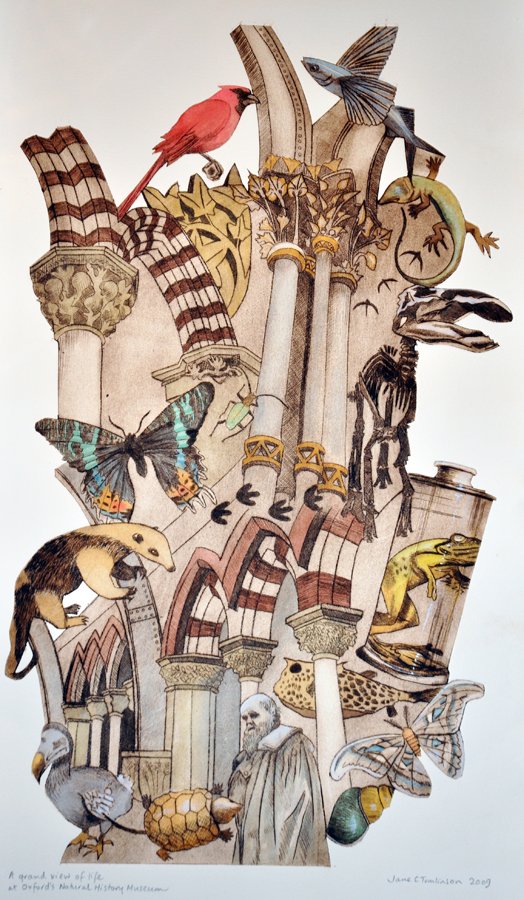
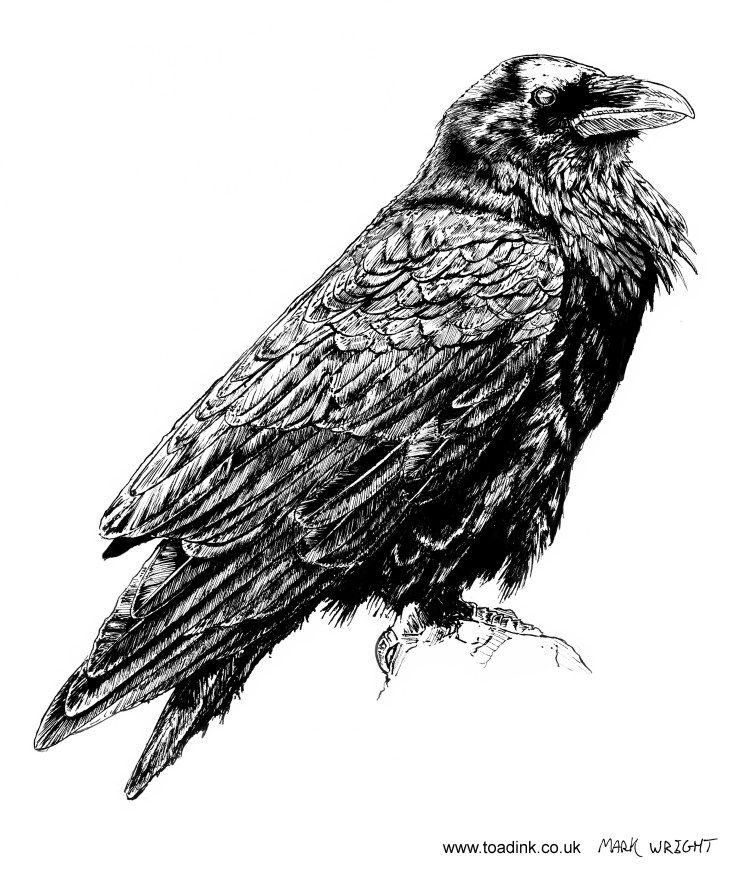
As part of our Visions of Nature year in 2016, we invited you to send in your own ‘visions of nature’. We didn’t know what to expect, but week after week we received pictures of beautiful paintings, drawings, photographs, and textile art, all inspired by the natural world or by the Museum and its collections.
All of these artworks can now be found in the online gallery, but we’ve picked out a few here to show you and to mark the end of the project. Thanks very much to everyone who took part.
Emma Reynard
Jake Spicer – Main court Oxford University Museum of Natural History
Jane Tomlinson – Oxford University Museum of Natural HistoryDeidre Bean – Cicada
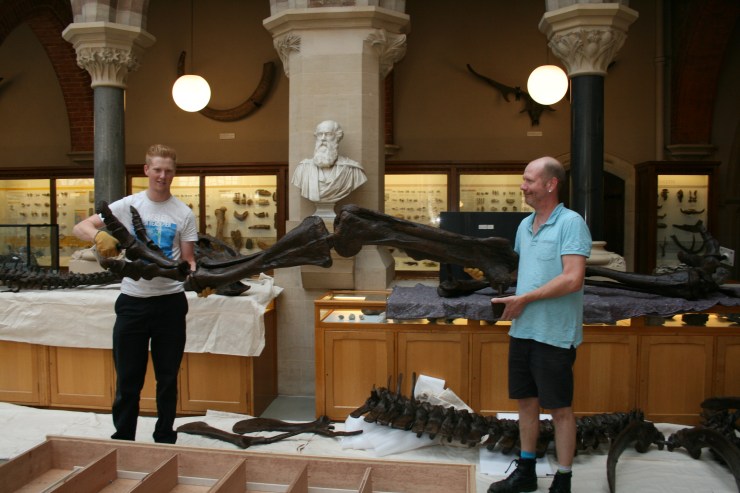
Last year we introduced you to Adam Fisk, our (then) new apprentice. He’s the slightly younger-looking one in the photo above; on the right is Pete Johnson, the Museum’s technician and Adam’s mentor and supervisor. Together, the two are a vital component that keeps the Museum machinery a-turning.
Over the past twelve months or so Adam has busied himself with many vital tasks: installing and de-installing our exhibitions, including Kurt Jackson’s Bees (and the odd wasp) in my Bonnet and Microsculpture; reconstructing an Edmontosaurus; and, more recently, sporting an excellent Star Wars Christmas jumper.
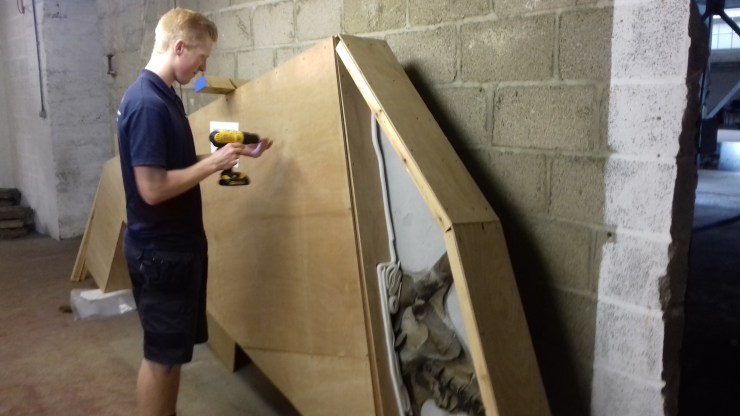
Packing an Attenborosaurus ready for transit
We’re therefore exceptionally pleased to announce that Adam has just been selected as a winner in the Annual University of Oxford Apprenticeships Awards. This calls for a small whoop, and a large ‘Well done Adam!’.
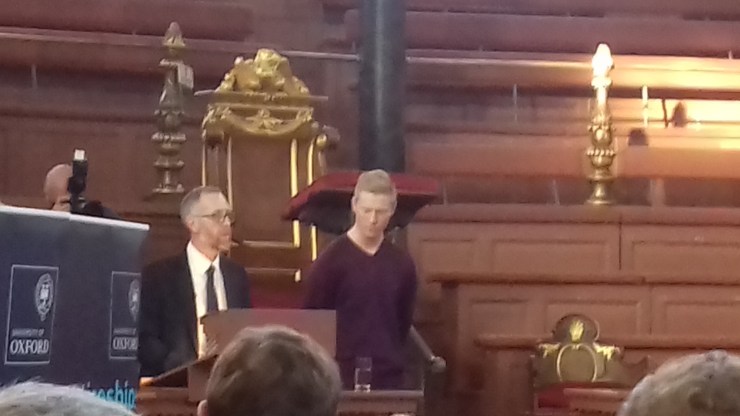
The awards, which celebrate the achievements of the University’s apprentices, supervisors and departments, were given out at a ceremony at the rather grand Sheldonian Theatre this afternoon.
Adam collecting his award at the Sheldonian Theatre in Oxford
When Adam joined the Museum last summer for his three-year apprenticeship he had just finished his GCSEs. Now he’s walking the stage at the Sheldonian… As Pete says:
Adam’s contribution to all aspects of work from maintenance and workshop demands to exhibition installation and Collections assistance has been outstanding. We have all benefitted greatly from his input, and he has helped us to achieve a high standard of public service.
Thanks for all the hard work Adam and we look forward to the next 18 months with you on the team.
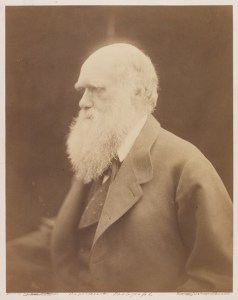
The latest display in our changing Presenting… case showcases some pioneers of photography and features a recently-discovered original print of Charles Darwin by Julia Margaret Cameron…
In the early days of photography, in the mid-19th century, a number of photographic innovators had close links to the Museum and its collections. Perhaps the most famous of these is Charles Lutwidge Dodgson (1832-1898), better known as Lewis Carroll. Dodgson was an author and mathematician at Christ Church College in Oxford, and also an accomplished early photographer.
Dodgson’s friends were often the subjects of his photos. A well-known example is Alice Liddell who, as well as sitting for portraiture, provided inspiration for Dodgson’s book Alice’s Adventures in Wonderland, as did the Dodo in the Museum’s collections.
The image at the top of the article is titled The Anatomy Lesson with Dr George Rolleston and was taken by Dodgson around 1857. It shows Dr Rolleston, Professor of Medicine at the University of Oxford at the time, pictured with a selection of specimens from the Museum’s collections.
Two of Dodgson’s subjects were accomplished photographers in their own right, and perhaps the most famous female photographers of their time: Julia Margaret Cameron (1815-1879) and Sarah Angelina Acland (1849-1930).
Cameron’s innovative and distinctive style of portraiture raised photography to a true art form. Her intentional use of shifted focus and experiments with process and finish gave an ethereal look to her works resembling the artistic style of the contemporary Pre-Raphaelites.
Many prominent scientists sat for Cameron, including naturalist Charles Darwin. She took the portrait above in 1868 at her home on the Isle of Wight. An original print of this photograph, made by Cameron, was recently discovered in the Museum Archive, uncatalogued. It features her signature on the back and the blind stamp from her printseller in London on the front.
‘Mr Ruskin & his old friend at Brantwood’ by Sarah Angelina Acland, 1893
Sarah Angelina Acland, inspired and taught by Cameron, is best known for her innovations in colour photography, but she also took many black and white photographs while learning the art form. The portrait above features her father Sir Henry Wentworth Acland and the artist John Ruskin at his home. Both Ruskin and Acland were instrumental in the founding of this Museum, and Sarah even helped to lay the founding stone in 1855.
In a 1904 Royal Photographic Society exhibition Acland was the first to exhibit work combining images taken with red, green and blue filters, three years before the launch of the colour photography process invented by the Lumière brothers.
These images, including the original print of Charles Darwin by Julia Margaret Cameron, are on display in our Presenting… case until 24 January.
To coincide with our display of the Oxford Photographic Society‘s annual show, here Society member Ron Perkins recounts how he captured these great shots of the magnificent Bald Eagle.
Bald eagles, the national birds of the USA, are charismatic, powerful creatures. Young eagles are tawny brown but acquire their majestic black plumage, with white heads, after two years.
In early winter the Alaska Chilkat Bald Eagle Preserve attracts up to 3,000 eagles which pause on their seasonal migration to the south in order to feed on the salmon that swim up the river to spawn.
A Bald Eagle eating salmon on the river bank
Having discovered this photo opportunity via the internet I easily recruited three Oxford Photographic Society members to travel to Alaska. The journey took two and a half days via Seattle and Juneau by air and on to the small town of Haines by an 80-mile ferry trip. Haines is near the Pacific coast so although there was snowfall most days the daytime temperatures were about -5C. Each day we drove 20 miles along the banks of the river to the best photographic locations to get our shots.
An adult eagle attacking a juvenile
After spawning, the fish die in the shallows at the edges of the river. Then the eagles drag the dead salmon onto the snow-covered banks. The fish weigh up to 15 pounds so moving them is difficult; some adult eagles watch juvenile birds moving the salmon onto the riverbanks and then attack to drive away the juveniles.
Arriving at the preserve
Eagles always attack into the wind, so it is easy to plan and position yourself to capture these shots. And the combination of large numbers of eagles with frequent dramatic action is a powerful attraction for wildlife photographers.
Oxford Photographic Society’s Natural World exhibition runs until Sunday 22 January in the Museum’s Café Gallery.
As part of the Museum’s Visions of Nature year in 2016, we have had the pleasure of hosting three poets in residence: John Barnie, Steven Matthews, and Kelley Swain. During the year the poets worked alongside staff in the collections and out in the Museum itself to gain inspiration for their writing. A small anthology of the resulting poetry is published at the end of 2016.
In this video John Barnie reads his poem The Grand Concourse, inspired by the Museum’s main space. Listen out for other references to the Museum in the poem. John is a poet and essayist from Abergavenny, Monmouthshire.
You can meet John on National Poetry Day on Thursday 6 October 2016, when he will be at the our special event during the morning.
This is the second in a short series of articles to accompany the Stone Age Primates temporary display at the Museum, created with the Primate Archaeology group at Oxford University. Here, Dr Tomos Proffitt, Postdoctoral Research Assistant in Primate Archaeology, shows how the use of stone tools by modern primates might connect with our earliest human ancestors.
Over the past five years I have been fortunate enough to work with and study some of the earliest known stone tools, uncovered from archaeological sites at Olduvai Gorge, one of the most famous Palaeolithic archaeological sites on our planet. Olduvai Gorge seemingly appears out of nowhere as you drive down the dirt tracks of the north western slope of the Ngorogoro caldera and national park in Northern Tanzania.
The view from the top of Naibor Soit overlooking Olduvai Gorge. Photo Credit: Tomos Proffitt
It is here that the famous Louis and Mary Leakey uncovered evidence which proved that our evolutionary origins extended not thousands, but millions of years into the past, and over the years the site has provided a wealth of animal and early human, or hominin, fossils as well as tens of thousands of examples of the stone tools they made.
Two million years ago if you were sitting where I was in Olduvai, the most noticeable feature would have been a great lake surrounded by vast floodplains, occupied by a range of herbivorous and carnivorous animals taking advantage of the abundant grass, shrubs and fresh water constantly feeding the lake. It is in this setting that you would have found small groups of our hominin ancestors (Homo habilis) standing upright and walking across the floodplains in search of food.
Lake Ndutu located at the south western end of Olduvai Gorge. Early hominins would have occupied a similar lake environment. Photo Credit: Tomos Proffitt.
As a large part of my research involved closely studying and analysing the stone tools used by the hominins who once lived in this landscape my thoughts turned to how these individuals would have used tools for the different tasks they faced.
Once this hominin group had found a partially eaten carcass, possibly that of a Deinotherium (an extinct ancestor of the modern day elephant), they would have set about trying to make the most of this valuable resource.
By using quartz flakes with extremely sharp cutting edges, made by striking a quartz block with a round hammerstone cobble, they would have been able to cut the small scraps of meat that were still attached to areas of the carcass untouched by other predators, such as lions, hyenas, wild dogs and vultures. The hominins, would, however, also have been very interested in the leg bones because they contained an incredibly nutritious food source than not many other animals could easily get to – the bone marrow.
Examples of quartz anvils used by early hominins at Olduvai Gorge. Photo Credited to Mora and de la Torre, 2005.
After butchering the animal they would have carried the meat and bones back to another group, some of whom had been collecting various nuts and roots and were now busy preparing them to be eaten. They would be cracking open the nuts and pulverising the roots on a large flat quartzite anvil using rounded hammerstones. The group that had just arrived would have used the same tools to carefully open the elephant leg bones to access the marrow inside. A whole range of dynamic food gathering, eating, sharing, learning, teaching, tool making, communicating behaviour was taking place at this location.
Fast forward 2 million years: since that original meal, the site has been repeatedly buried in sand and sediment and eroded by flowing water and the only thing that remains from this location of vibrant activity and of the lives of these hominins are a few fossilised bones and a small collection of fragmented and broken stones. This is the type of material we were excavating in 2015.
Archaeologists use a range of methods to try and understand how stone tools were used and some of the most powerful insights can be gained through observing how stone tools are used today.
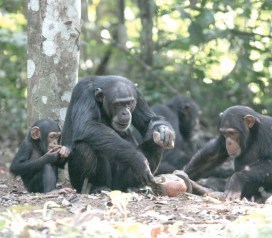
Chimpanzees using both a hammerstone and anvil to crack open nuts. Photo Credit: Haslam et al, 2009.
Transport yourself now to a small forest clearing in western Africa, where a group of our closest living relatives, chimpanzees, are quietly sitting underneath a number of nut- and fruit-bearing trees. This group is taking advantage of these important food sources, and is doing so by using stone anvils and stone hammers not too dissimilar from the group of hominins at Olduvai Gorge, two million years earlier.
A hammerstone used by a capuchin, on display in the Museum
But it is possible to directly observe the chimpanzee behaviour, recording how the tools are being made and used, what waste is being produced, the learning processes going on between infant and adult, and the range of social interactions that are happening. This modern primate behaviour represents a valuable window into the types of activities that some of our earliest hominin ancestors may have also undertaken.
The Stone Age Primates exhibit at the Museum showcases these types of stone tools and how they are used by modern primates. By closely studying how our closest living primate ancestors, including chimpanzees, capuchins and macaques, make, use and discard stone tools it is becoming increasingly possible to better understand the dynamic range of early human behaviours behind similar types of hammers and anvils found at Olduvai Gorge and other East African archaeological sites.










 More Than A Dodo