To coincide with our display of the Oxford Photographic Society‘s annual show, here Society member Ron Perkins recounts how he captured these great shots of the magnificent Bald Eagle.
Bald eagles, the national birds of the USA, are charismatic, powerful creatures. Young eagles are tawny brown but acquire their majestic black plumage, with white heads, after two years.
In early winter the Alaska Chilkat Bald Eagle Preserve attracts up to 3,000 eagles which pause on their seasonal migration to the south in order to feed on the salmon that swim up the river to spawn.
A Bald Eagle eating salmon on the river bank
Having discovered this photo opportunity via the internet I easily recruited three Oxford Photographic Society members to travel to Alaska. The journey took two and a half days via Seattle and Juneau by air and on to the small town of Haines by an 80-mile ferry trip. Haines is near the Pacific coast so although there was snowfall most days the daytime temperatures were about -5C. Each day we drove 20 miles along the banks of the river to the best photographic locations to get our shots.
An adult eagle attacking a juvenile
After spawning, the fish die in the shallows at the edges of the river. Then the eagles drag the dead salmon onto the snow-covered banks. The fish weigh up to 15 pounds so moving them is difficult; some adult eagles watch juvenile birds moving the salmon onto the riverbanks and then attack to drive away the juveniles.
Arriving at the preserve
Eagles always attack into the wind, so it is easy to plan and position yourself to capture these shots. And the combination of large numbers of eagles with frequent dramatic action is a powerful attraction for wildlife photographers.
Oxford Photographic Society’s Natural World exhibition runs until Sunday 22 January in the Museum’s Café Gallery.
As part of the Museum’s Visions of Nature year in 2016, we have had the pleasure of hosting three poets in residence: John Barnie, Steven Matthews, and Kelley Swain. During the year the poets worked alongside staff in the collections and out in the Museum itself to gain inspiration for their writing. A small anthology of the resulting poetry is published at the end of 2016.
In this video John Barnie reads his poem The Grand Concourse, inspired by the Museum’s main space. Listen out for other references to the Museum in the poem. John is a poet and essayist from Abergavenny, Monmouthshire.
You can meet John on National Poetry Day on Thursday 6 October 2016, when he will be at the our special event during the morning.
This is the second in a short series of articles to accompany the Stone Age Primates temporary display at the Museum, created with the Primate Archaeology group at Oxford University. Here, Dr Tomos Proffitt, Postdoctoral Research Assistant in Primate Archaeology, shows how the use of stone tools by modern primates might connect with our earliest human ancestors.
Over the past five years I have been fortunate enough to work with and study some of the earliest known stone tools, uncovered from archaeological sites at Olduvai Gorge, one of the most famous Palaeolithic archaeological sites on our planet. Olduvai Gorge seemingly appears out of nowhere as you drive down the dirt tracks of the north western slope of the Ngorogoro caldera and national park in Northern Tanzania.
The view from the top of Naibor Soit overlooking Olduvai Gorge. Photo Credit: Tomos Proffitt
It is here that the famous Louis and Mary Leakey uncovered evidence which proved that our evolutionary origins extended not thousands, but millions of years into the past, and over the years the site has provided a wealth of animal and early human, or hominin, fossils as well as tens of thousands of examples of the stone tools they made.
Two million years ago if you were sitting where I was in Olduvai, the most noticeable feature would have been a great lake surrounded by vast floodplains, occupied by a range of herbivorous and carnivorous animals taking advantage of the abundant grass, shrubs and fresh water constantly feeding the lake. It is in this setting that you would have found small groups of our hominin ancestors (Homo habilis) standing upright and walking across the floodplains in search of food.
Lake Ndutu located at the south western end of Olduvai Gorge. Early hominins would have occupied a similar lake environment. Photo Credit: Tomos Proffitt.
As a large part of my research involved closely studying and analysing the stone tools used by the hominins who once lived in this landscape my thoughts turned to how these individuals would have used tools for the different tasks they faced.
Once this hominin group had found a partially eaten carcass, possibly that of a Deinotherium (an extinct ancestor of the modern day elephant), they would have set about trying to make the most of this valuable resource.
By using quartz flakes with extremely sharp cutting edges, made by striking a quartz block with a round hammerstone cobble, they would have been able to cut the small scraps of meat that were still attached to areas of the carcass untouched by other predators, such as lions, hyenas, wild dogs and vultures. The hominins, would, however, also have been very interested in the leg bones because they contained an incredibly nutritious food source than not many other animals could easily get to – the bone marrow.
Examples of quartz anvils used by early hominins at Olduvai Gorge. Photo Credited to Mora and de la Torre, 2005.
After butchering the animal they would have carried the meat and bones back to another group, some of whom had been collecting various nuts and roots and were now busy preparing them to be eaten. They would be cracking open the nuts and pulverising the roots on a large flat quartzite anvil using rounded hammerstones. The group that had just arrived would have used the same tools to carefully open the elephant leg bones to access the marrow inside. A whole range of dynamic food gathering, eating, sharing, learning, teaching, tool making, communicating behaviour was taking place at this location.
Fast forward 2 million years: since that original meal, the site has been repeatedly buried in sand and sediment and eroded by flowing water and the only thing that remains from this location of vibrant activity and of the lives of these hominins are a few fossilised bones and a small collection of fragmented and broken stones. This is the type of material we were excavating in 2015.
Archaeologists use a range of methods to try and understand how stone tools were used and some of the most powerful insights can be gained through observing how stone tools are used today.
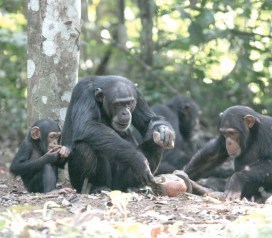
Chimpanzees using both a hammerstone and anvil to crack open nuts. Photo Credit: Haslam et al, 2009.
Transport yourself now to a small forest clearing in western Africa, where a group of our closest living relatives, chimpanzees, are quietly sitting underneath a number of nut- and fruit-bearing trees. This group is taking advantage of these important food sources, and is doing so by using stone anvils and stone hammers not too dissimilar from the group of hominins at Olduvai Gorge, two million years earlier.
A hammerstone used by a capuchin, on display in the Museum
But it is possible to directly observe the chimpanzee behaviour, recording how the tools are being made and used, what waste is being produced, the learning processes going on between infant and adult, and the range of social interactions that are happening. This modern primate behaviour represents a valuable window into the types of activities that some of our earliest hominin ancestors may have also undertaken.
The Stone Age Primates exhibit at the Museum showcases these types of stone tools and how they are used by modern primates. By closely studying how our closest living primate ancestors, including chimpanzees, capuchins and macaques, make, use and discard stone tools it is becoming increasingly possible to better understand the dynamic range of early human behaviours behind similar types of hammers and anvils found at Olduvai Gorge and other East African archaeological sites.
Young volunteers Genevieve Kiero Watson and Poppy Stanton tell the tale of the Museum’s resident Wool Carder Bee and their investigative bee work in our Life Collections…
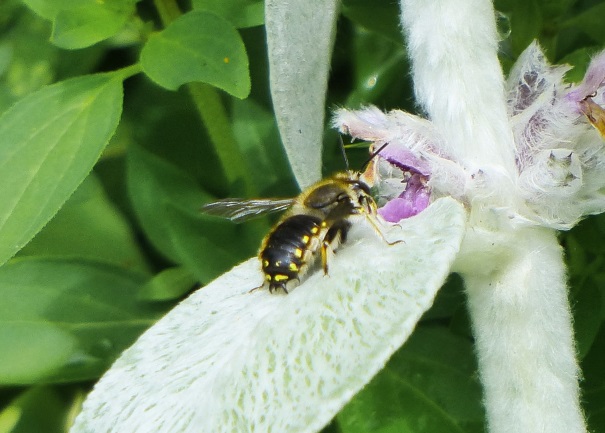
A small guardian patrols its territory among the luscious bed of Lamb’s-ears that grow at the front of the Museum. This feisty critter, the Wool Carder Bee (Anthidium manicatum), is just one of the roughly 270 bee species that buzz around Britain. Having spotted this unusual hovering bee we seized the opportunity to identify, photograph and explore the species a little further.
The male of this solitary bee species is fiercely territorial, fighting off other males as well as any other insects it considers to be intruders. Techniques used in combat vary from skilful aerial hovering to ferocious wrestling. But perhaps its greatest weapon is a series of stout spines found at the tip of the abdomen. These are used to bully an intruder into submission, or even to kill it. In so doing, the male protects the precious supply of pollen for the smaller females which in turn collect it on stiff bristles on the undersides of their abdomens.
Females, being slightly less aggressive, are in charge of constructing the nests, which are built in existing cavities such as beetle holes. Hairs shaved off plants, such as the favoured Lamb’s-ear, are used to create the brood cells for the next generation.
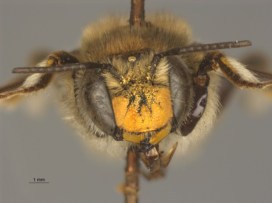
Male Wool Carder Bee on Lamb’s ear in the Museum’s front garden
The Museum houses many specimens of the Wool Carder Bee and our job was to pull out the data from each one to help with an ongoing online survey about this species. Although making friends with hundred-year-old bees was enjoyable, trying to comprehend the miniscule handwritten labels accompanying them was altogether more trying.
Every label explains where and when the bee was captured, who collected and identified it, and gives the reference for its current collection. All this on a slip of paper no bigger than half a stamp.
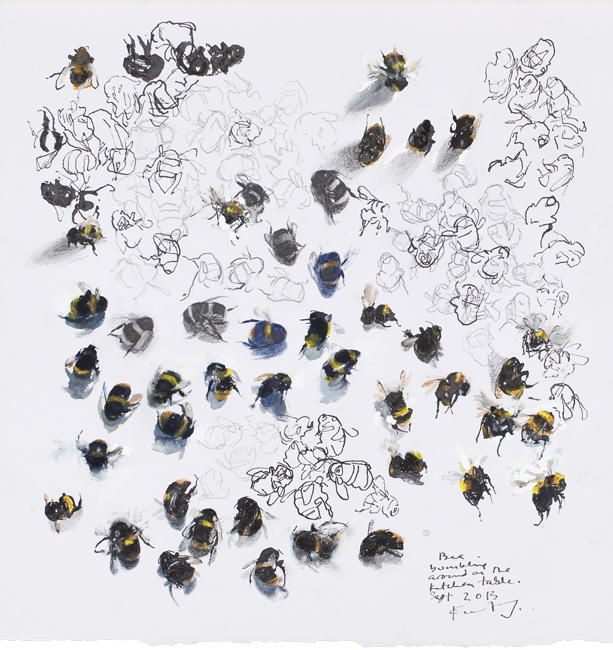
One of the Museum’s Wool Carder Bee specimens, circled, featured in a display of all 270 species of British bee in the Bees (and the odd wasp) in my Bonnet exhibition by artist Kurt Jackson
After recording data from 120 labels we began to find the grid reference of the location each was originally collected. This too was challenging as many place names have changed in the last hundred years. Ultimately, the information will be used by the Bees, Wasps & Ants Recording Society (BWARS) to improve the distribution map for the Wool Carder Bee.
Why not see if you can spot the Wool Carder Bee in your garden? Characteristics to look out for include small spines on the tip of the abdomen and lateral lines of yellow spots on either side of the abdomen. The bees themselves are about 11-13mm long for females, and 14-17mm for males. Good luck!
This is the first in a short series of articles to accompany the new Stone Age Primates temporary display at the Museum, created with the Primate Archaeology group at Oxford University. Here, Michael Haslam, ERC Senior Research Fellow in Primate Archaeology, outlines the importance of this emerging field of study.
Humans evolved over millions of years. You can see displays about this in natural history museums all over the world, usually with skulls of extinct ancestors such as Homo erectus. Alongside these bones there are often stone tools of various shapes and sizes, showing how our technology has also changed over time. Ultimately, human tool use has led all the way from sticks and stones to the computer, phone or tablet that you’re using to read these words.
However, for all those millions of years other members of our family were evolving too. What if we had an archaeological record for non-human animals as well? The Primate Archaeology project at Oxford University exists to answer this question.
‘The Rise of Modern Humans’ display in the Museum
Primates, the group that humans belong to, also includes apes and monkeys, as well as more remotely related animals such as lemurs. Yet when we see these animals in museums, they very rarely have a set of their own extinct ancestors on display, or any examples of the technologies that they have developed.
Why not? For one thing, it is difficult to find fossil ancestors of animals that live mostly in tropical forests because their bones aren’t preserved well in that environment. And most primates, like most animals, don’t use tools in the wild, so there is nothing left behind to tell us about their past behaviour.
But there is another reason. We view the human past as a series of ancestors evolving towards the way we are now; yet we tend to see monkeys and apes as unchanging over time. If asked to imagine a chimpanzee three million years ago, you would probably picture something that looks like a chimpanzee today. But modern chimpanzees didn’t exist back then, just as modern humans didn’t.
Wild chimpanzee at Bossou, Guinea. Photo by Michael Haslam.
The main reason we think of humans as changing and evolving is because of the archaeological evidence that we’ve collected. As we discovered more and more bones and stones it became clear that dozens of human ancestor species have lived on Earth, including close relatives such as the Neanderthals in Europe and Asia.
A hammerstone used by a capuchin, on display in the Museum
So what would we find if we looked for the archaeology of other primates? They don’t build cathedrals, or use pottery or metal, and they don’t leave behind written messages like the Egyptians, Maya or Romans did. That’s a problem. But the solution to the problem is actually the same one that archaeologists have always used for human ancestors: find the stone tools.
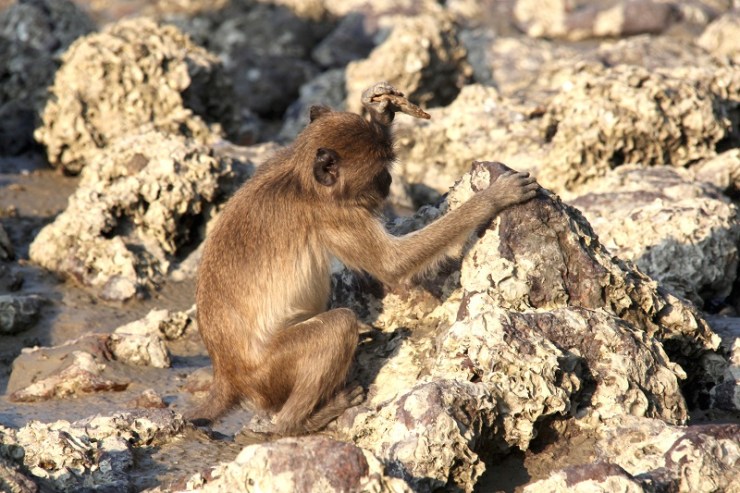
There are three types of wild primate that use stone tools: the chimpanzees of West Africa (Pan troglodytes verus); the Bearded Capuchin monkeys of Brazil (Sapajus libidinosus); and the Burmese Long-tailed Macaques of Southeast Asia (Macaca fasciaulria aurea). They mainly use stones as hand-held hammers, to break open hard foods such as nuts and shellfish. The capuchins also use stones to dig in the hard ground, which helps to protect their fingers when searching for roots or spiders to eat.
Wild long-tailed macaque using a stone tool at Laem Son National Park, Thailand. Photo by Michael Gumert.
The Primate Archaeology Project was set up at Oxford University in 2012, supported by the European Research Council. Since that time, our team has spent many months watching these animals use stone tools in the wild. We record how they select certain sizes and types of stones (you wouldn’t use a soft sponge as a hammer, and neither would they!), and how they carry their tools around from job to job like a modern tradesman. We used these observations to work out what primate tools look like today, and then we went digging into the past.
We found macaque tools buried in beach sands in western Thailand, and ancient capuchin tools in the forests of northeast Brazil. In both cases, we recognized the tools because they were similar to ones still in use today. Importantly, we also found that the tools were damaged in very particular ways by the monkeys that had used them, because hitting hard things together usually means that one of them gets broken.
Primate archaeology excavation, Serra da Capivara National Park, Brazil. Photo by Michael Haslam.
We used radiocarbon dating to work out that the archaeological capuchin tools were at least 600 years old. That means that there were monkeys sitting around in Brazil with stone hammers, cracking and eating nuts, before Christopher Columbus ever left Europe. Previous excavations in the Ivory Coast have found even older primate tools – chimpanzees there were using stone hammers more than 4,000 years ago!
Primate archaeology is still a new research field, with more questions than answers, but then so was human archaeology when it began. We really don’t know what technology apes and monkeys were using during the millions of years that they have evolved, but we are taking the first steps towards solving that mystery.
Stone Age Primates display in the Museum
Working with the Museum, the Primate Archaeology project team has put together a new temporary display, ‘Stone Age Primates’, to sit alongside the current human evolution cases in the Museum. In the display you can learn more about the research and see tools used by primates past and present. You can also follow the group on Twitter @primatearch.
Have you created a ‘vision of nature’ that you could share with us? During 2016, the Museum has seen some wonderful work inspired by nature and the natural environment, as part of our Visions of Nature year. To take the idea further we’d like to showcase work by our visitors and online readers too.
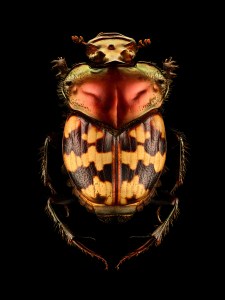
Visions of Nature kicked off with Kurt Jackson’s Bees (and the odd wasp) in my Bonnet exhibition, a celebration of the diversity of bees through Jackson’s textured paintings, mixed media sculptures and beautiful ceramics. This was followed in May by Microsculpture, a showcase of photographer Levon Biss’ extraordinary portraits of insects from our collections.
And later this autumn our three poets in residence will round off the year with a poetic vision of nature, inspired by their time here.
Splendid-necked Dung Beetle (Helictopleurus splendidicollis) from the Microsculpture exhibition by Levon Biss
The Museum’s court is often alive with visitors engaging artistically with the collections, sketchpad or camera in hand. The Visions of Nature year is the perfect opportunity to share your work with us. Whether it’s paintings, photographs, sculptures, drawings, or textiles, we would love to see what has inspired you, either in the Museum or out there in the natural world.
To show us your vision of nature, whether old or new, just Tweet or Instagram a photo of your work using #visionsofnature and tag @morethanadodo too so that we’ll definitely see it. Alternatively, you can email your photos to communications@oum.ox.ac.uk.
Then we’ll choose a rolling selection of submissions to exhibit throughout the rest of the year on the Visions of Nature website. If your image is selected we’ll get in touch to make sure you are happy for us to do this.