A plesiosaur named Eve

A Spotlight Specimens special for Oxford Festival of Nature

by Juliet Hay, Earth Collections preparator and conservator

I feel myself very lucky to have a job that involves working with the fossil remains of long-extinct animals. One of the things my colleagues and I are currently working on is a plesiosaur – a marine reptile that lived in the sea millions of years ago.

This particular specimen was found in a clay pit near Peterborough by members of the Oxford Clay Working Group in 2014, and is a near-complete example of its kind. The palaeontologists who found the specimen named it Eve, although we don’t know if it was male or female, and perhaps never will.

The discovery of large fossil vertebrates like this is rare, so we are fortunate to have had the specimen donated to the Museum by the quarry owners Forterra.

Juliet at work on the plesiosaur skull

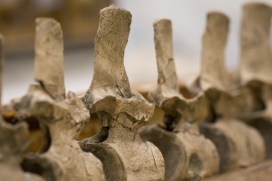
The plesiosaur is 165 million years old and, when alive, was around 5.5 metres long. It had a long neck, a barrel-shaped body, four flippers and a short tail. The find is particularly exciting as the skull was also discovered. It is encased in a clay matrix, which is relatively easy to remove, but the work has to be carried out under magnifying lenses and microscopes.

As the skull is quite small relative to the size of the body, the features are very delicate and it is a painstaking process to remove the sediment without damaging the fossil bone or losing any tiny fragments. Fortunately, pictures of the skull have been produced using CT scanning technology, and the images are proving invaluable as an aid to assist in its preparation. It’s a bit like having a jigsaw puzzle with the picture on the lid to refer to!

sdfsd
A belemnite hooklet at 12x magnification, found with the plesiosaur remains and possibly part of Eve’s last meal

The clay covering the skull is being sieved and examined and tiny hook-shaped fossils have been found. These came from the arms of squid-like creatures called belemnites, which may have formed a large part of the plesiosaur’s diet.

It is too early to say for sure, but Eve could represent a species new to science, as some features, such as the shape of the flipper bones and some of the surfaces of the bone in the skull, are quite unusual. Further research needs to be done before the findings can be published in scientific journals – watch this space.

And if you’re visiting the Museum before 25 July, you can see some of the fossilised remains of Eve for yourself, in our Presenting… display case.

OFoN_logo_green block_small

Making Microsculpture

Microsculpture

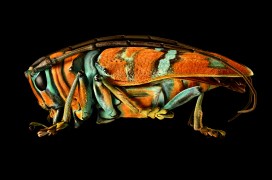
Today we are excited to be opening our new special exhibition, Microsculpture: The Insect Photography of Levon Biss. You may well have already heard about Microsculpture, and have perhaps watched the video showing how Levon Biss made these incredible portraits of insects from the Museum’s collection.

As we open the show in the Museum’s main court we wanted to give a little more insight into the process that Dr James Hogan, an entomologist in our Life Collections, went through to select and describe the specimens for the project. So I put a few questions to James to explain the making of Microsculpture from his point of view.

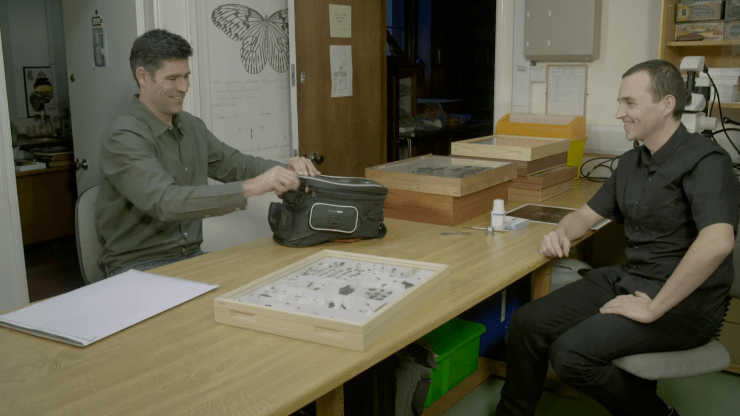
James Hogan (right) selecting specimens with Levon Biss

There are 23 specimens on show in the exhibition: how did you choose these particular ones?
We wanted a wide variety of specimens that would all show some interesting surface detail. Some were also chosen for their spectacular colours, interesting shapes or strange appearance.

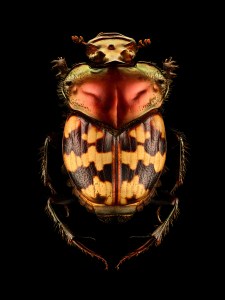
Splendid-necked Dung Beetle (Helictopleurus splendidicollis). From Madagascar. Length: 10 mm
Splendid-necked Dung Beetle (Helictopleurus splendidicollis) from
Madagascar. Length: 10 mm

But perhaps 95 per cent of the specimens we initially considered were rejected because we had some pretty strict criteria; very hairy specimens, which includes most bees, were out as the image processing was too difficult; the specimens had to be intact, so no broken antennae or legs.

Probably the biggest problem was finding specimens which were clean enough. Because Levon’s technique reveals so much detail, any dirt on the specimen is glaringly obvious. And the whole idea was to look at the surface structures, which are obviously very small and easily obscured by any dirt.

How did you prepare them for their close-ups?
All the specimens needed a bit of preparation work before being ready for Levon’s photography. First they needed to be remounted on the end of long pins to allow more clearance space for the lighting setup. Some of the specimens are very small and fragile and this is the stage where damage is most likely to occur.

After remounting, all the insects needed at least some degree of cleaning under the microscope. For this I used a range of fine paintbrushes; we also make our own tools from micro-pins bent into different points and hooks. Again, I had to be careful to not damage the specimens – easily done by over-enthusiastic cleaning!

Where do the specimens come from?
The specimens in the exhibition are from the Museum’s very large insect collection, stored behind the scenes in many different rooms. The insects in the show are from all over the world, from a back garden in England to a remote island near Antarctica. Some were collected over 150 years ago while others were collected very recently by Museum staff.

Of particular historical significance is the Tricolored Jewel Beetle (Belionota sumptuosa) which was collected by the Victorian naturalist and explorer Alfred Russel Wallace, co-publisher of the theory of evolution with Charles Darwin in 1858.

Tricolored Jewel Beetle (Belionota sumptuosa), collected by Alfred Russel Wallace in Seram Island, Indonesia. Length: 25 mm
Tricolored Jewel Beetle (Belionota sumptuosa), collected by Alfred Russel Wallace in Seram Island, Indonesia. Length: 25 mm

How big are the actual specimens in comparison with the photos?
The actual specimens are mostly pretty small, ranging from 6 mm to about 30 mm. Some of the larger printed photographs will be about a thousand times larger than the specimen!

Orchid Cuckoo Bee (Exaerete frontalis) from Brazil. Length: 26 mm
Orchid Cuckoo Bee (Exaerete frontalis) from Brazil. Length: 26 mm

What do you hope people will get out of the pictures in the exhibition?
To me insects are beautiful creatures and Levon has done an outstanding job of revealing this. I hope the photographs will spark people’s interest in insects and inspire more people to study them.

The photographs certainly pose some interesting questions, and reveal that there is so much we don’t know, particularly about the functions of all their strange and varied adaptations.

Is it valuable to showcase specimens from the collections in this way?
One of the most exciting parts of this exhibition for me was the opportunity to show part of the Museum’s collection which visitors don’t normally see.

The collection is used all the time by scientists, artists and educators, but unfortunately most of it is unsuitable for display because the specimens are so small. Levon’s ultra-high resolution photography has in a way solved this problem, allowing us to showcase some of these spectacular, but tiny and fragile creatures in all their beauty.

Looking up

Blue sky

There can be many reasons for a museum’s decision to install a temporary exhibition, but the most powerful is that its visitors have asked for it. While working in the Museum’s shop, Magdalena Molina is often quizzed about the building’s iconic roof, which can be admired as they browse. “What’s it made from? Who designed it? How does it get cleaned?” The most popular question of all is, “Where can I find out more?”.

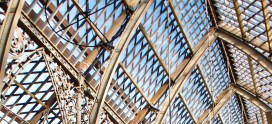
A detail from the roof's rafters
A detail from the roof’s rafters. Credit: Mike Peckett.

Magdalena is an experienced designer, who has worked on various exhibitions, so she approached the Museum with her ideas for a creative, artistic display all about the roof. An exhibition to satisfy the interests of curious visitors.

As a designer I feel inspired by the exquisite design and architecture of the roof of the Museum. Assisting in the shop, I have received a lot of comments from visitors who are fascinated by the building.

Visitor exploring the exhibition

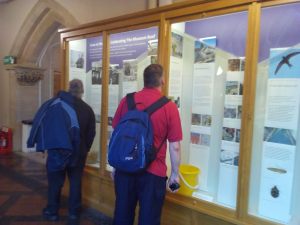
The exhibition, Lives at the Top: celebrating the museum roof, has just opened. It allows visitors to discover the people behind its creation, secrets of its beautiful design and find out how it has been maintained for generations to come.

It begins with the origins of the Museum building, with an architectural competition won by Woodward and Deane, soon followed by the architect’s tragic early death.

Magdalena with one of the Curiosity Boxes

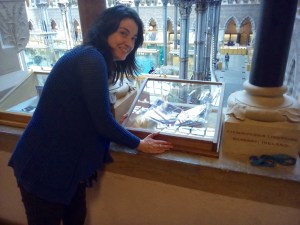
The story continues with the 2013 roof renovation project and moves on to current museum concerns such as pests living up in the rafters. There are also 6 ‘Curiosity Boxes’ to explore, which use mirrors and magnifiers to look at the roof in a new, imaginative way.

Magdalena hopes that visitors will:

Follow the story which celebrates the people involved in the life of this astonishing roof,  and playfully engage with the interactive designed boxes to help them explore different perspectives of the roof.

Magdalena is encouraging visitors to join the celebration of beautiful roofs, ceilings and architectural details, by sharing their photos with us… and the world! Inspired by the Lives at the Top exhibition, we’ve put together a special board on the Museum’s Pinterest account. If you would like to appear on the board, simply share your photo on Twitter or Instagram and tag with #lookingupMNH.

Lives at the Top is open until 13th November 2016.

A scene from the 2013 renovation. Credit: Mike Peckett

Presenting… the wonderful diversity of bees

IMG_7937

Since the launch of our Kurt Jackson exhibition in March, the Museum has gone a bit bee mad. We’ve had themed events for all different audiences; expert beekeepers sharing their top tips with adults, right through to little ones trying on beekeeping outfits and building a giant beehive. There’s even more coming soon, including a talk by Kurt, the artist himself, on 12th May.

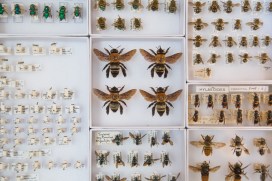
Now the buzz has spread to the Presenting… case, our changing display that shows off real treasures from the collection. The Jackson exhibition focuses on some of the 270 British bees, but this smaller display gives a different perspective, exploring the amazing variety of bees found around the world.

A selection of specimens from the Museum's collection, which shows how varied bees can be.
A selection of specimens from the Museum’s collection, which shows how varied bees can be.

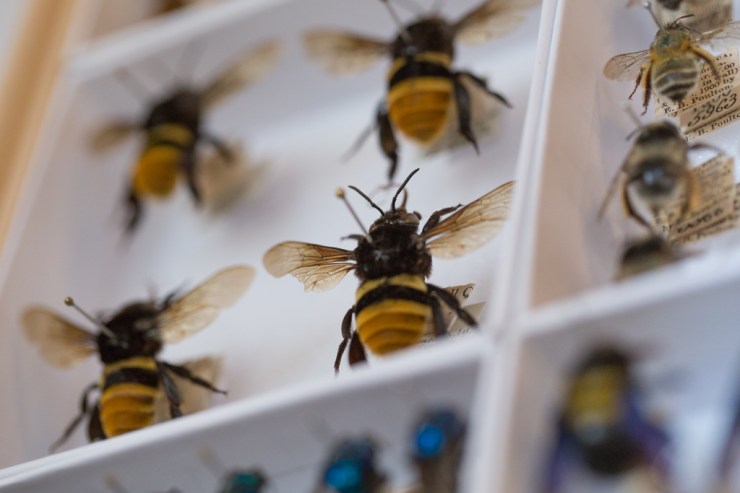
Bees are one of the major groups of insects, numbering about 20,000 described species. Only a very small proportion of bees are the familiar honeybees or bumblebees that we think of first – most species are actually solitary bees. Bees exist in a great diversity of shapes, sizes and colours. In particular the smaller species do not look like bees at all and are often mistaken for small wasps or flies.

Many bees are specialised as pollinators and have evolved together with flowering plants for over 100 million years. In return for pollination services, plants provide nectar, pollen and other substances to bees.

IMG_7933Although most are specialist pollinators, about 10 per cent of bee species are parasites of other bees, taking advantage of the nectar and pollen collected by their host to feed their own young. These parasitic bees can be quite strange in appearance – not needing to collect pollen they have typically lost most of their hair and appear more like wasps.

The Museum has one of the most important bee collections in the world, containing specimens collected over 200 years ago and from many different countries. The star bee specimen, and one of the Museum’s greatest treasures, has to to be Wallace’s Giant Bee (Megachile pluto). This is the first time it has been on open display to the public.

Wallace
Wallace’s Giant Bee (Megachile pluto) alongside a honeybee (Apis mellifera)

It was captured by the Victorian explorer and naturalist Alfred Russel Wallace in 1859. Only found on the Indonesian island of Bacan and its two neighbouring islands, this giant was believed to be extinct until it was re-discovered in 1981. The massively enlarged mandibles of the female are used for collecting tree resin and excavating tunnels in termite nests. To give an impression of scale, Wallace’s Giant Bee is shown here next to a familiar honeybee (Apis mellifera).

You have just a couple of weeks left to appreciate the wonderful diversity of bees, before it closes on 16th May.

‘Father of English geology’

William_Smith

by Kate Diston, Head of Archives and Library

Today marks the 247th birthday of William Smith. “Who’s he?”, you may well ask. William Smith is perhaps one of the least well-known, yet very significant, figures in the history of the science. Among other things, he created the very first geological map of England and Wales, 200 years ago.

Smith’s work as a land surveyor and mining engineer in the early days of the Industrial Revolution allowed him to understand first-hand how the layers, or strata, of rock beneath the earth are related to those above and below them. From this, he realised you could predict those three-dimensional layers in other locations and also represent the whole thing on a two-dimensional map.

Smith_1815Map
A section of the famous 1815 geological map of England and Wales
IMG_4696
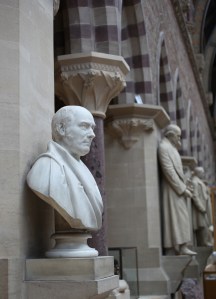
William Smith’s bust in the Museum court

If you visited us in the past few months you may have seen lots of Smith’s maps and other material in Handwritten in Stone, our special exhibition which celebrated his life and work. Now, a new exhibition featuring copies of items from our collections is opening in Smith’s birthplace of Churchill, Oxfordshire.

The displays at the Heritage Centre in Churchill take a very different look at the ‘father of English geology’, offering a rare glimpse of Smith’s personal correspondence with his family.

In honour of Smith’s birthday, we showed off his most famous work, the beautifully coloured 1815 map, in front of his bust in the Museum court today. As one of the Museum’s treasures not normally on display, it is a real treat to see it being admired by visitors.

20160323_151319
Visitors get a close look at the original 1815 map with Chris Jarvis

The calm before the swarm

IMG_7427
Juliet and Pete painting wooden panels ready to hang Kurt’s work

In just 24 hours, our brand new exhibition will be open to the public. Bees (and the odd wasp) in my bonnet has been over a year in the making, but it’s all finally falling into place and an unexpected calm has set in.

The exhibition is an arts/science collaboration, with vibrant artwork by Kurt Jackson alongside bee specimens from the Museum’s collection and the latest scientific research on threats to British bee populations. Pop in and see it between 18 March and 29 September.

But let’s lift the gallery barrier and take a peek at some of the hard work that goes into putting an exhibition like this together.

IMG_7586
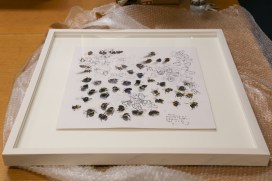
One of Kurt Jackson’s paintings is unwrapped

Back in November 2014, we first met with Kurt Jackson to discuss a new direction in his work. Famous for dramatic, dynamic landscape paintings, he had recently become particularly fascinated by bees.

He thought the Museum would be the perfect place to exhibit his new paintings and sculptures and, of course, we agreed.

Measuring 'Hives' bronze sculptures
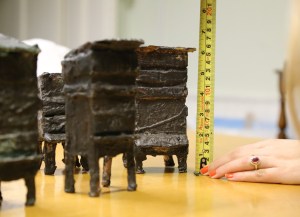
Measuring ‘Hives’ bronze sculptures

Fast forward 15 months and these works arrived at the Museum, couriered all the way from Kurt’s home and studio in Cornwall. We then spent several days unpacking, measuring, examining and photographing each of the pieces.

When the Museum takes on loan items, we need to fill in object condition reports so we can be sure how they come into the building… and how they leave at the end of the show! With 57 pieces to work through, it was a painstaking process, but we all relished the opportunity to get up close to the beautiful artworks. Holding them in our hands and visualising them on display was a special experience.

Examining the back of one of the largest paintings in the exhibition, "Vespa".
Examining the back of one of the largest paintings in the exhibition, “Vespa”.

While Kurt was painting, drawing and sculpting to create these works, we were also working hard preparing the exhibition space to show them off. Pete Johnson and Adam Fisk, from the Museum’s workshop, created large wooden panels to hang paintings, installed all sorts of intriguing 3D works and suspended fabric banners, to name but a few challenges. They’ve done a great job in creating a contemporary art gallery space in a Victorian museum.

IMG_7842
One specimen for each of the 270 British bee species

Bees are fascinating for artists and scientists alike. The scientific specimens and text panels interspersed among the artworks draw attention to the amazing diversity of British bees (almost 270 species in total) and explore the causes of population decline.

This was put together by James Hogan, in our Life Collections, but included further expert advice from Professor Dave Goulson of the University of Sussex and Professor Charles Godfray of Oxford University, to ensure all of the research was accurate and right up to date.

As we tick off the last tasks on our to do list, I can’t wait to see the exhibition buzzing with visitors from tomorrow morning.

Rachel Parle, Interpretation and Education Officer