Presenting… the wonderful diversity of bees
IMG_7937

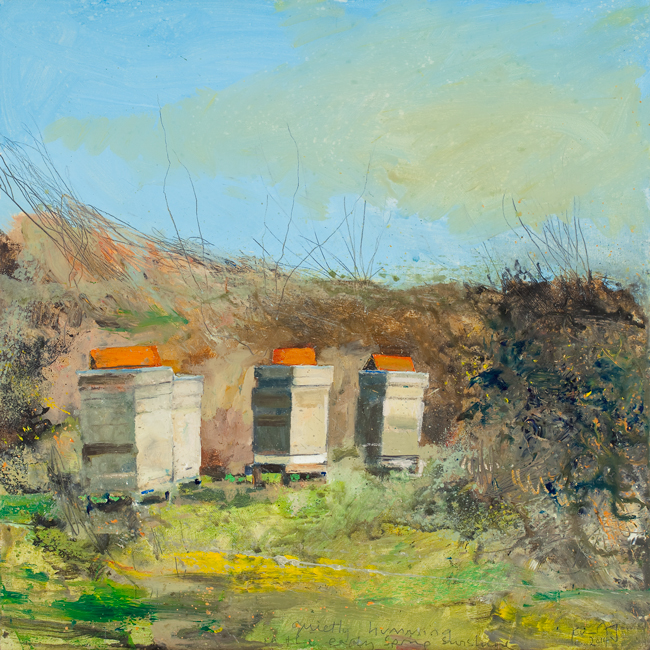
Since the launch of our Kurt Jackson exhibition in March, the Museum has gone a bit bee mad. We’ve had themed events for all different audiences; expert beekeepers sharing their top tips with adults, right through to little ones trying on beekeeping outfits and building a giant beehive. There’s even more coming soon, including a talk by Kurt, the artist himself, on 12th May.

Now the buzz has spread to the Presenting… case, our changing display that shows off real treasures from the collection. The Jackson exhibition focuses on some of the 270 British bees, but this smaller display gives a different perspective, exploring the amazing variety of bees found around the world.

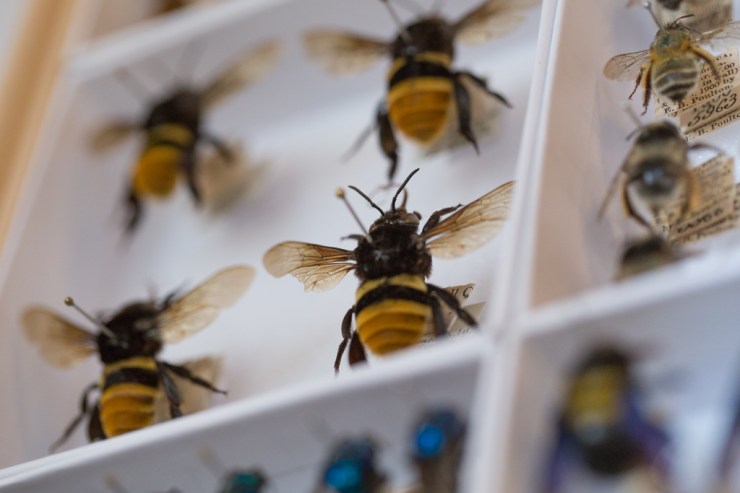
A selection of specimens from the Museum's collection, which shows how varied bees can be.
A selection of specimens from the Museum’s collection, which shows how varied bees can be.

Bees are one of the major groups of insects, numbering about 20,000 described species. Only a very small proportion of bees are the familiar honeybees or bumblebees that we think of first – most species are actually solitary bees. Bees exist in a great diversity of shapes, sizes and colours. In particular the smaller species do not look like bees at all and are often mistaken for small wasps or flies.

Many bees are specialised as pollinators and have evolved together with flowering plants for over 100 million years. In return for pollination services, plants provide nectar, pollen and other substances to bees.

IMG_7933Although most are specialist pollinators, about 10 per cent of bee species are parasites of other bees, taking advantage of the nectar and pollen collected by their host to feed their own young. These parasitic bees can be quite strange in appearance – not needing to collect pollen they have typically lost most of their hair and appear more like wasps.

The Museum has one of the most important bee collections in the world, containing specimens collected over 200 years ago and from many different countries. The star bee specimen, and one of the Museum’s greatest treasures, has to to be Wallace’s Giant Bee (Megachile pluto). This is the first time it has been on open display to the public.

Wallace
Wallace’s Giant Bee (Megachile pluto) alongside a honeybee (Apis mellifera)

It was captured by the Victorian explorer and naturalist Alfred Russel Wallace in 1859. Only found on the Indonesian island of Bacan and its two neighbouring islands, this giant was believed to be extinct until it was re-discovered in 1981. The massively enlarged mandibles of the female are used for collecting tree resin and excavating tunnels in termite nests. To give an impression of scale, Wallace’s Giant Bee is shown here next to a familiar honeybee (Apis mellifera).

You have just a couple of weeks left to appreciate the wonderful diversity of bees, before it closes on 16th May.

‘Father of English geology’

William_Smith

by Kate Diston, Head of Archives and Library

Today marks the 247th birthday of William Smith. “Who’s he?”, you may well ask. William Smith is perhaps one of the least well-known, yet very significant, figures in the history of the science. Among other things, he created the very first geological map of England and Wales, 200 years ago.

Smith’s work as a land surveyor and mining engineer in the early days of the Industrial Revolution allowed him to understand first-hand how the layers, or strata, of rock beneath the earth are related to those above and below them. From this, he realised you could predict those three-dimensional layers in other locations and also represent the whole thing on a two-dimensional map.

Smith_1815Map
A section of the famous 1815 geological map of England and Wales
IMG_4696
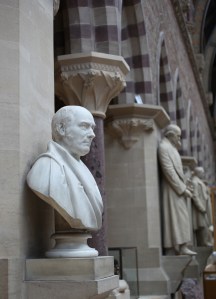
William Smith’s bust in the Museum court

If you visited us in the past few months you may have seen lots of Smith’s maps and other material in Handwritten in Stone, our special exhibition which celebrated his life and work. Now, a new exhibition featuring copies of items from our collections is opening in Smith’s birthplace of Churchill, Oxfordshire.

The displays at the Heritage Centre in Churchill take a very different look at the ‘father of English geology’, offering a rare glimpse of Smith’s personal correspondence with his family.

In honour of Smith’s birthday, we showed off his most famous work, the beautifully coloured 1815 map, in front of his bust in the Museum court today. As one of the Museum’s treasures not normally on display, it is a real treat to see it being admired by visitors.

20160323_151319
Visitors get a close look at the original 1815 map with Chris Jarvis

The calm before the swarm

IMG_7427
Juliet and Pete painting wooden panels ready to hang Kurt’s work

In just 24 hours, our brand new exhibition will be open to the public. Bees (and the odd wasp) in my bonnet has been over a year in the making, but it’s all finally falling into place and an unexpected calm has set in.

The exhibition is an arts/science collaboration, with vibrant artwork by Kurt Jackson alongside bee specimens from the Museum’s collection and the latest scientific research on threats to British bee populations. Pop in and see it between 18 March and 29 September.

But let’s lift the gallery barrier and take a peek at some of the hard work that goes into putting an exhibition like this together.

IMG_7586
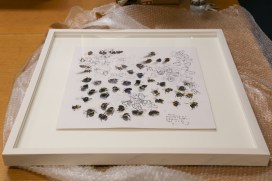
One of Kurt Jackson’s paintings is unwrapped

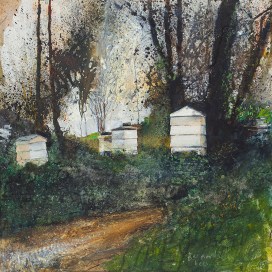
Back in November 2014, we first met with Kurt Jackson to discuss a new direction in his work. Famous for dramatic, dynamic landscape paintings, he had recently become particularly fascinated by bees.

He thought the Museum would be the perfect place to exhibit his new paintings and sculptures and, of course, we agreed.

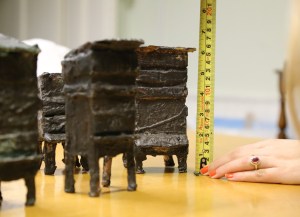
Measuring 'Hives' bronze sculptures
Measuring ‘Hives’ bronze sculptures

Fast forward 15 months and these works arrived at the Museum, couriered all the way from Kurt’s home and studio in Cornwall. We then spent several days unpacking, measuring, examining and photographing each of the pieces.

When the Museum takes on loan items, we need to fill in object condition reports so we can be sure how they come into the building… and how they leave at the end of the show! With 57 pieces to work through, it was a painstaking process, but we all relished the opportunity to get up close to the beautiful artworks. Holding them in our hands and visualising them on display was a special experience.

Examining the back of one of the largest paintings in the exhibition, "Vespa".
Examining the back of one of the largest paintings in the exhibition, “Vespa”.

While Kurt was painting, drawing and sculpting to create these works, we were also working hard preparing the exhibition space to show them off. Pete Johnson and Adam Fisk, from the Museum’s workshop, created large wooden panels to hang paintings, installed all sorts of intriguing 3D works and suspended fabric banners, to name but a few challenges. They’ve done a great job in creating a contemporary art gallery space in a Victorian museum.

IMG_7842
One specimen for each of the 270 British bee species

Bees are fascinating for artists and scientists alike. The scientific specimens and text panels interspersed among the artworks draw attention to the amazing diversity of British bees (almost 270 species in total) and explore the causes of population decline.

This was put together by James Hogan, in our Life Collections, but included further expert advice from Professor Dave Goulson of the University of Sussex and Professor Charles Godfray of Oxford University, to ensure all of the research was accurate and right up to date.

As we tick off the last tasks on our to do list, I can’t wait to see the exhibition buzzing with visitors from tomorrow morning.

Rachel Parle, Interpretation and Education Officer

Visions of 2016

Bee 1

This year promises to be a little bit different. We’re looking at the Museum and its collections from a new point of view – through the eyes of artists, photographers and writers. We’re presenting different ‘visions’ of the natural world in a series we’ve called Visions of Nature. With a title borrowed from John Ruskin, there’s a definite nod to our Pre-Raphaelite roots, but there will be plenty of opportunities for an up-to the minute look at natural history, too. Here’s a few more details about what we’re planning…
Bee 2_crop

Kicking off this year’s exhibition programme will be a brand new show from artist Kurt Jackson. You may know his dramatic landscapes or even his work as artist in residence at Glastonbury, but this time, insects are the focus for his brush, pencil and chisel.

In Bees (and the odd wasp) in my bonnetwe’re bringing together Jackson’s beautiful paintings, sculptures and sketches with specimens from the Museum’s enormous bee collection and the latest contemporary research into bee population decline.

Bee 7

At the moment we’re choosing which specimens to include and are eagerly looking forward to a trip down to Kurt Jackson’s home in Cornwall to collect the artworks. With each bee pinned in place and every last painting hung perfectly, we’ll be opening the exhibition on Friday 18th March. There are lots of exciting events focussed around bees, too – including a special tour and talk by Jackson himself and a workshop run by a local beekeeper that describes how a bee colony changes over the course of a year. You can book a place on these and more here.

Exaerete Frontalis_Side View_v20

Next up will be Microsculpture; The insect photography of Levon BissThis really will make you see insects in a different light, with 10mm specimens blown up to 3m prints, all on display in the Museum court. Over the last couple of years, Levon, who is famous for dramatic photographic portraits of sports, music and film stars, has been working with James in our Life Collections team to select bizarre and beautiful insects. The result is a collection of beautifully-lit, high magnification portraiture that celebrates the amazing diversity of the insects and their morphology.

Visions of Nature logo_Single logoThe final third of the year will be centred around a literary vision of nature. We’ll be collaborating with some of our favourite natural history writers from the worlds of fact and fiction to offer an exciting programme of talks, debates and workshops. Key to this part of the year will be our poets in residence. Throughout 2016, three poets, John Barnie, Steven Matthews, and Kelley Swain, will be working alongside staff in our collections and out in the Museum itself to gain inspiration for their writing.
In the autumn, they will take part in a number of events and activities to present their work, and will be publishing a small anthology at the end of the year.

With plenty of other ideas in the mix, including exhibitions by Oxfordshire artists and photographers exploring the natural world and even a possible comedic vision of nature, there’s far too much to include here. So, there’s a dedicated Visions of Nature site, where you can find out about the poets’ latest inspiration, which exhibitions are opening soon, and what events you can sign up for. An exciting year ahead!

Secretarial work

After Treatment 2

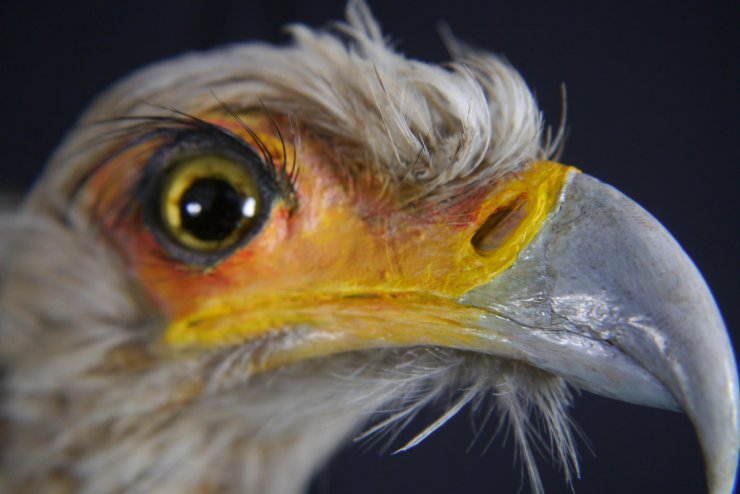
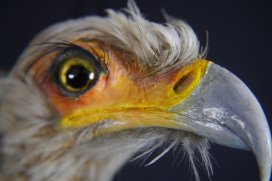
Our striking Secretary Bird stands at over 1 metre tall and should be one of the most impressive specimens in the Museum, but it hasn’t been looking its best for a while. This African bird of prey was looking rather sorry for itself, with scruffy feathers and moth damage. Conservation intern Ruth Murgatroyd stepped in to bring it back to its former glory.

**

Wrapped and ready for the freezer

The first step for any specimen undergoing conservation treatment is a 72 hour spell in the freezer at -30⁰C. This kills off any inhabiting webbing clothes moths, which can be very destructive to taxidermy specimens. Getting ready for the freezer required some creative packaging to protect the characteristic quill shaped plumage and tail feathers, before wrapping in plastic.

The feathers would need a good groom, which is a lot easier once they’re clean. I used dry methods first, including a brush dust with a vacuum cleaner and the very effective use of cosmetic sponges. The feathers were further cleaned with a gentle non ionic detergent in water and rinsed with a water/ethanol mix. I used a paint brush to dab the solution onto each feather individually.

Ruth cleaning tail feathers

When the feathers were clean and dry they were groomed to realign the filaments of the feathers, known as barbules. Parts of the bird’s tail and right wing were missing, so as this is a display specimen, we decided it was appropriate to recreate these areas to more accurately represent what the bird looks like in the wild. Any additions had to be easily identifiable and reversible. Goose feathers were sourced and colour-matched with Orasol dyes. They are now held in place by adjacent feathers and give a much more natural appearance.

Before treatment, with missing wing and tail feathers

The face of the Secretary Bird had been previously painted but this was quite faded in colour compared to the buoyant oranges and yellows of the animal in the wild. We decided to reflect this with a touch up. The new layer was painted in with acrylics, but a base layer of water soluble adhesive now protects the original paint, so layers of paint could be taken back at any time.

The finishing touch to the conservation of a taxidermy specimen is often to make sure the eyes are clean and gleaming. Saliva on a swab is really effective for this.

The Secretary Bird was then ready to go back in its newly-polished case. This had also been lined with UV film to protect the specimen from light damage. Just before it went back on display, the bird made an appearance at the Museum’s daily ‘Spotlight Specimens’ session where it met visitors keen to hear about its recent conservation.

Secretary Bird  back on display
Secretary Bird back on display

Pop in to the Museum to see the finished Secretary Bird on display and standing tall .

Ruth Murgatroyd, Conservation Intern

So long, 2015…

IMG_6901-Edit

As you can tell from the adornment of our Red Deer, Christmas is upon us, so it’s nearly time to bid farewell to another year. It’s been another remarkable twelve months here at the Museum so here’s a little round up a few highlights from 2015…

As winter gave forth to spring
News emerged of a heartwarming thing
The Art Fund whispered in our ear
We were nominees for Museum of the Year!

Although eventual winners we were not
It mattered really not one jot
For in celebration we embarked
On the Dodo Roadshow – a tremendous lark

Back in April we’re pleased to say
Another award came our way
Goes to Town gave creatures free reign
And grabbed a gong for Marketing Campaign

But we weren’t always on the road
In our exhibitions many stories were told
Of evolution, geology and sensory powers
Science and research passed the visitors’ hours

Our doors were open without interruption
While out on the lawn was a volcanic eruption
University scientists had plenty to say
On a really Super Science Saturday

So to our schools, and families, and adults and more
Thank you, cheers, and thank you some more

Here’s our programme for January to April. See you in 2016…