A slice of science with your cuppa

IMG_1084

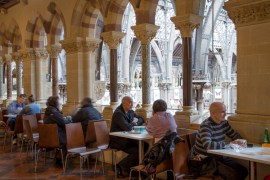
The view from the Museum’s upper gallery has always been spectacular; it’s the best place to admire the roof’s decorative iron work or to spot the dinosaurs lurking below. But add a great cup of coffee and a slice of cake to the experience and it steps up to a new level of pleasure. So it’s been fantastic to see so many happy visitors enjoying a break in our brand new café, Mortons at the Museum.
IMG_1127But we know that our visitors are a discerning bunch and are keen to learn, even when they’re enjoying elevenses, so we’ve installed a new display that runs the length of the upper gallery. A-Z is a taster of 26 natural history topics for you to get your teeth into.

From A for Adaptation to Z for Zoogeography, the alphabetical adventure whizzes past terms as diverse as Nocturnal and Living FossilIt’s designed so that you can take a pick and mix approach to whet your appetite, before devouring the large-scale displays around the Museum.
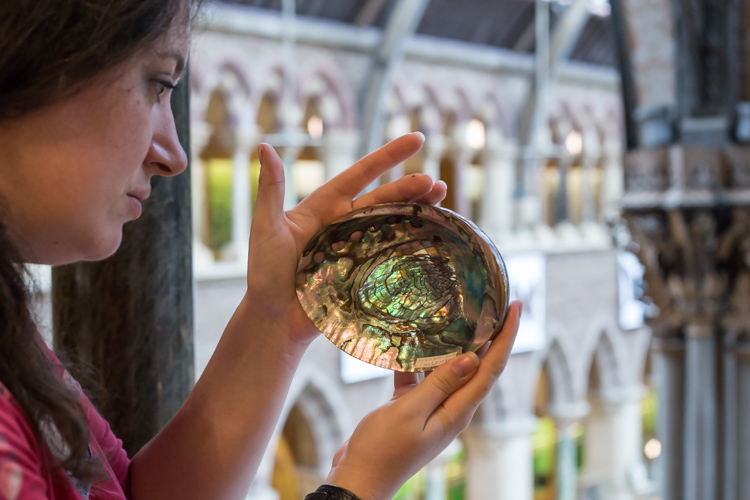
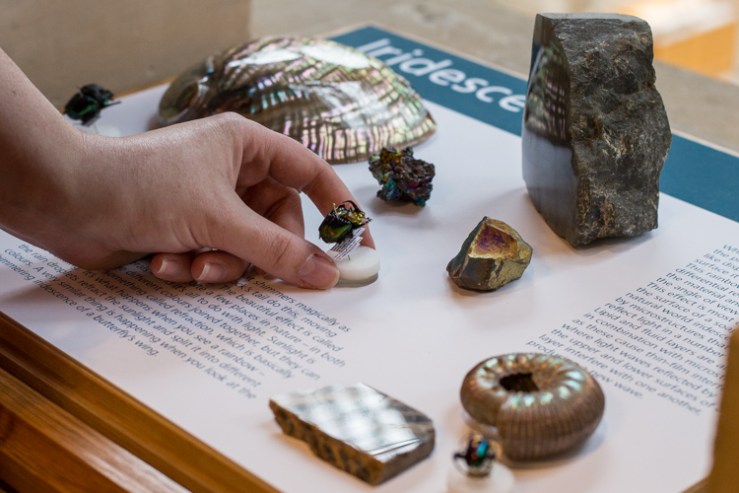
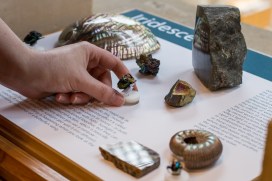
Zoë Simmons examining an abalone shell ready for the Iridescence case.
Zoë Simmons examines a Haliotid shell for the Iridescence case.

Zoë Simmons, of the Museum’s Life Collections, curated A-Z. She says that “One of the greatest challenges of the project was working on a display that encompasses such a wide range of subjects and crosses all disciplines of the Museum’s collections. I learnt a lot whilst researching and writing up the text for these displays.

“My favourite case is Iridescence. Not only is it full of beautiful rainbow-hued objects, but it has examples from all areas of the collections. There’s a fossilised ammonite, peacock ore, a Nectarinia bird, a jewel scarab and a Haliotid shell. It’s wonderful to be able to put a truly multi-disciplinary case together, as the opportunity is rare.”
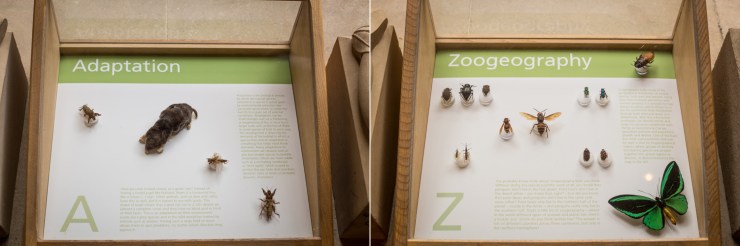
A to Z

Each case has two levels of interpretation; a shorter, more light-hearted piece of text pitched at an average 10 year old visitor (though enjoyed by big kids too!), plus a more in-depth explanation for those who prefer a bit more science with their snacks.

IMG_1122
Lovely cakes in the new Café.

Tea and Typescake and Camouflage and sandwiches and Stromatolite seem to sit well together. Next time you’re experiencing museum fatigue, join us for a little nibble of natural history up in our brand new café.

Bon appétit.

Rachel Parle, Interpretation and Education Officer

A little piece of history

Glass tiles

Regular readers of our closure blog, Darkened not Dormant, will know all about our Goes to Town project, where twelve plucky specimens escaped from the Museum for an eight month holiday in venues all around Oxford city centre. Like any good treasure hunt, the Goes to Town trail presented a competition which promised a valuable prize…

The framed fragment of roof tile, presented to the Goes to Town competition winners

Each of the twelve specimens carried two ratings, one for Danger and one for Rarity. To enter the competition, trail hunters needed to find all the displays and then tell us which specimen was rated most dangerous and which most rare. The most dangerous was the Snowy Owl, the sharpest living predator on the trail; and the rarest were the animals from Alice’s Adventures in Wonderland which are, of course, completely fictional. If you entered without checking all the specimens and guessed that the Dodo would be the rarest then we caught you out – sorry!

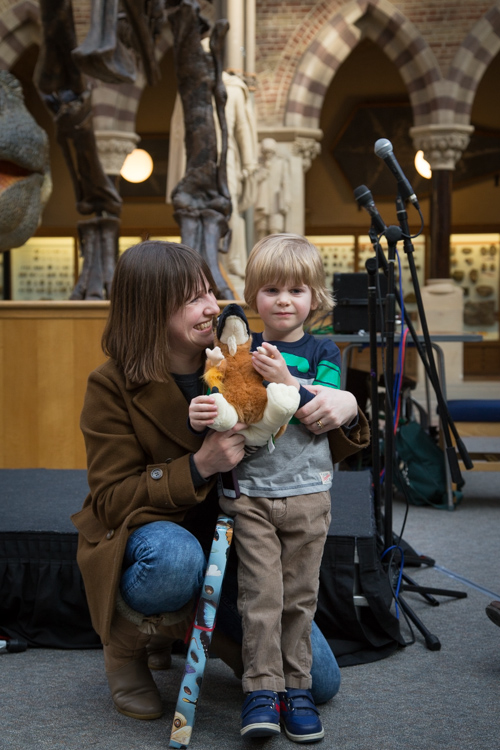
Winners also got a cuddly dinosaur.
Which is best – piece of glass, or cuddly dino?

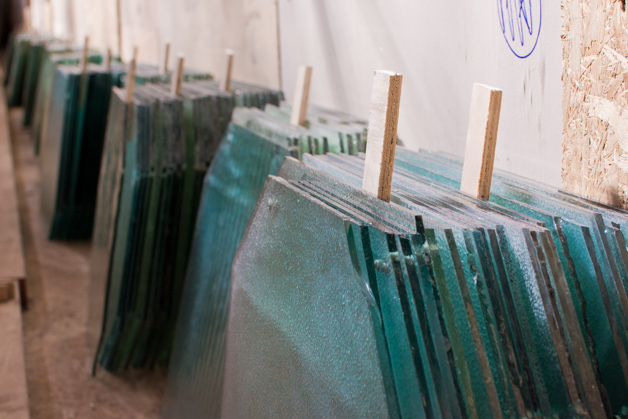
Around 80 people entered the competition and three winners were chosen at random. We held a little award ceremony on our reopening day on Saturday 15 February, where all three winners attended to receive their prizes. And the prizes were quite special. One was a cuddly dinosaur toy (always special, right?) and the other was a small framed, cut fragment of one of the glass tiles from the Museum’s roof.

The whole reason for our closure last year was to have the original Victorian roof repaired, so we felt that it was a fitting prize to present a little piece of the fabric of the roof – a little piece of history – to the winners. Congratulations again to the three winners and we hope those small fragments of the Museum are now hanging proudly on three walls somewhere in Oxford.

IMG_0883
Adults get the cuddly dino too, of course.
Museum directo Professor Paul Smith presents the prizes
Museum director Professor Paul Smith presents the prizes.

Breakout!

8.Ident

I bring you breaking news from the Museum of Natural History. As you all know, the Museum has been closed for over a year and, during that time, a number of our specimens have been popping up in unlikely places around Oxford city centre.

The Goes to Town project has seen a penguin in the fish mongers, a bank vole in the bank and a book worm in a book shop. All was going swimmingly until today.

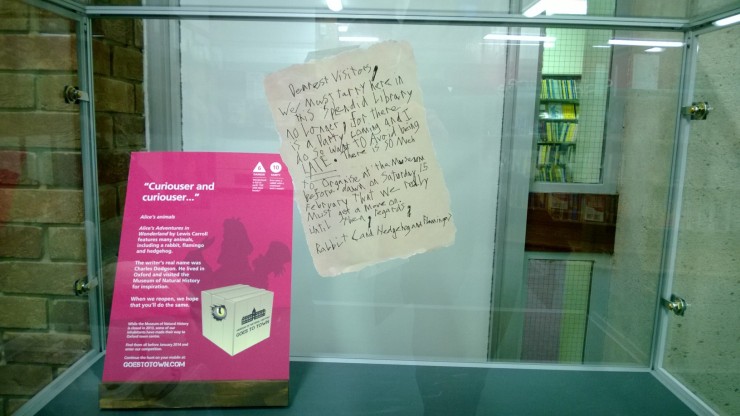
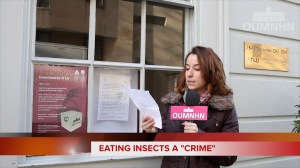
3.RachelSeriousWe’ve been receiving reports from several of our Goes to Town venues that there’s been a breakout. The snowy owl has vanished from the University Church, the edible insects have escaped from the Turl St Kitchen and a white rabbit is on the loose from the Central Library. There’s trouble afoot.

We’ve put together a special bulletin of Oxford University Museum of Natural History News.

Scott Billings at St Mary the Virgin Church
Scott Billings at the University Church

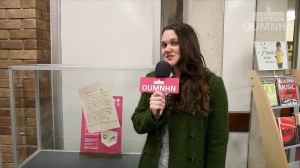
Reporters Bethany Palumbo, Jess Suess and Scott Billings joined me to bring you the latest story direct from the scene.

The mystery has been give an even more intriguing twist by the appearance of letters left behind by the escaped specimens. Each creature has its own motive for abandoning its case, but there is a definite theme throughout; they’re all coming home!

A note left behind by the white rabbit, Oxford Central Library
Bethany Palumbo at Turl St Kitchen

As each report unfolds, it’s clear that the specimens have escaped in order to return to the Museum, ready for our re-opening on Saturday 15th February.

So, who is behind this mass escape? Watch the report video to find out.

Jessica Suess at Oxford Central Library

The Museum of Natural History will be the place to be on Saturday 15th February. Even the Goes to Town specimens don’t want to miss out on the action! Join us then, dawn till dusk.

Rachel Parle, Interpretation and Education Officer
Natural Histories: On Tour

Order

In May this year we opened Natural Histories, our collaborative exhibition with the Museum  of the History of Science on Oxford’s Broad Street, who hosted the displays. As we wrote at the time, it was a great opportunity to put on view some lovely and important specimens while we were closed. It also linked nicely with the long history of the museums in Oxford, beginning as far back as 1683.

Lost and FoundIt was a lot of hard work pulling together all the material, themes, and displays for Natural Histories so we were particularly pleased when Banbury Museum, one of the University museums’ development partners, approached us asking if the exhibition might tour there…

And so it has. It’s a short, one-stop tour admittedly, but with a bit of jiggling and reconfiguration here and there, the whole Natural Histories show is now open to the public in Banbury.

Banbury MuseumSo if you missed it at the Museum of the History of Science, head over to Banbury Museum by 22 February 2014 and have a look.

There’s plenty to see, including the jawbone of the Oxfordshire Megalosaurus, the world’s first scientifically-described dinosaur; creatures collected by Charles Darwin; and a meteorite the age of the Earth itself. With touchable specimens too (of course), Natural Histories explores some big themes and ideas that have shaped our understanding of the natural world.

But as the finished exhibition is now on display for all to see, here instead are a few behind-the-scenes shots of the late night measuring, painting, fixing and adjusting that were needed to get everything ready for opening day last Saturday. Thanks very much to everyone who mucked in and helped out.

_DSC1117
Making a few adjustments…
An almost-closed case
Almost ready for closure
_DSC1126
Finding the spot
Glass cleaner at the ready

_DSC1138

Scott Billings – Communications coordinator

Am feeling quite jolly!

"Many thanks for kind congratulations – am feeling quite jolly!"
“Many thanks for kind congratulations – am feeling quite jolly!”

This lovely example of Alfred Russel Wallace’s beautiful handwriting and cheerful nature was written to chemist and Wallace’s good friend Raphael Meldola. He wrote it on his 90th (and sadly last) birthday. It is particular favourite of Annette Lord, who has scanned and transcribed the Museum’s collection of 300+ Wallace documents.

Fungus weevils (Anthribidae) collected by Wallace

Today marks 100 years since Wallace’s death and provides a good opportunity to reflect on his achievements. We’ve set up a display in the Museum to mark the occasion and show some of the most impressive Wallace specimens in our collection. Wallace travelled to remote, dangerous parts of the world in search of new and fascinating species. He was a meticulous and careful collector; you can’t help but marvel at how the incredibly long antennae of these beetles survived the journey back to Britain!

Wallace is now credited by many as co-author of the theory of evolution through natural selection, so it is very exciting to hear that today Sir David Attenborough is due to unveil a statue to the great man at the Natural History Museum in London.

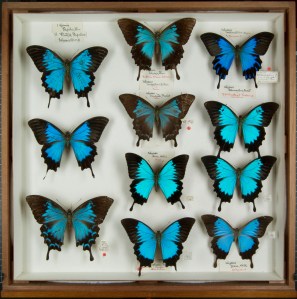
Ulysses Butterflies (Papilio Ulysses)
Ulysses Butterflies (Papilio Ulysses) collected by Alfred Russel Wallace

Wallace is not a household name like his collaborator Charles Darwin, but naturalists and Wallace fans all over the world will appreciate this gesture and the new interest in his work that this will promote.

If you would like to know more about Alfred Russel Wallace, you may like to see this new slideshow that the BBC have released today. It tells the story of his life and works and is narrated by Sir David Attenborough, one of Wallace’s greatest supporters.

Rachel Parle, Education Officer


Why Wallace?

David Attenborough in the Museum with Wallace's Giant Bee
Sir David Attenborough in the Museum with Wallace’s Giant Bee

Sir David Attenborough is arguably the world’s most famous living naturalist and broadcaster. Here he sits in the Museum of Natural History, holding our priceless Wallace’s Giant Bee specimen. So why did a man as important (and busy!) as Attenborough take the time to pose for our photo? It’s because Attenborough, like thousands of other natural history enthusiasts, knows that Alfred Russel Wallace is one of the greatest naturalists, geographers and explorers of all time. So what’s so great about him? Why are we dedicating Wallace Week to celebrating his work?

Chris Jarvis, Education Officer, explain why he thinks Wallace is so special…

Chris at Sedgwick
Chris Jarvis at the Sedgwick Museum

Last week I gave a talk on Alfred Russel Wallace at the Sedgwick Museum in Cambridge. I was asked ‘Why does Wallace deserve the statue next to Darwin’s, which he’s likely to get in London’s Natural History Museum?’ My answer was that ‘He deserves a statue as an inspiration on the importance of following your own interests, despite the barriers that may stand in your way’.

Unlike Darwin, Wallace was a largely self-made man. Born into a large family (he was the 8th of 9 children) that was always on the edge of financial disaster, Wallace was inspired by his love of the natural world around him and encouraged to explore it. Later he wrote that he could recall virtually every detail of the environment of the river Usk that was his playground but could hardly remember anything of his family, even faces, from that time! His love of the great outdoors led him to teach himself botany and entomology and how to collect, identify and preserve insects. Today, at a time when many children are being diagnosed as suffering from ‘Nature Deficit Disorder’ Wallace is a particularly pertinent example of the benefits of exploring the natural world.

At school, Wallace described himself as a ‘dull, ignorant and uneducated person’. Lessons were basic and dry and he left school finally in 1837 aged 14. Ironically for the father of Biogeography it was Geography that he found the driest of subjects, after Latin grammar!

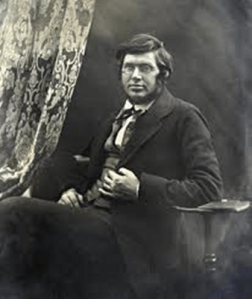
Young Wallace
Young Wallace

Despite this, Wallace was a voracious reader and seems to have sought out his own curriculum. His family, although poor in other ways, always had interesting books around the house and Alfred was introduced to libraries, museums and working men’s institutes from an early age. His favourite books as a child included ‘Gulliver’s Travels’, ‘Robinson Crusoe’ and Mungo Park’s ‘Travels in West Africa’ and clearly fuelled the lust for adventure that led to his collecting trips in the tropics.

Wallace’s understanding of the importance of self-education and modest beginnings led him to be a firm supporter of the aphorism that ‘knowledge is power’ and he was involved in advising on setting up public libraries, museums and other free institutions that encouraged education throughout his life. His legacy, as important as all his discoveries and theories are, is surely as an inspiration to all of us to get out into nature, to read about what you find there and then share that knowledge with others, it may lead you to some amazing places and discoveries as it did Wallace!