Getting about

Westwood

With our Goes to Town exhibits in place all over Oxford city centre, we are keeping our collections hard at work even while the Museum is closed. But it isn’t just our specimen collections that are getting all the action – material from the Archives has journeyed outside the Museum walls too…

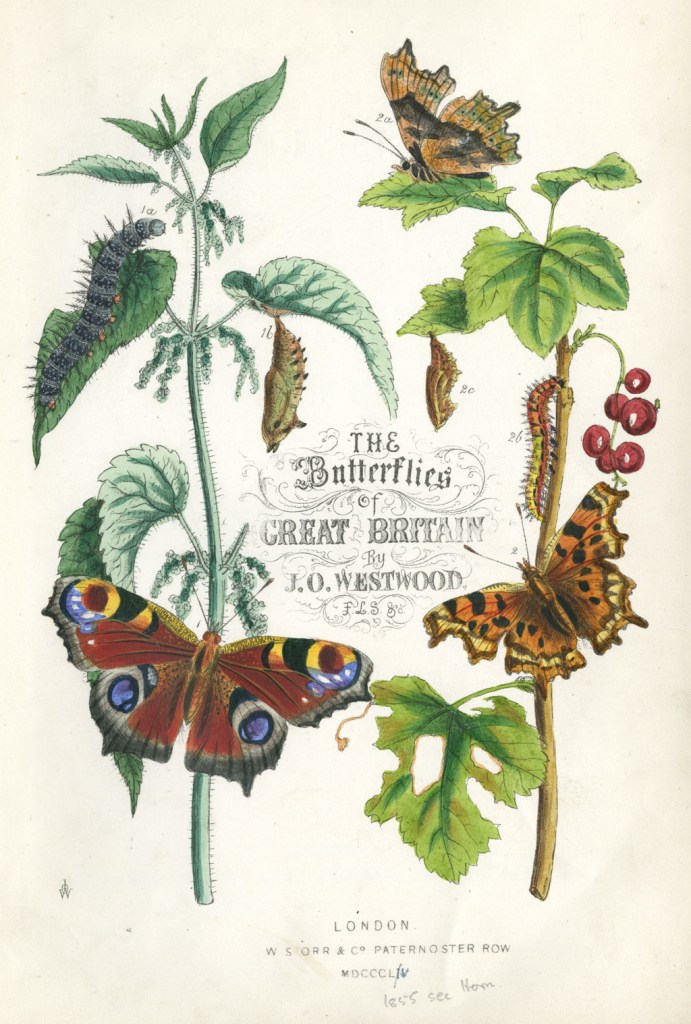
In association with the Friends of Summertown Library, we have put together a display from our archival collections celebrating former Summertown resident and Museum scientist John Obadiah Westwood. Westwood was the first Hope Professor of Zoology at the University in the late 19th century, and in addition to being a leading figure in the development of entomology as an academic discipline, he was also an amazing artist.

Westwood was so well known for his ability to accurately capture the details of insect specimens in his own work that he was commissioned to complete illustrations for a number of important entomological texts of his time.
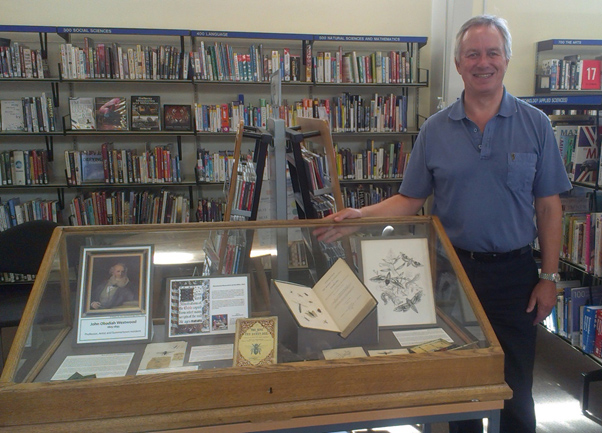
Chairman of the Friends of Summertown Library, Marcus Ferrar, with the display at Summertown Library

Our archive is full of examples of Westwood’s talents, though most of his drawings have never been on display to the public before. This first-of-a-kind display for our Archive features a number of original copies of his work, including drawings of butterflies, beetles and even medieval manuscripts. It also features lots of interesting facts about Westwood, including his love of gardening and his fascination with biblical texts.
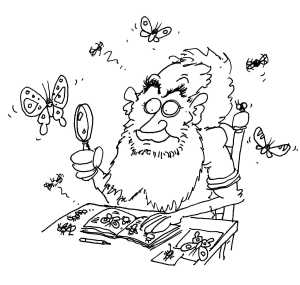
Westwood by Chris JarvisThe exhibit in Summertown Library runs until 18 October 2013 and can been seen during library opening hours. If you’re there with children don’t forget to ask for a Museum of Natural History colouring sheet, featuring this drawing of Westwood in action by our other talented Museum artist and Education Officer, Chris Jarvis.

A big thanks goes to the Friends of Summertown Library for working with us to make this unique opportunity happen. Do let us and the library know what you think.

Kate Santry, Head of Archival Collections

Look out Oxford…

GTT

There’s a flurry of last minute activity around here at the moment. Display cases are being collected; a funny proto-human ape creature model is being cleaned and prepared for the limelight; and logo-adorned lab coats are being freshly starched and pressed. We are preparing to go to town.

Mobile site
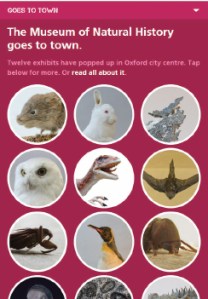
The smartphone-friendly Goes to Town website

You may have seen our teaser trailer a few weeks back. If not, you can check it out here. It didn’t give much away, but regular readers of this blog deserve a proper heads-up: Next week we will be installing twelve specimens in venues all around Oxford city centre, creating the Goes to Town trail, accompanied by a specially-designed mobile website.

You can see what the goestotown.com website will look like on the right here. It features lots of extra info about each specimen on the trail, along with audio recordings about each exhibit made by Museum staff and Oxford University scientists. The site will go fully live after the specimens are all safely in their new homes next week.

Goes to Town will remain in the twelve Oxford venues for six months. During that time residents and visitors to the city can complete the trail and enter our competition. Every specimen display has two Top Trumps-style ratings, one for Danger and one for Rarity. If you tell us which has the highest rating in each category we’ll enter you into a draw for prizes to be awarded when the Museum reopens in February 2014.

There will be another little film to follow too, so watch out for that. In the meantime we need to get back to preparing our crate-clad displays. As you can see below, the workshop chaps are beavering away at this right now…

See you in town!

Crate
Preparing the displays

Scott Billings – Communications coordinator

Meet Professor Dodo

Professor Dodo

A couple of weeks ago we opened Natural Histories, our temporary exhibition developed in collaboration with, and hosted at, the Museum of the History of Science. If you’re in Oxford and haven’t been to see it, pop in to the MHS on Broad Street; the exhibition’s in the basement.

There’s a host of interesting things to look at, including the jaw of the first scientifically described dinosaur, the Megalosaurus; a gigantic ammonite fossil which you can touch; and specimens collected by Charles Darwin during his famous voyage on board The Beagle.

Monstrosities
This ‘Monstrosities’ drawer features specimens collected by John Obadiah Westwood (1805–1893), each exhibiting some kind of deformity.

We were keen to put something specifically for families and children into the exhibition too. So our education officer Rachel Parle coaxed our primary education officer Chris Jarvis, who is also a splendid cartoonist, to create the Professor Dodo character you see above.

Prof D narrates and guides younger visitors through the exhibition, pointing out interesting things and raising a few questions along the way. So if you have children, bring them along too.

Finally, if you can’t make it to the exhibition, or would like to read about some of its themes and specimens at your leisure, then check out the dedicated Natural Histories website, which contains a selection of images and text from the gallery displays.

As ever, let us know what you think, either in the comments below or via Twitter @morethanadodo.

Scott Billings, Communications coordinator

Lightning strikes!

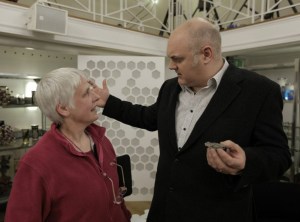
Science Club presenters Mark Miodownik, left, and Dara Ó Briain, right, talk fulgurites with Monica Price, assistant curator of Mineralogy Collections  at the Museum

I’ve just been getting our fulgurites out of their drawer for their second outing to London. ‘What’s that?’ I hear you ask. Well, the clue’s in the name, for ‘fulgur’ is Latin for lightning. Fulgurites form when lightning strikes the ground; and if the ground happens to be made of sand, the intense heat of the lightning melts the grains of sand to form a tube of natural glass. The longest known fulgurite is nearly five metres long, but they are always very fragile things.

A bit of discussion about fulgurites at the end of filming the pilot programme
A bit of discussion about fulgurites at the end of filming the pilot programme. Presenter Dara Ó Briain is holding the Drigg fulgurite. Photo: Alastair Duncan

So why is a fulgurite going to London? We get all sorts of requests to see specimens, from researchers, amateur enthusiasts, students and artists, and even people who are just curious. Our collections are there to be used and enjoyed after all. But in this particular case the producers of the BBC4 programme Science Club were making a pilot for their new series and were looking for a fulgurite to star in the show.

I took two different fulgurites to the recordings, both found in the early 19th century. One is a piece labelled as coming from Drigg in Cumberland. This was a famous discovery; even Charles Darwin knew about them, for he wrote that the fulgurites he discovered in South America were very like those of Drigg in appearance. The second was found in Westphalia, Germany, and it shows a glassy trace of the lightning’s path as it passed through the sand.

Mark was determined to have his photograph taken holding a fulgurite.
Mark was determined to have his photograph taken holding a fulgurite! Photo: Alastair Duncan

For this pilot programme Science Club was investigating natural disasters. Presenter Dara Ó Briain was joined by expert demonstrator Professor Mark Miodownik who had quite a shocking experience with a lightning machine! We were also shown why it is dangerous to stand under a tree during a thunder storm, and we heard about the lucky escapes some people have when struck by lightning.

Fulgurites are rather rare and special, and as the pictures show, both presenters enjoyed a chance to get a close look at these natural curiosities.

The pilot programme was successful, and one of our new Education trainees, Liz Danner, will be taking the fulgurites back for the final filming of Science Club this week. If you would like to see them too, they will feature in our next ‘Presenting…‘ display soon. Follow the blog and we’ll let you know when

Watch out for more Science Club on BBC4 – it’s fascinating and fun.

Monica Price, Assistant curator, Mineral Collections

1683 and all that…

16836Just a quick post to say that things are pressing ahead with our Natural Histories exhibition, which is being hosted and co-curated by the Museum of the History of Science in Broad Street.

Jewson delivery

This morning, as I arrived at the MHS, Jewson had just delivered the pre-cut MDF boards that we will use to make various plinths and structures for many of the specimens in the exhibition.

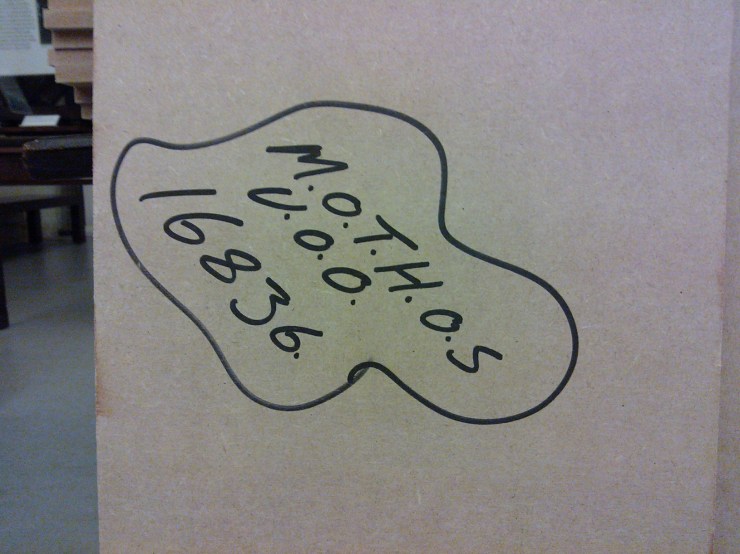
But along with this delivery came a sweet little coincidence; perhaps even a good omen. On one of the Jewson boards the order number had been written in black marker pen and the number, which you can see above, was 16836, tantalisingly close to 1683, the year this building was founded by Elias Ashmole as the original Ashmolean Museum. The ‘6’ is even written just a little bit smaller than the ‘year’.

Given that Natural Histories is partly about a temporary return of Oxford University‘s natural history collections to their original home in the building in Broad Street, this is an unusually apposite order reference.

I don’t know when in 1683 the building opened, but I really hope it was June.

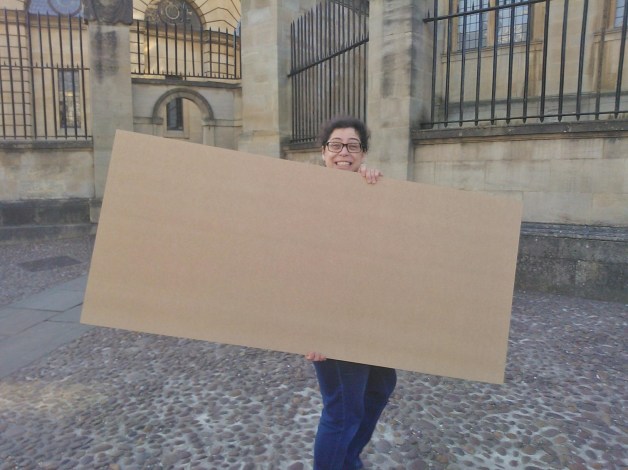
Cheryl helps bring the boards into the Museum of the History of Science

Scott Billings, Communications coordinator