This sumptuous video features on our brand new Out of the Deep display and brings to life the two large marine reptile skeletons seen in the cases. The Museum exhibition team worked with Martin Lisec of Mighty Fossils, who specialise in palaeo reconstructions. Martin and his animators also created a longer video explaining how the long-necked plesiosaur became fossilised, as well as beautiful illustrations of life in the Jurassic seas. Martin explains the process of animating these long-extinct creatures:
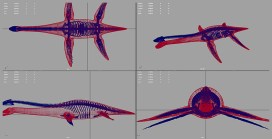
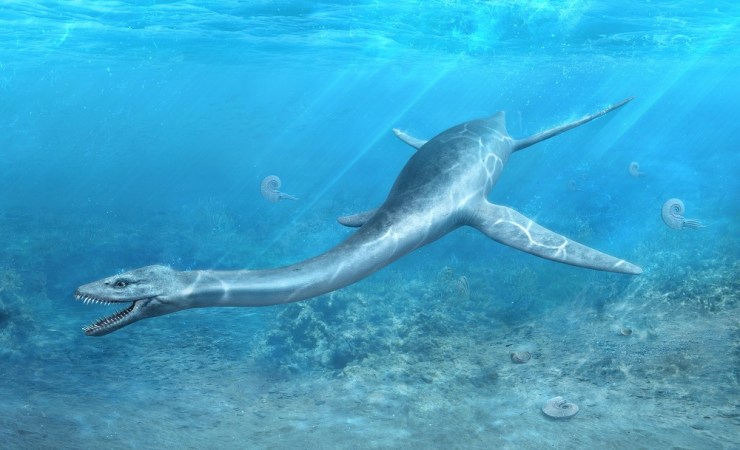
The first step was to make 3D models of all the animals that would appear in the films or illustrations. After discussion with the Museum team, it was clear that we would need two plesiosaurs (one short-necked, known as a pliosaur, one long-necked), ammonites, belemnites and other Jurassic sea life. Now we were able to define the scale of detail, size and texture quality of the model.
In consultation with Dr. Hilary Ketchum, the palaeontologist on the project, we gathered important data, including a detailed description of the discovered skeletons, photographs, 3D scans, and a few sketches.
This slideshow requires JavaScript.
We created the first version of the model to determine proportions and a body shape. After several discussions with Hilary, some improvements were made and the ‘primal model’ of the long-necked plesiosaur was ready for the final touches – adding details, mapping, and textures. We could then move on to create the other 3D models.
This slideshow requires JavaScript.
The longer animation was the most time-consuming. We prepared the short storyboard, which was then partly changed during the works, but that is a common part of a creative job. For example, when it was agreed during the process that the video would contain description texts, it affected the speed and length of the whole animation – obviously, it has to be slower so that people are able to watch and read all important information properly.
A certain problem appeared when creating the short, looped animation. The first picture had to precisely follow the last one – quite a difficult goal to reach in case of underwater scenery. Hopefully no-one can spot the join!
This slideshow requires JavaScript.
At this moment we had a rough animation to be finalised. We had to make colour corrections, add effects and sound – everything had to fit perfectly. After the first version, there were a few more with slight adjustments of animation, cut and text corrections. The final version of both animations was ready and then rendered in different quality and resolution for use in the display and online.
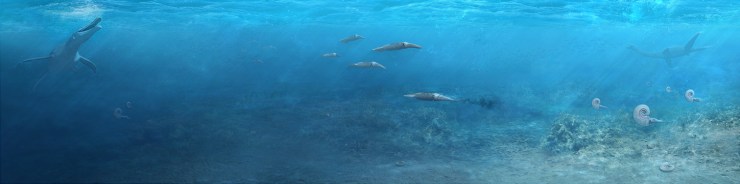
The last part of the project was creating a large illustration, 12,000 x 3,000 pixels, which would be used as a background for a large display panel. Text, diagrams and a screen showing the animations would be placed on this background, making the composition a little tricky. We agreed that the base of the illustration would be just the background. The underwater scene and creatures were placed in separate layers so that it would be easy to adjust them – move them, change their size, position etc.
This slideshow requires JavaScript.
In the first phase, we had to set the colour scale to achieve the proper look of the warm and shallow sea, then we made rough sketches of the scene including seabed and positions of individual creatures. We had to make continuous adjustments as the display design developed.
Then we finished the seabed with vegetation, gryphaea shells and plankton floating in the water. The final touch was to use lighting to create an illusion of depth for the Jurassic creatures to explore.
We’ve just opened a brand new, permanent display called Out of the Deep, featuring two beautifully preserved plesiosaur skeletons. Remarkably, both of these marine reptile fossils have skulls, which is more unusual than you might think. Dr Hilary Ketchum, collections manager in the Museum’s Earth Collections and curator of Out of the Deep, describes how the skull of the long-necked plesiosaur made it safely from a quarry to a museum display.
At the bottom of a clay pit in 2014, palaeontologists from the Oxford Clay Working Group discovered a 165-million-year-old fossil plesiosaur skeleton, and they knew they had found something special. Plesiosaur bones are fairly common in the quarry, but skeletons are rare. Skeletons with skulls are rarer still. Fantastically, at the end of their newly-found plesiosaur’s neck was a skull. Barely visible underneath the clay, only the tip of the snout and a few teeth were exposed.
Can you see the skull? Fossil hunting in the quarry takes time, patience and a good eye to distinguish between bones and clay. Image: Mark Wildman, Oxford Clay Working Group.
Plesiosaur skulls are usually made up of around 33 bones, not including the tiny bones from inside the eye sockets, called the sclerotic ring. The skull bones are among the smallest and most fragile in the entire skeleton. This means they are much less likely to be preserved, and less likely to be discovered, than the larger and more robust backbones and limb bones.
A plaster jacket was made around the skull while still in the quarry. Image: Mark Wildman, Oxford Clay Working Group.
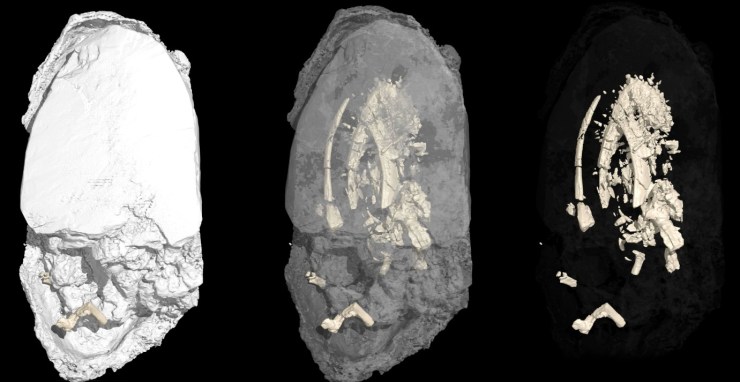
When the plesiosaur skeleton arrived in the Museum in 2015, the skull and some of the surrounding clay was encased in its protective plaster field jacket. As tempting as it was, instead of cracking open the jacket straight away, we decided on a more technological approach. Professor Roger Benson and Dr James Neenan took the specimen to the Royal Veterinary College to use their enormous CT scanner, normally used for scanning horses and other large animals, and took thousands of X-rays of the jacket. This allowed them to build up a 3D model of the fossil inside – our first tantalising glimpse of the whole skull!
The CT scan of the plaster jacket (left) revealed the location of the skull inside the jacket (middle). The jacket was then digitally removed (right) to reveal a 3D image of the skull.
Having the CT scan of the skull was like having a picture on a puzzle box
Juliet Hay, Earth Collections conservator and preparator
Although the CT scan was incredibly useful, we still had to proceed with the preparation with caution. It was possible that not all of the bones had not been detected by the scanner, especially the incredibly thin bones of the palate.
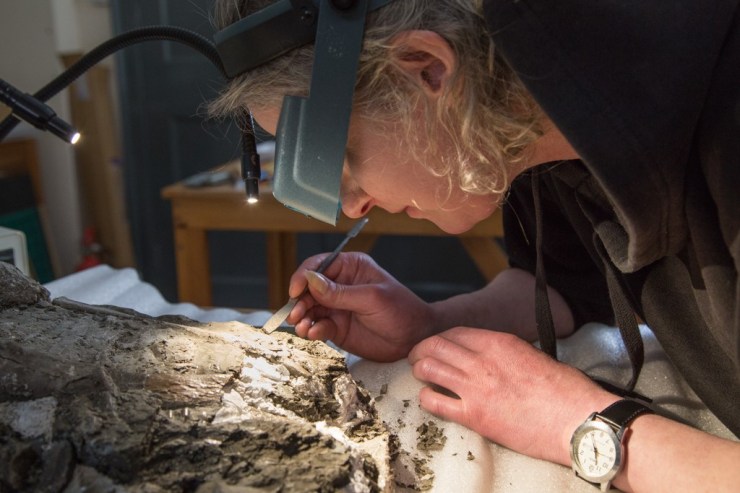
After opening the plaster jacket, Juliet began to carefully remove the clay from around the fossil bone.
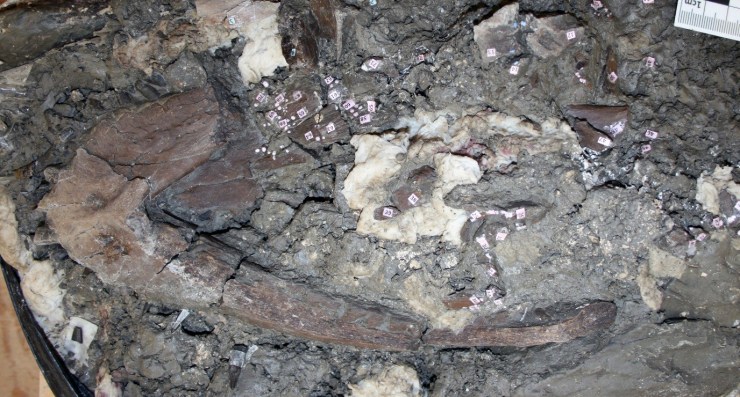
Slowly and carefully, Juliet and I removed the soft clay from around the skull. The weight of clay pressing on top of the skull for millions of years had crushed it, breaking some of the bones into a lot of smaller pieces. In order to keep track of them we attached a number to each piece of bone and photographed it from several different angles before removing it from the jacket.
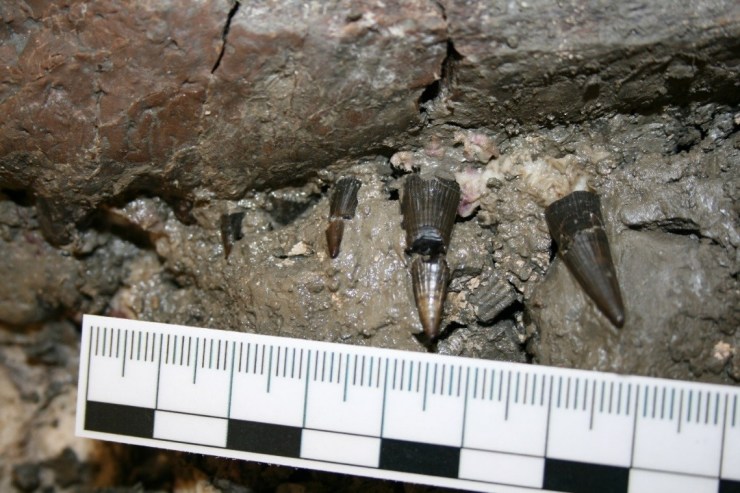
Each individual bone was mapped using a numbering system. The numbers were attached with the conservation adhesive Paraloid B72 in acetone, so that they could be easily removed later.The plesiosaur’s pointed teeth being revealed.
When all the bones had finally been removed from the clay, we had over 250 pieces. Next came the challenge of the three-dimensional jigsaw!
With knowledge about plesiosaur skulls from my PhD, and some extra expert help from Roger Benson and Dr Mark Evans, Curator of Natural Science and Archaeology, New Walk Museum and Art Gallery, I was able to build up the skull, piece by piece, until it was nearly whole again.
After many months of painstaking work, the beautifully preserved skull of this long-necked plesiosaur can finally be seen in the Out of the Deep display.
Amazingly, the skull is even more complete and more beautifully preserved than we could tell from the CT scan. The sutures between the individual bones can be seen in exquisite detail, and even though I work with fossils every day, I still find it amazing that it is 165 million years old.
*
With special thanks to:
Oxford Clay Working Group: Mark Wildman, Carl Harrington, Shona Tranter, Cliff Nicklin, Heather Middleton, and Mark Graham, who uncovered and excavated the long-necked plesiosaur.
Forterra, for generously donating the plesiosaur skeleton to the Museum, after it was discovered in a Forterra quarry.
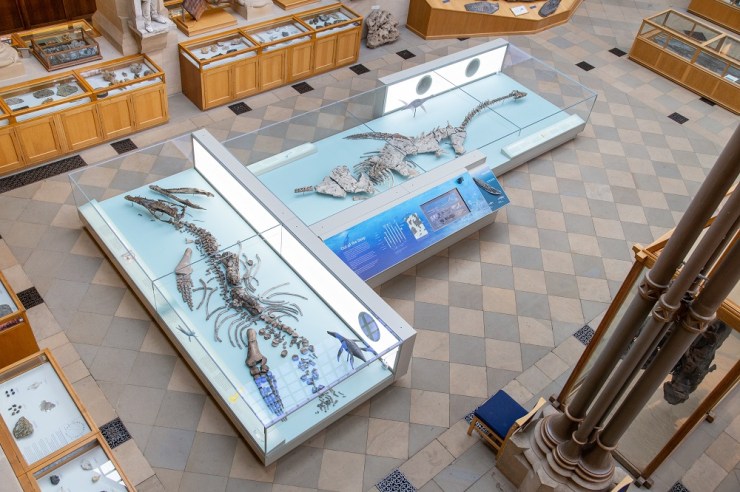
Fitting together the remains of long-dead sea creatures is no easy job. A brand new permanent display, Out of the Deep, has brought together two Jurassic marine reptiles in the largest new display in the Museum for decades. But getting them out on show was a long, delicate process that took hundreds of careful steps.
The specimens are rare and remarkably complete, and on full display for the first time. The short-necked plesiosaur, known as a pliosaur, was discovered by a former Museum curator in the 1990s in Yarnton, Oxfordshire, just a few miles from the Museum.
The larger long-necked plesiosaur was found in a quarry in Cambridgeshire in 2014 by the Oxford Clay Working Group, and donated to the Museum’s collections by the quarry’s owner Forterra. You might remember this fossil from our excited article when the specimen first arrived at the Museum, back in 2016.
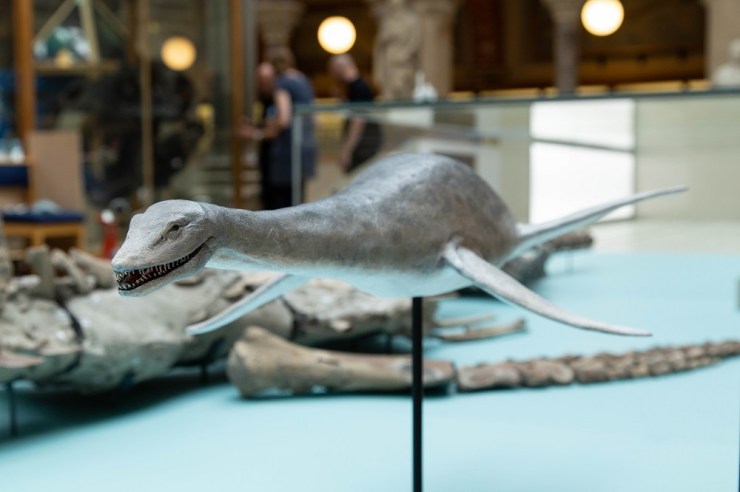
Model of the long-necked plesiosaur, made by Crawley Creatures
Before the fossils could take centre stage, their set had to be built, in the shape of two enormous display cases, designed and constructed to house these special specimens. Every day, for two weeks, the team from showcase specialists Click Netherfield pieced together slabs of glass, built walls, installed lights and fitted portholes. Yes, portholes!
A young visitor peers at the plesiosaur through a porthole
The display is positioned in the south aisle of the Museum – if you know the building, this is on the right as you come in, alongside large dinosaur skeletons. We’d measured and planned the space again and again, with our designers Calum Storrie and Pat O’Leary, but couldn’t quite picture this huge display sitting alongside the other cases. Each specimen is almost five metres in length, so the cases really are whoppers. Once the pieces started to come together, we could see that this was going to a really dramatic addition to the Museum. We chose a clean, contemporary look, with lots of glass and powder-coated steel. The colour of the metal case was carefully chosen to stand out (no oak-effect), but sit well in amongst the warm tones of the stone and brick work – RAL 7032 if you’re interested!
Here’s a time-lapse video to show you how the cases were built, piece by piece over two weeks.
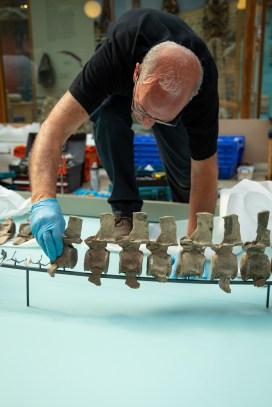
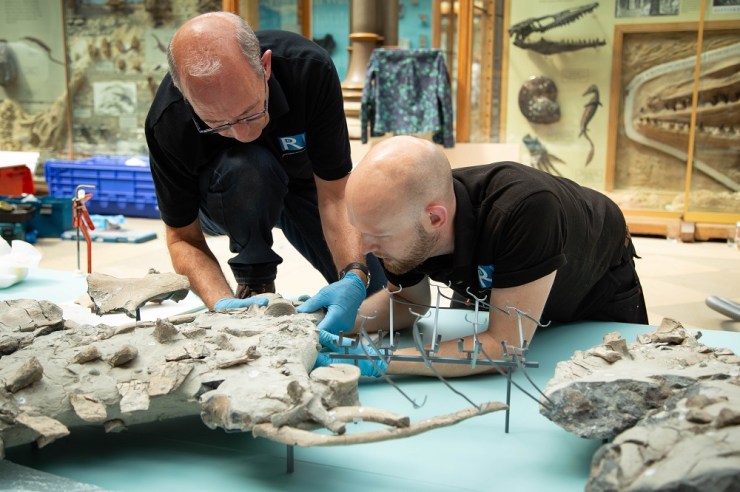
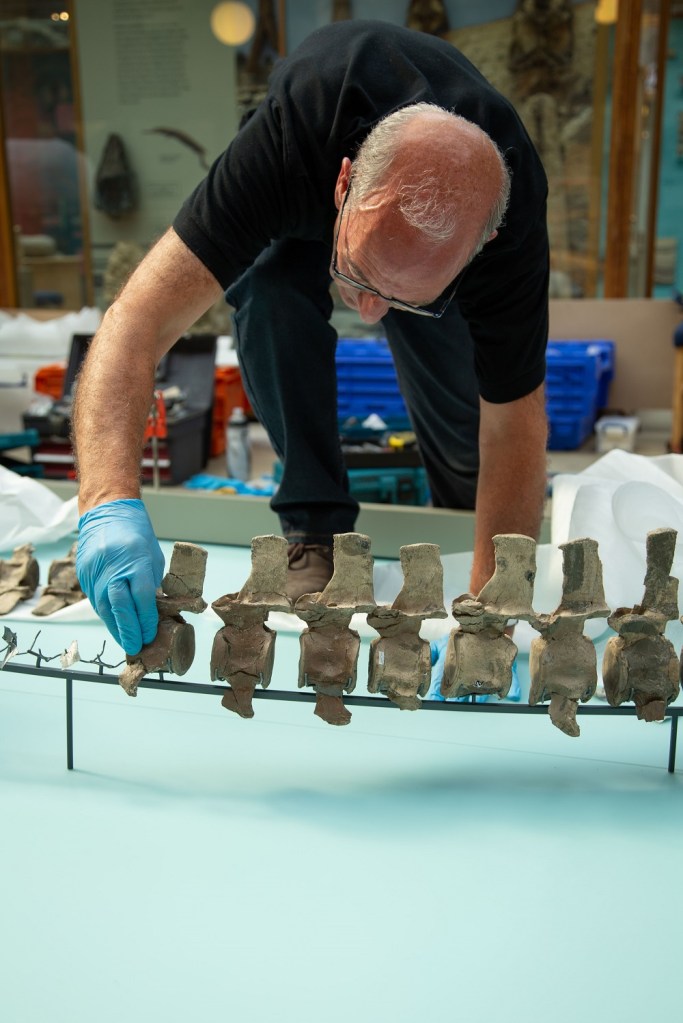
Once the enormous cases were in place, we could start installing the stars of the show – the two plesiosaur skeletons. Museum staff had worked closely with Richard Rogers Conservation to build an intricate web of steel that would hold each fragment of the skeleton in place, showing it off to its full potential. This mount was screwed into place on the acrylic base board then the individual bones were gently slotted into place.
Richard Rogers slots a vertebra into place on the carefully-crafted mountRichard Rogers and James Dawson position plesiosaur ribs
Here’s a glimpse of the installation process in a handy time-lapse film:
After countless of hours of excavation, preparation, planning, measuring (measuring again) and installing, Out of the Deep is ready! It’s open now in the Museum and the specimens are accompanied by specially commissioned digital reconstructions (more about that soon), videos that share the stories behind the specimens’ discovery and even a touchable 3D print of a plesiosaur flipper. Come along and meet the Jurassic beasts that deserved all this care and attention.
The finished Out of the Deep display is open now
**
The project has been generously supported by grants from the DCMS/Wolfson Museums and Galleries Improvement Fund, and WREN’s FCC Community Action Fund.
In the latest display in our Presenting… series, collections manager Amoret Spooner takes a look at the wonderful and sometimes strange world of the praying mantis.
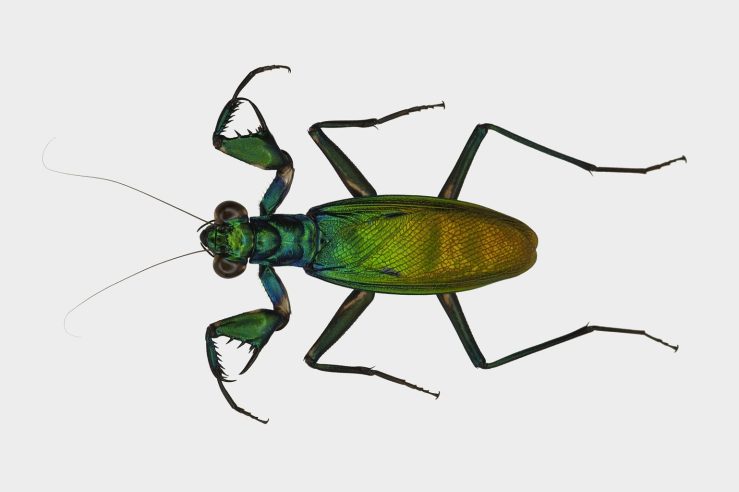
Praying mantis is the common name given to an order of insects called Mantodea, a word which derives from mantis meaning prophet, and eidos meaning form or type. The more familiar ‘praying mantis’ refers to the striking way that they hold their large forelimbs, in a ‘praying’ posture.
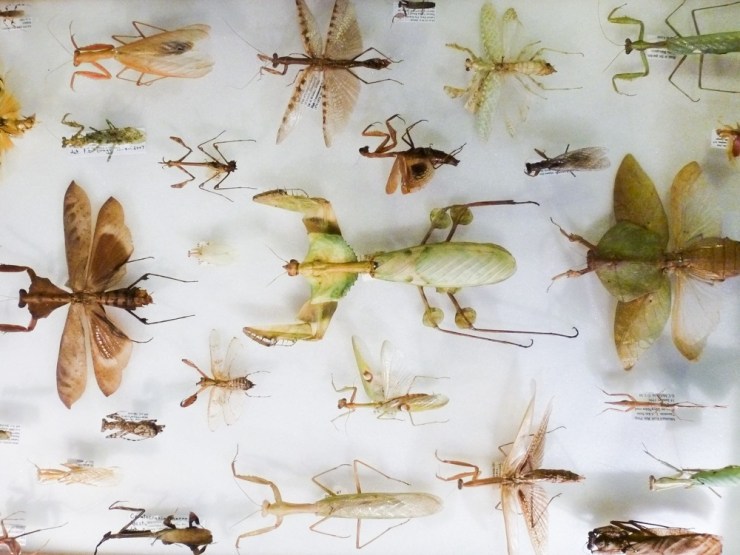
There are over 2,400 species of mantis worldwide, split into 21 different families. The image above shows their incredible diversity of colour, shape and size. But while they may differ in appearance, their biology and many behavioural traits are the same.
Mantis are predators of insects, including other mantis, but larger species will eat small lizards and birds. But they are perhaps best known for being cannibalistic. This behaviour is most commonly seen in nymphs straight out of the egg case, or ootheca, but it can also occur when the female eats the male after mating. However, cannibalism is not required to mate, so when it happens it’s usually because the female is hungry!
The egg case, or ootheca, of mantis vary greatly depending on the size and behaviour of the species.Revisio Insectorum Familiae Mantidarum was one of John Obadiah Westwood’s greatest works. Thankfully he kept all of his drawings, annotated pages and notes for the publication, allowing us an insight into the years of work he put into its production.
Praying mantis are ambush hunters, either camouflaging themselves while waiting for their prey to approach, or actively stalking prey. Their compound eyes are specialised in perceiving motion, and are widely spaced giving them a wide field of vision. Along with powerful front legs and an ability to move the head up to 180°, this makes them successful predators.
The Museum’s archive contains original drawings and annotations by John Obadiah Westwood (1805–1893), the first Hope Professor of Zoology. As a renowned scientist Westwood described many new mantis species, and he was also a talented artist.
The Presenting… Marvellous Mantodea case is on display at the Museum until 1 November 2018.
This article is taken from European research magazine Horizon as part of our partnership to share natural environment science stories with readers of More than a Dodo. For more on the development of the brain see our Brain Diaries exhibition site.
One of the major features that distinguishes humans from other primates is the size of our brains, which underwent rapid evolution from about two to three million years ago in a group of our ancestors in Africa called the Australopithecines. During this period, the human brain grew almost three-fold to reach its current size. Scientists know this from skull remains, but have puzzled over how it happened…
This year, the mystery was partially solved by Professor Pierre Vanderhaeghen at the Flanders Institute for Biotechnology in Belgium. Prof. Vanderhaeghen, who was conducting his work as part of the GENDEVOCORTEX project, went on a hunt for the genes that drove the growth of human brains.
Scientists had suspected that brain expansion began in our human ancestors when they evolved genes that are switched on in the foetus, when a lot of key brain development occurs. Prof. Vanderhaeghen therefore looked for genes present in human foetal tissue, but missing from our closest living relatives, apes.
His lab discovered 35 hominid – present only in apes and humans – genes that were active in foetal brain tissue. They then became intrigued by three specific genes – all similar to NOTCH genes, an ancient gene family involved in sending messages between cells and that are present in all animals. They found that the three new genes, collectively named NOTCH 2NL, were created by a “copy and paste error” of an original NOTCH gene.
This error created entirely new proteins which likely helped our ancestors’ cerebral cortex to balloon. This is the part of our brain responsible for our language, imagination and problem-solving abilities. Scientists at the University of California, Santa Cruz, have also identified the NOTCH 2NL genes in DNA from Homo sapiens’ extinct cousins – the Neanderthals and Denisovans.
(The NOTCH 2NL) genes are only present in humans today. They were also present in Neanderthal DNA, but not in chimpanzees
Prof. Vanderhaeghen
Evolution These genes control the growth rate and differentiation of brain stem cells – the starter cells that multiply and give rise to all neurons in our brain – causing them to seed more nerve cells, which in turn helped to expand brain size. The genes likely led to more neurons and brain tissue in our ancestor’s descendants – including Neanderthals, Denisovans, and modern humans.
Prof. Vanderhaeghen’s research could also help to provide new insights into brain disorders. The US researchers linked genetic faults in DNA that were very similar to NOTCH 2NL, to children born with enlarged brains or small brains. Many of the new human-specific genes are located in a small area of our genome that plays an important role in brain size, according to Prof. Vanderhaeghen.
As DNA in this area closely resembles another part of the genome where it was originally cut and pasted from millions of years ago, errors are more likely, said Prof. Vanderhaeghen. “Patients who have (inherited) deletions in this area tend to be at risk of developing schizophrenia, whereas patients with duplications are more at risk of autistic spectrum disorder,” he said.
Prof. Vanderhaeghen is now studying some 20 of the remaining human-only genes to see how they contributed to the evolution of the human brain.
Something like 40-50% of the Neanderthal genome can still be found in people today.
Prof. Svante Pääbo, Max Planck Institute for Evolutionary Anthropology, Leipzig, Germany
The use of genetics to study human evolution in this way is helping to transform our understanding of how our own species compared to our ancestors. Traditionally, scientists have studied extinct species by looking at the fossilised remains of their bones. This was how they discovered the existence of Neanderthals, the extinct human species that lived across Europe and much of Asia before vanishing around 40,000 years ago.
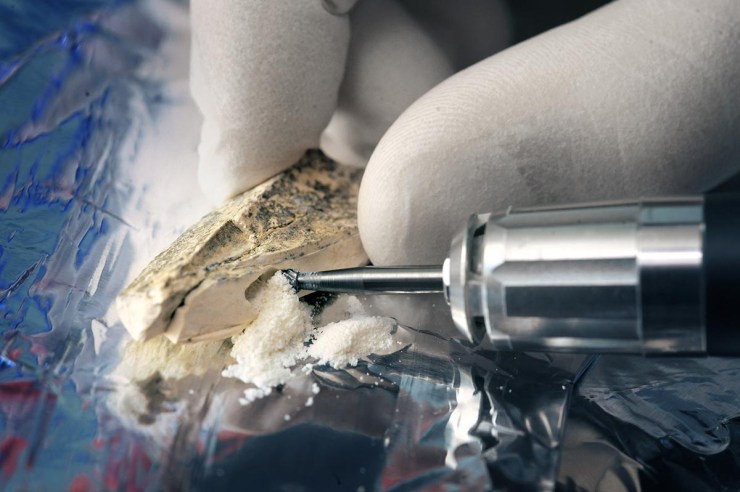
In the last decade, however, scientists have begun to look at the DNA inside these bones. Professor Svante Pääbo, director of the Max Planck Institute for Evolutionary Anthropology in Leipzig, Germany, has led the way in sequencing DNA of these extinct humans from small bone fragments.
This allows scientists to compare modern human DNA with that of extinct humans, rather than just living relatives like chimps. Already, the work has revealed some surprising findings – our own species appears to have interbred with some of these ancient relatives during our history.
Ancient humans Scientists have found that the DNA of every person outside Africa is 1-2% Neanderthal, meaning that these extinct human relatives had offspring with our own ancestors.
An international consortium of researchers is sequencing the 3 billion bases that make up the genome of our closest relative – the Neanderthal. The sequence is generated from DNA extracted from three Croatian Neanderthal fossils using novel methods developed for this project. Image credit – Frank Vinken for Max Planck Society
“Different people tend to carry different pieces of the Neanderthal genome,” said Prof. Pääbo, who is undertaking a project called 100 Archaic Genomes to decipher the DNA of ancient human individuals. “Something like 40-50% of the Neanderthal genome can still be found in people today,” he said.
According to Prof. Pääbo, we retained some of this DNA because it offered an advantage to our ancestors. “Some (of this retained DNA) has to do with the immune system, presumably helping us to fight off infectious diseases.”
The power of genetics to unravel the history of human evolution took a new twist in 2010 after Prof. Pääbo’s lab sequenced DNA from a finger bone fragment found by a Russian archaeological team in a remote Siberian cave.
The analysis revealed the bone belonged to a previously unknown human relative, now called Denisovans after Denisova Cave where the bone was found. This mysterious ancient human species lived at around the same time as Neanderthals, but further east into Asia.
Last year, Prof. Pääbo’s group published DNA sequences from a tooth found in the cave – the fourth ever Denisovan discovered. We now know Denisovan DNA carries more variation than Neanderthal DNA, leading scientists to conclude that they were more widespread than the better-known Neanderthals.
Denisovans left a more impressive stamp on some of us than Neanderthals, according to Prof Pääbo. Their DNA can be found in people across Asia today, while indigenous peoples of Papua New Guinea and Australia may carry up to 5%. Tibetans also carry some Denisovan DNA in their genomes, which has helped them adapt to life at high altitudes where there is little oxygen in the atmosphere.
Prof. Pääbo and his colleagues will soon publish their third high-quality genome – where almost the entire DNA sequence is intact – of a Neanderthal from Siberia. A deciphered genome of this quality allows for better DNA comparisons and could tell us more about the evolution of important genes – such as those linked to the development and function of the brain. It will add yet another puzzle piece to help us understand the history of our closest extinct relatives, according to Prof. Pääbo.
“There may even be other forms of extinct humans out there to be discovered by studying the DNA of the (ancient) bones we find,” he said.
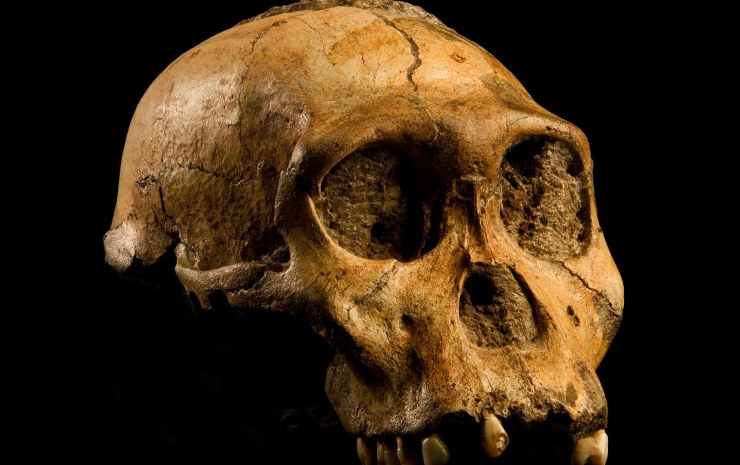
Top image: The skull of a Australopithecus sediba, a species of Australopithecines, who were our ancestors and whose brains started to grow two to three million years ago. Image credit – Australopithecus sediba by Brett Eloff, courtesy Profberger and Wits University is licensed under CC BY-SA 4.0.
Cephalopods are a remarkable group of molluscs that includes nautilus, octopuses, cuttlefish and various groups of ‘squid’. The other major groups of molluscs includes more familiar shelled animals such as gastropods (snails and slugs), bivalves, and chitons, as well as some less familiar forms.
In natural history museums, molluscs are normally represented by shell collections because the hard shelly parts are easier to preserve and store than the soft tissue. This creates a bias against the soft-bodied cephalopods, such as squids, octopuses and cuttlefish, because aside from the cuttlebones of cuttlefish and the thin gladius in squids there aren’t many hard parts that can be preserved to represent these animals in dry collections. For octopuses it’s normally only the beak and microscopic radulae, a toothed tongue-like structure, that can be preserved. But there is one notable exception: the eggcases of argonauts.
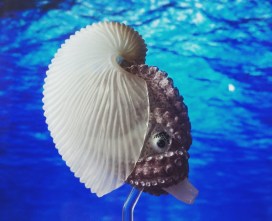
Model of Argonauta argo. Image: Mark Carnall
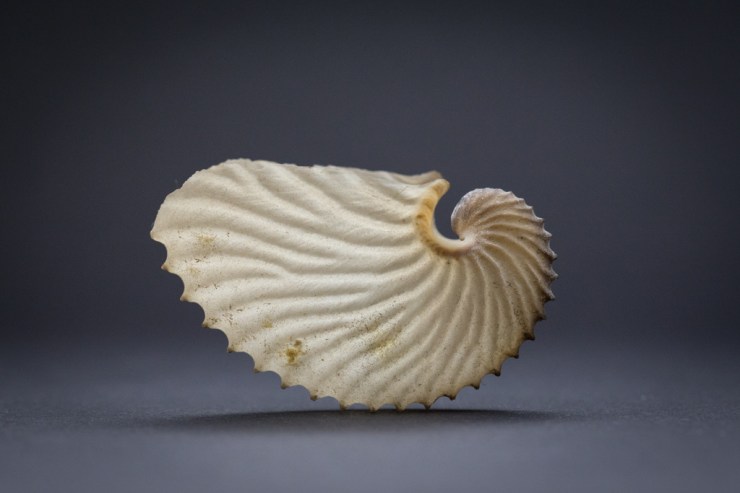
Argonauts, four* species of octopuses in the genus Argonauta, are unusual in that they produce a paper-thin eggcase, sometimes referred to as a shell. Unlike a true shell it’s not attached to the body of the argonaut, but secreted by two specialised webbed arms. The eggcases themselves are sometimes called paper nautiluses because they resemble the spiral shells of nautiluses, but they are structurally and functionally very different.
External morphology of a female paper nautilus (Argonauta argo) with eggcase. Poli, Giuseppe Saverio. Testacea utriusque Siciliae. (1791-1827). http://biodiversitylibrary.org/page/44020354
Argonaut eggcases wash on up shorelines around the world and have been known for centuries. But it’s only comparatively recently that the origin and use of these cases has been described. When eggcases containing live argonauts were first encountered it was supposed that argonauts were reusing empty shells created by another animal, much like hermit crabs repurpose gastropod shells.
Pioneering research by marine biologist Jeaneatte Villepreux-Power in the 19th century led to observations of Octopus and Argonauta, confirming that the eggcases are made and repaired by female argonauts. It wasn’t until 2010 that we understood how argonauts use these cases to float in the ocean. It turns out that they ‘bob’ their shells to gulp a pocket of air. Then, using their second pair of arms, they trap the air in the top of the shell and dive releasing enough air to maintain the required buoyancy.
Only female argonauts make the eggcases, so the free-floating males are tiny in comparison. In addition to providing a home for female argonauts, these structures are used to brood embryos in. One eggcase was described with nearly 50,000 embryos attached to the inside of the shell.
Preparation showing series of argonaut egg cases of varying sizes.
Thanks to their oddity and beauty these eggcases are common in museum collections, but they represent one of the marvels of evolution. Unlike many bottom-dwelling octopuses, female argonauts have evolved this amazing structure to function as an underwater craft to allow them to leave the ocean floor and inhabit the open oceans: the true astronauts of the sea.
To celebrate the pioneering work of Jeaneatte Villepreux-Power, these amazing animals, their eggcases, and a selection of museum specimens are on display in the Museum’s Presenting… case until the 3 July 2018.












 More Than A Dodo