Stop, look, listen

By Sarah Lloyd, Head of Education, and William Sharpley, Youth Forum member

Connecting with the natural world around us is important for many reasons. It’s proven to help our mental health, it’s enjoyable and fascinating, and it gives us an insight into the rhythms and changes of the life that surrounds us. And during the pandemic lockdown this has taken on more significance than ever.

Over the past few months we have been keeping in touch with the Museum’s youth groups as part of our HOPE for the Future project, which is supported by the National Lottery Heritage Fund. The project is themed around the Museum’s British insect collection and our discussions with the youth groups have triggered a particular interest in the diversity of insects in our outdoor spaces.

Common Cardinal Beetle (Pyrochroa serraticornis). These beetles are often found basking in the sun on leaves and flowers in woodland margins. Image: William Sharpley.

A great way to become more observant about the world around you is through photography. During a recent lockdown walk, Youth Forum member William Sharpley took out his camera and captured the beautiful images of insects you can see in this post. Looking at insects more closely made William curious about what he could find in his garden, where he noticed a colony of bees active around a compost bin.

The compost bin is in an old coal bunker. It gets very hot in the sunny weather. I have watched the bees going in and going out of here.
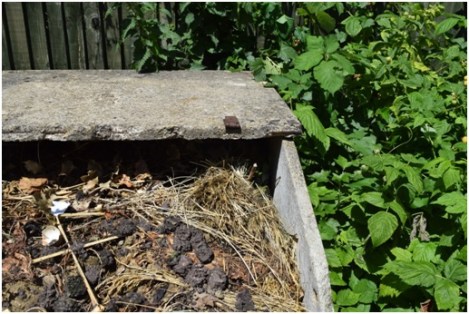
The compost bin in an old coal bunker provides a good habitat for a colony of Tree Bumblebees (Bombus hypnorum). Image: William Sharpley.

Noticing what animals are present, and learning to identify them, helps to build a picture of how the natural world may be changing.

Bees are a good case study. The image below is of a Tree Bumblebee (Bombus hypnorum). Tree Bumblebees were first recorded in the UK in 2001, and since 2007 they have thrived in our increasing urban environments, with numbers and range rising dramatically. They are now a common sight in gardens, establishing colonies in enclosed spaces above ground. William’s old coal bunker compost heap is the perfect spot.

Tree Bumblebees (Bombus hypnorum) like this one have increase in numbers and range dramatically in the UK over the past couple of decades. Image: William Sharpley.

By noticing new species around us we are reminded that populations of living things change over time. Some species, like the Tree Bumblebee, have become more common, while others, such as the Great Yellow Bumblebee (Bombus distinguendus), are now much rarer than they once were.

Great yellow bumble bee (Bombus distinguendus). Image by Nick Owens.

Once we know what is around us we can turn our attention to patterns of behaviour. William went on to use his science skills to plan an investigation.

I will be trying to find out if bees are more active during the morning or in the afternoon. I will count the bees going in and out of the nest at different times during the day.

The Youth Forum conducted a similar study earlier in the spring, observing when female Hairy-footed Flower Bees and Honeybees were active and feeding on garden plants. They found that the Hairy-footed Flower Bees foraged mostly in the morning, and the Honeybees in the afternoon.

Feeding behaviour in bees is an interesting thing to study because it may be affected by some pesticides called neonicotinoids. Honeybees exposed to low levels of these pesticides spend less time feeding, and over a long period their reduced food intake causes a hive of bees to decline and become more susceptible to other pressures, such as disease, habitat destruction, or extreme weather.

Rather than relying on a handful of chemicals like neonicotinoids, farmers are now encouraged to use a range of methods to control pests. These include using natural predators – known as biological control – and organic methods.

From these relatively simple observations of the natural world we can gain important information about changing environments. And by sharing what we notice, and encouraging others to do the same, we are better able to understand environmental changes and we’ll feel more connected to nature as a bonus. So head out and start looking!

The Museum’s Youth Forum was established to connect with and learn from local young people. The group meet every month to take part in a programme of activities designed for and by the group.

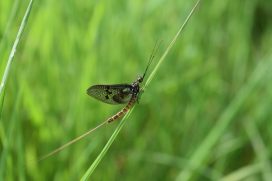
Top image: Common mayfly (Ephemera Danica) by William Sharpley.

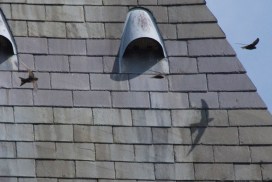
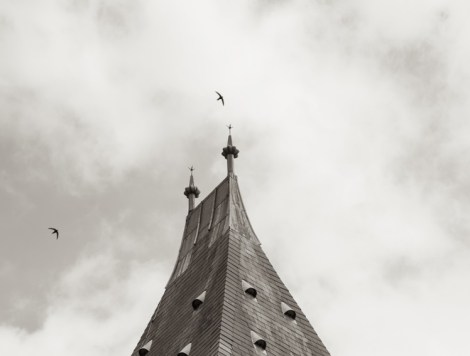
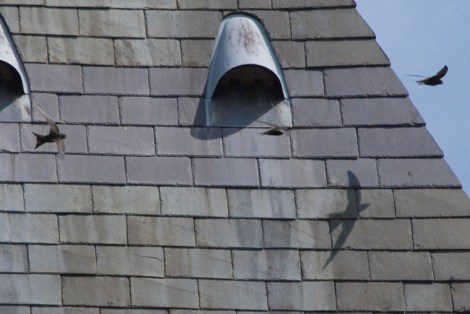
Swifts flying around the Museum tower

Flight and fight

By Chris Jarvis, Education Officer

Last week’s observations of the swift nest boxes in the Museum tower highlighted the drama the colony faces in the struggle for survival. This week’s survey made that struggle even more explicit…

Clambering through the darkened spaces of the Museum tower, lit faintly by the red lights that the swifts cannot see but which help give surveyors a dim view of the ladder rungs and observation platforms, I peered briefly into each nest box to count the birds and eggs.

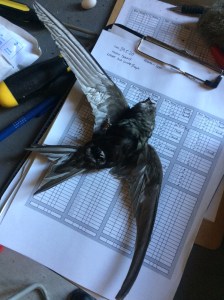
In one box I came across a dead bird, alone and lying on its back. Carefully bagging up the body for later investigation I continued my count while pondering the cause of its death, the sadness relieved slightly with the discovery of new eggs in other boxes and the promise of new life to come.

The body of a dead swift found during the weekly survey of the colony of birds in the Museum tower

Screams and banging from birds prospecting for nest sites are a regular backdrop to each survey. Birds call and swoop past the boxes only inches from my ears, separated by just a few roof slates. The birds within scream back in answer. But on this occasion, half way down the tower, I became aware of particularly loud and persistent screams and banging, coming from within a box.

A quick peek inside revealed a hectic struggle between at least three swifts, wings drawn back, wrestling and rolling around, pecking and slashing at each other with their sharp claws. It was actually impossible to see if the fight involved three or four birds as the struggle filled every inch of the small box with wings, beaks, claws and feathers.

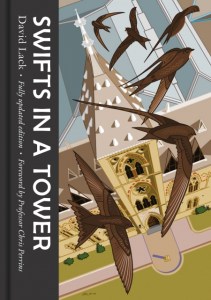
David Lack first documented these fights in his excellent book Swifts in a Tower. He proposed that they were the result of birds entering an already occupied box in the struggle to find a suitable nest site.

Swifts flying around the Museum tower
Swifts circle the tower prospecting for potential nest sites, screaming and banging to check which are occupied and which are vacant. Image: Gordon Bowdery

Sitting and anxiously listening beside the box, I recorded the fight lasting 15 minutes from the time I became aware of it. Lack documented ‘gladiatorial shows’ that lasted five and three quarter hours; they were painful to watch, he admitted, as the swifts have a surprisingly strong grip and claws capable of drawing blood, but rarely resulted in death.

When the noise died down, I gently lifted the cloth blind to take another look. Only two birds remained, both looking exhausted and fiercely gripping each other’s feet, one lying under the other. A quick flurry and the upper bird disengaged and jumped from the nest box entrance.

Cover of 2018 edition of Swifts in a Tower by David Lack
Cover of the 2018 edition of Swifts in a Tower by David Lack

Lack also mentions in his book that it is usually the bird underneath in these struggles that is the winner and I was relieved when the remaining bird picked itself up and returned to the two eggs, which had somehow remained in the nest, settled on top of them and preened itself. This suggested that the nest’s original occupant had won, driving off an intruder.

The screaming and banging outside the boxes is a check for a screamed response from within. It reveals whether a box is already occupied or empty, before the bird risks entry. Presumably, the fight I witnessed was the result of a bird not hearing a response or perceiving it as coming from another box.

The drama of the fight illustrates the incredible importance of nest sites and the fidelity the swifts have to them after a year on the wing. Nest sites are at a premium and swifts are almost totally dependent on nesting in old buildings as there are so few forests with suitably old, cavity filled trees remaining.

Once a nest is occupied the owners will fight furiously to defend it and David Lack did record occasional incidents of birds fighting to the death. So perhaps this was the cause of the dead bird I had found lying on its back, but that will have to wait for a later examination.

Meanwhile keep an eye on our nest box; you never know what drama may play out next…

It is important to record nest sites and, if you can, put up nest boxes. RSPB’s Oxford Swift City project, which the Museum and Oxford City Council were involved in, annually surveys and records nesting sites so that development in these areas is restricted during the breeding season and developers must include plans to protect and provide new nest sites when repairs to property or new building takes place. If you would like to help with the work of conserving one of the most dramatic annual migrants to our shores visit the RSPB site.

Robin

The dawn chorus

By Chris Jarvis, Education Officer

With the noises of the hectic morning commute temporarily silenced, it has never been a better spring to enjoy the sounds of the dawn chorus. If you are able to get out early it’s a great way to reduce some of the stresses of lockdown. But if you can’t, or would rather have a lie-in, here we bring a little of the dawn chorus to you.

The video above shows the beautiful grounds of Harcourt Arboretum, a site a few miles outside Oxford that is part of Oxford University’s Gardens, Libraries and Museums. The chirruping, tweeting soundtrack was recorded at the start of the pandemic lockdown, and is an excerpt from 50 minutes of uninterrupted dawn chorus which you can listen to in full here (recommended background while WFH!):

The enveloping sound of the dawn chorus is an ensemble piece, but who are the individual players? To hone your birdsong identification skills and practice picking out individual songs of some common British birds, Andy Gosler at the Edward Grey Institute for Ornithology has put together this beautiful resource.

So now we’re in the zone, let’s find out a little more about the dawn chorus and how it’s made.

A sense of dawn
Why are so many birds singing at dawn and not at another time of day? There are several good reasons which may explain this.

At dawn, there are fewer other environmental noises cluttering the airwaves and the air density and temperature allow sound to travel further. Many migrant birds arrive in the UK overnight and early morning, and those that are ready to breed begin looking for mates and territories early in the day. So singing at this time stakes a clear claim to new arrivals and announces that the territory is already taken.

For insectivorous birds and those that use sight to find food, dawn is the least profitable time to search. Insects are more dormant in colder temperatures and food less easy to spot in dawn’s lower light levels and early morning mists. It’s a better use of time and energy to sing!

But why spring? What triggers birds to start singing? It clearly makes sense to breed at this time of year when there is a steady supply of food, as insect population growth coincides with the re-growth of the plants that feed many insects.

But the real trigger is day length. Increased light boost hormones in birds that spark incredible physiological changes. Unlike humans, birds have an amazing ability to reduce and increase the size of various organs according to their use, carefully regulating the amount of energy expended by those organs.

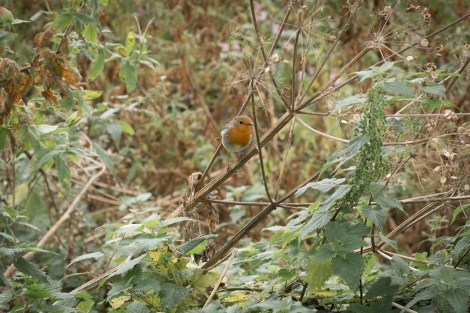
Robin
The Robin (Erithacus rubecula), Britain’s national bird, is one of the many voices contributing to the dawn chorus. Image: Scott Billings

Shifting sounds
As hormone levels increase, not only do birds’ sexual organs increase in size ready for the breeding season, but the part of their brains dedicated to sound processing and sensitivity also increases, meaning that birds’ hearing abilities fluctuate throughout the year.

Imagine not being able to recognise what people were saying or who was talking in winter, then suddenly being able to pick out every minute difference in tone, volume and timbre in spring! When you listen to the cacophony that is the dawn chorus, this is exactly what each bird is doing – recognising each individual and its territorial and breeding condition – and many birds show less acuity for this outside the breeding season.

Sound location also improves. Humans have relatively large, wide heads and this allows us to judge the direction a sound is coming from by detecting the slight differences heard by each ear. With their tiny heads, birds cannot do this when their heads are still, so they move their heads around a lot to help locate sounds.

You might be thinking that with such sensitive hearing birds would be in danger of going deaf during a raucous dawn chorus. But they have another adaptive trick up their sleeves. Inside the inner ears are tiny cilia, or hairs, that detect the vibrations of sound. In mammals, these hairs gradually diminish over time and don’t grow back, but birds have the ability regrow cilia throughout their lives!

Hidden music
Birds are also able to process birdsong much more quickly and fully than we can, hearing things that our brains are just too slow to cope with. Whilst we may love the musicality of the dawn chorus, we are actually missing many of the individual notes.

A verdant scene at Harcourt Arboretum

Sonograms of bird songs show that where humans often hear just a couple of notes there may be several more emitted at rapid speed.

How do they do it? We sing by passing air over flaps of skin in our sound-producing organ, the larynx, a bit like blowing over a piece of grass trapped between your thumbs. But birds have separately evolved another and more impressive way of singing. They don’t just have one organ to produce song, they have two – called syrinx.

Syrinx are more like drum skins that can be tightened or loosened by muscles as sound passes over them. They can be operated independently or together enabling a single bird to sing a chord of several notes at the same time in harmony with itself!

Time to tune in to the dawn chorus and marvel at the complex, beautiful phenomenon of birdsong…

Diving into deep time

Our current First Animals exhibition is extending its run until 1 September, and to mark the extension our Research Fellow Imran Rahman takes a look at how animal life in the ancient oceans was brought to life in our Cambrian Diver interactive installation.

One of the biggest challenges in developing the First Animals exhibition lay in visualising rare fossil specimens as ‘living’ organisms, transforming them from two-dimensional imprints in the rock into three-dimensional animated computer models.

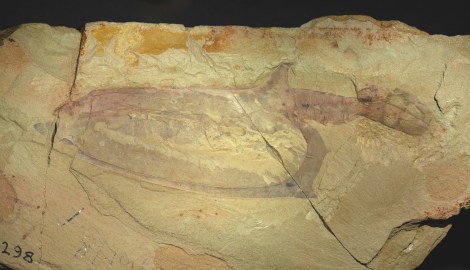
Many of the specimens on display in First Animals were collected from sites of exceptionally well-preserved fossils called Lagerstätten. These deposits preserve the remains of soft-bodied organisms that are almost never seen in the fossil record; things such as comb jellies and worms, as well as soft tissues such as eyes, gills and muscles. Even so, most of these fossils are flattened and two-dimensional, which makes it very difficult to reconstruct what they looked like in life.

Vetulicola cuneata from the Chengjiang fossil site had a large body with triangular openings on either side and a segmented tail. Its three-dimensional shape is uncertain.

To help exhibition visitors visualise the animals in a living environment we worked closely with Martin Lisec and his team at Mighty Fossils to create a set of detailed computer models of a key set of animals. We have worked with Martin before on the video of a Jurassic sea inhabited by plesiosaurs and other marine animals for our Out of the Deep display. That was very successful, but our idea for First Animals was even more ambitious: to create a unique interactive installation called the Cambrian Diver.

The material focused on the Chengjiang animals from the Cambrian of Yunnan province, China, which provides the most complete record of an early Cambrian marine community, from approximately 518 million years ago. Using fossil evidence of the organisms thought to have lived at the time we selected 12 species that were representative of the diversity of the Chengjiang biota.

The first phase was collecting as many materials as possible to be able to create 3D models. As usual, we started with rough models, where we set basic dimensions, shapes and proportions of body parts. Once approved, we moved to very detailed models for the animations, artworks and textures for less detailed models to be used within the interactive application. – Martin Lisec, Mighty Fossils

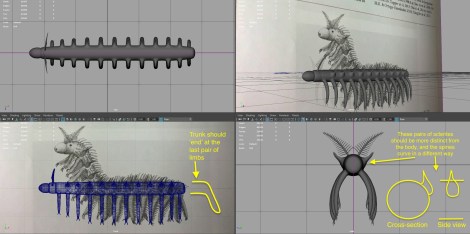
Images showing a preliminary 3-D model of the lobopodian Onychodictyon ferox in multiple views, with annotations in yellow highlighting changes suggested by Museum researchers.

To provide two-dimensional templates for Mighty Fossils to work from we scoured the scientific literature for the most recent accurate reconstructions available for each of the species.

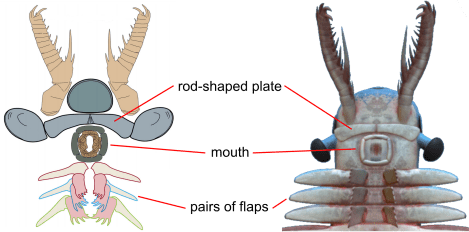
The predatory arthropod Amplectobelua symbrachiata is a good example. We drew heavily upon a 2017 paper by Dr Peiyun Cong and colleagues, which included a very detailed reconstruction of the head region. This reconstruction shows that the underside of the head of Amplectobelua consisted of a rod-shaped plate, a mouth made up of two rows of plates, and three pairs of flaps with spiny appendages, all details that are included in our 3D model.

Scientific reconstruction (left) and our 3D model (right) of the arthropod Amplectobelua symbrachiata. Left-hand image modified from Cong et al. (2017).

Colour and texture were another consideration. To inform these we looked at living species that are thought to have similar modes of life today. For Amplectobelua, a free-swimming predator, we examined the colouration of modern marine predators such as sharks. Many sharks have countershading, with a darker upper side of the body and a lighter underside, which acts as camouflage, hiding them from potential prey.

We reconstructed our Amplectobelua model with similar countershading camouflage, with blue and red colouration inspired by the peacock mantis shrimp, a brightly coloured predatory arthropod that lives in the Indian and Pacific oceans.

3-D model of Amplectobelua in angled upper (top) and lower (bottom) views, showing countershading.

The next vital step was establishing how the animals moved and interacted with one another. This is a major challenge because in many cases there are no modern equivalents for these extinct early animals. For Amplectobelua we inferred that the flaps on the sides of the body were used for swimming, with the tail fan helping to stabilize the animal as it moved through the water. This agrees with previous interpretations of swimming in closely related animals such as Anomalocaris.

The models were built and textured by Mighty Fossils using the 3D gaming engine Unity. The video below is an accelerated sequence showing how the elements of the model are layered together.

The finished, animated and annotated Amplectobelua model is shown below, and can be zoomed and rotated. All the models generated by Mighty Fossils for the First Animals exhibition are gathered in a collection on our Sketchfab page.

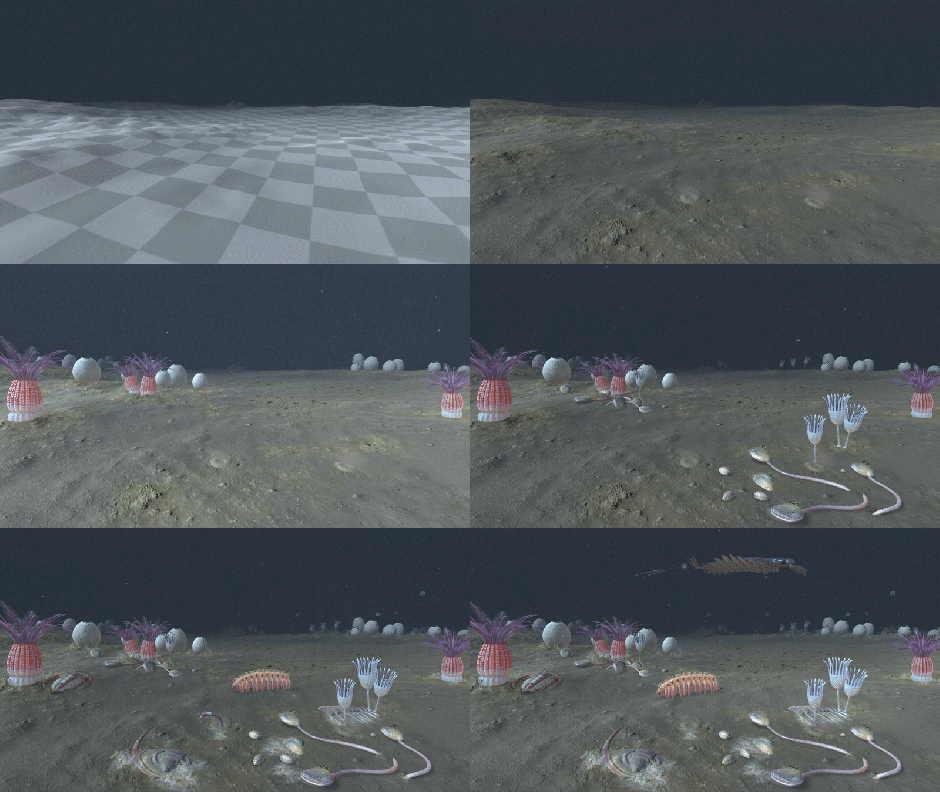
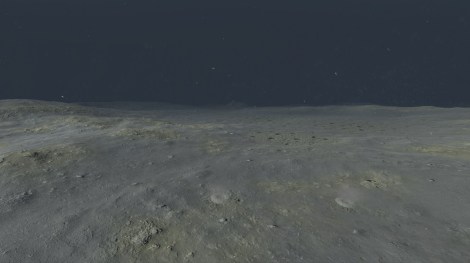
Once animated models of all 12 species were created we placed them in a realistic marine environment. Study of the rocks preserving the Chengjiang fossils suggests these animals lived in a relatively shallow, well-lit sea, perhaps 50 metres deep and characterised by a flat, muddy seafloor. A continuous shower of organic particles is thought to have filled the water column, as in modern oceans.

Reconstruction of the Cambrian seafloor with ‘marine snow’

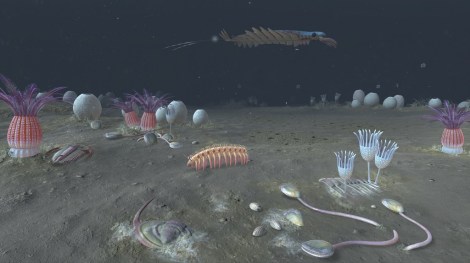
Based on present-day marine ecosystems, we infer that the number of immobile suspension feeders would have been much greater than the number of predators. As a result, we included multiple individuals of the suspension feeders Cotyledion, Saetaspongia and Xianguangia, which were tightly grouped together, but only a small number of the active predators Amplectobelua and Onychodictyon.

This scene is now populated with animals, including two predators: Amplectobelua (swimming) and Onychodictyon (centre)

The final step involved setting up a camera and user interface to allow visitors to discover the various animals in our interactive environment. For this we worked with creative digital consultancy Fish in a Bottle to identify eight locations, each focused on a different animal.

As the video above shows, users can navigate between locations by touching an icon on the screen, and when the Cambrian Diver sub arrives at a location information about the animal, its mode of life and its closest living relatives is presented on-screen. A physical joystick allows users a 360-degree rotation to look around the scene, and explore the ancient watery world.

This project was significantly bigger than the Out of the Deep work we had done previously with the Museum, mainly because of the complicated approval procedure needed for 20 individual 3D models. Along with three large illustrations, two animations and the interactive application this was a big workload! Fortunately, we managed to finish the whole project on time for the opening of the exhibition. – Martin Lisec

First Impressions: exploring early life through printmaking

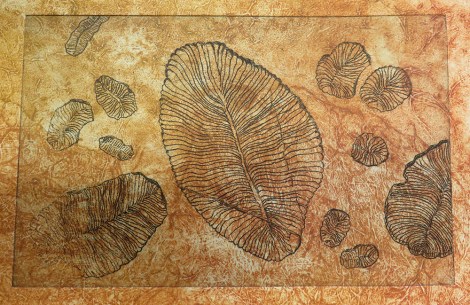
Dickinsonia by Claire Drinkwater

by Rachel Parle, public enagement manager

In each of our special exhibitions, we complement contemporary scientific research with contemporary art. In recent years this has included Elin Thomas’s crocheted petri dishes, Ian Kirkpatrick’s migration and genetics-themed installation, and who could forget the enormous E. coli sculpture by Luke Jerram?!

First Animals exhibition is on show until 24 February 2020

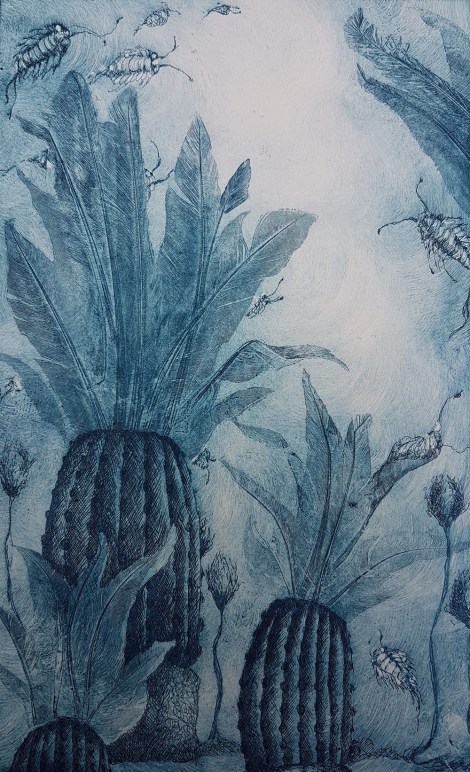
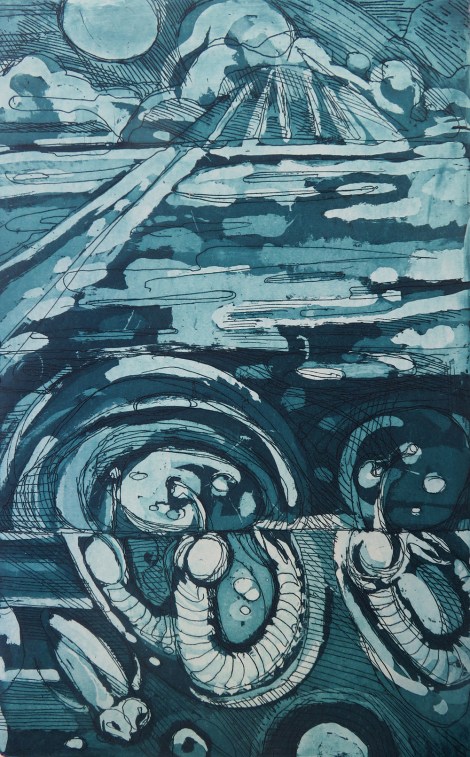
For our current exhibition, First Animals, we’ve taken this collaboration to a new level by commissioning original works from a total of 22 artists, all part of Oxford Printmakers Co-operative (OPC) – a group of over a hundred printmakers which has been running for more than 40 years.

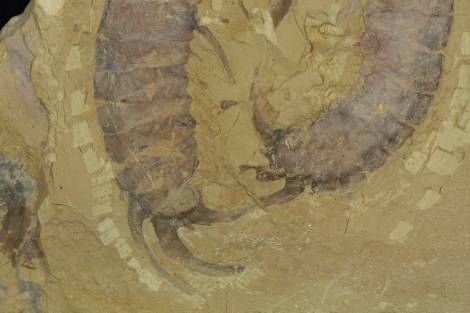
First Animals looks at the very earliest evidence of life on Earth, dating back half a billion years. Some of the fossils on display are shallow impressions in the rock – the only direct evidence we have that life existed at that time.

Amplectobelua symbrachiata – one of the incredible Cambrian fossils from the Chengjiang site in China

To kick-start the project we ran a series of workshops for OPC artists to meet the Museum researchers working on the exhibition, and to see the fossils first hand. There were also opportunities to draw directly from these unique fossils, many of which have never been displayed in the UK before.

Discussions between researchers and artists revealed fascinating similarities between these ancient fossils and the process of printmaking. Sally Levell, of Oxford Printmakers Co-operative, explains:

I was completely fascinated by the fossil collection in the Museum, especially the fine specimens from Chengjiang and Newfoundland. They are preserved as mere impressions in the rock, so they are, in essence, nature’s prints.

Each printmaker partnered with a researcher who could answer questions, provide extra info and help the artist decide which specimen or subject to depict in their final print. It’s clear from talking to the printmakers that this direct contact with the experts was invaluable and made the work really meaningful.

Xianguangia by Charlie Davies

We couldn’t have worked without the patient explanations and “show and tell” sessions with the three main researchers – Dr Jack Matthews, Dr Imran Rahman and Dr Duncan Murdock. They were just excellent and their dedication to their work was an inspiration to all of us printmakers.

Sally Levell

Over a period of around seven months, ideas blossomed and printing presses were put into action, with the printmakers exploring the forms, textures and evolution of the fascinating first animals. The final result is First Impressions, an enticing art trail of twenty-five prints dotted around the Museum, both within the First Animals exhibition gallery and nestled within the permanent displays.

Ottoia by Jackie Conway

Such a large group of artists brings a huge variety of techniques and styles, all under the umbrella of printmaking; from a bright, bold screen print in the style of Andy Warhol, to a delicate collagraph created from decayed cabbage leaves! To take part in the art trail yourself, simply grab a trail map when you’re next in the Museum.

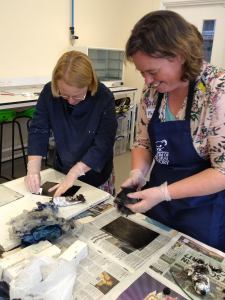
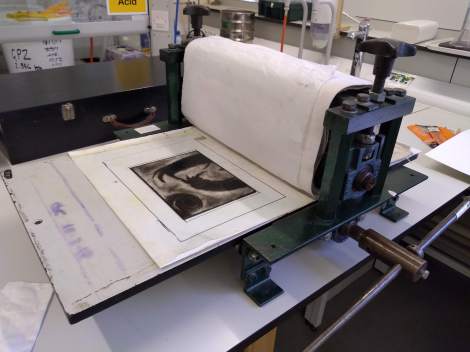
Workshop printers inking up their plates

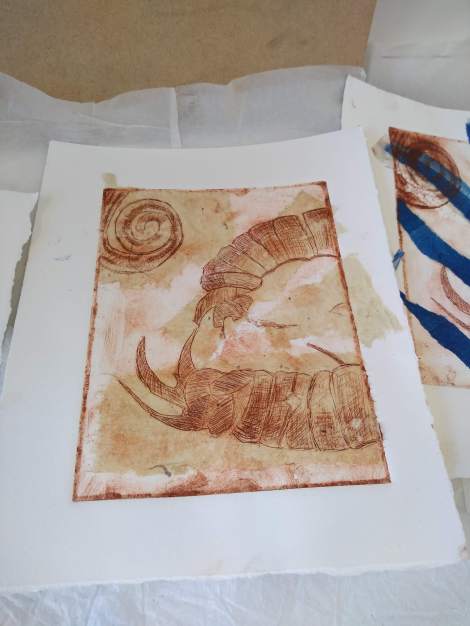
But our foray into fossils and printmaking didn’t stop there. OPC member Rahima Kenner ran a one-day workshop at the Museum where participants made their own intaglio prints inspired by the First Animals fossils. The group of eight people featured artists and scientists alike, all keen to capture the unique fossils through print techniques.

Designs were scratched onto acrylic plates and inked up, before a professional printing press created striking pieces to take home. Participants also explored techniques such as Chine-Collé, the addition of small pieces of paper to create texture and colour underneath the print.

It was a delight to be able to share with the group our enthusiasm for these discoveries in the medium of making the drypoint prints and to share their enjoyment of learning and using the new techniques. Some lovely work was produced in a single day.

Rahima Kenner

A plate about to go into the press

A finished print, using intaglio and chine-colle

The First Impressions project has been transformative for the Museum team and for the Oxford Printmakers Co-operative. Catriona Brodribb describes its impact on the printmakers :

It’s been a great opportunity to challenge one’s own artistic boundaries in terms of stretching the imagination, and for our members to throw themselves into something new, and enjoy responding to such ancient material in a contemporary way.

The First Animals and First Impressions exhibitions are open until 24 February 2020 and are free to visit.

Ice age bones tell tale of human impact on animals

In a series of short videos we look at some of the interesting and sometimes unexpected ways that people use the Museum’s collections.

In this video we meet Dr Chris Stimpson, who uses our collections to identify small bones he has collected from ancient Vietnamese caves. His work helps us to understand the impact humans have had on various species of animal over thousands of years.