Comedy rears its ugly head

Logo blob fish
Is the Blobfish the ultimate ugly animal?

Animals with big eyes, fluffy tails and cute noses are easy to love. But what about those with tentacles, slimy skin or a large throat pouch?! Luckily the Ugly Animal Preservation Society is here to fight their corner. Education Officer Chris Jarvis shares some tales from a special event…

Comedy met conservation on Saturday night, as the Museum teamed up with Berkshire, Buckinghamshire & Oxfordshire Wildlife Trust, compere Simon Watt and the Ugly Animal Preservation Society. During the evening, six comedians put the case for their own neglected animals in need of conservation: the Scrotum Frog; Christmas Island Frigate Bird; Kaluga Sturgeon; Slimehead; Okapi, and Yak. The audience then voted to choose the official mascot for Oxford, but which of these lovely uglies did they choose?

The Scrotum Frog

Par Samuel Garman (1843-1927) [Public domain], via Wikimedia Commons
Image: Samuel Garman via Wikimedia Commons

Chosen by Iszi Lawrence, this unfortunately-named amphibian’s population in Lake Titicaca is now dwindling. It’s threatened by the introduction of alien salmon for the angling fraternity and is also blended to make a medicinal frog frappe by Andean locals with strong stomachs!

Christmas Island Frigate Bird

By Charlesjsharp (Own work) [CC BY-SA 3.0 (http://creativecommons.org/licenses/by-sa/3.0)], via Wikimedia Commons
Photo: Charlesjsharp via Wikimedia Commons
Some may find its inflatable throat pouch off-putting (in the same way the Scrotum Frog brings certain disturbing images to mind), but not advocate Eleanor Morton. This critically endangered seabird is one of a family of only five species that grace our oceanic skies and deserves our attention.

Kaluga Sturgeon

By User:Cacophony [GFDL (http://www.gnu.org/copyleft/fdl.html), CC-BY-SA-3.0 (http://creativecommons.org/licenses/by-sa/3.0/) or CC BY 2.5 (http://creativecommons.org/licenses/by/2.5)], via Wikimedia Commons
Photo: Cacophony via Wikimedia Commons
Hideous and aggressive, these formidable fish grow to a ton in weight and have suffered a population decline of 80% over the last 90 years: we humans like to eat their eggs and their spawning grounds are now severely polluted. Without action we may lose one of the largest fresh water fish in the world. Kaluga Sturgeon champion Paul Duncan McGarrity made the case for this fugly fish.

Slimehead

By Pengo (Own work) [CC BY-SA 3.0 (http://creativecommons.org/licenses/by-sa/3.0) or CC BY 3.0 (http://creativecommons.org/licenses/by/3.0)], via Wikimedia Commons
Photo: Pengo via Wikimedia Commons
Nigel Lovell chose this sociable, deep sea fish which has been severely overfished due to the remarkable success of a rebranding campaign. You might know it better as the ‘Orange Roughy’ seen in fishmongers since the 1970s. But just remember it’s a ‘Slimehead’ – your dinner guests might not want to see that on their menu!

Okapi

By Raul654 (Own work) [GFDL (http://www.gnu.org/copyleft/fdl.html) or CC-BY-SA-3.0 (http://creativecommons.org/licenses/by-sa/3.0/)], via Wikimedia Commons
Photo: Raul654 via Wikimedia Commons
A rather beautiful (to my mind) relative of the giraffe, which looks like it put on a zebra’s pyjama bottoms by mistake! Rosie Wilby’s case for the Okapi was strengthened by a wonderful demonstration of its courtship behaviour involving a member of the audience and an 18-inch purple tongue*!

*Photographs cannot be shared.

Yak

Photo: travelwayoflife via Wikimedia Commons

Chosen by Teiran Douib, and not to be confused with the domestic yak, the wild yak is listed as vulnerable in its native Himalayas due to poaching, cross-breeding and climate change. These wonderful creatures are blessed with electrically non-conductive fur to survive electrical storms. They are one of the largest of all cow species, reaching up to 2.2 metres at the shoulder. However, their udders and scrotums are particularly small and hairy as protection against the cold.

Once the comedians had made their pitch it was time to decide on an ugly animal mascot for Oxford. Voting was frenetic and passionate as the issues at stake clearly hit home. But finally a champion emerged…

The winner was…the Kaluga Sturgeon! Yes, it’s official, Oxford’s Ugly Animal Mascot is a one-ton, aggressive fish that occasionally upends boats. As Paul Duncan McGarrity pointed out, it’s a shame that Oxford doesn’t have a long-standing boating rivalry with another city where this might come in handy…

Imitation game

Last month we had the pleasure of hosting artist and scientist Dr Immy Smith as part of her week-long takeover of @IAmSciArt on Twitter. Drawing inspiration from the Museum’s collections, Immy has created some beautiful paintings. Here she tells us a little more about her interests and work…

My current artwork is focused on crypsis and mimicry – the ways that animals and plants disguise themselves or pretend to be something they’re not. Cryptic camouflage helps animals to avoid being seen, often to help them catch prey – or to avoid becoming prey themselves! Mimicry is also often about trying not to get eaten: the harmless hornet moth, for example, mimics a stinging insect to deter predators. I use these themes to develop print art projects, and also public workshops to help people learn more about the ecology of cryptic animals.

Cryptic Cards by Immy Smith

In my arts practice I try to imagine how animals and plants might evolve to camouflage themselves on human-made materials, and what they might look like. Will we one day find moths adapted to hide on advertising hoardings, or beetles mimicking litter? I made an entire deck of Cryptic Cards as a response to this kind of question.

Another project I’m working on at the moment is called Emergent Crypsis. This is a collaboration with Norweigan generative artist Anders Hoff who makes art using algorithms executed by a computer. I’m imagining how creatures might adapt to an extreme example of human-made patterns – computer generated abstract images.

Violin Beetle (Mormolyce phyllodes) by Immy Smith

My work requires me to closely study many animals and plants, but how do I learn about all these species in order to draw their imaginary relatives? How do I make my art a convincing representation of how life might find ways to hide on human-made art?

One answer is of course, the internet. I’ve been lucky enough to find many wildlife photographers online who are kind enough to let me use their images as reference. But photographs alone are not always enough to get to know the fine details and defining characteristics of a species: the joints and articulations of small insects, for example, are best studied from specimens. And some species are rare, or even extinct, and it can be hard to find photographic a reference.

Leaf-footed Bug (Diactor bilineatus) by Immy Smith

This is where scientific collections come into the picture. The collections held in museums and other institutions are not only essential for scientists and scientific illustrators, they are also an invaluable resource for artists of many disciplines, science communicators, and educators of many kinds. In the collections at the Oxford University Museum of Natural History I can photograph and sketch leaf-mimicking insects, for example, that are native to the forests of South America which I may never visit. I can study in minute detail the articulation of beetles that are rarely seen, and which might be difficult to find – and irresponsible to collect – myself.

A display of terrestrial bugs (Heteroptera) in the Museum, including the Leaf-footed Bug painted by Immy Smith

Not only do I find specific species that I want to study in natural history collections, I often see new ones – animals I didn’t know about or hadn’t thought of drawing before. In the same week that I visited Oxford, I also made a trip to Herbarium RNG in Reading to study plant mimicry, and found similar inspiration there. I can channel all this into both aesthetic art destined for print and sciart workshops that communicate the wonders of insects or plants with the wider community.

Working on sciart projects and educational workshops helps me appreciate the multitude of ways in which collections benefit research and education. We must try to communicate the plethora of roles they play, and the host of ways they cross into our lives – whether through scientific research on insects pollinators of the crops we eat, or via a deck of cards made by someone like me for mainly recreational purposes. We must fight to protect scientific collections because they are a resource that benefits all of us as a society.

Stories from Stone, Body and Bone

rosehill exhibition postcard image for web

Each year the Museum works with members of the community on a wide variety of projects using our collections to enthuse and engage people in natural history. These projects often result in some amazing outcomes but until now we have been unable to find the right space to celebrate this work in the Museum. So this month we are very happy to unveil our new Community Case, dedicated to doing just that.

Community case front for web
Stories from Stone, Body and Bone in the new community case

Our opening display focuses on the Children in Need-funded Story Makers programme. In partnership with Fusion Arts, this initiative helps Oxford primary school pupils to develop their communication skills by taking inspiration from museum collections. And this year they teamed up with us to create Stories from Stone, Body and Bone.

Pupils from New Marston, Wood Farm, and Rose Hill Primary schools worked with Story Makers founder and arts psychotherapist Helen Edwards in two visits to the Museum, stimulating and developing imaginative ideas, stories and artwork.

During these visits the Story Makers met with our education officer Chris Jarvis and together they looked at rocks and minerals, tectonic plate formation, and the evolution of skeletons and animal posture. They explored the collections creatively through sensory observation, using the hands, body and senses to develop self-awareness and self-confidence.

story makers work 3 for web
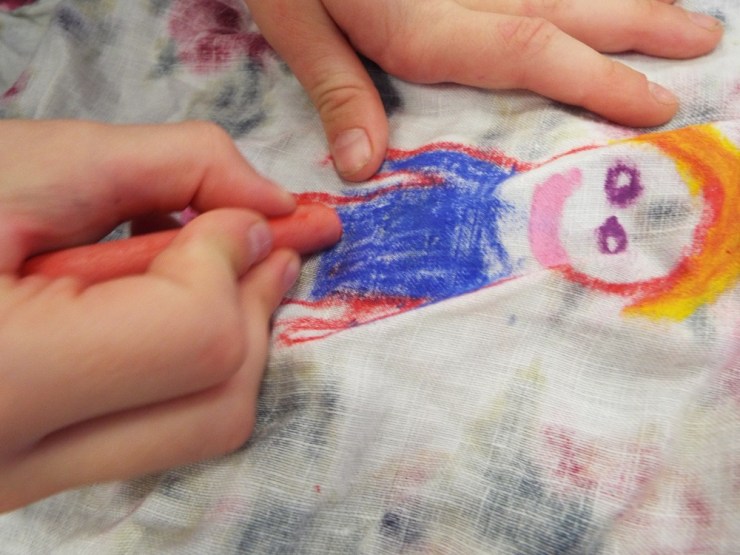
Getting creative with chalks and textiles

We work with the children as artists and we carefully designed a series of sessions that enabled them to have direct sensory engagement with objects in the museum. We then used art processes to portray their experiences and feelings about their interactions.
Helen Edwards, Integrative Arts Psychotherapist

Back at school, the pupils used visual art, drama, movement and modelling to communicate feelings and ideas that emerged from these museum encounters, sharing thoughts with the group in a playful and trusting atmosphere.

story makers students for web cropped

Group sessions back at school involving movement, drama and art

story makers work 4 for web
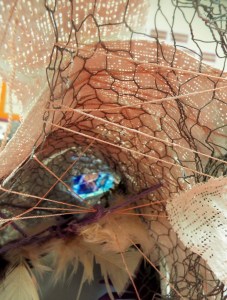
Detail from one of the Stone Age caves

Each Story Maker then created a Stone Age character – someone who might dream up and pass on stories full of meaning and myth. They imagined places in which their Stone Age characters might live, thinking about what they might see looking out from these spaces, through the cracks, crevices and windows in their caves.

From these ideas emerged beautiful, bright, and colourful models of these fictional abodes, as well as stories and poetry about their characters.

Story Makers built the children’s capacity to think reflectively, enriching their speech and language, and helped them to develop their writing skills as the stories were compiled into Story Makers books.

story makers artwork for web
Stone Age houses and landscapes as part of the Stories from Stone, Body and Bone project

Everyone should get to do this, it is like a dream come true
Story Maker, from the Stories from Stone, Body and Bone project

Stories from Stone, Body and Bone is on display until Sunday 21 May in our new Community Case. The next display, installed on 22 May, will feature artwork by our community of artists who use the collections as inspiration for their work.

The power of real

mnh-badger

Of all the questions that curious children ask about specimens in the Museum, the most frequent by far is ‘Is it real?’. It’s a surprisingly complex question, mixing ideas of authenticity with more basic confusion over whether something is, was, or wasn’t ever alive.

So what do children make of all the weird and wonderful things on display in museums and how does it affect their experiences? Research by psychologist Dr Louise Bunce aims to find out, as she explains here…

If you want to know when dinosaurs roamed the Earth, or how bees extract nectar from a flower, or what meteorites are made of, what would you do to find out? Search the web perhaps? The answers to all these questions, and many more besides, can be found on the internet, so why visit a museum instead to learn about the natural world?

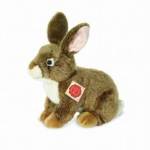
Example animal used in the research - Oryctolagus cuniculus and the toy rabbit
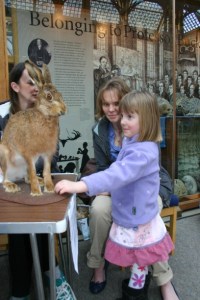
A taxidermy rabbit (Oryctolagus cuniculus), used in the research in the Museum…

Despite the wealth of information available online, the objects in museums continue to captivate visitors and offer something that the internet can’t. There’s something about ‘the real’ that has a certain power. Standing close to, and sometimes even touching, the genuine article – whether that be the head of a Dodo, or a painting by a Dutch Master, or a fossilised dinosaur skeleton – can induce goose bumps in museum visitors. But where does this potent effect come from?

... and a soft toy rabbit. Even younger children know the toy rabbit is not 'real'.
… and a soft toy rabbit. Even younger children know the toy rabbit is not ‘real’.

To begin to look at this question I have studied the importance and understanding of the ‘real’ in children visiting museums. When do children develop an understanding that they are looking at the real thing as opposed to a copy or model?

I conducted research with children visiting the Oxford University Museum of Natural History to see whether they understood that displays are of genuinely real animals, not manufactured models or replicas. And if they think they are models, how does that affect their experience?

The results were quite striking. Most 4- to 5-year-olds believed that the animals on display were not real because they were not moving, or because they were not alive. Consequently their reaction was somewhat dismissive.

A child participating in the research at the Museum

In contrast, most older children, those from the age of around 8 years, said that the animals were real because, for example, they had the real animal’s fur, or other authentic features. These children were also more curious about the animals because they were more likely to ask a question about the displays than children who perceived the specimens as not real.

So if younger children were missing out on the power of the real, I wondered whether there was something we could do to help them. I repeated the experiment but this time introduced children to toy animals and asked them to compare them to the museum animals. Now the majority of 4- to 5-year-olds seemed to gain a sense of awe because they perceived the museum animals as genuinely real in comparison to the toys, which they knew were not real.

These experiments seem to indicate that children do not necessarily perceive museum objects in the same ways as adults, but that we can help to give them meaningful encounters with museum specimens to create an inspiring museum visit. So don’t just Google it – grab the kids, a cuddly toy prop, and get down to the museum – or indeed out into nature – to be inspired by the real.

Do worms get old?

Old worms

by Sophie Gilbert

I have recently finished my PhD in the Department of Biochemistry at the University of Oxford, working under the supervision of Alison Woollard (Royal Institution Christmas Lecturer in 2013). I specialised in a species of very small (1mm long) nematode worm called Caenorhabditis elegans. These animals may sound exotic, but in reality, they are found at the bottom of nearly every garden in the world. Intriguingly, the worms’ characteristics vary according to their nationality: those found in Hawaii tend to be more promiscuous than their British counterparts, and Australian worms contain a mutation that not only makes them more social, but also increases their alcohol tolerance.

In this short video you can see worms crawling around under a dissecting microscope, which is how we visualise them. The biggest worms you can see are, in fact, only 1mm long! The worms eat bacteria (E. coli, non-pathogenic), which is growing in this petri dish full of bacteria.

The great thing about these worms is that they’re in many respects like small humans: they have a nervous system, a gut, muscles, skin, stem cells, and in addition they sleep and even grow old in much the same way we do. How do you spot an old worm? Like us, they get wrinkles and slow down, don’t move as much, and their organs start to fail. However, there are many advantages of looking at all these systems and processes in worms rather than humans – they only live for around 20 days (no waiting around for them to slowly age), they lay 300 eggs in the first few days of adulthood (there are always lots of them to look at), and they’re much smaller, simpler and easier to manipulate. This is not to mention that most humans would probably object to being grown in a lab. 

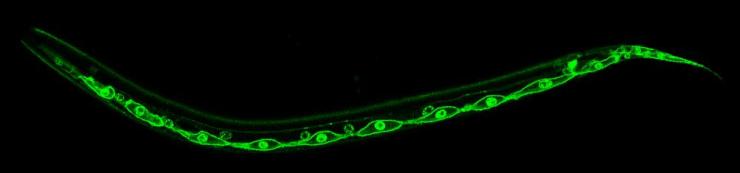
Stem cells visible inside a worm

Recently, I volunteered to bring the worms – and my colleagues – to Super Science Saturday at the Museum of Natural History, during which we explained to families how we use C. elegans to study the genetics of ageing: parents tend to show a particular interest in this topic. Until relatively recently, it was believed that ageing was an inevitable consequence of living – an unfortunate response to environmental stress and general wear-and-tear. Remarkably, it has now been discovered that many aspects of ageing are actually encoded in our DNA: changing just one gene can have a drastic effect, either shortening or extending our lifetime. We can use worms to explore this effect – and we can also use worms to discover new genes and processes that underlie healthy ageing.

Sophie and colleagues at Super Science Saturday, March 2016

Being able to demonstrate this rapidly expanding research field – as well as the worms themselves – to the public, especially to children, allows people to learn enough about biology to appreciate both its social and economic value, as well as giving us as scientists an invaluable insight into why our research is important. Next time, however, I might include a new warning sign for the microscope: “Look, don’t lick!”

Introducing the Dodo Crew

IMG_7579

by Carly Smith-Huggins, Education Officer

Over the past six months we’ve been trying something new at the Museum, working with an enthusiastic group of young people who have come to call themselves The Dodo Crew. Otherwise known as the Museum Youth Forum, the group meets up with us once a month to discuss ideas, plan events, see the collections, and generally have a dialogue about the Museum and its activity.

Dodo crew stickerThe Crew is made up of eleven 14-19 year olds who are already passionate about natural history and we’re really pleased to have them on board. Many museums across the UK run youth forums to engage the young people within their community, who are often underrepresented in museum audiences.
In fact, I was on a Museum Youth Forum at Norwich Castle Museum and found the experience very valuable as I had the opportunity to express my opinion, contribute and be part of a community, and make new friends. The group also enabled me to find my passion for working in museums, which I did not get from formal education or at home.

By joining the forum our Dodo Crew gets a chance to be involved in what we do as a museum, which I think is very important. And it will hopefully help us to be more successful in attracting people aged 14-19 years.

Going behind the scenes is great- seeing objects and talking to people.

It really felt like a unique opportunity and made me feel special.

IMG_7458
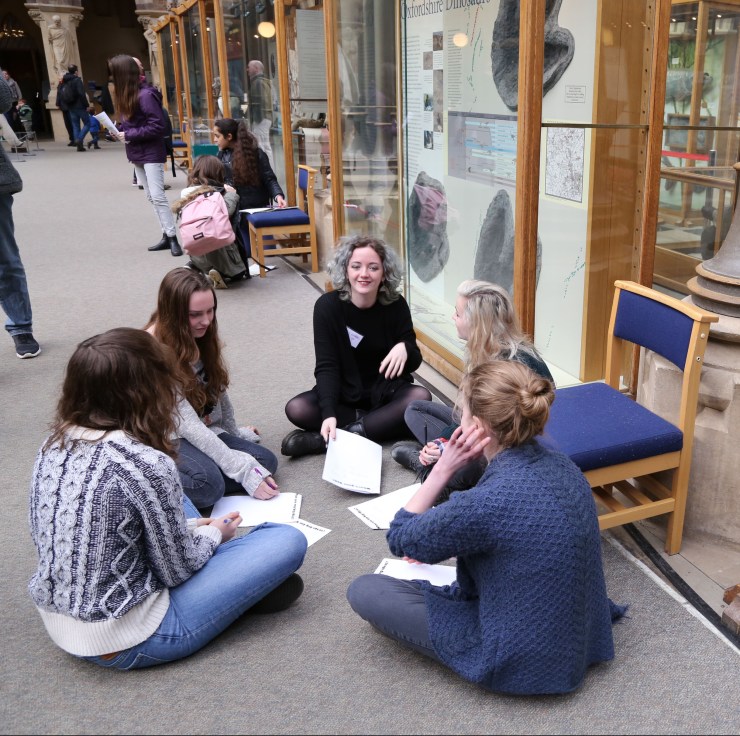
Members of the Dodo Crew get down to some planning in the Museum court

So what exactly have we been doing? The Crew has been enjoying taking part in various activities, from live animal handling and taxidermy demos, to planning events and meeting scientists. They will also be helping with programmed events, designing their own events, contributing to temporary exhibitions, and much more.

And their very first event is this Saturday 16 April, all about skin and bones. Everyone is welcome between 2-4pm, so come and meet the Dodo Crew and see their great ideas in action (and if that doesn’t entice you, there will also be a live chameleon!).

IMG_7576
Getting up close and personal with a friendly skunk