Scouring the archives, and receiving an unexpected package, help our documentation officer Sarah Joomun in her investigations into the Museum’s Lyell collection of fossil material.
Read more on the latest post from Past to Present…
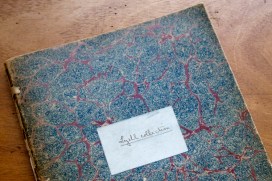
When I started work on the Lyell project in July of this year, I was very keen to know more about the history of the collection, both before and after it arrived at the museum. Collections often arrive at the Museum with associated material such as catalogues, letters or notebooks and after they arrive any activity related to the collection should be documented.
The first step in investigating the history of the collection was to find out what was in the Museum’s records. I began by looking at the donors database; this recorded the date that the Lyell collection arrived (1903) and the donor, Sir Leonard Lyell, Charles Lyell’s nephew. There was a little more information in the donors card index, which mentioned the fact that the collection came in two parts, the bulk of the collection in 1903 and then additional Italian specimens in 1907. The Collections Manager, Eliza…
As you can tell from the adornment of our Red Deer, Christmas is upon us, so it’s nearly time to bid farewell to another year. It’s been another remarkable twelve months here at the Museum so here’s a little round up a few highlights from 2015…
As winter gave forth to spring News emerged of a heartwarming thing The Art Fund whispered in our ear
We were nominees for Museum of the Year!
Although eventual winners we were not
It mattered really not one jot
For in celebration we embarked
On the Dodo Roadshow – a tremendous lark
Back in April we’re pleased to say Another award came our way Goes to Town gave creatures free reign
And grabbed a gong for Marketing Campaign
But we weren’t always on the road
In our exhibitions many stories were told
Of evolution, geology and sensory powers
Science and research passed the visitors’ hours
Our doors were open without interruption
While out on the lawn was a volcanic eruption
University scientists had plenty to say
On a really Super Science Saturday
So to our schools, and families, and adults and more
Thank you, cheers, and thank you some more
Handwritten in Stone 9 October 2015 – 31 January 2016
Today sees the opening of our new special exhibition – Handwritten in Stone – celebrating the life and work of William Smith on the bicentenary of his publication of the first geological map of England and Wales.
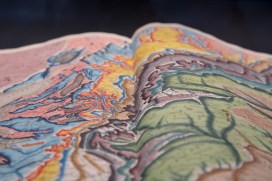
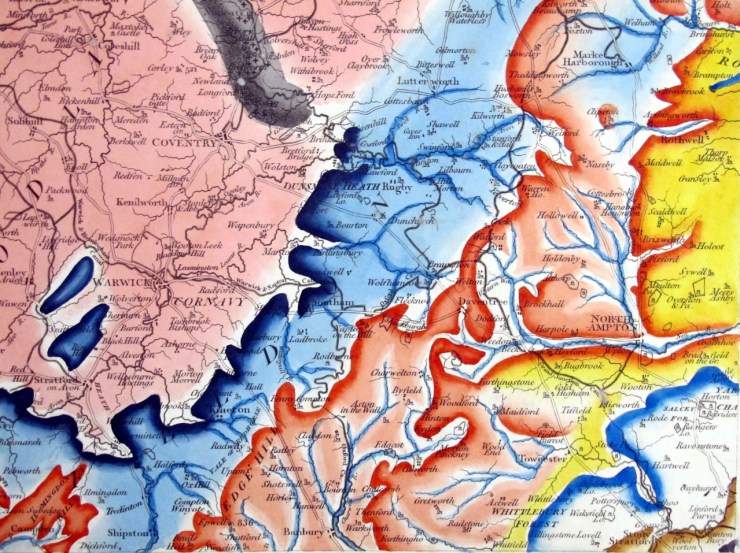
Dubbed ‘The Map that Changed the World’ in Simon Winchester’s book of that title, the beautifully hand-coloured map revealed a three-dimensional arrangement of rock layers, or strata, along with a fourth dimension – time.
This work earned Smith the moniker ‘the father of geology’, an accomplishment all the more impressive given that Smith achieved it single-handedly and with very little formal education.
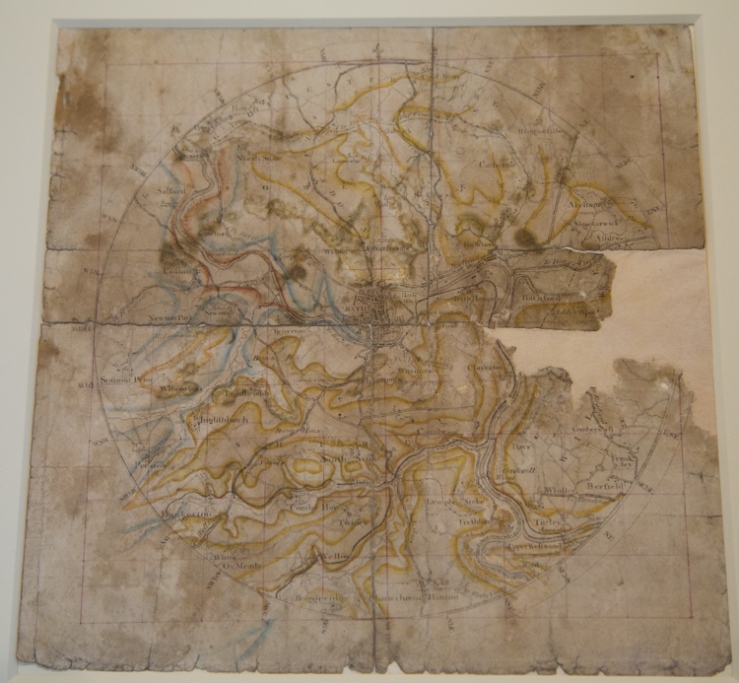
This 1799 map of Bath, on display in the exhibition, is the oldest geological map in the world
The Museum holds the largest archive of Smith material in the world. Alongside the famous 1815 map, shown at the top of the article, are personal papers, drawings, publications, maps and geological sections, most of which are being displayed for the first time. With these we have some fossil material from the collections: Smith realised that particular combinations of fossils were unique to different rock formations and could be used to date the strata.
Design work on the ‘drawing board’, created by Claire Venables at Giraffe Corner. Photo: Claire Venables
Handwritten in Stone, supported by the Heritage Lottery Fund, is the first show in our new special exhibition gallery on the upper east side of the building. Working out how to use the space was a learning process, and the final, elegant design is the work of local consultancy Giraffe Corner.
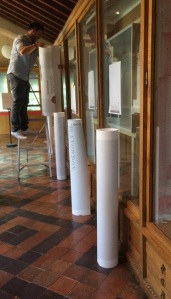
To bring the final exhibition together we collaborated with writer Rebecca Mileham, an installation team from the Ashmolean Museum, and more than 50 volunteers. Look out for more about the volunteers’ contributions on this blog soon.
Applying the graphics in the gallery. Photo: Claire Venables
The 1815 map itself takes centre-stage in the exhibition, flanked on one side by the history of Smith’s work building up to its publication, and on the other by the legacy of his techniques, which are still used today.
To discover the full story of William ‘Strata’ Smith head over to the upper east side of the Museum before 31 January.
And don’t forget to look out for our What’s On programme which includes lots of William Smith and geology-focused events, including a public talk by author Simon Winchester on 13 October.
Glowing from the success of our ‘Goes to Town’ and ‘Goes for a Pint’ events, which helped us win this year’s Museums and Heritage Award for best marketing campaign, we decided to ‘Go to the Festival’: the Lyme Regis Fossil Festival to be precise. Thousands of fossil collectors and holiday makers came to a marquee on the beach to discover more about fossils and enjoy all sorts of activities led by museums, universities, societies and conservation groups.
Monica and a festival-goer discuss William Smith’s map
This year marked the 200th anniversary of the very first geological map of Britain, made by geologist William ‘Strata’ Smith. As we hold the largest archive of his maps and papers, we were delighted to come and exhibit at the festival.
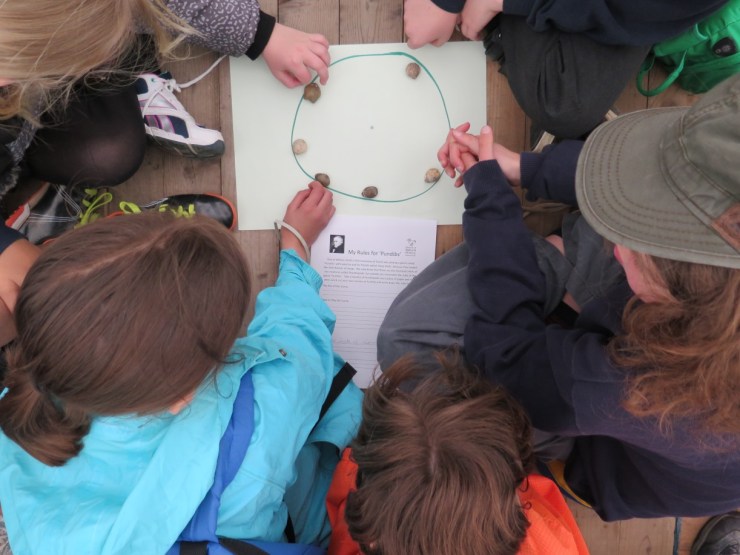
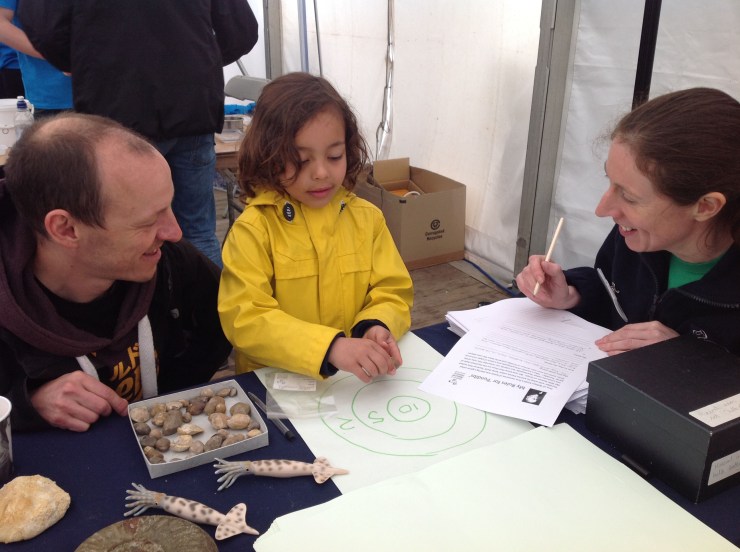
We brought with us some beautiful old specimens and archives from our collections, and let everyone enjoy and even play with real fossils. Play? Well, William Smith grew up in the Oxfordshire village of Churchill and used to play a game he called ‘pundibs’ using fossil brachiopods. He didn’t say what the rules were, and it appears that nobody living there today can remember either. We decided to challenge festival-goers to devise new rules.
Phil from Earth Collections shares some of the Museum’s fossil specimens
Brachiopods are curious aquatic animals that are very common in the fossil record, but are much rarer today. They have shells composed of two valves, a bit like a clam, but with a very different kind of body inside. The brachiopod holds onto a rock with its long stalk-like ‘pedicle’, opens its shell, and as the water filter through, catches food with tiny fibres on its loop-like ‘brachia’ or arms. The shell can be shaped like a pottery oil lamp, giving brachiopods their common name ‘lamp shells’.
Our brachiopod fossils proved quite challenging to play with. If you rolled them, they veered sideways. If you threw them, they’d bounce in all directions. Variations on skittles, boules, bowls and dice were all suggested, and even a race game to see which would fall to the bottom of a bowl of water first. Perhaps the original game is the one suggested by a former school teacher; children in his school used to play ‘dibs’, a throwing and catching game now better known as ‘knuckle bones’, ‘jacks’ or ‘five stones’.
Writing down the rules with Eliza
We thoroughly enjoyed our time at Lyme Regis, talking about fossils, answering enquiries, helping people have fun discovering the amazing world of geology – and of course, playing ‘pundibs’!
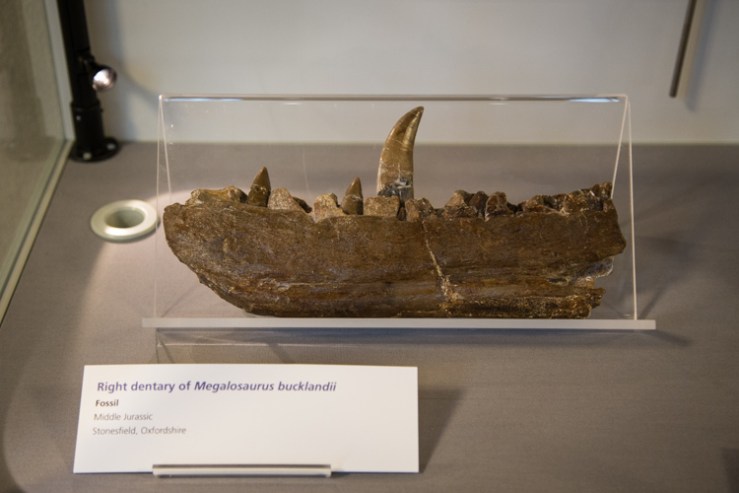
One of the Museum’s most significant specimens is the iconic jaw bone fossil used in the first scientific description of a dinosaur – Megalosaurus – in 1824. For the latest in our Presenting… series of displays we are showing this ‘first dinosaur’ along with some archival material documenting its discovery and description.
The fossil was acquired by William Buckland (1784-1856), Reader in Geology at the University of Oxford, after being found in a slate quarry in Stonesfield, just a few miles north of this Museum. Buckland soon realised it was something out of the ordinary and showed it and other Stonesfield bones to comparative anatomist Georges Cuvier, who noted similarities with living lizards. The name Buckland chose, Megalosaurus, means ‘great lizard’.
The Presenting… display of Megalosaurus bucklandii, on show until 17 May 2015
Later, in 1842, Richard Owen coined the term ‘dinosaur’ to describe a group of animals including Megalosaurus and other recently found ‘great lizards’ such as Iguanodon.
The dentary bone was just the front half of the lower jaw. The blade-like, serrated teeth tell us that Megalosaurus was a meat eater. Its teeth were often damaged, worn out or lost in battles with prey or rivals. Fortunately, Megalosaurus could replace its teeth several times during its lifetime. In this specimen six of the teeth are only partially erupted, with two just emerging along the gum-line and only one fully erupted tooth remaining.
The single-case Presenting… display is located near to the Welcome Desk and the Megalosaurus material will be on show until 17 May – see it while you can. If you miss this, don’t worry as casts of the fossils are on permanent display in the main court.
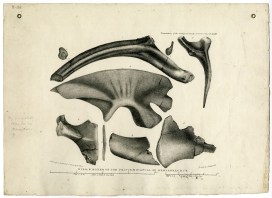
These drawings, by William Buckland’s wife Mary Morland, featured in Buckland’s “Notice on the Megalosaurus or great Fossil Lizard of Stonesfield” in the Transactions of the Geological Society of London, Series 2, vol. 1, pp. 390-396.
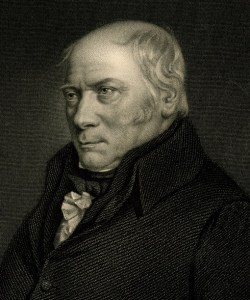
Today marks the 246th birthday of William Smith, the ‘father of English geology’. While the Museum has been marking this important day for a number of years, 2015 also happens to be a particularly special year for this remarkable man.
William Smith is perhaps most famous for publishing the first geological map of England and Wales in 1815, making this the bicentenary of the incredible feat.
Though Smith single-handledly mapped the geology of the country, and created a map that would change the way we understood the world beneath our feet, too few people know his name and what he achieved.
To celebrate the bicentenary, and also in the hope that Smith will become a wider-known figure in the history of science, a number of organisations across the world, including us here at the Museum of Natural History, will be holding events during the year.
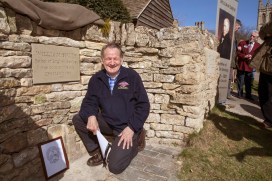
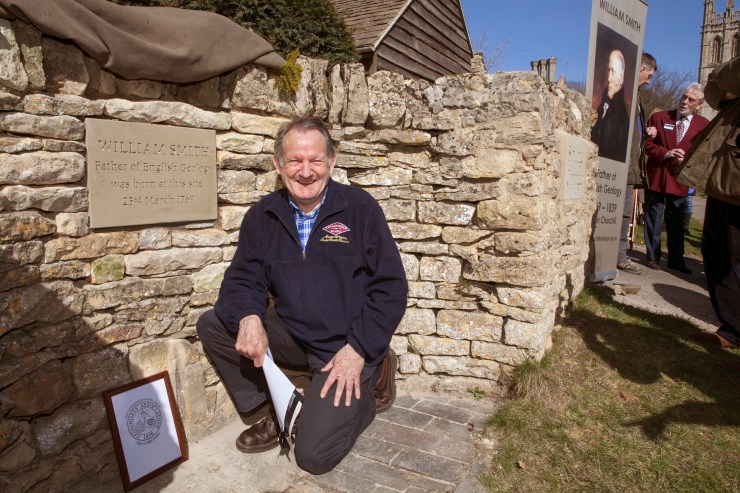
This weekend marked the official kick-off of events with the opening of the Churchill Heritage Centre special exhibition, curated by the Museum and displayed in the heart of Smith’s home town. A plaque to mark the place where he was born in 1769 was also unveiled, which you can see in the photo at the top of this post.
The plaque, sponsored by the Curry Fund was unveiled by Professor Hugh Torrens, the leading expert on William Smith. A large crowd gathered for the event, with a mix of local people proud of their connection to one of their most famous residents, as well as a familiar group of Smith academics, experts and enthusiasts.
Smith enthusiasts and Churchill residents gather for the exhibition launch
The exhibition, which is open weekends and bank holidays, will run until the end of September.
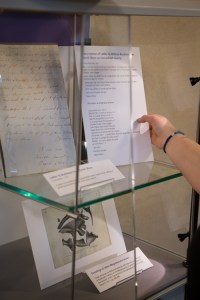
It includes well known publications from the William Smith archive here at the Museum of Natural History such as his geological map of Oxfordshire. Rarely seen items such as letters between himself and his niece, an excerpt from his diaries and the marriage deed of his grandparents will also be on display.








 William Smith is perhaps most famous for publishing the first geological map of England and Wales in 1815, making this the bicentenary of the incredible feat.
 This weekend marked the official kick-off of events with the opening of the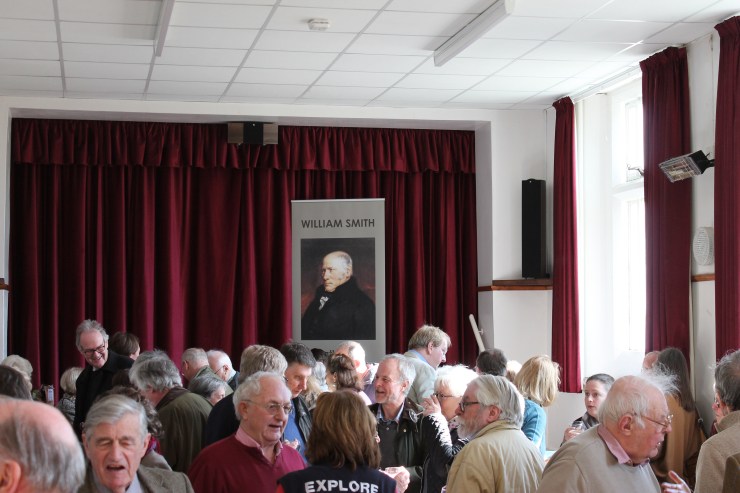
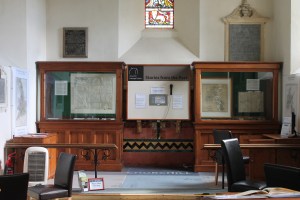 It includes well known publications from the William Smith archive here at the Museum of Natural History such as his geological map of Oxfordshire. Rarely seen items such as letters between himself and his niece, an excerpt from his diaries and the marriage deed of his grandparents will also be on display.
 More Than A Dodo