‘A thoroughly unhousewifely skill’

HodgkinBust etc 009

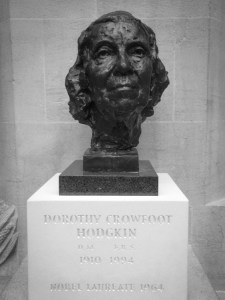
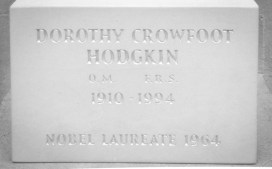
For International Women’s Day, the Museum of Natural History celebrates the life and career of Dorothy Hodgkin, one of its most eminent researchers. Hodgkin was awarded the Nobel Prize for Chemistry in 1964, and is still the only UK woman to have been awarded one of the science Nobels.

When the Museum of Natural History was designed in the 1850s, the building was intended not just to house a museum but also the burgeoning science departments of the University. The lettering above the doors facing the court continues to record these early affiliations: ‘Department of Medicine’, ‘Professor of Experimental Philosophy’, and so on.

Dorothy_Hodgkin_Nobel
Dorothy Mary Hodgkin (1910–1994) Image: Nobel Prize

As individual departments grew they moved into their own buildings across the science campus. One of the last research groups left in the Museum was the Department of Mineralogy & Crystallography, which, from the 1930s onwards, was the research home of the outstanding X-ray crystallographer Dorothy Hodgkin (1910-1994), winner of the Nobel Prize for Chemistry in 1964.

The Daily Mail famously celebrated her success with the headline ‘Oxford housewife wins Nobel’, but The Observer was no more enlightened, commenting that Hodgkin was ‘an affable looking housewife’ who had been awarded the Nobel Prize for ‘a thoroughly unhousewifely skill’.  That socially disruptive ability was an unparalleled proficiency with X-ray analysis, particularly in the elucidation of the structure of biological molecules.

Hodgkin undertook her first degree at Oxford from 1928 to 1932, initially combining chemistry and archaeology but later focusing on the emerging technique of X-ray crystallography. Her undergraduate research project was carried out using this technique in a Museum laboratory within what is now the Huxley Room, the scene of the 1860 Great Debate on evolution between Bishop Wilberforce and T. H. Huxley. She then journeyed across to Cambridge for her PhD before returning to Oxford in 1934 and resuming her association with the Museum.

Model_of_the_Structure_of_Penicillin,_by_Dorothy_Hodgkin,_Oxford,_c.1945
Model of the Structure of Penicillin, by Dorothy Hodgkin, Oxford, c.1945, in the Museum of the History of Science

Back in Oxford, Hodgkin started fundraising for X-ray apparatus to explore the molecular structure of biologically interesting molecules. One of the first to attract her attention was insulin, the structure of which took over 30 years to resolve – a project timescale unlikely to appeal to modern research funders. Other molecules proved more tractable, including the newly discovered penicillin, which Hodgkin began to work on during the Second World War, and vitamin B12.  It was for the determination of these structures that she was awarded the Nobel Prize.

Dorothy Hodgkin’s new X-ray laboratory was set up in a semi-basement room in the north-west corner of the Museum.  The room is now a vertebrate store but was once also the research home of Prince Fumihito of Japan, when he was based in the Museum for his ichthyological research (and It is still the only room in the Museum with bulletproof windows).

Initially, Hodgkin’s only office space consisted of a table in this room and a small mezzanine gallery above, which housed her microscopes for specimen preparation. Once prepared, she then had to descend a steep, rail-less ladder holding the delicate sample to the X-ray equipment below. Later, Hodgkin had a desk in the ‘calculating room’ (now housing the public engagement team) where three researchers and all of their students sat and undertook by hand the complex mathematics necessary after each analysis to determine the crystal structures of organic molecules.

Paul Smith – Director

If you would like to learn more about Dorothy Hodgkin and her work, then read Georgina Ferry’s excellent biography ‘Dorothy Hodgkin: A Life’ which has just been re-issued as an e-book and new, print-on-demand paperback by Bloomsbury Reader.

 This year’s Dorothy Hodgkin Memorial Lecture will be held in the Museum at 5 pm on Thursday 12 March, and is open to all. The lecture will be given by Dr Petra Fromme (Arizona State University) who is an international authority on the structure of membrane proteins.

Ray of sunshine

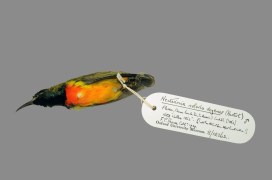
nectarina_solaris Working on the Lepidoptera Project in the Entomology department keeps me very busy during the day, but I rarely get to see other parts of the Life Collections. So it was a real treat when my boss Darren said I could look at the specimens in the bird skin store. While carefully going through the drawers, I found this spectacular little bird from the family Nectariniidae. The species is Cinnyris solaris, which is also has the evocative name of Flame-Breasted Sun Bird. This particular specimen was an amazing surprise, because of the label data. It states:

Flores (lesser Sunda Islands, Indonesia) [?1862] Noted “Wallace 1862”[?Collected or obtained  from Alfred Russell Wallace?] F.P. Pascoe Coll. 1909

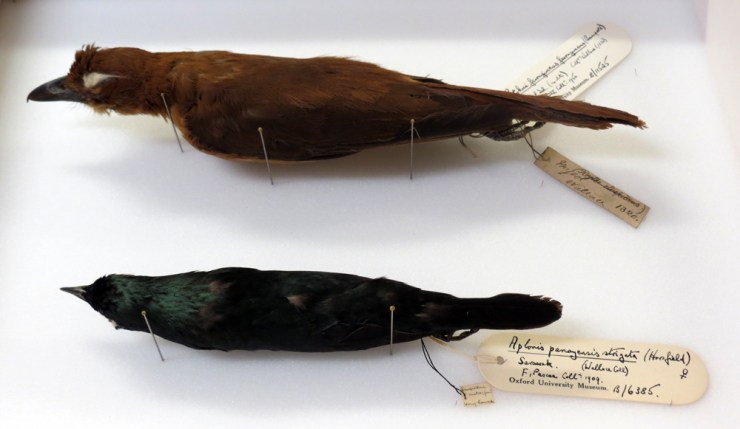
A bird that was probably collected by Alfred Russel Wallace! I checked the excel spreadsheet that listed all of the birds in the museum collected by the famous 19th century naturalist and got my second surprise- it wasn’t on the list! Five other Wallace birds were listed (including the two shown here) but the Sun Bird wasn’t there.

WALLACEBIRDS
Two of the other Wallace birds in the Museum’s collection

I decided to do some research on the specimen, and here is what I found out: The specimen was donated to the museum in 1909 by the English entomologist Francis Polkinghorne Pascoe, who acquired a lot of material from Wallace over the years. In Wallace’s paper A List of Birds inhabiting the Islands of Timor, Flores and Lombok the bird is mentioned as Nectarina solaris (it was later placed in the genus Cinnyris.) The bird would have been in Wallace’s possession when Pascoe acquired it.

Wallace, A.R. (1863) A list of Birds inhabiting the Islands of Timor, Flores and Lombok with Descriptions of the New Species pg. 486

However, the bird was also more likely to have been collected by Wallace’s assistant Charles Allen rather than Wallace himself, as Wallace never set foot on Flores. Wallace did not think much of Charles Allen as an assistant, as detailed in this letter to Wallace’s mother on 30th September 1854:

If it were not for the expense I would send Charles home; I think I could not have chanced upon a more utterly…careless boy.

nectarina_solaris_versoIn 1893, the major portion of the collection was donated to the British Museum in London via a relative, Miss Pascoe, but she donated the remainder to the Hope Department here at the Museum in 1909. Alfred Russel Wallace himself was said to have suggested this. These items were mostly insects, but also included this beautiful Flame-Breasted Sun Bird. Today the Flame-Breasted Sun Bird is a scarce species due to its limited island range, but is not considered threatened. I feel privileged to have chanced across such an amazing specimen in the bird stores. Gina Allnatt, Curatorial assistant (Lepidoptera) ** Letter used by Gina for research can be seen at Wallace Letters Online

Happy Birthday Darwin!

Onthophagus australis

By Darren Mann, Head of Life Collections

A birthday, on 12 February, and an ‘inordinate fondness for beetles’ are possibly the only things Charles Darwin and I have in common. In his autobiographical notes (1887) Darwin says that at the age of ten he made the decision to collect, but not kill insects; at the same age I was given, by my junior school teacher, four Madagascan hissing cockroaches (the large male I called Burt). So Darwin and I began a lifelong fascination with natural history at a similarly early age, though with very different results.

Much is written about Darwin and his scientific accomplishments, but did you know he was also an avid beetle collector? The quote below is testament to his enduring enthrallment with beetles.

“I feel like an old war-horse at the sound of the trumpet when I read about capturing of rare beetles… It really almost makes me long to begin collecting again”

Trypocopris vernalis
Trypocopris vernalis, collected by Darren Mann, North Wales, 1986

Darwin was also a close correspondent of Reverend F.W. Hope, the founder of the entomological collections at the Museum, and the two often set out on insect-collecting expeditions together. These trips regularly resulted in the capture of rare or unusual species, and an occasional publication.

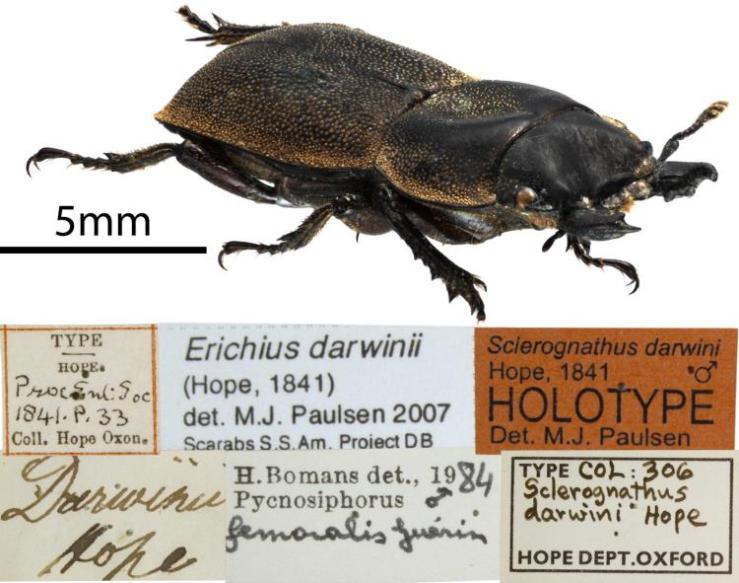
In 1831, Darwin embarked on his famous voyage around the world as naturalist on the HMS Beagle. He returned to England, in 1836, with around 4,000 insects, some of which were donated to his good friend Hope. Hope scientifically described a few of Darwin’s new species of beetles and named them in Darwin’s honour. Examples include the ground beetle Carabus darwinii and the stag beetle Dorcus darwinii.

Dorcus darwinii Hope, 1841 “The above insect I have lately received from Chili. It is named in honour of Charles Darwin, Esq., who has greatly contributed to our acquaintance with the Entomology of Valparaiso, Chili, and other parts of the South American continent.” Hope, F.W. 1843. On some nondescript Lamellicorn Beetles Transactions of the Royal Entomological Society of London 3(4): 279–283.
Dorcus darwinii (Hope, 1841)
“The above insect I have lately received from Chili. It is named in honour of Charles Darwin, Esq., who has greatly contributed to our acquaintance with the Entomology of Valparaiso, Chili, and other parts of the South American continent.” Hope, F.W. 1843.

During the Beagle voyage Darwin became the first collector of Tasmanian beetles. Onthophagus australis, collected by Darwin in Hobart Town in Tasmania in 1836, is shown in the photo at the top of this post. Whilst in Hobart Town he was also surprised to find

“Four species of Onthophagus, two of Aphodius, and one of a third genus, very abundant under the dung of cows; yet these latter animals [cows] had then been introduced only thirty-three years. Previously to that time, the Kangaroo and other small animals were the only quadrupeds; and their dung is of a very different quality to that of their successors introduced by man.”

This observation, possibly made on his birthday (and what a great way to spend the day) points to research questions that are ongoing today: the effects of habitat change from forest to pasture, and the impact that introduced farm animals have on native dung beetle populations.

In his 1871 publication, The Descent of Man, Darwin returned to dung beetles, writing about their sexual dimorphism, or differences in appearance between males and females, and arguing that there must be a contest between males and females which drives rapid evolutionary divergence amongst populations. There is now considerable scientific evidence to support these views on sexual selection, some based on dung beetle research.

Phanaeus vindex
Phanaeus quadridens from the New World

So we come full circle. I work in the building where, in 1860, there was the first public meeting on Darwin’s then newly-published book, The Origin of the Species, an event now often referred to as the Huxley–Wilberforce debate, or Great Debate. My hobby and research interest focus on dung beetles and their ecology, including the effects of habitat change and loss of dung beetle diversity. And within sight of my office are those dung beetles Darwin wrote of from Hobart Town…

I am fortunate to be part of the curatorial team that looks after Hope’s collection, including those specimens given to Hope by Darwin. We have put a few of these on public display for the first time as part of our ‘Presenting…’ series of temporary exhibitions and to celebrate Darwin’s (and my) birthday I will give an informal short talk in the Museum on Thursday 12 February at 2.30pm, focusing on Darwin material from the collections.

http://darwin-online.org.uk/

Little and large

Blog branding

Amo Spooner from the Museum’s Life Collections has been out in the Museum sharing some of her favourite objects. Here’s the latest in our Spotlight Specimens series…

**

P1090762

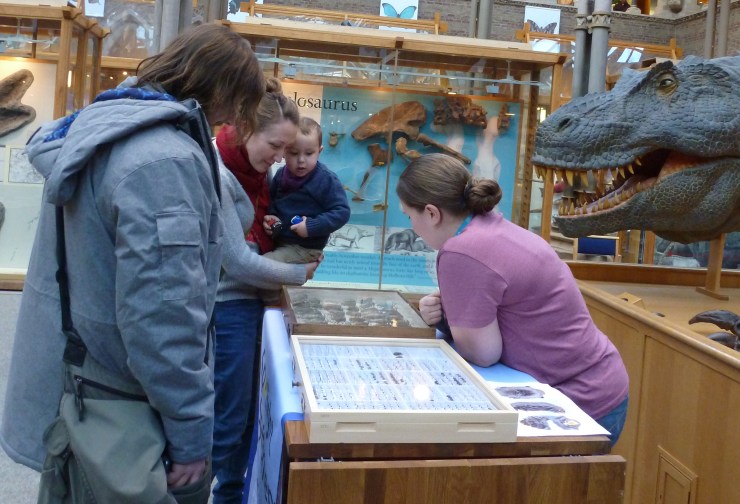
Big impressive beetles or small shiny ones? That is the question. For me it’s all about the small ones, but here I am getting people’s (and the T. rex’s) attention with the big ones. It’s my tactic for engaging their interest before I try to convince them that the small ones are so much cooler!

Monday – Thursday at 2.30pm a member of the Museum’s collections staff can be found out in the Museum talking about something interesting. For my latest session of Spotlight Specimens I chose to show off drawers of my favourite beetles.

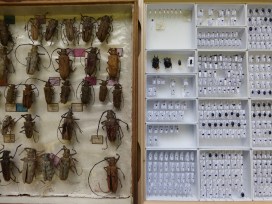
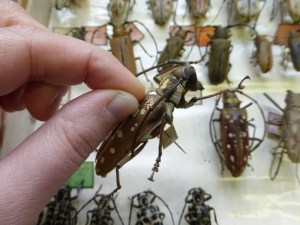
P1020715The big ones are from a family of beetles called Cerambycidae or Longhorn Beetles. This family is found all over the world and varies greatly in size and colour. These ones are particularly interesting to me because of the historic collection they are from. The vast Baden-Sommer collection, containing many different beetle families, came to the museum via a dealer in 1910 and unusually it is still in its original layout. The labels you can see in the drawer were written by the two entomologists that collected the specimens, J. Baden and M. Sommer.
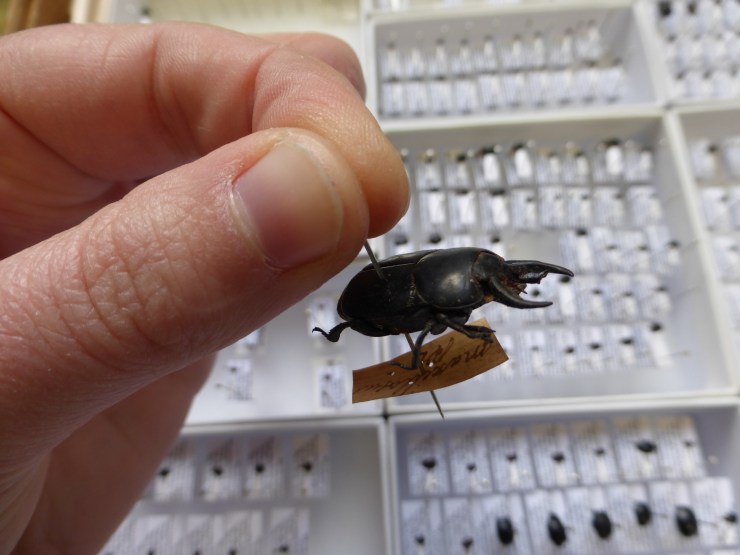
The one you see in my hand (above) is in the subfamily Lamiinae – also charmingly known as Flat Faced Longhorns.

Part of my job is to re-curate and move historic specimens into pest-proof housing –  I am currently writing a blog post explaining this, so watch this space! In a nutshell, the Baden-Sommer Longhorns are a good example of drawers in need of some TLC. This leads me nicely on to my second choice of drawer, the Histeridae.

P1020717These are my first love when it comes to beetles. The Histeridae, or Clown Beetles, vary a lot in size; the one in my hand (below) is about as big as they get, but they can be as small as 1 mm in length.
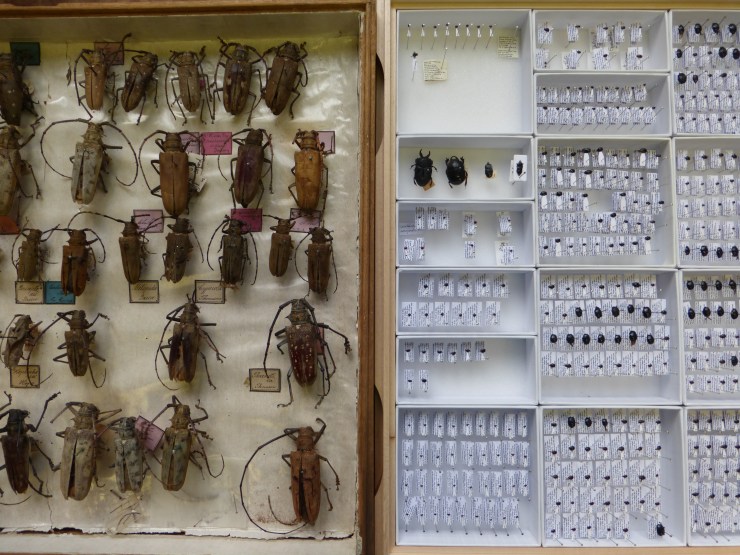
P1020709I have re-curated all of the Museum’s historic Histeridae specimens and mounted up many modern ones, like you can see above. This modern system of trays and pest proof drawers ensures the longevity of specimens, as well as making them easier to access.

So what makes the little ones so special? During the afternoon I met visitors from home and abroad, young and old. I convinced them to to look a little closer, admiring their shiny black armour and fascinating adaptations. I think they finally agreed that big isn’t always best.

Amo Spooner, Collections assistant (Life)

Top 5 – Lepidoptera

leps

Our monthly staff meetings are a chance to catch up on what’s happening across the Museum. But recently it’s also been used as an opportunity to share some of the hidden gems in the Museum’s collection. Each month, one member of staff selects 5 of their personal favourite specimens to talk about. We thought that you might like to share this experience, so the Top 5 will be blogged here each month for you to enjoy.

With 2 million butterflies and moths in the Museum’s collection, choosing a top 5 is certainly a challenge. But Gina Allnatt is feeling brave…

**

WORKING2
Gina working on a draw of Lepidoptera (moths and butterflies)

I work on the Lepidoptera Project, which is a two-year project to database, catalogue, re-curate and photograph moths and butterflies in the Life collections. Because it’s such a large and amazing collection, I had trouble deciding what to choose for top five specimens. In fact, I almost wish it had been a top ten. But who knows…maybe there will be a part two to this at some point.

So here goes…

5 – Wallace’s Golden Birdwing (Ornithoptera croesus)

putative_syntype_male

This is a recent discovery and one we’re very excited about. We believe that this is the specimen, or one of the specimens, that Alfred Russel Wallace described so passionately in correspondence to his dealer Samuel Stevens.

The beauty and brilliancy of this insect are indescribable, and none but a naturalist can understand the intense excitement I experienced when I at length captured it. On taking it out of my net and opening the glorious wings, my heart began to beat violently, the blood rushed to my head, and I felt much more like fainting than I have done when in apprehension of immediate death. I had a headache the rest of the day, so great was the excitement produced by what will appear to most people a very inadequate cause. –A.R. Wallace 1859, from Proceedings of the Entomological Society.

Observant Wallace fans may have noticed that it doesn’t have Wallace’s typical round labels. It was re-labelled when it was donated to the Museum in 1871. It seems that Hewitson, a wealthy collector, removed all the original labels when they came into his care – a nightmare for me when I’m trying to trace things!

4. Lampides carissima from the Challenger Expedition

Lampides carissima

One of our volunteers, Willow, was databasing a drawer of Lycaenidae and he asked me why there was one butterfly separate from the main group. He wanted to know what species it was so he could database it. So I picked up the specimen and I immediately saw “Challenger, July 1874”.

Arthur Gardiner Butler

Entomologist Arthur Gardiner Butler, who then worked at the British Museum, produced a paper called “The Lepidoptera collected during the recent expedition of the H.M.S. Challenger,” which lists all the species of butterflies and moths collected on the expedition and where they were found. And there, in the paper, we have; “Jamides carissima, collected Tongatabu, July 1874″. This is the only Challenger specimen we have found so far in the Entomology collections, but there could well be more. We’ll see… challenger

3. Extinct Moths and Butterflies

Kona Giant Looper Moth

The collection contains some extinct and critically endangered moths, all of which were endemic to particular islands around the world. Above you can see the Kona Giant Looper moth, which was endemic to Hawaii. Two females and one male collected by R.C.L Perkins. This was one of the world’s largest Geometrids. This shows how important historic collections are for reminding us what we have, what we’ve lost and what we need to look after.

2. Wallace’s Sun Moth

sunmoth

This specimen came from the Brazilian orchid house of Alfred Russel Wallace. It’s a moth from the family Castniidae, or Sun Moths. When the moth was first found it caused a bit of confusion; Wallace was thrown by the insect’s moth-like appearance and clubbed antennae. Was it a moth or a butterfly? This reminds us that there are exceptions to every rule – when someone tells you butterflies have clubbed antennae and moths don’t, it’s not always true! Even Wallace got caught out sometimes.

1. World’s Oldest Pinned Insect

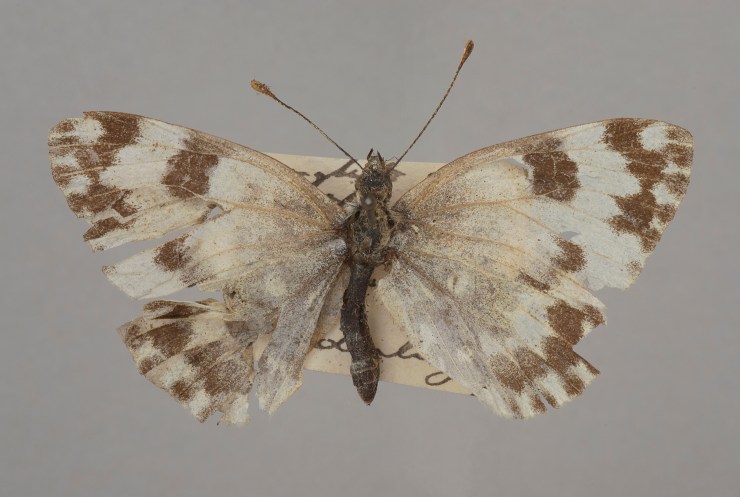
Bath WhiteBefore insects were preserved on pins, they were glued onto card or pressed in books, rather like a botanical specimen. This Bath White butterfly (Pontia daplidice) is the oldest known pinned insect and its label suggests is was collected in Cambridge by William Vernon, in 1702.
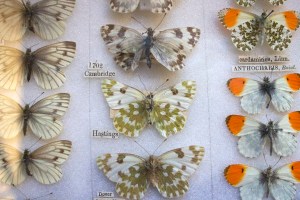
oldest_insect_on_a_pinBut research now suggests that Vernon was capturing Bath Whites as early as 1699, so the specimen could be even older than that. So it’s at least 313 years old this year and is still on its original pin!

To find out more about the Lepidoptera Project, follow us on Twitter @hopeulikemoths

Gina Allnatt, Curatorial assistant (Lepidoptera)