Birds of paradise

By Eileen Westwig, Life Collections Manager

The latest in our Presenting… series of single-case displays takes a look at one of the world’s most spectacular groups of birds – Paradisaeidae, or the birds of paradise.
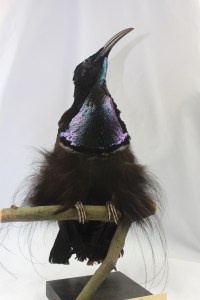
A beautiful male Magnificent Riflebird (Lophorina magnifica)

The first bird of paradise to arrive in Europe was a skin that came to Spain in 1522. Many of these early skins were prepared by native hunters without wings or feet to better show off the bird’s spectacular plumage. Upon arrival in Europe, the apparent lack of wings and legs led to the myth that these birds originated from paradise and floated high in the skies, only to fall down to earth after their death.

Birds of paradise are members of the family Paradisaeidae, which contains more than 40 recognised species. Their closest relatives are crows and jays, of the Corvid family.

They inhabit the rainforests of Papua New Guinea, Eastern Indonesia and Eastern Australia and mainly feed on fruit and some insects. Hybridisation, when two birds of different species crossbreed, is quite common and can explain why many of the early described species were so “rare”.
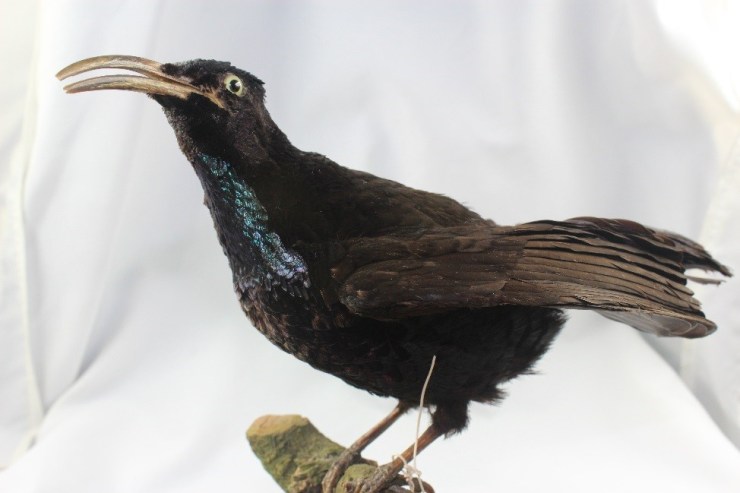
Male Paradise Riflebird (Lophorina paradiseus) showing off iridescent plumage on its chest
Female Paradise Riflebird (Lophorina paradiseus) without colourful plumage, which helps to blend into the environment

Most species of birds of paradise are sexually dimorphic, meaning males exhibit the spectacular plumage these birds are best known for, whilst females have much less ornamentation and coloration. The male’s display feathers are highly specialised and have evolved from basic feathers. Like all feathers, they are shed and regrown every single year, which puts quite a strain on the males.

One of the first few Westerners to see these birds in their native habitat was naturalist and explorer Alfred Russel Wallace. He described the encounter, from a 19th-century Westerner’s point of view, in Narrative of Search after Birds of Paradise (1862) as:

Nature seems to have taken every precaution that these, her choicest treasures, may not lose value by being too easily obtained. […] In […] trackless wilds do they display that exquisite beauty and that marvellous development of plumage, calculated to excite admiration and astonishment among the most civilized and most intellectual races of man…

The Presenting… Birds of paradise case will be on display until 3 September 2019.
Image: (c) Mark Garrett

All hail the swift

Image: Maciej Szymański

By Chris Jarvis, Education Officer

This week is Swift Awareness Week and that means it’s time to celebrate our screaming summer visitors – the avian ones, that is.

Here at the Museum we eagerly await the return of these long distance migrants each May. This is not only because for many of us they herald the start of summer, but also because the swifts that nest each year in the Museum tower are part of the longest-running continuous study of any bird species in the world.

Taking the long view of these amazing birds we know that, like all birds, they evolved from a particular group of dinosaurs. Birds, in effect, are living dinosaurs. The earliest fossil swift, the ‘Scania Swift’, is around 49 million years old and shows us that by this time they had already evolved in forms that are virtually indistinguishable from today’s birds. Today, they have diversified into around 100 different species including our Common Swift (Apus apus).

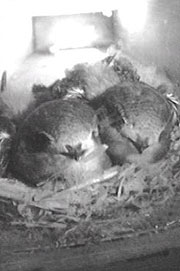
Swifts in the tower nests as seen on webcam
Swift chicks in a nestbox in the Museum tower, shown on the webcam feed

Swifts have taken life on the wing to the extreme. Not only are they the fastest recorded bird in level powered flight, reaching speeds of nearly 70mph, but once launching themselves from the nest that they hatched in they may not land for the next two years of their lives!

They are so adapted to life in the air that they are capable of eating, mating and even sleeping on the wing. During sleep, it is thought that the two hemispheres of the brain take it in turns to nap as the swift slowly circles at heights of up to 30,000 feet. They do not even land to collect nesting material, instead relying on whatever feathers or pieces of plant material are floating in the air to build their nests.

During this two-year flight they will follow their food – the seasonal blooms of flying insects that appear after summer rains – on a 14,000 mile annual migration to southern Africa and back, living in perpetual summer.

Whilst for a long time scientists thought swifts were closely related to similar looking birds, swallows and martins, DNA analysis has revealed that they are the product of another amazing type of evolution – called convergent evolution – where organisms with similar lifestyles independently evolve similar traits. It turns out that whilst swifts may look like swallows, they are actually more closely related to hummingbirds; swallows, on the other hand, are more closely related to kingfishers than to swifts.

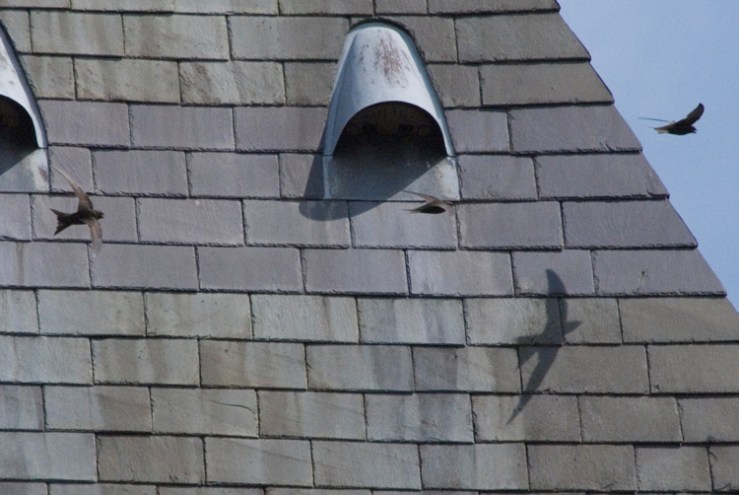
Swifts flying around the Museum tower
Swifts circle the entrances to the nest areas in the Museum’s tower. Image: Gordon Bowdery

Studies show that the population of breeding swifts in the UK has roughly halved between 1995 and 2016. The causes of this decline are debated: Lack of nest sites, lack of food, and changes to global weather patterns have all been implicated. The truth is that a bird which lands only once a year is extremely difficult to study.

We hope for a successful breeding season here in the tower, but if you would like to observe them yourself you can watch the swifts on our nest cam and compare the ups and downs of their populations over the years on our website.


Writing from experience

The Museum’s building and collections provide inspiration for scientists and artists alike, often acting as a springboard for the creation of new work. Following a year here as one of three poets-in-residence, Kelley Swain returned to lead a session with Oxford Scholastica students, showing how museum objects can inspire creative writing.

by Kelley Swain

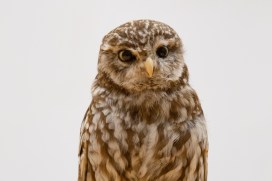
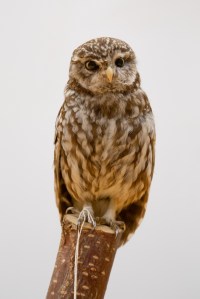
The experience of looking at the taxidermy Little Owl (Athene noctua) provided inspiration for Tallulah’s poem

Delving into the archives and behind-the-scenes stores, meeting researchers and conservators, and finding inspiration in the architecture, history, and collections were all part of my residency at the Museum during 2016. I’ve always written poetry inspired by the history of science and its fascinating objects, and I have come to appreciate museum objects not only as inspiration for my own poetry, but as teaching tools, or “object lessons” to inspire others.

It was lovely to be asked to lead a new series of these “object lessons” for a group of summer school students at Oxford Scholastica. Some of them had never encountered taxidermy, let alone a room full of articulated, stuffed, and preserved specimens. Awe abounded – both its wonder and, for some, its horror. It was a great opportunity to teach the students not only poetry, and why writing poetry inspired by museum objects can be moving, thoughtful, and important, but also to teach them about conservation and preservation.

Here we share the work of 13 year old Tallulah Xenopoulos, who created this poem following an encounter with a taxidermy owl during the workshop:

Stupid dead owl.
The wooden door opens slowly, and, although there’s a green stone with bumpy edges and
shiny sides, a jar filled with silky insects and a board with beautifully painted butterflies.
Both your eyes land on the owl.
His feathers brush down his back and he stares down at his lightly spotted blanket where his
delicate legs connect and hatch onto the bumpy branch.
His eyes
And his beak
And legs
And nails
He stares at you almost like he knows what you’re thinking – which is dumb because he’s
dead – but he scares you and fascinates you at the same time.
A piece of dust has fallen beneath his eye and I bet he’d love to just brush it away, cause
he’s like that.
But also.
He’s an owl.
A stupid.
Dead owl.
With nothing but stuffed insides and scrawny legs.
And a heart. A dead heart which they slipped out and replaced with stuff.
-”do you think they stuffed him alive?”
The boy next to you whispers. You don’t reply. But the thought of death. And of his feathers
falling the second he felt the blood rushing through him go cold and dusty, travels across
your mind.
“Do you think he knew he was about to be?” you answer
Because the poor clueless animal looks as if he knew nothing.
knows nothing.

Kelley Swain’s own poetry from the Museum residency is featured in Guests of Time, a beautiful hardback volume edited by Prof John Holmes which features new work by John Barnie and Steven Matthews, alongside 19th-century poetry from writers linked with the early days of the Museum. Together, the poems in this anthology are a tribute to the Pre-Raphaelite origins of the Museum and a rejuvenation of its artistic legacy.

Presenting… Christmas Island

By Eileen Westwig, Collections Manager in the Museum’s Life Collections.

About 320 km south of Java in the Indian Ocean lies Christmas Island. Although discovered and named on Christmas Day in 1643, the island remained unexplored until its first settlement in 1888, a development which had dire consequences for some of its native species.

Christmas Island is home to a variety of endemic animals such as rats, land crabs, butterflies and many birds. The accumulation of bird droppings over thousands of years made the island rich in phosphate, and the commercial potential of these deposits brought many expeditions to the island. With the ships’ cargo came black rats.

Two species of endemic rats, Maclear’s Rat (Rattus macleari) and the Bulldog Rat (Rattus nativitatis) went extinct within 20 years of settlement, despite having been previously very numerous on the island.

One of the skins of Maclear’s Rat (Rattus macleari) collected by H.E. Durham, and now held in the Life Collections of the Oxford University Museum of Natural History.

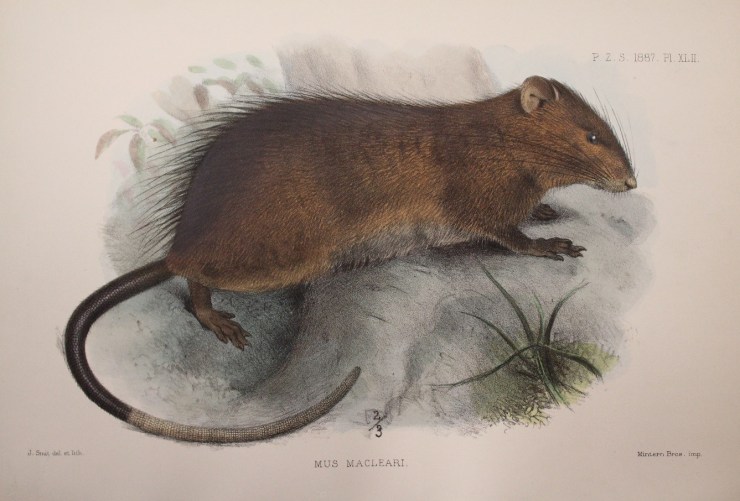
Maclear’s Rat, seen at the top of the page in an illustration from an 1887 publication, was described as chestnut brown above, with a partly white, long tail. It was once the most numerous mammal on the island ‘occurring in swarms’. The Bulldog Rat had a much shorter tail and a layer of subcutaneous fat up to 2 centimetres thick, the function of which is unknown to this day.

The likely cause of their extinction was the introduction of diseases by the ship rats, to which the Christmas Island rodents had no immunity. The disappearance of the native rats also had a knock-on effect: the parasitic Christmas Island Flea (Xenopsylla nesiotes) depended on the rats as hosts, and so the fleas became extinct with the rats’ demise.

In 1901 Dr. Herbert E. Durham, a British parasitologist investigating the origins of beriberi disease, led an expedition to Christmas Island. During his visit he collected several specimens of Maclear’s Rat, but was unable to find any Bulldog Rats, despite a lengthy search and the offer of a reward. Two of the nine Maclear’s Rats Durham obtained showed abundant parasites, trypanosomes, in their blood.

Christmas Island possesses quite a number of peculiar species in its fauna, and it is regrettable that observations were not made before animals had been imported to this isolated station, as well as that my own notes are so incomplete.

Dr. Herbert E. Durham

Durham also found blood parasites in the native fruit bats (Pteropus melanotus) but noted that these were unlikely to have been introduced, instead were “an old standing native occurrence.” These bats still inhabit various islands in the Indian Ocean, including Christmas Island, where they are critically endangered.

Original letter by H.E. Durham offering his Christmas Island specimens to the Museum in 1938.

The Museum holds a range of material from Christmas Island, including six skins and three skulls of Rattus macleari, which were collected by H. E. Durham in 1901-02, and donated in 1938.

Visit the Museum’s Presenting… case between now and 6 March to see Christmas Island specimens from the collections.

Mammoth tusks and cocktail sticks

By Pete Brown, Move Project Assistant

As part of the Museum of Natural History Move Project Team I have helped move and repackage tens of thousands of specimens since 2017, removing boxes filled at any time over the last 150 years from their old storage location in a deconsecrated church building near Oxford.

At our new facility we have been documenting and repacking the contents in new, clean containers and placing them in environmentally stable, safe warehouses specially adapted for museum storage.

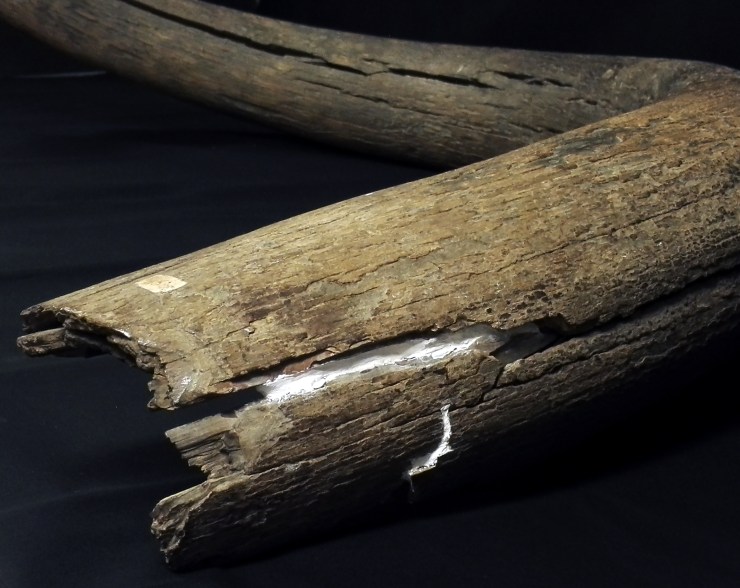
Some objects are trickier to store than others. Things that are long, heavy, curvy and fragile are tricky. Mammoth tusks are long, heavy, curvy, and fragile. This means:

  1. They’re not going to fit in a normal box.
  2. They’re going to be difficult to move around.
  3. That beautiful curve will mean that all the weight of the tusk may be bearing down on just two small contact points where the tusk meets the storage surface.
  4. Because those points are fragile, they’re likely to get damaged.
A lot of weight can rest on small areas of the tusk, putting strain on the specimen and potentially causing damage

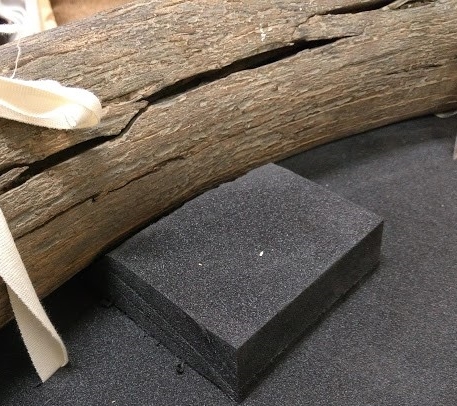
The tusk in this article is a prime example. The area nearest the camera in the photo above provided just a tiny point of contact with the floor and was very loose, almost to the point of detaching. It needed to be repaired, and stored in such a way that it wouldn’t get damaged again.

Pete Brown carries out delicate conservation work on the mammoth tusk

I filled some of the missing areas around the fragile area with an easily removable fine acrylic putty to prevent further movement and loss of the original material. A cotton tape sling helped to suspend the fragment in place during the work.

Thick plastazote provided a sturdy, slightly yielding bed for the tusk to lie on in storage, but to prevent the tusk from getting damaged again more needed be done to reduce the pressure on the points of contact.

The dark grey foam material, plastazote, is often used as a cushioned support for museum objects

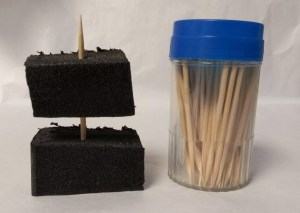
I cut depressions into the plastazote where the tusk naturally lay to increase the total surface area supporting the weight of the tusk, and fixed plastazote wedges and supports in place with cocktail sticks to again increase the contact area and prevent movement. Cotton fabric ties, fed through slits in the plastazote, also helped to guard against unwanted movement.

Cocktail sticks: not just for cheese and pineapple

The repaired end of the tusk is now only supporting a fraction of the weight it used to, and once the tusk and the plastazote bed are placed into their new custom-made crate it will be ready for long-term, safe, damage-free storage!

The end of the tusk after treatment

To keep up with all the move project action, follow the museum hashtag #storiesfromthestore on Twitter @morethanadodo.


Understanding beeswax

By Tuuli Kasso, PhD in Science Fellow at the Natural History Museum of Denmark, University of Copenhagen. Tuuli is a visiting researcher, who has used the Museum’s collection to help her understanding of beeswax. 

When working on the dissertation for my MSc in Archaeological Science last year, I explored the medieval craftsmanship of sealing wax. I was interested in the way the medieval wax seals had flaked, as the beeswax dried out. Drawing on my previous education in conservation techniques, I began a close investigation of the prestigious material, beeswax.

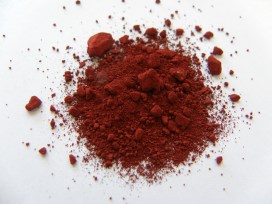
Medieval craftsmen used a range of dangerous materials to make sealing wax. The red pigment cinnabar, a mercury (II) sulphide, and red lead, are now known to be extremely poisonous.

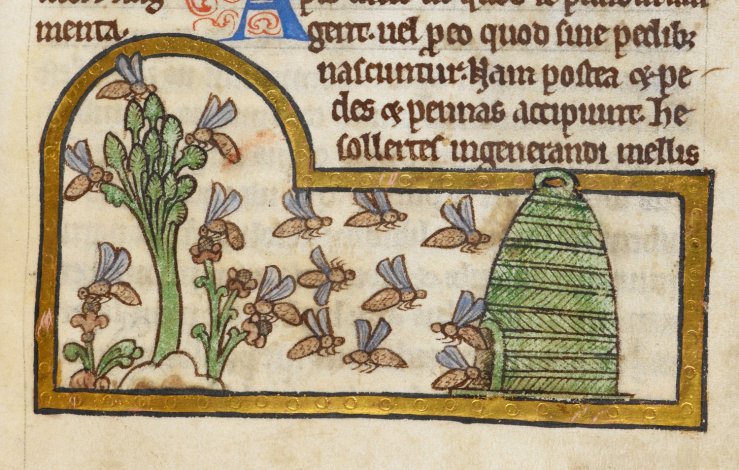
Although some of the ingredients of sealing wax are very hazardous, there is nothing dangerous in beeswax… except the bees! Produced by honey bees, Apis mellifera, honey and beeswax were important commodities in the Middle Ages. Beekeeping was a skilful profession, housing colonies in woven hives, known as skeps. Colonies were carefully selected to overwinter for the next season.

Manuscript illuminations provide detailed information on the types and construction of beehives in the Middle Ages.England, 13th century. British Library Royal 12 C XIX f. 45.

Beeswax was also important in the Middle Ages for lighting, and beeswax candles were preferred for their pleasant smell. After the Protestant Reformation in the 16th and 17th centuries, the religious use of candles decreased, so demand for beeswax declined.

Even today, the Catholic and Orthodox Churches still require the candles they use to contain a proportion of beeswax.

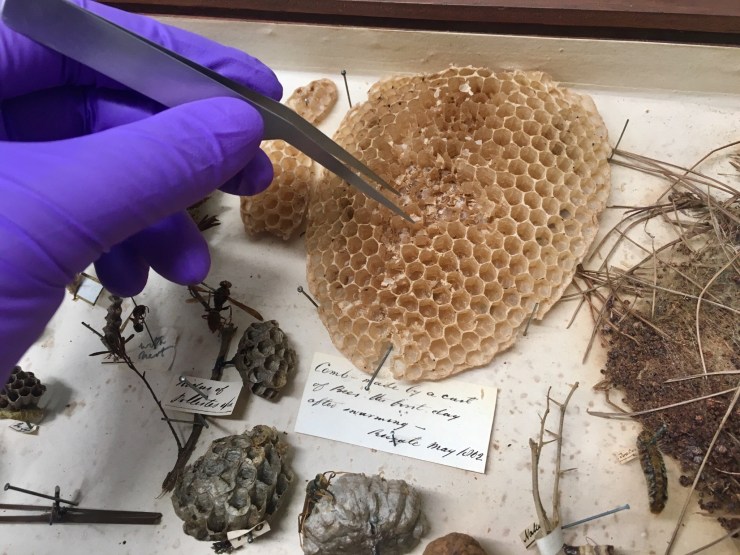
On my quest to understand the degradation of beeswax in sealing wax and write my disseration, I was very lucky to use some samples from the entomological collections from the Oxford University Museum of Natural History. After some early mornings spent amongst the Westwood collection, I found the perfect specimens of natural honeycombs, from the 19th century. The old hand-written labels were also a lovely encounter when exploring the historical collections.

I compared the samples to modern beeswax and medieval seal samples, and learned that the degradation of beeswax is caused by multiple factors, triggered also by storage conditions. The composition of beeswax is very complex, and there are differences caused by the age of the bee in addition to geographical provenance.

A selection of bee specimens from the Museum’s collection.

The recent catastrophic decline of bee populations has drawn focus to save the bees, and in my PhD research (University of Copenhagen and University of Cambridge) I will explore the recovery of ancient DNA and proteins of bees from beeswax, to cast light on the health of bee populations over time.