On a dung beetle’s trail

dung-beetles-blog-post

Thanks to the work of our Head of Life Collections Darren Mann, and the Dung Beetle UK Mapping Project team, the conservation status of the UK’s dung beetles, chafers, and stag beetles (Scarabaeoidea) is currently undergoing a comprehensive review.

Contributing to this effort, Jack Davies, one of our summer interns, has been on the trail of a species that has proven to be particularly rare in the UK…

Aphodius lividus
Aphodius lividus

I am on the hunt for Aphodius lividus, a dung beetle with a truly cosmopolitan distribution, being found across most of the globe, but which is rather rare in Britain. Since 1990 it has been recorded at only six sites, though historical accounts suggest it was more common in the past.

Most of these historic records are from the south east of England, particularly Kent and the London area, but there are several geographically isolated records from across England and Wales too. So might A. lividus, whilst being extremely local, actually be widespread across the UK?

During my time at the Museum I have been contributing to a comprehensive review of this species’ distribution by helping to verify these records. This has involved a thorough search of collections, journals and the Museum archives, a process which revealed that many of the recordings of A. lividus were almost certainly erroneous.

We were able to discount the only two Welsh records, as well as single records from Cheshire, Leicestershire and Lincolnshire. Our reasons for doing so included a lack of supporting evidence, the unreliability of certain collectors, and the confirmed misidentifications of some specimens.
IMG_9966
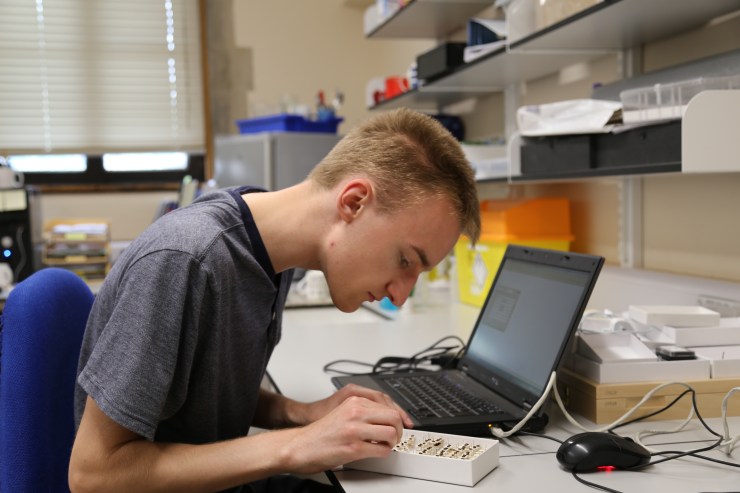
Jack Davies working on a collection of Aphodius lividus

The number of known localities for A. lividus decreased further when we realised that three of the reported sites in Kent most probably all refer to the same location. This is a common problem in this type of research, due to the very broad locality names found on Victorian specimen labels.

So it has become clear that this incredibly scarce beetle is even rarer than we first thought. But it’s not all bad news for A. lividus; our research has uncovered reports from localities in Devon and Northumberland in the old literature, which we found to be trustworthy records.

Aphodius lividus
Map showing the distribution of the dung beetle Aphodius lividus in the UK

All the verified data from the project has been collated to produce this map of the distribution of A. lividus in the UK. Its very local distribution, and the very low number of recent records, confirm that this species should be classified as Vulnerable to Extinction in the UK.

Although it would be a shame to lose this species in Britain, we don’t believe it should be a priority for conservation efforts. Since Aphodius lividus has a strong preference for high temperatures, it’s likely that the UK is simply at the very edge of its range.  It is also a very abundant species in many areas around the world, and it contributes little in terms of ecosystem services in Britain compared to many of our other dung beetles.

So conservation should instead aim to preserve the dung beetle ecosystem as whole, which supports a huge number of species and also brings many benefits to agriculture.
The bully bee

Bee3

Young volunteers Genevieve Kiero Watson and Poppy Stanton tell the tale of the Museum’s resident Wool Carder Bee and their investigative bee work in our Life Collections…

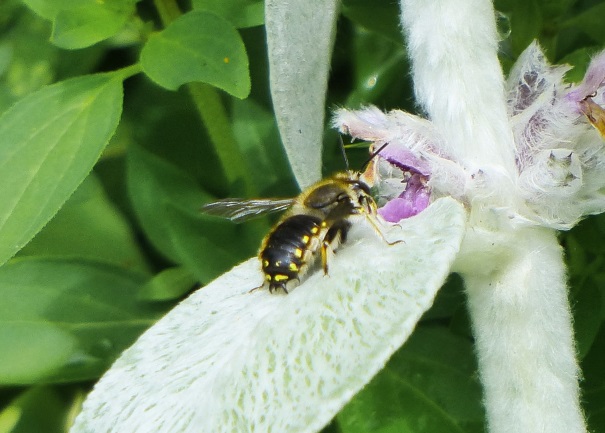
A small guardian patrols its territory among the luscious bed of Lamb’s-ears that grow at the front of the Museum. This feisty critter, the Wool Carder Bee (Anthidium manicatum), is just one of the roughly 270 bee species that buzz around Britain. Having spotted this unusual hovering bee we seized the opportunity to identify, photograph and explore the species a little further.

The male of this solitary bee species is fiercely territorial, fighting off other males as well as any other insects it considers to be intruders. Techniques used in combat vary from skilful aerial hovering to ferocious wrestling. But perhaps its greatest weapon is a series of stout spines found at the tip of the abdomen. These are used to bully an intruder into submission, or even to kill it. In so doing, the male protects the precious supply of pollen for the smaller females which in turn collect it on stiff bristles on the undersides of their abdomens.

Females, being slightly less aggressive, are in charge of constructing the nests, which are built in existing cavities such as beetle holes. Hairs shaved off plants, such as the favoured Lamb’s-ear, are used to create the brood cells for the next generation.

Male Wool Carder Bee on Lamb's ear in the Museum's front garden
Male Wool Carder Bee on Lamb’s ear in the Museum’s front garden

The Museum houses many specimens of the Wool Carder Bee and our job was to pull out the data from each one to help with an ongoing online survey about this species. Although making friends with hundred-year-old bees was enjoyable, trying to comprehend the miniscule handwritten labels accompanying them was altogether more trying.

Every label explains where and when the bee was captured, who collected and identified it, and gives the reference for its current collection. All this on a slip of paper no bigger than half a stamp.

One of the Musuem's Wool Carder Bee specimens, circled, featured in a display of all 270 species of British bee in the Bees (and the odd wasp) in my Bonnet exhibition by artist Kurt Jackson
One of the Museum’s Wool Carder Bee specimens, circled, featured in a display of all 270 species of British bee in the Bees (and the odd wasp) in my Bonnet exhibition by artist Kurt Jackson

After recording data from 120 labels we began to find the grid reference of the location each was originally collected. This too was challenging as many place names have changed in the last hundred years. Ultimately, the information will be used by the Bees, Wasps & Ants Recording Society (BWARS) to improve the distribution map for the Wool Carder Bee.

Why not see if you can spot the Wool Carder Bee in your garden? Characteristics to look out for include small spines on the tip of the abdomen and lateral lines of yellow spots on either side of the abdomen. The bees themselves are about 11-13mm long for females, and 14-17mm for males. Good luck!


Tongue-testing fossils, Victorian-style

IMG_9692

by Anna Dewar, Museum intern

Victorian geologist William Buckland had an impressive knack for finding fossils. He named the first dinosaur, Megalosaurus bucklandii, in 1824 after its discovery in Stonesfield near Oxford. You can see the Megalosaurus fossils on display in the Museum today.

Working as an intern here over the last few weeks, I have been confronted with hundreds of Buckland’s specimens, many of which have never been catalogued.

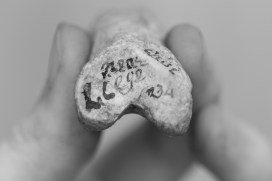
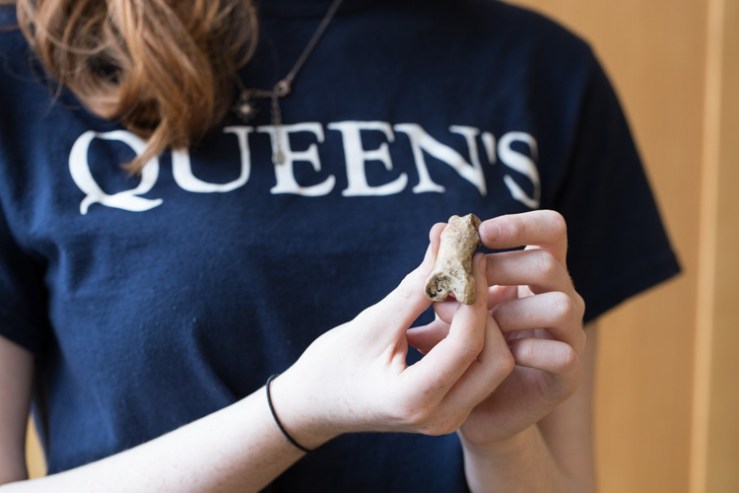
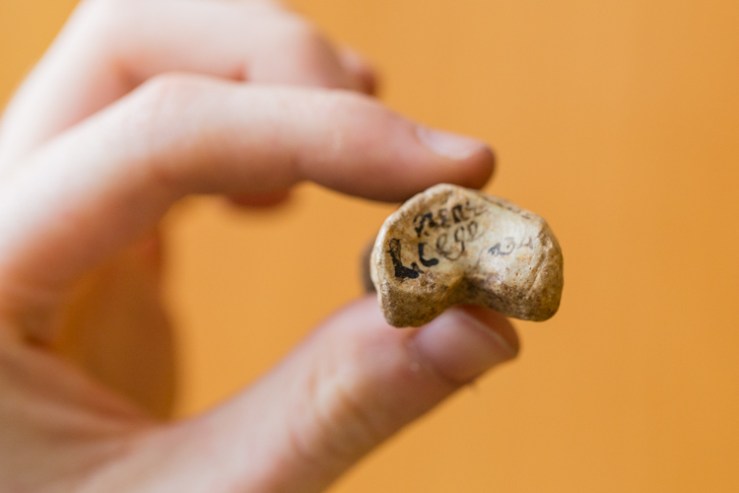
A couple of weeks ago I stumbled upon a cave bear toe bone, or phalanx, with a very unusual label. Written in Buckland’s handwriting was ‘Cave Bear Liège’ and the number ‘234’. No other fossils in this collection were numbered, and after a database search not one other specimen had been found near this Belgian city.

I then discovered something that, while it could be coincidence, demanded further investigation. On page 234 of Lyell’s Principles of Geology, Vol. II, published in 1832, appears the only mention of Liège in the entire book:

In several caverns…near Liège, Dr. Schmerling has found human bones in the same mud…with those of the…bear, and other… extinct species.

The mysterious ‘234’ perhaps references this page number; if so, it would indicate that the specimen was one of those Philippe-Charles Schmerling had discovered. But if this is the case, how did this fossil end up in Buckland’s possession?

IMG_9687
Anna holds the fossilised cave bear phalanx, or toe bone, showing the word ‘Cave Bear Liège’ and ‘234’ in William Buckland’s handwriting

After some further research, I learned that Schmerling presented his Liège findings to a group of naturalists including Buckland in 1835. Schmerling argued that the human bones he had discovered were also fossils, and so the same age as the bones of extinct animals.

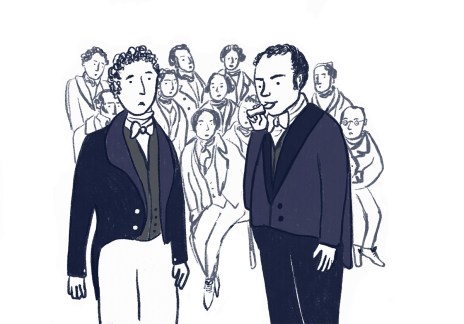
Buckland countered Schmerling’s claim by saying that “these animals lived and died before the creation of man” and that, instead, the human remains found alongside extinct species could be explained by burial. French geologist Élie de Beaumont, who was present at the meeting, remembered how Buckland chose to voice this opinion:

Mr Buckland took a bear bone, and put it on the tip of his tongue, to which it remained suspended…and, turning to…the assembly, Mr Buckland repeated many times…: ‘You say that it does not stick to the tongue!’ Mr Schmerling tried a few times to stick to his own tongue several human bones, but he did not succeed.

Buckland tongue test illustration_Ellena Grillo

An entirely speculative artist’s impression of William Buckland’s ‘tongue test’ demonstration

Whilst speaking to a crowd with a fossil on your tongue seems odd, Buckland did have reason. It was difficult to estimate the age of a specimen, and this ‘tongue test’ supposedly related to the mineralisation of the bone: if it stuck to your tongue, it was a fossil; if it didn’t stick, it was bone.

While Schmerling was left humiliated, it was realised after his death that he had found human fossils after all, including those of a Neanderthal. Obviously the tongue test was not as foolproof as Buckland believed.

While we’ll never know for sure, Buckland, by writing ‘234’, may have linked this bone from Liège to Schmerling.  It also happens to be a bear bone, small enough that it could conceivably adhere to a tongue. Could Buckland have slipped it into his pocket after his demonstration? Or perhaps for Schmerling, the bone, after having been coated in Buckland’s saliva while he himself stood humiliated, may have somewhat lost its appeal.

Whether or not this bone is THE bone at the heart of this spectacle, it does seem that life as a palaeontologist in the 19th century certainly wasn’t boring.

Beauty, strangeness and science

This year the Museum is playing host to three poets in residence as part of our Visions of Nature year. The poets, John Barnie, Steven Matthews, and Kelley Swain, have been working alongside staff in our collections and out in the Museum itself to gain inspiration for their writing over the past six months. In the autumn, they will take part in a number of events and activities to present their work, and will be publishing a small anthology at the end of the year.

Here Steven Matthews reveals what has inspired his poems during one of his recent visits to the Museum.

PAL_CL04499_03 (2)
Fossil in the Charles Lyell collection

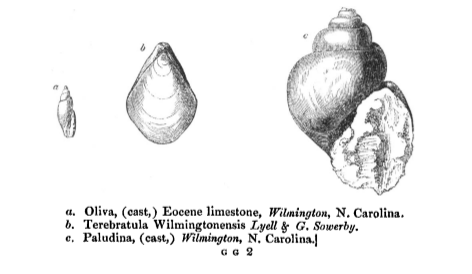
I was struck strongly, during our early visits as poets-in-residence behind the scenes at the Museum, by one particular aspect of the research being undertaken. The history of the Museum collections, their vast reach, is being traced in several instances by the identification of the particular individual specimen which was drawn and lithographed as part of a key scientific paper, in the nineteenth- or twentieth-centuries. Out of the many thousands of specimens held at the Museum, for example, we were shown the exact fossil in the Charles Lyell Collection which had helped, when reproduced in a paper, confirm the geological record of part of the United States.


'Observations on the White Limestone and other Eocene or Older Tertiary Formations of Virginia, South Carolina and Georgia' by Charles Lyell, 1845
‘Observations on the White Limestone and other Eocene or Older Tertiary Formations of Virginia, South Carolina and Georgia’ by Charles Lyell, 1845

The history of the Collections, in other words, is the history not just of their remarkable beauty or strangeness, but of their usefulness in advancing scientific thought; just as it is the history of the individual people who have recognised something new to say from the specimens they were studying. There is a firm analogy between this activity and what the making of poems involves. Concise comparison is, after all, what poetry also seeks to attain, bringing the multifariously divergent elements of the world into intense and new combinations with each other.

In preparing to write poems in response to the Museum building and Collections, I have kept that history in mind, researched it. I have read pamphlets by Henry Acland and John Ruskin, Victorians key to the impulse behind the creation of a Museum here to Science, and to defining what the nature of a building on these principles should look like. I have re-read much Victorian and Pre-Raphaelite poetry in order to steep myself in the kinds of language being used to describe Nature by poets at the time the Museum was becoming active. I have read in the work of scientists working at, or associated with, the Museum in its early days and subsequently.

IMG_9566
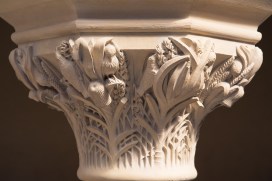
One of the capitals that adorn the Museum court carved by the O’Shea brothers

Out of this reading, but also out of the looking, the many hours spent with the Collections on public display or behind the scenes, have come what is a surprising variety of poems which reflects the wonderful and overwhelming reach of the items at the Museum. I have written about the O’Shea brothers who did much of the amazing carving of column-tops on the Ground Floor; there is a poem on the crystallographer Dorothy Hodgkin, whose lab I was privileged to spend some time alone in.

Dorothy_Hodgkin_Nobel

Nonsense verses have arisen from contemplating the presence of Lewis Carroll here; the astounding collection of multi-coloured marble blocks, the Corsi Collection, has impelled me to create blocks of prose-poetry in their shape. There is a poem ‘voiced’ by an ammonite. The sadness of some specimens, posed in isolation (or in glass jars) far from their original contexts, has moved me; as has the shocked intensified awareness that the history of the Collections is a history of accelerating losses, as more and more of the species gathered in the Museum are extinguished from the world each day.

Climbing down the primate family tree

This is the first in a short series of articles to accompany the new Stone Age Primates temporary display at the Museum, created with the Primate Archaeology group at Oxford University. Here, Michael Haslam, ERC Senior Research Fellow in Primate Archaeology, outlines the importance of this emerging field of study.

Humans evolved over millions of years. You can see displays about this in natural history museums all over the world, usually with skulls of extinct ancestors such as Homo erectus. Alongside these bones there are often stone tools of various shapes and sizes, showing how our technology has also changed over time. Ultimately, human tool use has led all the way from sticks and stones to the computer, phone or tablet that you’re using to read these words.

However, for all those millions of years other members of our family were evolving too. What if we had an archaeological record for non-human animals as well? The Primate Archaeology project at Oxford University exists to answer this question.

Rise of Modern Humans display
‘The Rise of Modern Humans’ display in the Museum

Primates, the group that humans belong to, also includes apes and monkeys, as well as more remotely related animals such as lemurs. Yet when we see these animals in museums, they very rarely have a set of their own extinct ancestors on display, or any examples of the technologies that they have developed.

Why not? For one thing, it is difficult to find fossil ancestors of animals that live mostly in tropical forests because their bones aren’t preserved well in that environment. And most primates, like most animals, don’t use tools in the wild, so there is nothing left behind to tell us about their past behaviour.

But there is another reason. We view the human past as a series of ancestors evolving towards the way we are now; yet we tend to see monkeys and apes as unchanging over time. If asked to imagine a chimpanzee three million years ago, you would probably picture something that looks like a chimpanzee today. But modern chimpanzees didn’t exist back then, just as modern humans didn’t.

Wild chimpanzee at Bossou, Guinea. Photo by Michael Haslam.

The main reason we think of humans as changing and evolving is because of the archaeological evidence that we’ve collected. As we discovered more and more bones and stones it became clear that dozens of human ancestor species have lived on Earth, including close relatives such as the Neanderthals in Europe and Asia.

A hammerstone used by a capuchin, on display in the Museum

So what would we find if we looked for the archaeology of other primates? They don’t build cathedrals, or use pottery or metal, and they don’t leave behind written messages like the Egyptians, Maya or Romans did. That’s a problem. But the solution to the problem is actually the same one that archaeologists have always used for human ancestors: find the stone tools.

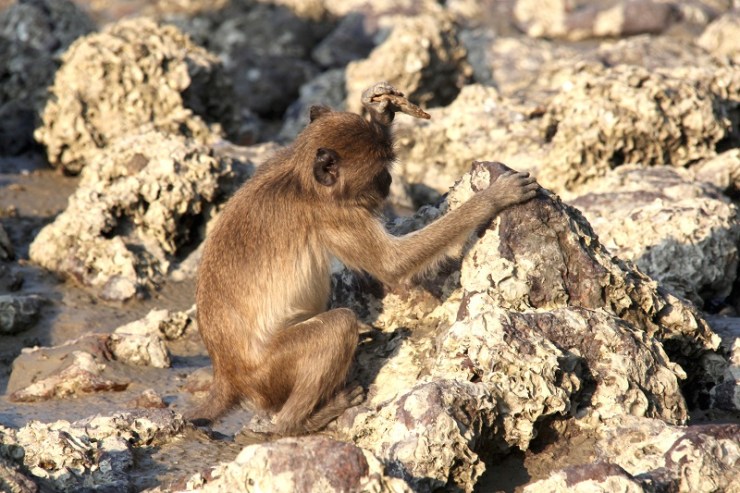
There are three types of wild primate that use stone tools: the chimpanzees of West Africa (Pan troglodytes verus); the Bearded Capuchin monkeys of Brazil (Sapajus libidinosus); and the Burmese Long-tailed Macaques of Southeast Asia (Macaca fasciaulria aurea). They mainly use stones as hand-held hammers, to break open hard foods such as nuts and shellfish. The capuchins also use stones to dig in the hard ground, which helps to protect their fingers when searching for roots or spiders to eat.

Wild long-tailed macaque using a stone tool at Laem Son National Park, Thailand. Photo by Michael Gumert.

The Primate Archaeology Project was set up at Oxford University in 2012, supported by the European Research Council. Since that time, our team has spent many months watching these animals use stone tools in the wild. We record how they select certain sizes and types of stones (you wouldn’t use a soft sponge as a hammer, and neither would they!), and how they carry their tools around from job to job like a modern tradesman. We used these observations to work out what primate tools look like today, and then we went digging into the past.

We found macaque tools buried in beach sands in western Thailand, and ancient capuchin tools in the forests of northeast Brazil. In both cases, we recognized the tools because they were similar to ones still in use today. Importantly, we also found that the tools were damaged in very particular ways by the monkeys that had used them, because hitting hard things together usually means that one of them gets broken.

Primate archaeology excavation, Serra da Capivara National Park, Brazil. Photo by Michael Haslam
Primate archaeology excavation, Serra da Capivara National Park, Brazil. Photo by Michael Haslam.

We used radiocarbon dating to work out that the archaeological capuchin tools were at least 600 years old. That means that there were monkeys sitting around in Brazil with stone hammers, cracking and eating nuts, before Christopher Columbus ever left Europe. Previous excavations in the Ivory Coast have found even older primate tools – chimpanzees there were using stone hammers more than 4,000 years ago!

Primate archaeology is still a new research field, with more questions than answers, but then so was human archaeology when it began. We really don’t know what technology apes and monkeys were using during the millions of years that they have evolved, but we are taking the first steps towards solving that mystery.

Stone Age Primates display in the Museum

Working with the Museum, the Primate Archaeology project team has put together a new temporary display, ‘Stone Age Primates’, to sit alongside the current human evolution cases in the Museum. In the display you can learn more about the research and see tools used by primates past and present. You can also follow the group on Twitter @primatearch.

Why the world needs Dung Beetles

To celebrate National Insect Week 2016 we thought we would introduce you to the custodians of the Hope Entomology Collection here at the Museum. Our insect collection is made up of a whopping 6 million specimens, so our resident entomologists definitely have their work cut out. However, they have taken a little time out to tell us all about their specialisms and why their favourite insects are the best.

Darren Mann – Head of Life Collections

Darren out in the field collecting Dung Beetles

Dung beetles have been my passion since my late teens. I started with British species and then gradually broadened my interests to encompass the world fauna. But why dung beetles?

Well, they are beautiful insects, exhibiting an array of shapes and colours; they have been around since the dinosaurs, and have interesting biologies and behaviours, from nest-building and parental care, to stargazing. As a group, dung beetles are also very important in the ecosystem, removing dung and recycling nutrients.

Not only that, but dung removal and relocation offers additional ‘ecosystem services’ of fly control, livestock parasite suppression, plant growth enhancement, improved soil structure, reduction of greenhouse gas emissions, seed dispersal, and pollination. Inevitably, they are a source of food for other animals too.

Darren takes a closer look at a collected specimen

Dung beetles are found in all regions of the world, and consist of three main groups: the dor or earth-boring beetles (Family Geotrupidae) of around 600 species; the ‘lesser’ dung beetles (Family Scarabaeidae, subfamily Aphodiinae) of around 3,500 species; and the ‘true’ dung beetles (Family Scarabaeidae, Subfamily Scarabaeinae) of around 6,000 species.

With just over 10,000 species in total you’d think we have found all the dung beetles out there, but not so: it’s estimated that 40 per cent of species new to science are still to be discovered. In the UK we have just 60 species and over half of these are in decline due to agricultural intensification, pollution, use of veterinary drugs, and changes in livestock farming practises. The Dung Beetle Mapping UK Project (DUMP) aims to highlight the importance of this group and promote research and conservation in this area.

Despite their name, not all dung beetles eat dung, with some species preferring fallen fruit, fungi, or even dead animals. The South American roller (Deltochilum valgum) is an avid predator of millipedes and another South American species (Zonocopris gibbicollis) feeds on snail mucus!

So with their high diversity, fascinating ecology, and great economic benefit, perhaps the question really should be ‘why not study dung beetles?’.