Spiky spiders

A Spotlight Specimens special for Oxford Festival of Nature

by Steven Williams, research student at Oxford Brookes University

I have been interested in Thorn Spiders since I was 12 years old. People are often afraid of spiders but the ones I study are not harmful to humans and I think they’re quite beautiful when you get up close and see them under a microscope.

They get the name ‘Thorn Spiders’ from the spines that protrude from their abdomen. These are assumed to be a defence mechanism but this has not been confirmed. The female Thorn Spiders are the ones with the larger spines – some reaching several centimetres in length; the males do not possess such striking features.
IMG_9143
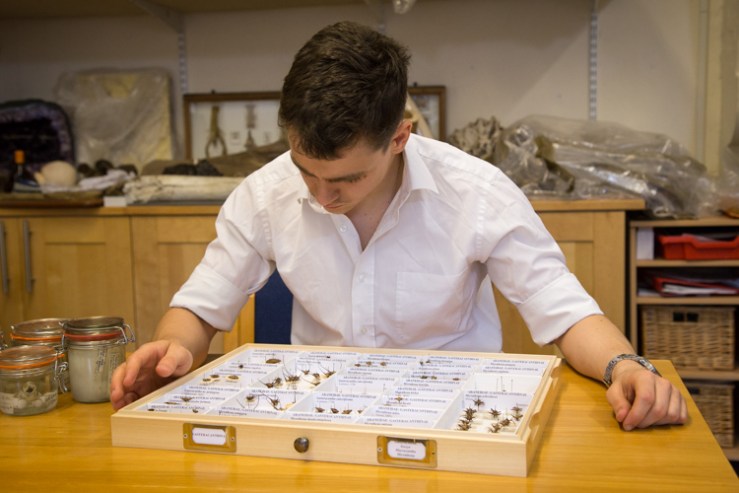
Steven Williams uses the Museum’s collections as part of his PhD research

My research revolves around how the different species of Thorn Spiders are related to each other and my aim is to create a kind of ‘family tree’ for the various species. I am also looking into the evolution of the spines and their habitats and distribution. They are commonly found across the Pan-Tropical region, with a few in the Americas and some in Australia. They are not found in Britain though unfortunately!
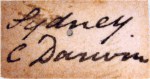
The handwriting on the specimen's label confirms that it was collected by Charles Darwin
The handwriting on the specimen’s label confirms that it was collected by Charles Darwin

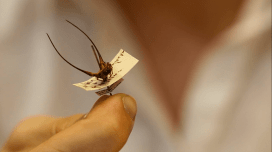
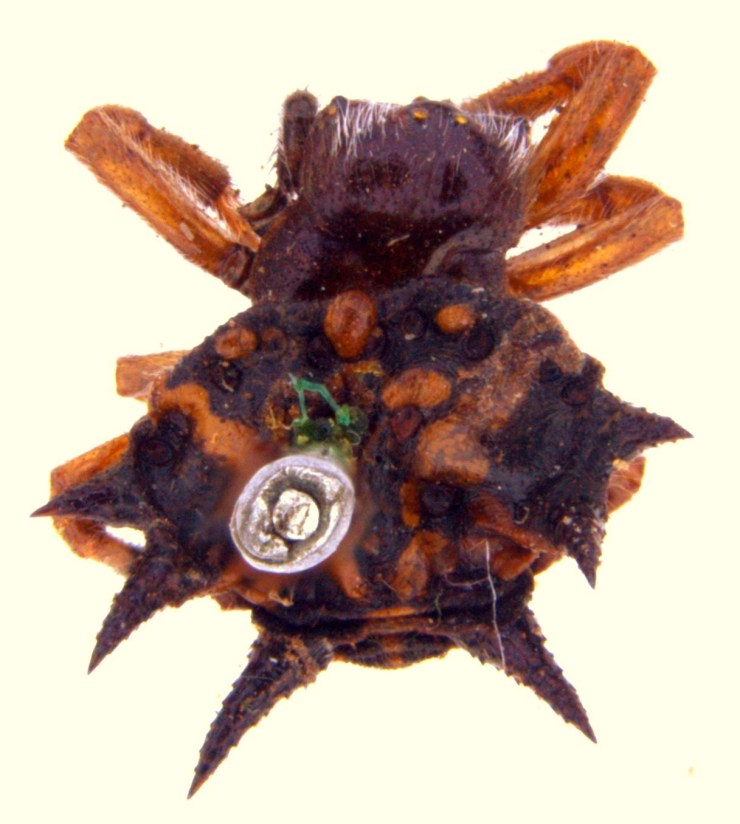
Here are my three favourite specimens of these spiders from the Museum’s collection. The Australian Jewel Spider/Christmas Spider  (Austracantha minax), below, was collected by Charles Darwin on the Voyage of the Beagle when he stopped in Sydney, Australia.

I found this specimen when I was looking through the Museum’s dried spider collection; staff were not aware of its existence, and it is now stored with all the other Darwin specimens. We can confirm that it was collected by Darwin because the handwriting on the label is the same as in Darwin’s letters of correspondence.
sdfgf
An Australian Jewel Spider (Austracantha minax), collected by Charles Darwin during the Voyage of the Beagle

The metallic Thorn Spider (Gasteracantha scintillans), below, has a beautiful deep green metallic abdomen. It reminds me of a Ground Beetle’s wing cases and the rich metallic colour is something you wouldn’t normally see in spiders. They are only found in the Solomon Islands and this is a species I am working on currently for another area of my research, separate from my PhD.
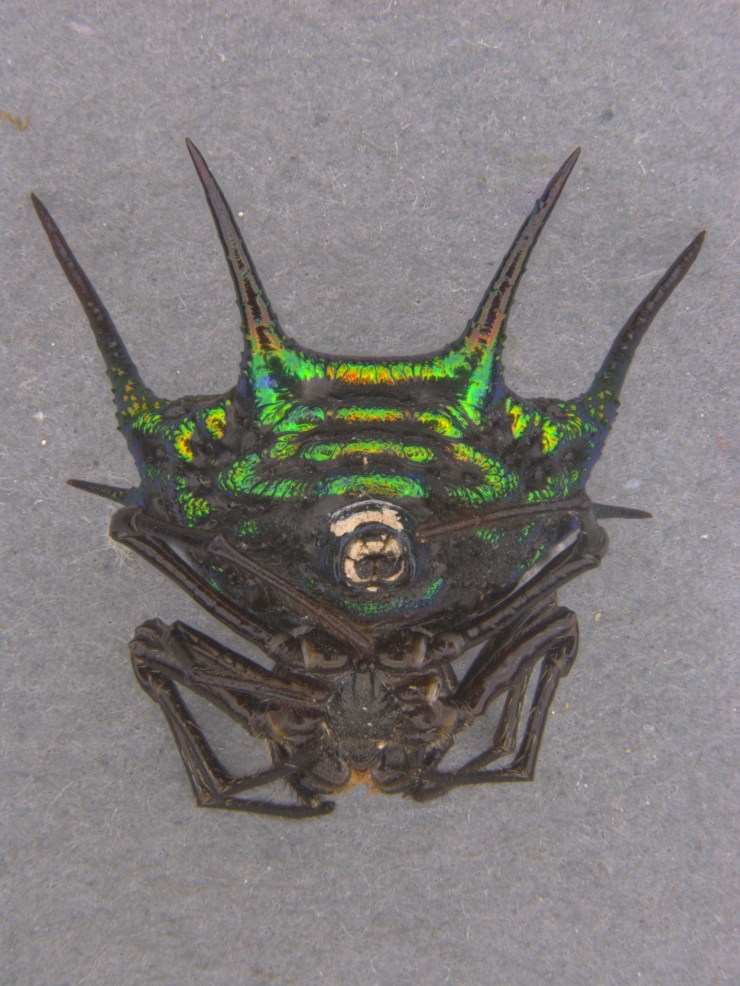
Metallic Thorn Spider (Gasteracantha scintillans)
Gasteracantha scintillans has an unusual metallic green abdomen

And this last one, Gasteracantha thorelli, I think is one of the coolest species of thorn spiders. I just love the large spines on this spider! The way the final pair of spines curve round reminds me of a bull’s horns.
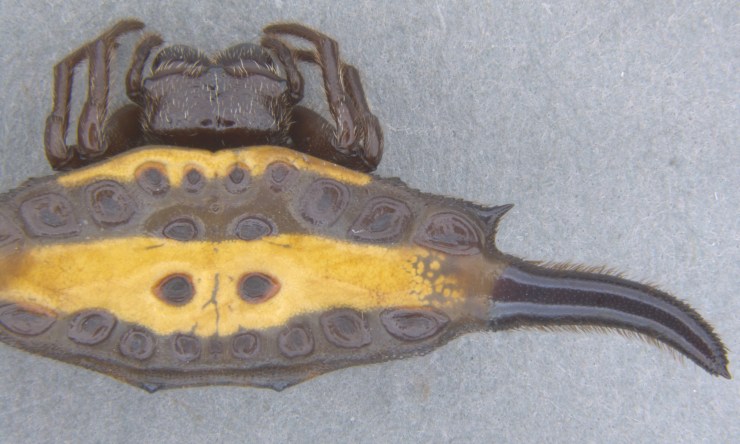
Gasteracantha thorelli has some impressive 'horns'
Gasteracantha thorelli has some impressive spines that look like a bull’s ‘horns’

OFoN_logo_green block_small


A plesiosaur named Eve

A Spotlight Specimens special for Oxford Festival of Nature

by Juliet Hay, Earth Collections preparator and conservator

I feel myself very lucky to have a job that involves working with the fossil remains of long-extinct animals. One of the things my colleagues and I are currently working on is a plesiosaur – a marine reptile that lived in the sea millions of years ago.

This particular specimen was found in a clay pit near Peterborough by members of the Oxford Clay Working Group in 2014, and is a near-complete example of its kind. The palaeontologists who found the specimen named it Eve, although we don’t know if it was male or female, and perhaps never will.

The discovery of large fossil vertebrates like this is rare, so we are fortunate to have had the specimen donated to the Museum by the quarry owners Forterra.

Juliet at work on the plesiosaur skull

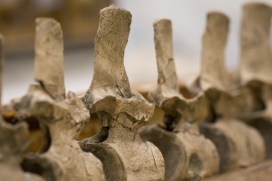
The plesiosaur is 165 million years old and, when alive, was around 5.5 metres long. It had a long neck, a barrel-shaped body, four flippers and a short tail. The find is particularly exciting as the skull was also discovered. It is encased in a clay matrix, which is relatively easy to remove, but the work has to be carried out under magnifying lenses and microscopes.

As the skull is quite small relative to the size of the body, the features are very delicate and it is a painstaking process to remove the sediment without damaging the fossil bone or losing any tiny fragments. Fortunately, pictures of the skull have been produced using CT scanning technology, and the images are proving invaluable as an aid to assist in its preparation. It’s a bit like having a jigsaw puzzle with the picture on the lid to refer to!

sdfsd
A belemnite hooklet at 12x magnification, found with the plesiosaur remains and possibly part of Eve’s last meal

The clay covering the skull is being sieved and examined and tiny hook-shaped fossils have been found. These came from the arms of squid-like creatures called belemnites, which may have formed a large part of the plesiosaur’s diet.

It is too early to say for sure, but Eve could represent a species new to science, as some features, such as the shape of the flipper bones and some of the surfaces of the bone in the skull, are quite unusual. Further research needs to be done before the findings can be published in scientific journals – watch this space.

And if you’re visiting the Museum before 25 July, you can see some of the fossilised remains of Eve for yourself, in our Presenting… display case.

OFoN_logo_green block_small

From worms to stars

A Spotlight Specimens special for Oxford Festival of Nature

by Imran Rahman, Research Fellow

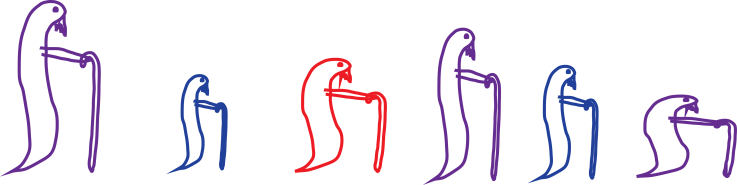
Starfish are among the most distinctive animals found along the seashore today. Together with other well-known forms such as sea urchins, sea cucumbers and brittle stars, they belong to a major group called the echinoderms, which is characterized by a unique type of symmetry — called fivefold symmetry. This means they can be divided into five roughly equal parts.

IMG_9013

In contrast, the closest living relatives of echinoderms are worm-like animals that have bilateral or mirror-plane symmetry, where they are divisible into mirror-image halves. It’s widely-thought that the common ancestor shared by echinoderms and other animals also had bilateral symmetry. Because they are so different to all other living animals, deciphering the evolutionary history of echinoderms, and their path from worms to stars, has proven a major challenge for scientists.

IMG_9006
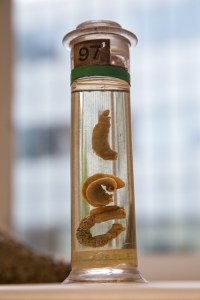
The closest living relatives of echinoderms are worm-like animals like these acorn worms Balanoglossus sp.) from Naples

Fortunately, fossils can shed light on echinoderm evolution. Echinoderms have an excellent fossil record because they possess a hard, mineralized skeleton, which greatly enhances their chances of being preserved as fossils compared to soft-bodied organisms. The first fossil echinoderms are over half a billion years old, and include extinct groups that show both bilateral and five-fold symmetry.

In addition, fossils are known that exhibit three-fold symmetry, as well as others that lack a clear plane of symmetry – they are asymmetrical. These fossils document the earliest history of echinoderms, and so could help us to better understand their evolution.

The fivefold symmetry of the starfish
The fivefold symmetry of the starfish (Randasia granulata from Madagascar)

Based on our understanding of living animals, and using modern methods for reconstructing the relationships of different species, it’s possible to infer that the early fossil echinoderms with bilateral symmetry belong at the base of the echinoderm evolutionary tree.

Print

The next branches in the tree lead to the asymmetrical fossil groups, and these are followed by those forms that show three-fold symmetry. Lastly, we see the diversification of forms with fivefold symmetry, including species belonging to the groups that still exist today, such as the starfish.

Using the fossil record, we can therefore see a clear picture of how echinoderms evolved from worm-like organisms into star-shaped creatures.

OFoN_logo_green block_small


Nature’s Waste Management Team

A Spotlight Specimens special for Oxford Festival of Nature

By Darren Mann, Head of Life Collections

One cow can produce over nine tonnes of dung per year. With a population of about 3.4 million cows in the UK alone, that’s a heck of a lot of dung deposited on our grasslands. Just imagine how much dung is produced every year if we include the output of horses, sheep, pigs, and all the wild animals out there.

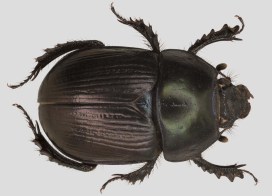
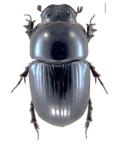
Dor Beetle – Geotrupes mutator

All of this dung is broken down by a multitude of invertebrates, including flies, worms, and beetles, as well as bacteria, fungi, and weathering. One of the key groups involved in the removal and degradation process is the aptly named ‘dung beetles’.

In the UK there are 61 species of dung beetle, though sadly just over half of these are now in decline and some have already become regionally extinct. UK dung beetles vary in size from just 3 mm to over 25 mm and occur wherever dung is found, though some prefer sandy soils and others like to live in woodlands.

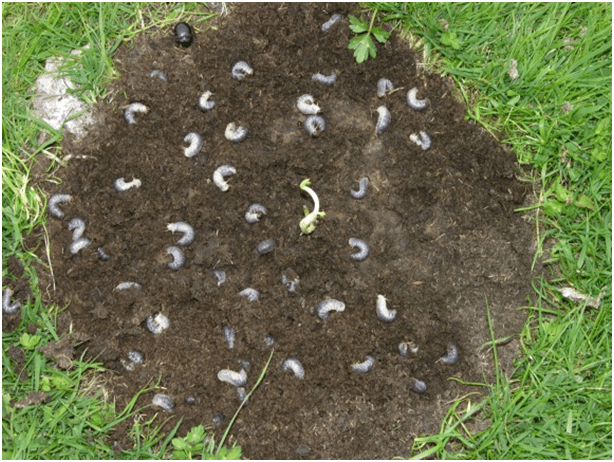
Larvae in dung pile
Dung beetle larvae (Aphodius fossor)

As adults, dung beetles feed on the liquid part of dung. The larvae of most of our species live inside the dung pile and are called the dwellers. These munch their way through the solid matter of the dung pile, gradually breaking it down over a few months. Other species such as Geotrupes mutator, pictured above, excavate a tunnel and bury the dung below ground. These tunnellers construct a brood chamber in which their young develop.

Aphodius fossor
Aphodius fossor

Through their actions, dung beetles perform a number of valuable ecosystem services. The most obvious is dung removal and degradation which leads to improved soil health by nutrient cycling and soil movement. By burying the dung they reduce the amount of available breeding habitat for pest flies and livestock parasites too.

All of these important services have been estimated to save the UK cattle industry £367 million per year. The value of dung beetles doesn’t end there as they also provide an important source of food for farmland mammals and birds. So next time you see a pile of dung in a field, just think of all the hard working beetles within…

Staff and associates of the Museum also run the Dung beetle UK Mapping Project – affectionately abbreviated to DUMP!

OFoN_logo_green block_small

Do worms get old?

Old worms

by Sophie Gilbert

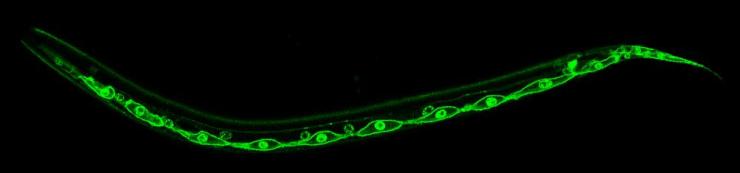
I have recently finished my PhD in the Department of Biochemistry at the University of Oxford, working under the supervision of Alison Woollard (Royal Institution Christmas Lecturer in 2013). I specialised in a species of very small (1mm long) nematode worm called Caenorhabditis elegans. These animals may sound exotic, but in reality, they are found at the bottom of nearly every garden in the world. Intriguingly, the worms’ characteristics vary according to their nationality: those found in Hawaii tend to be more promiscuous than their British counterparts, and Australian worms contain a mutation that not only makes them more social, but also increases their alcohol tolerance.

In this short video you can see worms crawling around under a dissecting microscope, which is how we visualise them. The biggest worms you can see are, in fact, only 1mm long! The worms eat bacteria (E. coli, non-pathogenic), which is growing in this petri dish full of bacteria.

The great thing about these worms is that they’re in many respects like small humans: they have a nervous system, a gut, muscles, skin, stem cells, and in addition they sleep and even grow old in much the same way we do. How do you spot an old worm? Like us, they get wrinkles and slow down, don’t move as much, and their organs start to fail. However, there are many advantages of looking at all these systems and processes in worms rather than humans – they only live for around 20 days (no waiting around for them to slowly age), they lay 300 eggs in the first few days of adulthood (there are always lots of them to look at), and they’re much smaller, simpler and easier to manipulate. This is not to mention that most humans would probably object to being grown in a lab. 

Stem cells visible inside a worm

Recently, I volunteered to bring the worms – and my colleagues – to Super Science Saturday at the Museum of Natural History, during which we explained to families how we use C. elegans to study the genetics of ageing: parents tend to show a particular interest in this topic. Until relatively recently, it was believed that ageing was an inevitable consequence of living – an unfortunate response to environmental stress and general wear-and-tear. Remarkably, it has now been discovered that many aspects of ageing are actually encoded in our DNA: changing just one gene can have a drastic effect, either shortening or extending our lifetime. We can use worms to explore this effect – and we can also use worms to discover new genes and processes that underlie healthy ageing.

Sophie and colleagues at Super Science Saturday, March 2016

Being able to demonstrate this rapidly expanding research field – as well as the worms themselves – to the public, especially to children, allows people to learn enough about biology to appreciate both its social and economic value, as well as giving us as scientists an invaluable insight into why our research is important. Next time, however, I might include a new warning sign for the microscope: “Look, don’t lick!”

Traces from space

Battlestar_d

by Sancia van der Meij, Research Fellow

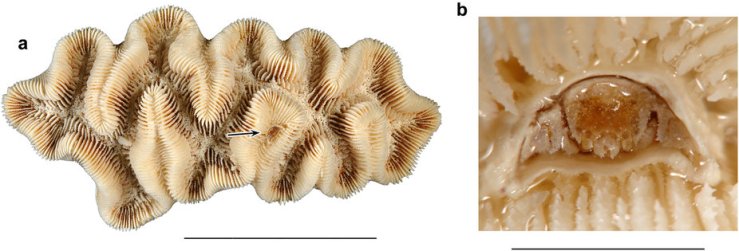
To understand how modern species evolved, we often turn to the fossil record, but this can be very difficult when the animal you would like to study is small and fragile. For example, the coral-dwelling crab family Cryptochiridae has more than 50 species today and occurs worldwide on coral reefs. These small crabs are less than 1 cm in size and have the unique ability to create little homes,or dwellings, in stony corals. This ability makes them an interesting study object to learn more about how different species cohabitate on reefs.

Modern cryptochirid crab in its coral home

Modern cryptochirid crab in its coral home

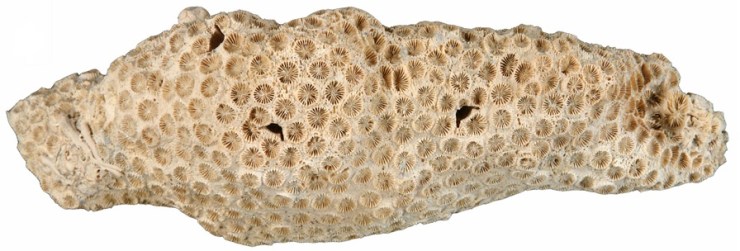
Unfortunately no fossils are known for these crabs; their size and thin carapace (shell) means they probably didn’t fossilise well. But together with colleagues from the United States, I’ve found crab dwellings in fossil corals for the very first time. The corals are several million years old and come from Florida and Cuba. Although we still don’t have fossils of the actual crabs, the holes, which are a type of trace fossil, are very valuable evidence.

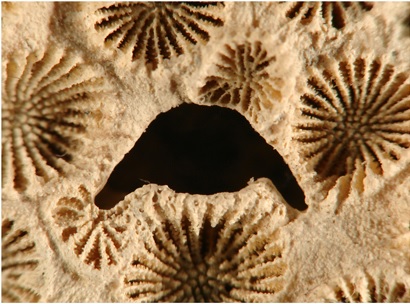
Three dwellings on a fossil coral from the lower-middle Pleistocene. Found in Palm Beach County, Florida. A close-up of one pit can be seen at the top of this post.
Three dwellings on a fossil coral from the lower-middle Pleistocene, found in Palm Beach County, Florida. A close-up of one pit can be seen at the top of this post.

To sci-fi fans, the dwellings have an extra significance. The shape of the entrance is very similar to the shape of the spaceship in the American science fiction series Battlestar Galactica, so the scientific name of the trace fossils is Galacticus duerri.

We’ve published a paper in the journal Scientific Reports on the first fossil evidence of these crabs.