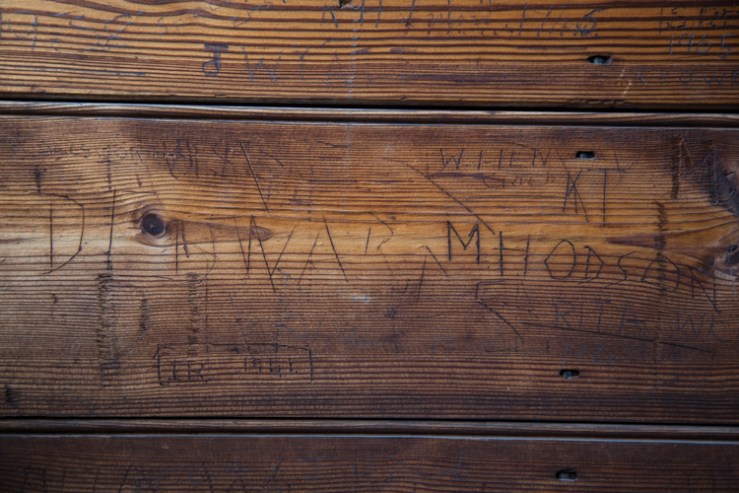
Who woz ere?

IMG_3505

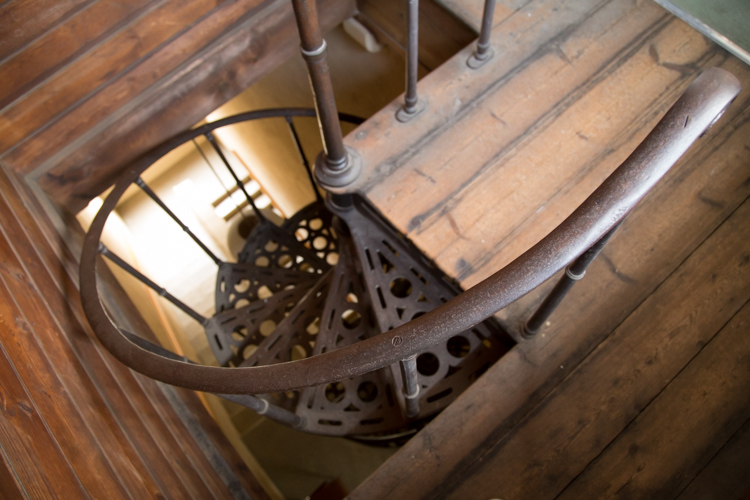
Find a dark corner of the museum, step behind a velvet rope and climb a narrow spiral staircase, and you reach a forgotten spot that is little more than a landing. But before you continue your journey and enter the next room, pause and look at the walls.
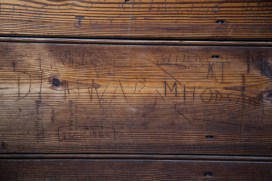
IMG_3518This little room behind the scenes in the museum is entirely wood panelled and seems to have become a spot to make your mark. Covering the walls, the door and even the ceiling are names and dates scratched into or scribbled onto the wood. The dates go as far back as 1920. Names, initials and numbers from the last 10 decades now overlap to create a textured collage.

It’s unclear how this tradition started, or why it seems to have been tolerated by the museum for so long, but it seems that hundreds of people who have spent time here wanted to leave a permanent reminder of their presence.
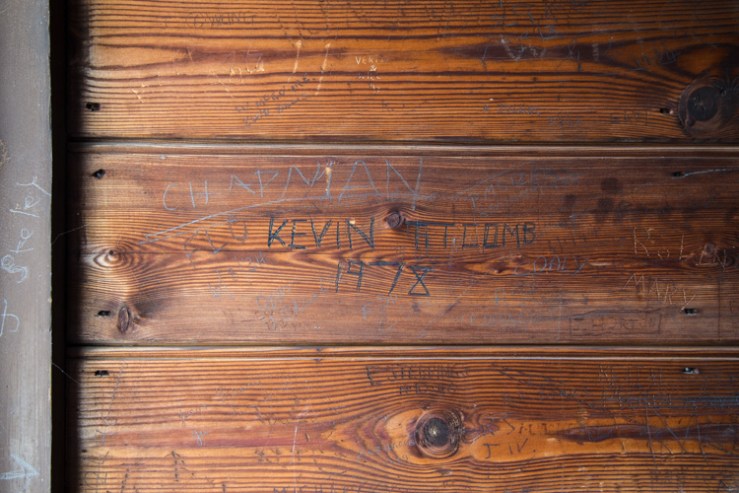
Kevin Titcomb, 1978
Kevin Titcomb, 1978

Some graffiti artists returned to admire their work and add to the collection many years later. Kevin Titcomb’s name is one of the larger in the room and he first made his mark 1978.
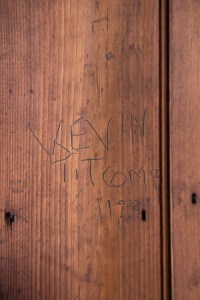
Kevin Titcomb, 1998
Kevin Titcomb, 1998

But look up to the ceiling and you’ll see his name appears again, with the date 1998. It looks like this time he’d run out of space on the walls and resorted to the ceiling – his handwriting suggests it’s a lot harder to write with your hand above your head!

The most recent addition was made in 2013, the year the museum closed for a roof renovation. You may remember we found some pretty significant graffiti back then too, as documented on our blog. Maybe the 2013 scribbler was inspired by this and wanted their name to be seen in 150 years time.
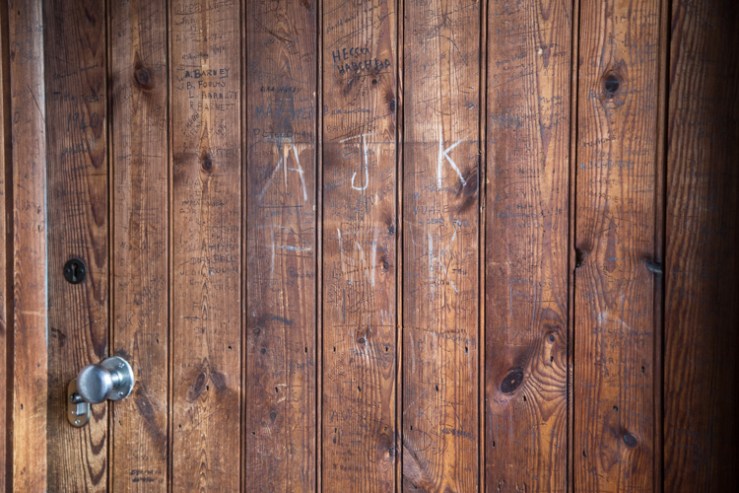
IMG_3509

This spiral staircase leads to 'graffiti corner'
This spiral staircase leads to ‘graffiti corner’

I was surprised that, after a good while searching the scribbles, I didn’t see any names that I recognised from current staff or museum legend. So who are these people who wrote on the walls? Staff using an alter ego? Visitors who snook behind the scenes and wanted to mark their bravery? Whoever they were, standing on that tiny landing surrounded by names, the graffiti certainly creates a feeling of history and a connection with the people who’ve been here before.

Rachel Parle, Interpretation and Education Officer


Rex in a box

Credit: Nicola Fielding

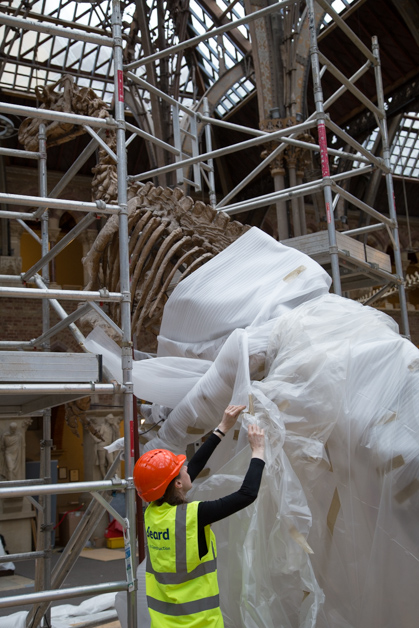
We couldn’t just tease you with last week’s shot of the Iguanodon being unwrapped. The sight of our enormous dinosaurs being liberated from the foam, tape and chip board which has encased them for the past year is too good not to share.

Credit: Mike Peckett

Each time I look out into the Museum court, another specimen has been revealed. The elephants are back, the camel is looking great and the giraffe is next on the list. But the biggest impact over the last couple of weeks has to be the large dinosaurs regaining dominance in the centre of the Museum.

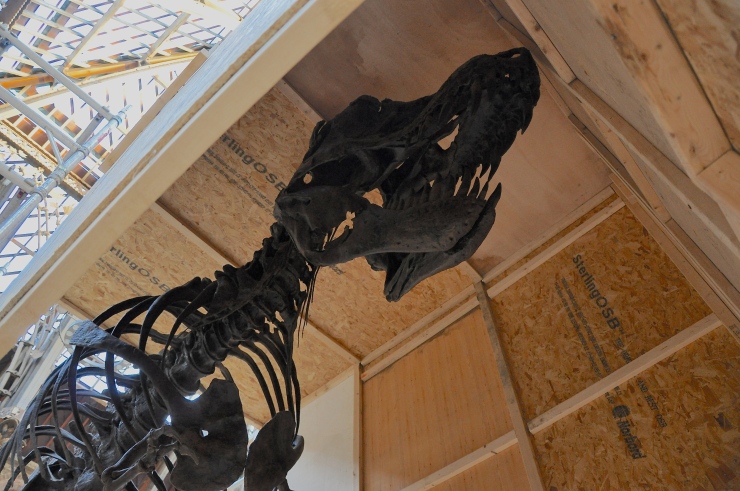
The T rex and Iguanodon skeletons are far too huge to move… and wouldn’t even get out of the front door! So they had their own bespoke wooden boxes built for them, which protected them from damage and dust during the roof restoration project.

But with just 3 weeks until our re-opening, the boxes are down and the foam wrapping has been discarded. Here are a few of my favourite shots of the return of the dinosaurs.

T rex being revealed Credit: Nicola Fielding
T rex being revealed
Credit: Nicola Fielding
The Iguanodon’s tail escapes its box
Credit: Scott Billings

Our dinosaurs are ready and waiting for the visitors to return on Saturday 15th February. We all hope to see you then!

Rachel Parle, Interpretation and Education Officer
“A thoroughly charming and highly skilled man”

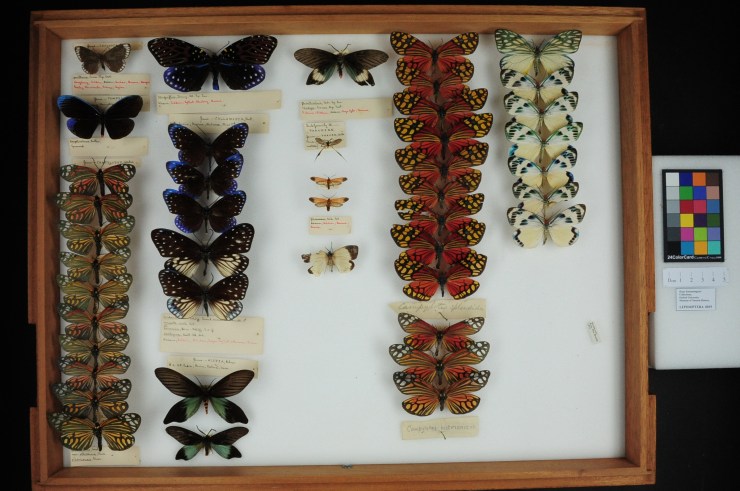
Moths in a drawer made by Brian Edmondson

At the beginning of the month we heard about the sad death of Brian Edmondson. Brian was a carpenter and ran his own business in Oxford for 42 years. Although many of the staff in the Museum may never have heard Mr Edmondson’s name before, they certainly know his work.

Brian Edmondson Credit: Oxford Mail
Brian Edmondson
Credit: Oxford Mail

Thirty years ago, the Museum’s Hope Entomological Collections started an enormous project to ‘rehouse’ their millions of specimens, moving them from substandard storage boxes to proper glazed drawers. Brian and his team beautifully crafted a huge number of drawers to hold the specimens and made them to satisfy the Museum’s exacting demands for design and build quality. For example, it was essential that they were airtight to prevent any pests (larvae of the museum beetle) getting in.

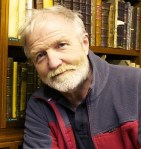
Dr George McGavin, television presenter and Honorary Research Associate of the Museum, remembers working alongside Brian on this project.

Dr George McGavin
Dr George McGavin

“Brian Edmondson was a thoroughly charming and highly skilled man. His workshop was on the Abingdon Road in Oxford and every so often a truck would arrive and teams of us would carry hundreds of drawers all the way up to the attic floor of the museum (there was no lift in those days!). Brian was a true professional and led a team of first rate craftsmen – the drawers were so well made you could often swap lids from one drawer to another and they still fitted.”

The drawers that Brian designed are still in use today and hold millions of insects in the Museum’s collection. Each time a drawer is pulled out and its contents admired or inspected, we mustn’t forget to pause and appreciate the craftsmanship that went into creating the specimens’ bespoke home.

Rachel Parle, Interpretation and Education Officer
Turtley happy!

Black marsh turtle

Why’s our black marsh turtle smiling? It’s turtley obvious, he’s a star! He’s having a Christmas holiday at Banbury Museum where he features in our Natural Histories exhibition. He’s joined by other treasures on tour from the University of Oxford, such as a meteorite from outer space as old as the Earth itself, the jaw of a real Oxfordshire dinosaur… and much, much more.

One of the things I like about Banbury Museum is that its entrance is slap bang in the middle of the Castle Quay Shopping Centre, next to the picturesque Oxford canal. It’s really easy to take a break from Christmas shopping and have a look around, and (yes, you’ve guessed it!) admission is turtley free!

Natural Histories is on until 22 February 2014, Mon – Sat: 10am – 5pm but check holiday period opening times on the museum website http://www.cherwell.gov.uk/museum/index.cfm?articleid=5758/.

Monica Price, Head of Earth Collections, and co-curator of ‘Natural Histories’

The Whales’ Tale

nicolacrompton's avatarOnce in a Whale

036B7584

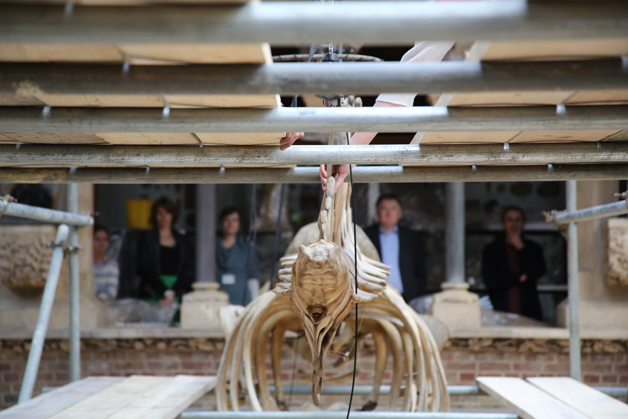
This week, the ‘whale aisle’ was invaded by a hoard of riggers and scaffolders, constructing a safe and simple means to transfer the specimens into their new positions in the gallery.

036B7734

Not moving too far, the specimens are now in size order and are staggered, taking advantage of the vast roof space. The Northern Bottlenose Whale is now at the highest level (7 meters up!) and the Dolphin at the lowest. This new positioning meant transporting the Orca, Beluga and Dolphin out of the aisle on wheels, and then returning them to their new locations, ready to be hoisted.

036B7810

036B7614

As a parting gift we made each specimen an engraved acrylic sign. This included updated taxonomic information and a contemporary, larger font to keep with the museum’s new visual identity. To further engage visitors, we provided all information on both sides of the panel. We also used this opportunity to take…

View original post 84 more words

Scaffolding sketches

P1020231_cropped

The Museum has a long history as a source of inspiration for artists; from the involvement of the Pre-Raphaelites in the building’s construction, to the thousands of art students that visit each year. This year’s closure period has been particularly interesting for one artist, Kate Kay.

Kate Kay in the Museum

Kate, who lives locally in Oxford, is doing a continuing practice course through Ovada, an Oxfordshire contemporary arts organisation.

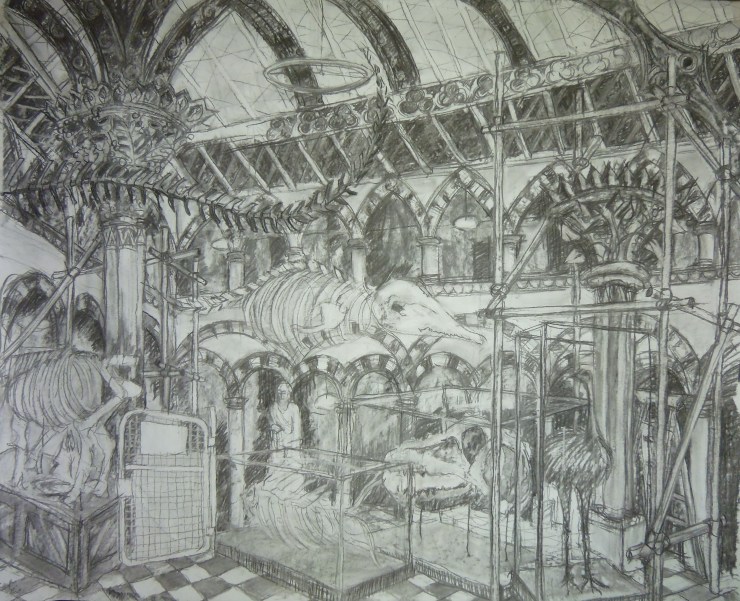
An architectural background and interest in drawing in large internal spaces led Kate to the Museum. She said “I’m particularly interested in framed structures through which one can see. The Museum of Natural History certainly provides this, with its dramatic and innovative structure, and its remarkable collection of skeletons adding further layers of interest. When I heard that the Museum was to be closed for renovation works, I realised that the scaffolding, and the protective wrapping of the skeletons would add yet more layers.”

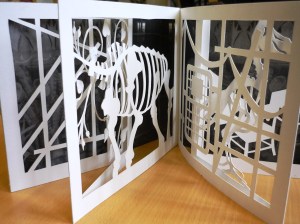
Cut paper work inspired by the layers in the Museum

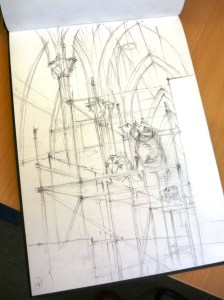
During the early part of the year, Kate visited regularly and was welcomed on site by the contractors. With hard hat and high-vis jacket, she was allowed to  go anywhere on the site, and she made numerous sketches and took photos. From May she then worked on a very large charcoal drawing (top of this post), incorporating various elements of the Museum and the renovation project in one image. She also produced a work in cut paper (right) combining several ‘see-through’ images. These were exhibited in an end-of-year show at the Oxfordshire Museum in Woodstock.

P1030503“Now that most of the scaffolding is down, one can see how the Museum has been transformed. I’ve really appreciated the opportunities that this project has provided, particularly in exploring up in the roof structure. I look forward to drawing in the Museum again, once it’s back in action in the spring, possibly focusing more closely on some of the other exhibits.”

It’s important that this special year of closure has been documented in Kate’s drawings. When we re-open, I hope that more artists than ever will be inspired by the Museum, as sunlight floods through our sparklingly clean roof.

Rachel Parle, Education Officer